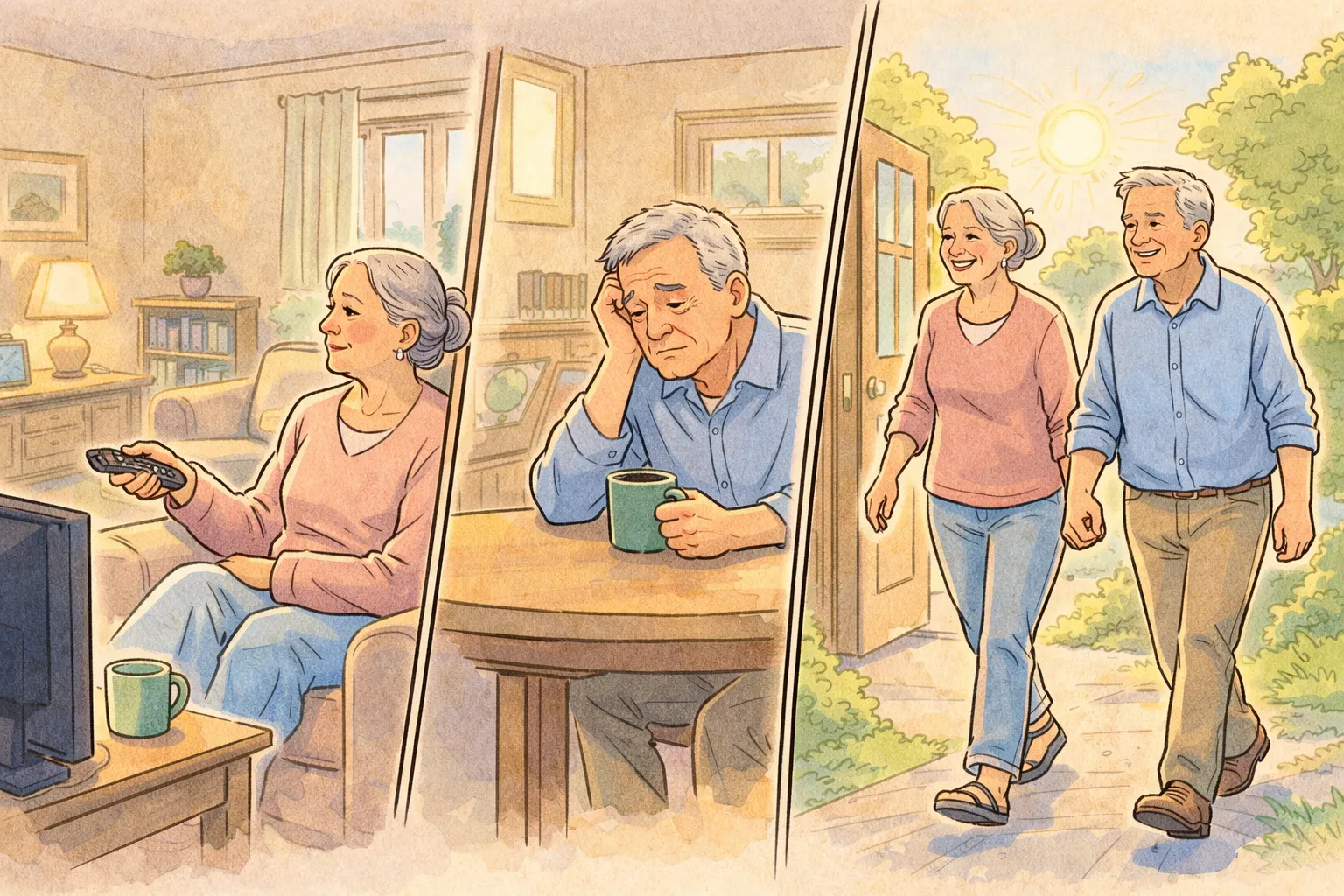
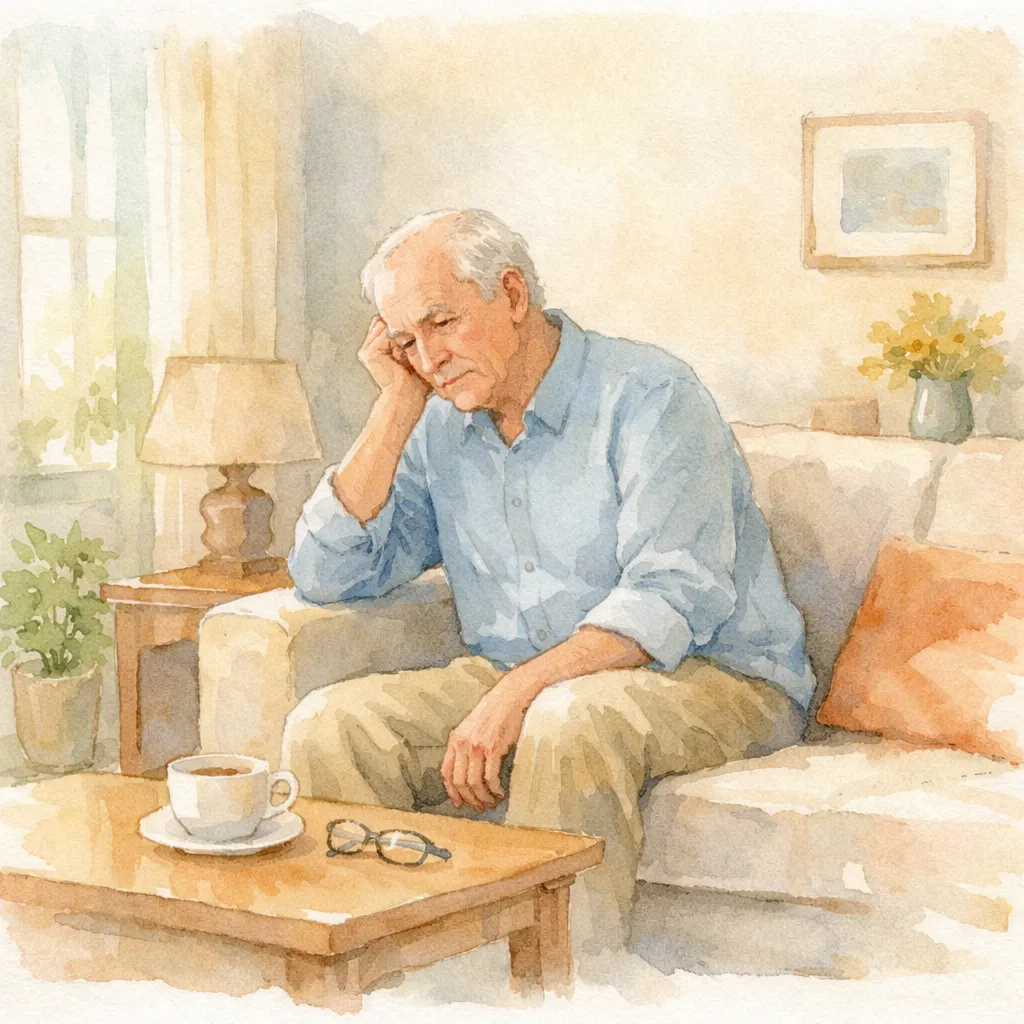
Panoramic comic-style illustration showing retirees staying indoors feeling low energy versus going outside feeling refreshed and active
“I didn’t go anywhere today.”
At first, that feels comfortable.
No traffic.
No pressure.
No schedule.
Just quiet.
But when many days start to look like this…
Something slowly changes.
Not suddenly.
Not dramatically.
But noticeably.
1. Why staying home feels good at first
After retirement, staying home can feel like relief.
no commute
no deadlines
no obligations
Home becomes a safe space.
And that’s a good thing.
2. When comfort turns into pattern
The problem is not staying home.
The problem is staying home too consistently.
When days repeat like this:
wake up
sit
move around the same space
minimal outside interaction
Your world quietly shrinks.
3. Your brain needs variation
The human brain responds to change.
Different places
Different faces
Different small experiences
When everything stays the same:
stimulation drops
alertness drops
energy drops
This is why long periods at home can feel oddly tiring.
4. The “slow blur” effect
Many retirees describe this feeling:
Days start blending together.
Monday feels like Wednesday.
Morning feels like afternoon.
There are fewer markers in the day.
This creates a sense of:
time moving strangely
lack of clarity
reduced motivation
5. Movement becomes minimal
At home, movement is limited.
fewer steps
less walking
less standing
more sitting
Even if you feel “rested,”
Your body slowly loses energy.
6. Social interaction drops quietly
This is one of the biggest changes.
Without realizing it, you may have:
fewer conversations
less eye contact
fewer spontaneous interactions
Even small interactions matter more than we think.
7. Mood becomes flatter
When environment and routine don’t change much:
Mood often becomes:
neutral
low-energy
slightly disconnected
Not depressed.
Just… flat.
8. The key problem is not laziness
This is important.
Staying home too much is not about laziness.
It’s about lack of variation.
Your brain and body are responding exactly as expected.
9. A simple way to fix it
You don’t need a busy life.
You need small changes.
Try:
stepping outside once a day
changing rooms intentionally
short walks
visiting one place weekly
brief social contact
Small changes → big impact
10. The 3-exposure rule
A simple structure:
Each day, include at least:
outside exposure
movement
human interaction
Even small versions count.
11. Real-life example
Carol, 71:
“I didn’t feel bad. Just… dull.”
She started going outside for 10 minutes every morning.
That alone made her feel more awake.
David, 68:
“I didn’t realize how little I was moving.”
He added one short walk after lunch.
His energy improved within a week.
12. Signs you may be staying home too much
days feel repetitive
you feel slightly tired without reason
you delay going outside
your mood feels flat
you move less than before
you have fewer conversations
If this feels familiar, it’s not a problem.
It’s a signal.
Quick checklist
did I go outside today?
did I move my body?
did I talk to someone?
did I change my environment at least once?
If not, tomorrow is a new chance.
The key insight
Home should feel safe.
Not limiting.
Conclusion
Staying home is comfortable.
But too much comfort can quietly reduce energy, clarity, and mood.
You don’t need a full schedule.
You need small variation.
That’s what keeps retirement feeling alive.
Disclaimer
This content is for general educational purposes only and does not consider individual health or psychological conditions. If prolonged low mood or isolation occurs, consult a qualified professional.
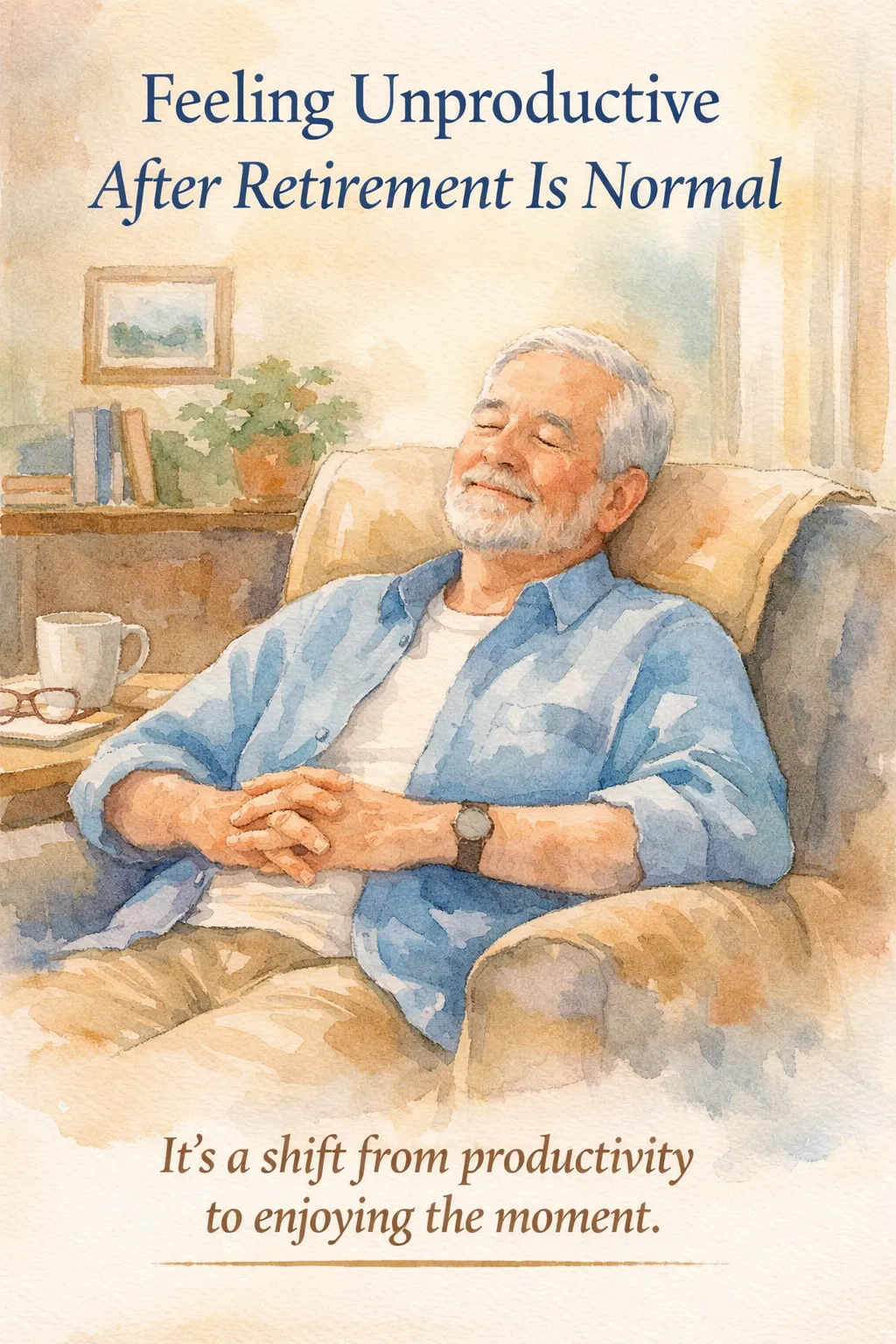
Older adult relaxing comfortably in a chair at home, representing a calm and quiet retirement day without pressure
“I didn’t really do anything today.”
This thought shows up more often than people expect after retirement.
The strange part is this:
You may have had a calm day. Nothing stressful happened. You weren’t overwhelmed.
And yet…
You still feel slightly uncomfortable.
Like something is missing.
Like the day didn’t “count.”
This feeling is very common.
And more importantly—
It’s completely normal.
1. Why productivity used to define your day
For decades, life followed a pattern:
tasks to complete
work to finish
responsibilities to manage
goals to reach
At the end of the day, there was a clear question:
“Did I get things done?”
That question shaped how you felt.
Productivity = satisfaction
2. What changes after retirement
Retirement removes that structure.
There is no longer:
a daily output requirement
a performance expectation
a clear definition of “done”
This creates a gap.
Not in time—
But in meaning.
3. The “invisible day” feeling
Many retirees experience this:
The day passes quietly.
But at the end, it feels like:
nothing important happened
nothing was completed
nothing stands out
This creates the feeling of being unproductive.
Even if the day was peaceful.
4. Why this feeling is uncomfortable
Your brain has been trained for years to measure value through output.
So when output disappears, the brain reacts:
“Was today useful?”
“Did I waste time?”
“Should I have done more?”
This is not a flaw.
It’s conditioning.
5. Rest is not the same as “nothing”
This is the key misunderstanding.
Rest is not empty.
Rest is active recovery.
But when you’re used to productivity, rest can feel like:
laziness
lack of purpose
wasted time
That’s not true.
It just feels unfamiliar.
6. The hidden pressure retirees carry
Even without a job, many retirees feel internal pressure:
“I should be doing something”
“I shouldn’t waste my time”
“I need to stay productive”
This pressure is often invisible.
But it shapes how your day feels.
7. A healthier way to define a “good day”
Instead of asking:
“What did I finish today?”
Try asking:
“Did today feel steady?”
or
“Did I take care of myself today?”
This is a different kind of success.
8. The 3 ways a day can be valuable
A good day in retirement can include:
Maintenance (simple tasks, small routines)
Enjoyment (rest, hobbies, calm moments)
Connection (conversation, interaction)
That’s enough.
9. Real-life examples
Susan, 68:
“I used to feel guilty for relaxing. Now I see it as part of my day—not a failure.”
Robert, 72:
“I stopped measuring my days by output. I started noticing how I felt instead.”
10. Signs you’re judging yourself too harshly
you feel guilty for resting
you compare today to your working years
you feel like you “should have done more”
you struggle to enjoy free time
you measure value only through tasks
If this sounds familiar, you’re not doing retirement wrong.
You’re just using old rules.
11. What to do instead
You don’t need to become more productive.
You need a new definition of enough.
Try:
one small task per day
one enjoyable moment
one form of connection
That’s a full day.
12. The mindset shift
Old mindset:
“I need to earn my rest.”
New mindset:
“Rest is part of a complete day.”
This shift removes pressure.
Quick checklist
did I move a little today?
did I have one calm moment?
did I connect with someone (even briefly)?
did I take care of myself?
If yes, the day counts.
The key insight
Feeling unproductive after retirement is not a problem.
It’s a transition.
You’re moving from a life measured by output…
To a life measured by experience.
Conclusion
Retirement is not about doing nothing.
It’s about doing what matters—at a different pace.
Some days will be quiet.
Some days will feel slow.
That doesn’t make them empty.
It makes them human.
Disclaimer
This content is for general educational purposes only and does not address individual psychological or medical conditions. If feelings of low motivation or mood persist, consult a qualified professional.
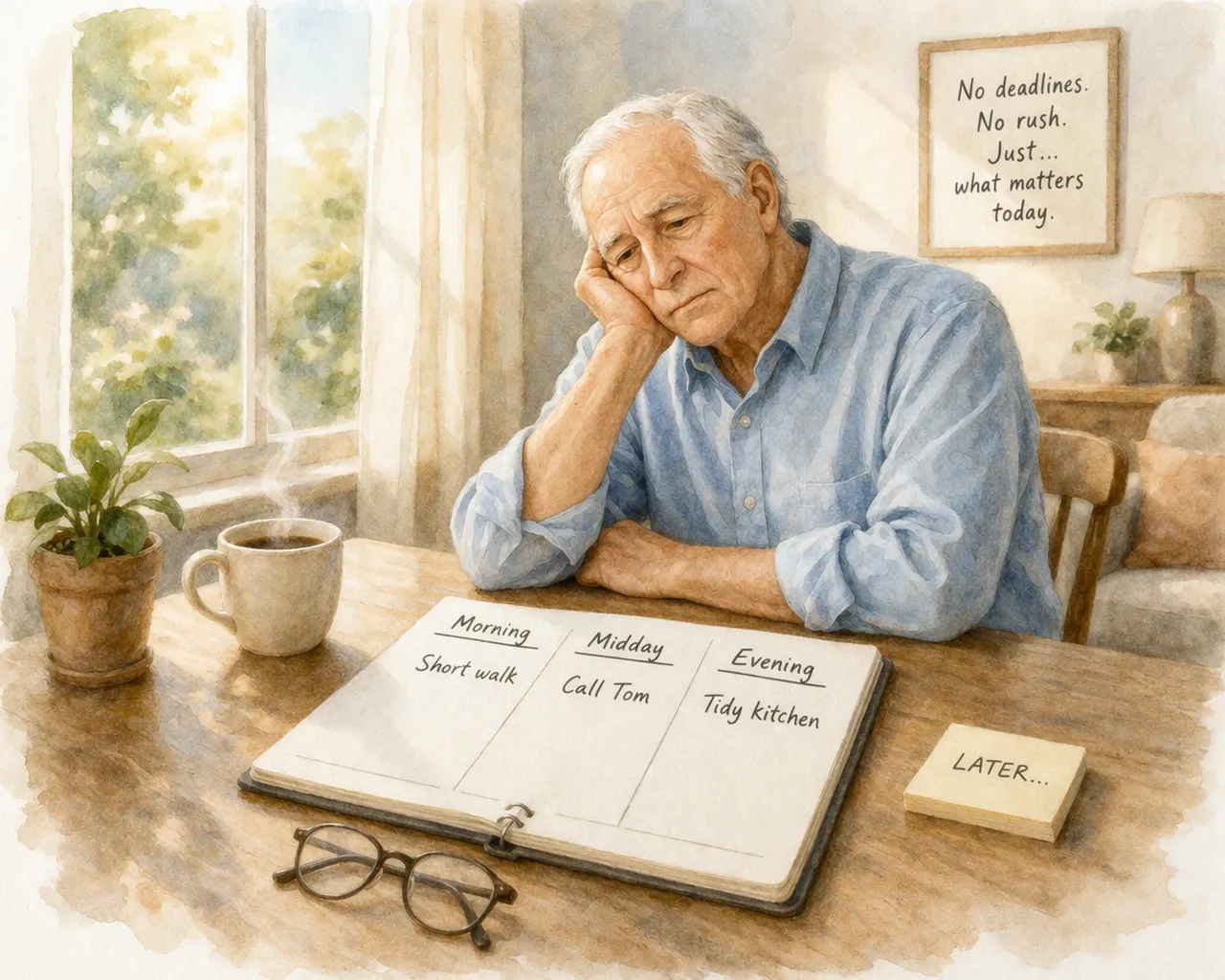
Older adult sitting quietly with a blank planner looking unsure how to start the day
“Nothing really needs to be done today… so why do I feel stuck?”
This is a quiet but very real experience after retirement.
No deadlines. No boss. No urgent emails.
At first, this feels like freedom.
But over time, something strange happens.
You start to feel:
unmotivated
slow to start the day
unsure what matters
mentally stuck
Not because you’re lazy.
But because nothing feels urgent anymore.
1. Why urgency disappears after retirement
During working years, urgency is built into life.
deadlines
meetings
responsibilities
expectations
These create structure automatically.
After retirement, that structure disappears.
And with it, urgency disappears too.
2. Why this creates a problem
You might think:
“No urgency = less stress”
But in reality:
No urgency can lead to:
delayed decisions
endless postponing
low energy
loss of direction
Without urgency, the brain struggles to prioritize.
3. The brain needs signals
Your brain works best when it has:
clear start points
clear reasons to act
small levels of pressure
Without these, everything feels optional.
And when everything is optional…
Nothing gets done.
4. The “I’ll do it later” loop
This is the most common pattern:
“I’ll go for a walk later.” “I’ll organize that tomorrow.” “I’ll call them sometime.”
Later becomes:
next day
next week
never
This creates a quiet mental burden.
Unfinished tasks drain energy.
5. The hidden emotional effect
When nothing feels urgent, you may start feeling:
slightly restless
mentally foggy
oddly tired
unaccomplished
Even if your day was “easy”
That’s because progress—not pressure—creates satisfaction.
6. The simple fix: gentle urgency
You don’t need stress.
You need light structure.
Think of it as “gentle urgency.”
Not pressure.
Just direction.
7. The 3-anchor day method
A simple solution:
Create 3 small anchors each day.
Morning Midday Evening
Each anchor = one small action.
Example:
Morning → short walk Midday → one task (call, errand) Evening → simple reset (tidy, plan)
That’s it.
8. Why this works
This method works because it:
gives your brain direction
creates light momentum
reduces decision fatigue
builds natural rhythm
You’re not forcing productivity.
You’re creating flow.
9. Real-life example
Mark, 70, said:
“I didn’t feel busy—but I also didn’t feel good.”
He started using a simple rule:
“One thing before lunch.”
That alone changed his days.
Linda, 67:
“I stopped waiting to feel like doing things.”
Instead, she picked one small action each morning.
Her words:
“That small start fixed everything.”
10. Signs you need more structure
You delay simple tasks
Days feel long but unproductive
You feel low energy without reason
You keep saying “later”
You don’t feel satisfied at the end of the day
If this feels familiar, you don’t need more discipline.
You need more clarity.
11. What not to do
Avoid:
over-scheduling your day
creating long to-do lists
forcing productivity
comparing yourself to your working years
This is not about doing more.
It’s about starting easier.
12. A better mindset
Instead of asking:
“What do I have to do today?”
Ask:
“What is one thing that will move my day forward?”
That one shift changes everything.
Quick checklist
choose 1 morning action
choose 1 practical task
choose 1 small reset
avoid “later” thinking
keep it simple
The key insight
Retirement doesn’t remove urgency.
It removes external urgency.
You replace it with gentle, internal direction.
Conclusion
When nothing feels urgent, life can feel slow and unclear.
The solution is not pressure.
It’s small structure.
A little direction each day creates:
better energy
clearer thinking
more satisfying days
That’s what makes retirement feel good again.
Disclaimer
This content is for general educational purposes only and does not consider individual mental health or medical conditions. If persistent lack of motivation or fatigue occurs, consult a qualified professional.
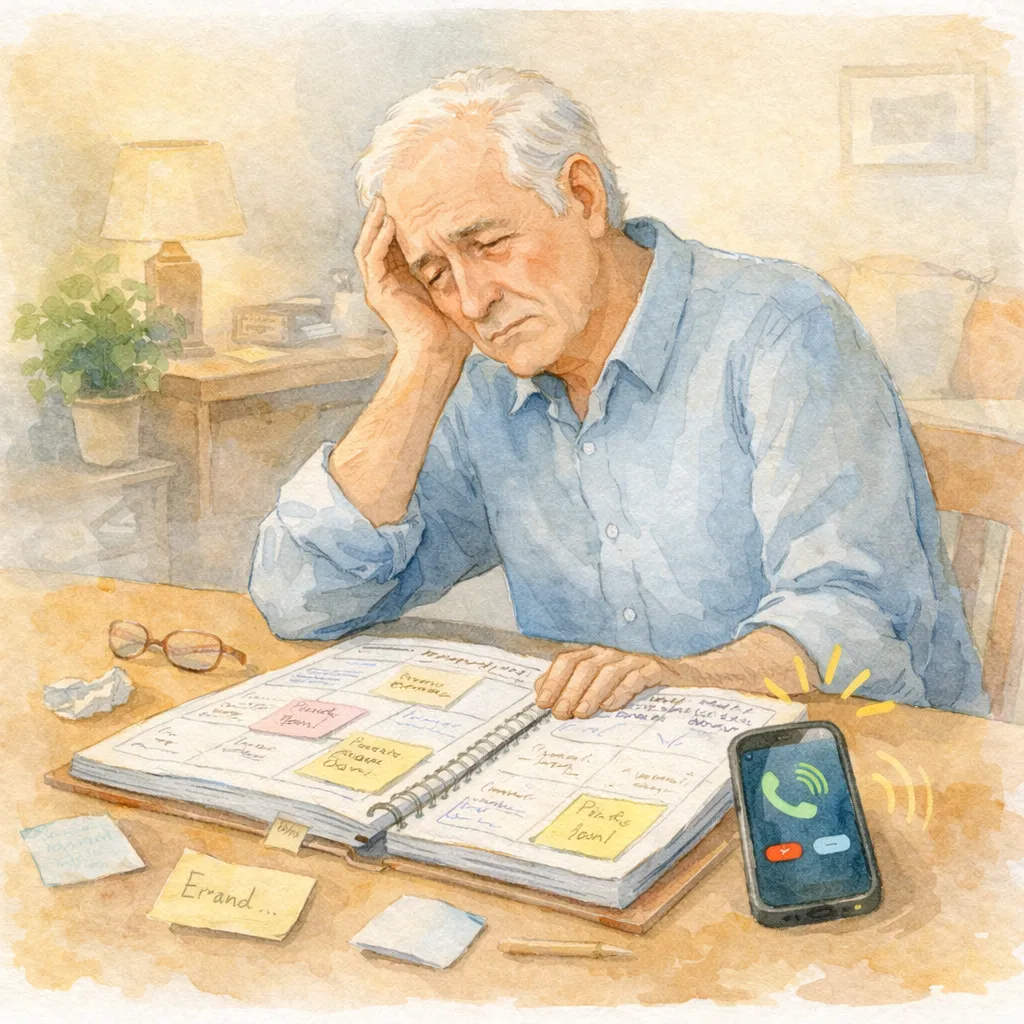
Older adult looking at a crowded weekly planner and phone, appearing tired from too many requests during retirement
Many retirees are kind, dependable, and easy to reach.
That sounds like a strength.
And often, it is.
But after retirement, being “always available” can quietly become expensive.
Not only financially.
Emotionally. Mentally. Physically. Even socially.
A lot of adults over 55 slowly become the person who is always expected to help.
The flexible one. The ride-giver. The babysitter. The problem-solver. The person who says yes because saying no feels uncomfortable.
At first, it feels generous.
Later, it can feel heavy.
This article looks at the hidden cost of being too available in retirement and how to protect your time, energy, and relationships without becoming cold or selfish.
Why this happens after retirement
Retirement changes how other people see your time.
Once you stop working, many people quietly assume:
you have more free time
your schedule is open
your needs are smaller
helping is easy for you
That assumption creates pressure.
Even when nobody says it directly.
You may hear things like:
“You’re retired, so I thought you’d be free.”
“Could you just do this one small thing?”
“You’re better at handling these things than I am.”
One request is usually manageable.
The problem is repetition.
When availability becomes your identity, your life starts filling with other people’s priorities.
The core rule
Being available is generous.
Being endlessly available is costly.
Retirement works better when kindness has limits.
1. The hidden emotional cost
Too much availability creates quiet resentment.
You may still love your family and friends.
But inside, you may start to feel:
taken for granted
overused
mentally crowded
invisible except when needed
That emotional drain is real.
And many retirees feel guilty for even noticing it.
They think:
“I should be grateful to be needed.”
But being needed is not the same as being respected.
If your time is always assumed, not asked for carefully, the relationship begins to tilt out of balance.
2. The hidden physical cost
Being overly available often increases physical strain.
This can look like:
too much driving
lifting things for others
helping with errands when already tired
skipping recovery days
adjusting your sleep around other people’s plans
For adults over 55, even small repeated demands can add up fast.
A favor that looks minor on paper may cost:
energy for the rest of the day
soreness the next morning
missed walking or exercise
reduced patience
worse sleep
The problem is not one busy day.
The problem is a pattern.
3. The hidden money cost
Many retirees underestimate how much “being helpful” costs.
Common examples:
gas and parking for rides
paying for little things and not getting repaid
groceries bought during shared errands
eating out because someone else changed the schedule
gift-like spending that becomes expected
Sometimes the cost is direct.
Sometimes it is indirect.
You may spend more simply because your week keeps getting reorganized around other people.
Table: Common hidden costs of being too available
Situation
Hidden Cost
Driving family members
fuel, parking, time
Last-minute babysitting
energy, meal disruption
Frequent errands for others
your own tasks delayed
Always hosting
groceries, utilities, cleanup
Emotional support without limits
mental fatigue
The money may not look dramatic in one week.
But over a year, it adds up.
4. The hidden schedule cost
Retirement needs rhythm.
Not a packed calendar.
Not total emptiness.
Rhythm.
But if you are too available, your schedule becomes reactive.
Instead of planning your week around:
energy
appointments
movement
meals
rest
You start planning around interruptions.
That creates a strange form of retirement stress.
You are not overworked in the old career sense.
But you are constantly adjusting.
And constant adjusting is tiring.
5. The hidden identity cost
Many retirees become “the reliable one.”
Again, that sounds positive.
But over time, this role can become limiting.
You stop asking:
“What do I want my retirement to feel like?”
And start responding mostly to:
“What does everyone else need from me this week?”
This is where retirement can quietly disappear.
Not through one major mistake.
But through hundreds of small yeses.
Real-life example: Ellen, 69
Ellen retired expecting more quiet mornings and less stress.
Instead, she became the default helper for everyone.
She drove her sister to appointments, picked up groceries for a neighbor, and watched her grandchildren several afternoons a week.
Individually, each request sounded reasonable.
Together, they made her feel constantly behind.
Her words were simple:
“I was busy all the time, but none of it felt like my life.”
When she began limiting favors to two planned help blocks per week, her mood improved almost immediately.
She still helped.
But she stopped feeling swallowed by it.
Real-life example: Daniel, 73
Daniel prided himself on always saying yes.
If anyone needed a ride, a call, a repair, or a favor, he handled it.
After a few years, he started feeling unusually tired and irritable.
He assumed aging was the reason.
But the bigger issue was this: he had no protected time.
Once he began saying, “I can help on Thursday, but not today,” his energy improved.
Nothing dramatic changed.
But his week felt more like his own again.
6. Why saying no feels so hard
For many older adults, saying no feels unnatural.
Common reasons include:
wanting to stay useful
fear of seeming selfish
habit from years of caregiving
worry that relationships will weaken
discomfort with disappointing people
But healthy boundaries do not weaken good relationships.
They clarify them.
The people who care about you can usually adjust.
The people who only valued your availability may resist.
That tells you something important.
7. The difference between generosity and overextension
A helpful question is this:
Did I choose this help calmly, or did I agree from pressure?
That difference matters.
Generosity feels steady.
Overextension feels tight.
Generosity leaves room for recovery.
Overextension leaves you depleted.
Table: Generosity vs. overextension
Generosity
Overextension
chosen freely
agreed from guilt
fits your energy
ignores your limits
occasional or planned
constant or assumed
leaves you steady
leaves you drained
This is one of the most useful retirement distinctions you can learn.
8. Signs you may be too available
You may be too available if:
people assume you will help before asking properly
your week keeps changing at the last minute
you feel irritated by “small” requests
your own routines keep getting delayed
you feel useful but not rested
you rarely have protected quiet time
If several of these feel familiar, the issue is probably not selfishness.
It is lack of limits.
9. A calmer way to help
You do not need to become unavailable.
You need a system.
A few simple rules can change everything.
Try one or two of these:
Help on planned days only
Do not answer every request immediately
Replace instant yes with “Let me check”
Limit driving favors each week
Keep one or two recovery blocks protected
Separate emergencies from convenience requests
This allows you to remain kind without becoming absorbent.
10. Simple scripts that protect your time
You do not need harsh language.
Calm, clear language works better.
Try:
“I can’t do that today, but I could help Thursday.”
“This week is full for me.”
“I’m keeping that day open to rest.”
“I’m not available for that, but I hope you can find another option.”
“I can help sometimes, but I can’t be the regular solution.”
These are not rude.
They are adult boundaries.
11. What healthy availability looks like
Healthy availability means:
people ask instead of assume
you have room to say no
you still protect your health
helping does not erase your own plans
generosity feels chosen, not extracted
This is what sustainable retirement support looks like.
You can be warm, dependable, and caring without becoming permanently on-call.
Quick checklist: Are you too available?
I often say yes before thinking
My schedule gets changed by other people’s needs
I feel guilty protecting rest
I help more than I recover
I feel useful, but not peaceful
My retirement often feels reactive
If this sounds familiar, you do not need to become harder.
You need clearer edges.
The bigger truth
Retirement is not only about having more time.
It is about finally having more say over your time.
That is a major difference.
And it is worth protecting.
When your availability is unlimited, your retirement slowly fills with borrowed priorities.
When your availability is intentional, your life feels calmer, kinder, and more stable.
Conclusion
The hidden cost of being too available in retirement is not just busyness.
It is the gradual loss of your own rhythm.
The fix is not isolation.
It is structure.
A few calm boundaries can protect:
your energy
your money
your mood
your relationships
your sense of ownership over your own life
That is not selfish.
That is wise retirement living.
Disclaimer
This content is for general educational purposes only and does not provide financial, legal, medical, or psychological advice. Individual family dynamics, health conditions, and financial situations vary. Consult qualified professionals when personal guidance is needed.
Older adult sitting quietly at home feeling tired despite a calm day
“I didn’t do much today… so why am I so tired?”
This is one of the most common—and least talked about—experiences after retirement.
Many people expect retirement to feel easier.
Less work More rest More freedom
But something unexpected happens.
You feel tired… even on quiet days.
This is not laziness. And it’s not a personal failure.
It’s usually the result of subtle changes in how your body, mind, and daily life work after retirement.
1. The hidden energy shift after retirement
When you stop working, your energy system changes.
Before retirement:
structured schedule
clear purpose
regular movement
After retirement:
flexible time
more decisions
less automatic activity
This shift alone can lower your energy without you noticing.
2. Decision fatigue increases
Retirement removes structure—but adds decisions.
Every day, you decide:
What should I do today?
When should I go out?
Should I rest or stay active?
These small decisions slowly drain mental energy.
Even if you didn’t “do much,” your brain did.
3. You move less than you think
During working years, movement is automatic.
Walking Standing Going out
After retirement, movement becomes optional.
And when it becomes optional, it often decreases.
Less movement = lower energy Even if you feel “rested”
4. Emotional energy becomes more important
Energy is not just physical.
It’s also emotional.
After retirement, you may have:
fewer conversations
quieter days
less stimulation
This can create a subtle feeling of low energy or heaviness.
5. Sleep patterns quietly change
Many retirees experience:
lighter sleep
waking earlier
more naps
Even small sleep changes affect your energy more than you expect.
6. The “low-pressure paradox”
This is the surprising part.
Less pressure should feel better.
But sometimes it leads to:
lower motivation
slower mornings
less mental engagement
Your brain still needs a certain level of activity to feel energized.
7. A simple way to restore energy
You don’t need a strict routine.
You need a gentle rhythm.
A simple daily structure:
one small morning activity
one movement (even 10 minutes)
one connection (call, chat, interaction)
That’s enough.
Real-life examples
“I thought I was just getting older. But adding a short walk helped my energy a lot.” — John, 71
“Having one small plan in the morning made my whole day feel better.” — Linda, 68
Quick self-check
You may feel tired because of:
lack of structure
too many small decisions
reduced movement
low interaction
irregular sleep
The key insight
Feeling tired in retirement is not about doing too much.
It’s often about not having enough balanced stimulation.
Conclusion
Retirement changes how energy works.
Instead of pushing harder, create a gentle daily rhythm.
That’s what restores energy naturally.
Disclaimer
This content is for educational purposes only and does not consider your personal situation. Persistent fatigue may be related to medical conditions. Please consult a qualified healthcare professional if needed.
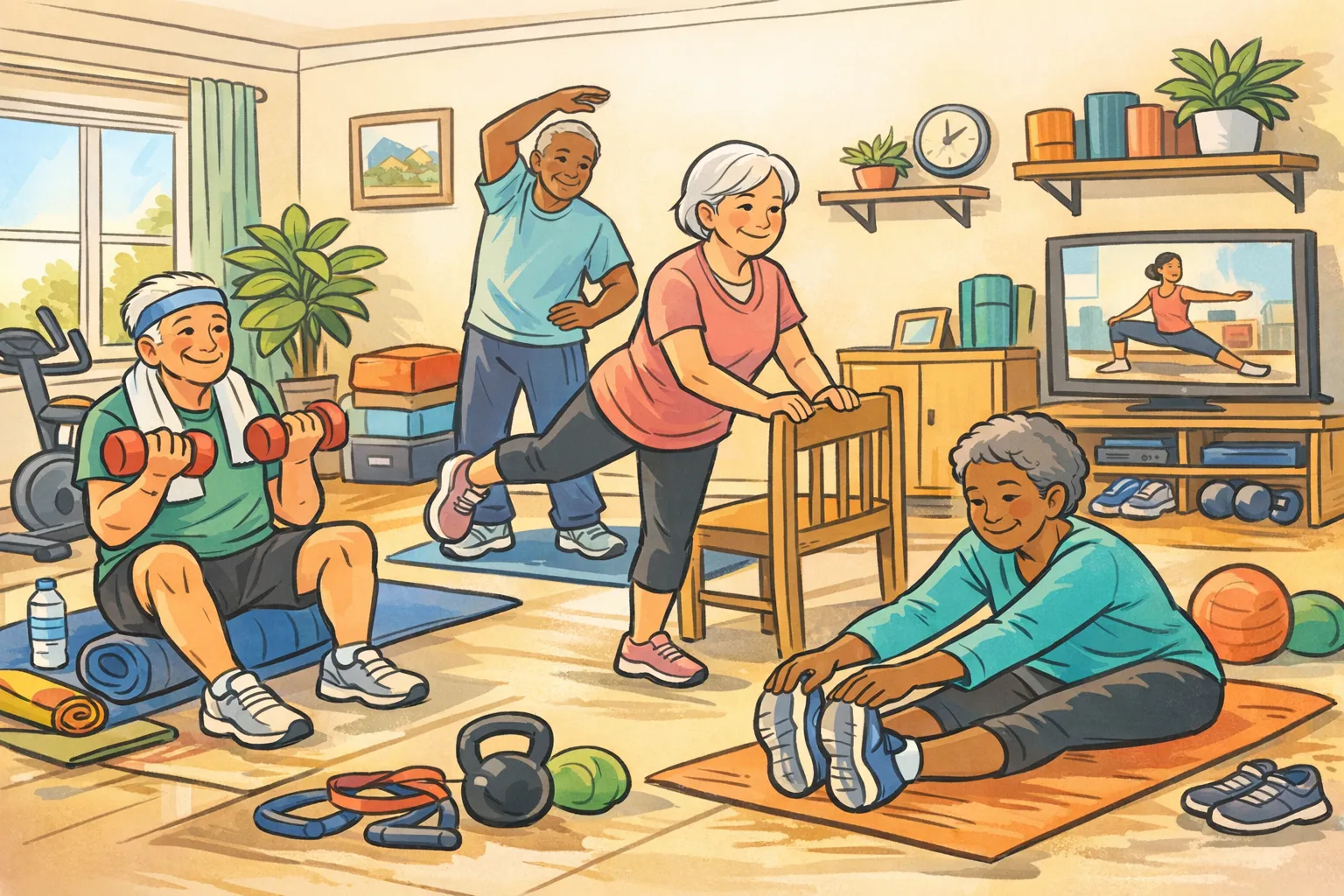
Home exercise progress for seniors works best when strength, balance, and gentle movement are built gradually enough to repeat without injury.
Cindy’s Column × Senior AI Money
A lot of home exercise plans fail for the same reason.
They start with enthusiasm and end with soreness, frustration, or a quietly abandoned routine.
One day you do too much because you feel motivated. The next day your knees complain, your back feels tight, or your energy drops. Then you “rest” for several days. Then restarting feels harder than beginning did.
That is why exercise progress after 55 is usually not a motivation problem.
It is a pacing problem.
For older adults, the real goal is not to crush a workout.
It is to build a routine your body can trust.
That matters because official healthy-aging guidance points in the same direction: older adults benefit from a mix of aerobic, muscle-strengthening, and balance activity, and regular movement supports thinking, independence, and fall prevention. CDC’s current guidance for older adults says adults 65+ should aim for at least 150 minutes of moderate aerobic activity each week, plus muscle-strengthening on at least 2 days and balance activities as part of weekly movement. NIA also emphasizes aerobic, strength, and balance work, while WHO recommends varied multicomponent activity that emphasizes functional balance and strength for older adults.
This guide is for adults 55+ who want home exercise to become steadier, safer, and more repeatable.
What progress really means at home
A lot of people define exercise progress too narrowly.
They think progress means:
more reps,
heavier weights,
longer walks,
harder routines,
more sweat,
more soreness.
Sometimes that is true.
But for many older adults, real progress looks like this:
you show up three times this week instead of once you stop needing three recovery days after each workout you finish feeling energized instead of defeated your balance feels steadier getting up from a chair you trust yourself to keep going next week
That counts.
In fact, it counts a lot.
Because the most valuable exercise plan is not the one that looks ambitious.
It is the one that survives ordinary life.
The consistency rule
Build the habit first. Build the challenge second.
That is the rule that keeps people from getting hurt.
A routine that is slightly too easy at first is usually much better than one that is slightly too hard.
NIA specifically notes that activity can be done through many kinds of movement, including structured exercise, chores, errands, walking, or leisure activity, and that older adults should include a combination of aerobic, muscle-strengthening, and balance work each week. NIA also notes that variety can make movement more enjoyable and may reduce overuse injury risk.
That means the best home exercise plan is not a punishment plan.
It is a repeat plan.
Part 1: Start with the three-part foundation
Home exercise goes better when you stop asking one routine to do everything.
A strong weekly plan for seniors usually includes three types of movement:
Aerobic work Walking in place, easy marching, indoor cycling, light stepping, short walking sessions
Strength work Chair stands, wall push-ups, resistance bands, light dumbbells, sit-to-stand practice
Balance work Heel-to-toe standing, one-leg support with a chair nearby, side stepping, standing from a chair with control
This matters because aging well is not only about endurance.
It is also about staying steady, strong, and independent.
NIA states that older adults benefit from aerobic, muscle-strengthening, and balance exercise, and its exercise materials note that balance training can help prevent falls and fall-related injuries. CDC’s older-adult guidance likewise includes aerobic, strength, and balance activity as part of the weekly recommendation.
If you are only walking, you may be missing strength and balance.
If you are only doing light weights, you may be missing endurance.
If you are only stretching, you may be missing enough challenge to build real function.
The answer is not more intensity.
It is better balance across the week.
Table 1. A simple home exercise structure for older adults
Exercise Type
Examples at Home
Main Benefit
Aerobic
Walking, indoor marching, step-touch, stationary bike
Supported single-leg practice, heel-to-toe, side steps
Helps stability and fall prevention
Mobility / flexibility
Gentle range of motion, calf stretch, shoulder circles
Helps movement feel easier
Recovery movement
Easy walk, light stretching, relaxed mobility
Helps you stay consistent
Part 2: Progress by adding small pieces, not giant jumps
One of the biggest injury mistakes is jumping too fast.
People often do this in one of three ways:
they suddenly double the time they add weight too fast they do the same movement too often because they think “more is better”
Usually, better progress looks smaller.
Examples of safe-feeling progress:
10 minutes becomes 12 1 set becomes 2 5 chair stands becomes 7 one balance drill becomes two short balance drills two workouts per week becomes three moderate sessions
That is enough.
Older adults often benefit more from slow, repeatable increases than from dramatic upgrades. CDC’s fall-prevention program materials note that building strength and balance takes time, and NIA’s exercise guidance emphasizes staying active regularly rather than treating exercise as a burst-and-crash effort.
A useful rule is this:
Change only one thing at a time.
Not all three.
So if you add time this week, keep the exercise selection the same.
If you add a little resistance, keep the number of sets stable.
If you add a third workout day, keep the sessions shorter.
That is how progress feels manageable instead of risky.
Part 3: Use the “finish feeling capable” test
A lot of home workouts are judged the wrong way.
People ask:
Did I do enough?
Was that hard enough?
Should I feel more sore?
A better question is:
How did I feel at the end?
For most seniors exercising at home, a good session should end with:
“I could probably do a little more, but stopping here feels smart.”
That is the sweet spot.
If you finish completely drained, your plan may be too aggressive.
If you regularly ache for days, the dose may be too high.
If you dread the next session, the routine may not be sustainable.
NIA’s exercise safety materials encourage older adults to listen to the body, use good form, and build activity in a way they can maintain. Its public guidance repeatedly frames movement as part of healthy aging, not as an all-out performance test.
That is why “finish feeling capable” is such a powerful rule.
It protects tomorrow, not just today.
Part 4: The week matters more than one workout
Many people think of exercise one workout at a time.
A better method is to think in weeks.
Why?
Because the body does not only respond to Tuesday.
It responds to the pattern of Monday through Sunday.
A smart home week for many older adults looks something like this:
2 strength sessions 3 to 5 moderate movement days 2 to 3 short balance sessions 1 or more easier recovery days
This does not mean every session has to be long.
In fact, short sessions often work better.
CDC’s older-adult activity guidance says the weekly goal can be spread across the week and that movement can be accumulated in realistic ways. NIA also emphasizes combining different activity types across the week, not relying on one single form of exercise.
So instead of trying to “make up for” missed exercise with one heroic session, build a week that feels believable.
Believable beats perfect.
Part 5: Pain, soreness, and warning signs are not the same thing
This is where a lot of older adults get confused.
Some exercise discomfort is normal.
Sharp or worsening pain is not.
Mild muscle fatigue after strength work can be expected.
Needing three days to recover every time is a clue something needs adjusting.
A little challenge is useful.
A pattern of flare-ups is not.
NIA’s guidance for exercise with aging and chronic conditions emphasizes adjusting activity to your body and health needs, and public-health guidance for older adults consistently encourages activity while also recognizing that chronic conditions, balance concerns, and other limitations may require modifications.
Practical red flags to respect:
pain that changes the way you move joint pain that gets worse during the session dizziness chest pain shortness of breath beyond expected effort swelling that seems unusual a “bad soreness” pattern that keeps returning
These are not signs to push harder.
They are signs to step back and reassess.
Part 6: The best progress often comes from boring repetition
This may be the least glamorous truth in exercise.
The things that help older adults most are often very ordinary:
chair stands supported balance practice light dumbbell work step-ups at a safe height walking band rows wall push-ups slow marching controlled sit-to-stand movements
These exercises may not look exciting.
But they transfer well to daily life.
They help you stand up, walk better, steady yourself, carry things, and keep confidence in your body.
NIA’s strength and balance guidance highlights exactly these kinds of basic, functional movements as important for healthy aging and fall prevention. WHO’s guidance for older adults similarly emphasizes multicomponent activity with functional balance and strength.
That means your home plan does not need novelty every week.
It needs usefulness.
Table 2. Common home exercise mistakes and better fixes
Common Mistake
What Usually Happens
Better Fix
Starting too hard
Soreness, skipped days, loss of confidence
Start shorter and lighter than your motivation wants
Doing only walking
Endurance improves but strength/balance lag
Add two strength days and short balance practice
Progressing everything at once
Fatigue or pain spikes
Change only one variable at a time
Exercising only when motivated
Inconsistent routine
Use a weekly structure instead of mood
Chasing soreness
Recovery gets harder
Judge success by steadiness and form
Repeating painful movements
Symptoms worsen
Modify, reduce, or stop and reassess
Part 7: Real examples
Elaine, 70
Elaine started a home routine with online videos and quickly did too much. She liked the feeling of “finally getting serious,” but her knees and hips disagreed. She switched to a simpler structure: walking indoors or outside on most days, chair stands twice a week, light dumbbell work twice a week, and short balance practice after brushing her teeth. Three months later, she was doing less per session than before, but much more across the month.
James, 74
James believed that if exercise was not hard, it was not working. So every home session turned into a test. He would do extra reps whenever he felt good, then disappear from exercise for four days. Once he started using the finish-feeling-capable rule, his routine stabilized. He kept each session moderate enough that he could repeat it. That changed everything.
Marsha, 66
Marsha already walked regularly but noticed she still felt unsteady stepping backward or getting up from low chairs. She added brief strength and balance work at home three times a week. Nothing dramatic happened in one week, but six weeks later she felt more confident moving around the house and handling ordinary tasks. Her progress came from targeted consistency, not intensity.
Part 8: A simple weekly model that actually works
Here is a realistic home model many older adults can adapt:
Monday Strength + short walk
Tuesday Easy movement or recovery walk
Wednesday Balance + light aerobic session
Thursday Recovery or mobility day
Friday Strength + short walk
Saturday Longer easy walk, dance, or active chores
Sunday Rest or gentle mobility
This is only a model.
The important part is the rhythm:
challenge,
recovery,
repeat.
Not every day needs to feel productive.
It needs to fit the whole week.
Checklist: Home Exercise Progress Without Injury
✔ Start with a weekly plan, not random workouts ✔ Include aerobic, strength, and balance work ✔ Begin slightly easier than your motivation wants ✔ Progress only one thing at a time ✔ Keep at least one recovery or lighter day in the week ✔ Use chair, wall, or counter support when needed ✔ Stop chasing soreness as proof ✔ Judge workouts by form and repeatability ✔ Keep sessions short enough to finish feeling capable ✔ Respect pain that changes the way you move ✔ Add balance work even if walking already feels fine ✔ Use simple, functional exercises you can repeat ✔ Build around your real energy, not your ideal self ✔ Track consistency first, intensity second ✔ Let steady weeks count as real progress
EEAT note
This article is educational guidance for older adults who want a safer, more repeatable home exercise routine. It does not claim that one routine prevents all injury or replaces individualized medical care. The strongest current public-health guidance supports a mix of aerobic, strengthening, and balance activity, with consistency and gradual progression playing a major role in healthy aging.
Final thought
The best home exercise plan is not the hardest one.
It is the one that keeps you moving next week.
And the week after that.
And the month after that.
Progress after 55 is often quieter than people expect.
Less drama. More rhythm. Less punishment. More trust.
That is how consistency gets built without injury.
Disclaimer
This article is for general educational purposes only and does not provide medical, physical therapy, rehabilitation, or fall-risk advice for any specific person. Exercise choices should reflect your health conditions, pain level, mobility, medications, balance, and medical history. Anyone with chest pain, dizziness, recent injury, worsening joint pain, falls, or significant changes in function should consult a qualified healthcare professional before changing exercise routines.
The best hobbies for brain health often combine hand use, enjoyment, and enough mental challenge to keep older adults engaged.
Cindy’s Column × Senior AI Money
When people talk about “brain health,” they often jump straight to puzzles.
Crosswords. Memory games. Brain apps. Number drills.
Those can be fine.
But for many adults over 55, that advice is too narrow.
A healthier question is not,
“What puzzle should I do?”
It is,
“What kind of hobby helps me stay alert, interested, emotionally engaged, and likely to keep showing up?”
That is where the “Hands + Heart + Head” rule comes in.
The best hobby for brain health is usually not the one that looks the smartest.
It is the one that asks something from your hands, gives something to your heart, and keeps something active in your head.
That idea lines up well with current healthy-aging guidance. The National Institute on Aging says cognitive health is the ability to think, learn, and remember clearly, and it notes that hobbies and social activities may help lower risk for some health problems, including dementia. CDC guidance also says regular physical activity can help keep thinking, learning, and judgment skills sharp as you age, while social well-being and mental stimulation are part of healthy aging. The Alzheimer’s Association similarly recommends mentally challenging activities, learning new skills, and increasing social engagement as ways that may support brain health.
This guide is for older adults who want a hobby that feels useful in real life, not just impressive on paper.
What the “Hands + Heart + Head” rule means
Hands means the hobby involves doing, moving, making, handling, building, arranging, shaping, playing, or physically participating in some way.
Heart means the hobby feels enjoyable, meaningful, calming, social, creative, or emotionally rewarding enough that you actually want to return to it.
Head means the hobby asks for attention, memory, sequencing, learning, judgment, strategy, curiosity, or problem-solving.
When a hobby hits all three, it often becomes much easier to sustain.
And consistency matters more than intensity.
A hobby you enjoy three times a week is usually more helpful than a “perfect” hobby you abandon after ten days.
Why this matters after 55
Later adulthood changes time, energy, and routine.
You may have more freedom, but you may also have less built-in structure.
You may want stimulation, but not chaos.
You may want to keep your mind active, but not feel like every enjoyable thing has been turned into a health assignment.
That is why hobby advice has to be realistic.
The hobby has to fit your actual life:
your hands,
your schedule,
your budget,
your mobility,
your attention span,
your social comfort,
and your energy on an ordinary Tuesday.
The good news is that brain-supportive hobbies do not have to be complicated. NIA, CDC, and the Alzheimer’s Association all point in the same broad direction: brain health is supported by a mix of mental challenge, physical activity, social connection, and healthy routines, not one magic activity. The U.S. POINTER trial also reported improved cognition in older adults at risk of decline when multiple lifestyle factors were addressed together, with stronger benefits in the more structured intervention group.
The hobby rule for retirees and older adults
Do not ask, “Is this hobby good for the brain?”
Ask three better questions:
Does it make me use my hands? Does it give me some emotional lift or meaning? Does it keep me mentally involved enough that I am not running on autopilot?
If the answer is yes to at least two, it is probably worthwhile.
If the answer is yes to all three, it is especially strong.
Part 1: Why “hands” matters
Many adults assume brain hobbies must be seated, quiet, and purely mental.
But “hands” matters because physical participation often improves attention and follow-through.
When your hands are involved, the activity becomes more real.
You are shaping clay.
Shuffling cards.
Planting herbs.
Painting a model.
Practicing chords.
Arranging flowers.
Knitting a pattern.
Handling wood, paper, photos, fabric, or tools.
That combination can make the brain stay present in a different way than passive entertainment.
Physical activity also matters more broadly for brain health. CDC says regular physical activity can help keep thinking, learning, and judgment skills sharp as you age, and can also reduce anxiety, improve sleep, and support emotional balance. NIA likewise says physical activity is essential for healthy aging.
This does not mean you need strenuous exercise.
It means hobbies that involve the body, even gently, often have an advantage.
Good “hands” hobbies include:
gardening knitting or crochet pottery woodworking model building cooking or baking painting birding with walking beginner dance or tai chi classes playing an instrument photography walks
Part 2: Why “heart” matters
A hobby can be technically good for you and still fail if it feels dull, lonely, or joyless.
Heart is what makes you stay.
Heart can mean:
pleasure,
purpose,
beauty,
calm,
connection,
achievement,
nostalgia,
or simply the feeling that the hour was well spent.
NIA says participating in hobbies and other social activities may lower the risk of some health problems and is associated with positive feelings such as happiness, life satisfaction, and sense of purpose. NIA also notes that loneliness and social isolation are associated with higher risks for health problems including cognitive decline.
That matters because people do not continue hobbies just because they are “good for them.”
They continue hobbies because the activity gives something back.
One person feels soothed by gardening.
Another feels alive in a choir.
Another loves the quiet focus of watercolor.
Another enjoys card games because of the social laughter more than the game itself.
Heart keeps the hobby from turning into homework.
Part 3: Why “head” matters
Head means the activity still asks something of your mind.
It does not have to be hard in an academic way.
It simply has to keep you engaged enough that your brain is not asleep at the wheel.
That can include:
learning rules remembering steps trying a new technique making decisions planning ahead solving little problems adapting when something goes wrong paying attention to detail listening and responding noticing patterns
The Alzheimer’s Association specifically recommends doing something new, learning a new skill, trying something artistic, or taking on mentally challenging activities that keep the brain working. It also notes that when an activity becomes too easy, adding something new can increase the challenge.
This is why some hobbies age well with you.
You can keep adjusting them.
If gardening becomes easy, try a new kind of planting plan.
If cards become automatic, learn a new strategy game.
If knitting is familiar, try a new stitch or more complex project.
If music is comfortable, learn a new piece instead of replaying only old favorites.
Table 1. Hobbies that fit the Hands + Heart + Head rule
Hobby
Hands
Heart
Head
Why It Works
Gardening
High
High
Medium
Movement, routine, sensory reward, planning
Knitting / crochet
High
Medium to High
Medium
Pattern memory, hand use, calm focus
Painting / sketching
High
High
Medium
Creativity, attention, emotional expression
Choir / music group
Medium
High
High
Listening, memory, timing, connection
Card or board games
Medium
High
High
Strategy, social contact, novelty
Cooking / baking
High
High
Medium to High
Sequencing, measuring, sensory reward
Photography walks
Medium
High
Medium
Movement, visual attention, exploration
Pottery / crafts
High
High
Medium
Fine motor work, creativity, concentration
Part 4: The best hobby is one you can repeat without resentment
This is where many people go wrong.
They choose the hobby that sounds most healthy rather than the hobby they can actually maintain.
A hobby is more likely to stick when it is:
easy to begin not too expensive close to home or low-friction adaptable to your current energy interesting enough that you want to improve a little
This matters because consistency beats intensity.
A 20-minute hobby done several times a week can have more value than an ambitious class you keep postponing.
So before you start something new, ask:
Can I do this at home or nearby? Can I do it even on a lower-energy day? Do I need a lot of gear? Would I still like a smaller version of this? Can I imagine doing this next month, not just this week?
Part 5: Beware of hobbies that are all “head” and no “heart”
Some older adults choose hobbies they think they should do.
That often sounds like:
I guess I should do memory puzzles. I heard language learning is good for the brain. I should probably use one of those brain apps.
There is nothing wrong with these.
But if the activity feels dutiful and emotionally flat, it often gets dropped.
That is why “heart” matters so much.
A hobby that makes you feel connected, proud, amused, soothed, or curious is often more sustainable than one that merely looks impressive.
You do not need the smartest hobby.
You need the hobby with the best return on attention.
Part 6: Social hobbies deserve more respect
People often treat social hobbies as “just social.”
But social engagement is one of the strongest reasons certain hobbies work so well.
A walking club,
a choir,
a craft group,
a volunteer shift,
a beginner art class,
a church study group,
a card group,
a dance class,
a community garden,
a ukulele circle.
All of these involve more than the activity itself.
You are remembering names.
Showing up on time.
Listening.
Responding.
Following turns.
Sharing interest.
Reading cues.
Telling stories.
Paying attention.
NIA says hobbies and social activities may lower the risk of certain health problems, and it links social connection with healthier aging. CDC also lists social well-being as part of healthy aging.
So if you enjoy people even a little, do not underestimate the brain value of group hobbies.
Part 7: Real examples
Elaine, 68
Elaine thought she needed a “brainier” hobby after retirement, so she bought several puzzle books and downloaded a memory app. She used both for two weeks and got bored. Then her daughter invited her to a beginner pottery class. Elaine loved it. It used her hands, demanded attention, and gave her a satisfying sense of progress. Six months later, she was still going every Thursday because the hobby felt restorative, not corrective.
James, 73
James worried that his world had become too passive: television, news, meals, and sleep. He joined a local birding group because it combined gentle walking with observation and small social contact. He said the hobby helped because it gave him a reason to notice things again. It was not only about birds. It was about being mentally present outdoors.
Marsha, 64
Marsha already knew how to knit, so at first she did not consider it a brain-health hobby. But once she joined a small knitting circle and started learning more complex patterns, the activity changed. It became social, mentally engaging, and emotionally grounding. What had been a quiet hand habit turned into a true Hands + Heart + Head hobby.
Part 8: How to choose your next hobby without overthinking it
Try this simple filter.
Choose hobbies that score well in at least three of these five areas:
easy to begin uses your hands or body somehow feels emotionally rewarding contains novelty or learning can include other people if you want it to
That short list usually points you in the right direction.
Examples of strong candidates:
gardening photography walks watercolor choir ukulele pottery cards or strategy games craft classes birding woodworking cooking projects flower arranging community volunteering with a hands-on task
Table 2. Common hobby problems and better fixes
Problem
What Usually Happens
Better Fix
Hobby feels too solitary
You lose momentum
Add a class, group, or buddy layer
Hobby feels too hard
You avoid starting
Choose a beginner version
Hobby feels too passive
It does not hold attention
Add a skill or goal element
Hobby feels expensive
You quit from guilt
Use library, community center, or starter supplies
Hobby feels too familiar
Brain challenge fades
Learn a new technique or variation
Hobby feels like homework
Motivation drops
Choose something with more heart and less pressure
Checklist: Hobbies for Brain Health
✔ Choose a hobby that uses your hands, body, or senses ✔ Make sure you actually enjoy it ✔ Look for some learning, novelty, or decision-making ✔ Prefer hobbies you can repeat weekly without strain ✔ Keep the startup cost low at first ✔ Pick a beginner version instead of an ideal version ✔ Add a social layer if loneliness is part of the problem ✔ Let the hobby be satisfying, not performative ✔ Increase difficulty only when it starts feeling too easy ✔ Use classes or groups for structure if needed ✔ Protect one or two regular hobby times each week ✔ Do not dismiss low-key hobbies that bring calm and focus ✔ Notice which activities leave you more alert afterward ✔ Drop hobbies that feel all duty and no reward ✔ Aim for consistency, not perfection
EEAT note
This article is practical healthy-aging guidance, not a promise that any single hobby prevents dementia or cognitive decline. The strongest public-health guidance points toward a mix of physical activity, social connection, mental stimulation, and enjoyable routine rather than one miracle activity.
Final thought
The best hobby for brain health is rarely the one that makes you feel virtuous.
It is the one that keeps you engaged enough to come back.
Hands to do. Heart to care. Head to stay awake.
That is a much better rule than chasing the “smartest” hobby in the room.
Disclaimer
This article is for general educational purposes only and does not provide medical, neurological, mental health, or rehabilitation advice. Brain health, memory changes, depression, mobility limits, and cognitive concerns vary widely. Anyone worried about noticeable changes in memory, judgment, mood, or daily functioning should speak with a qualified healthcare professional.
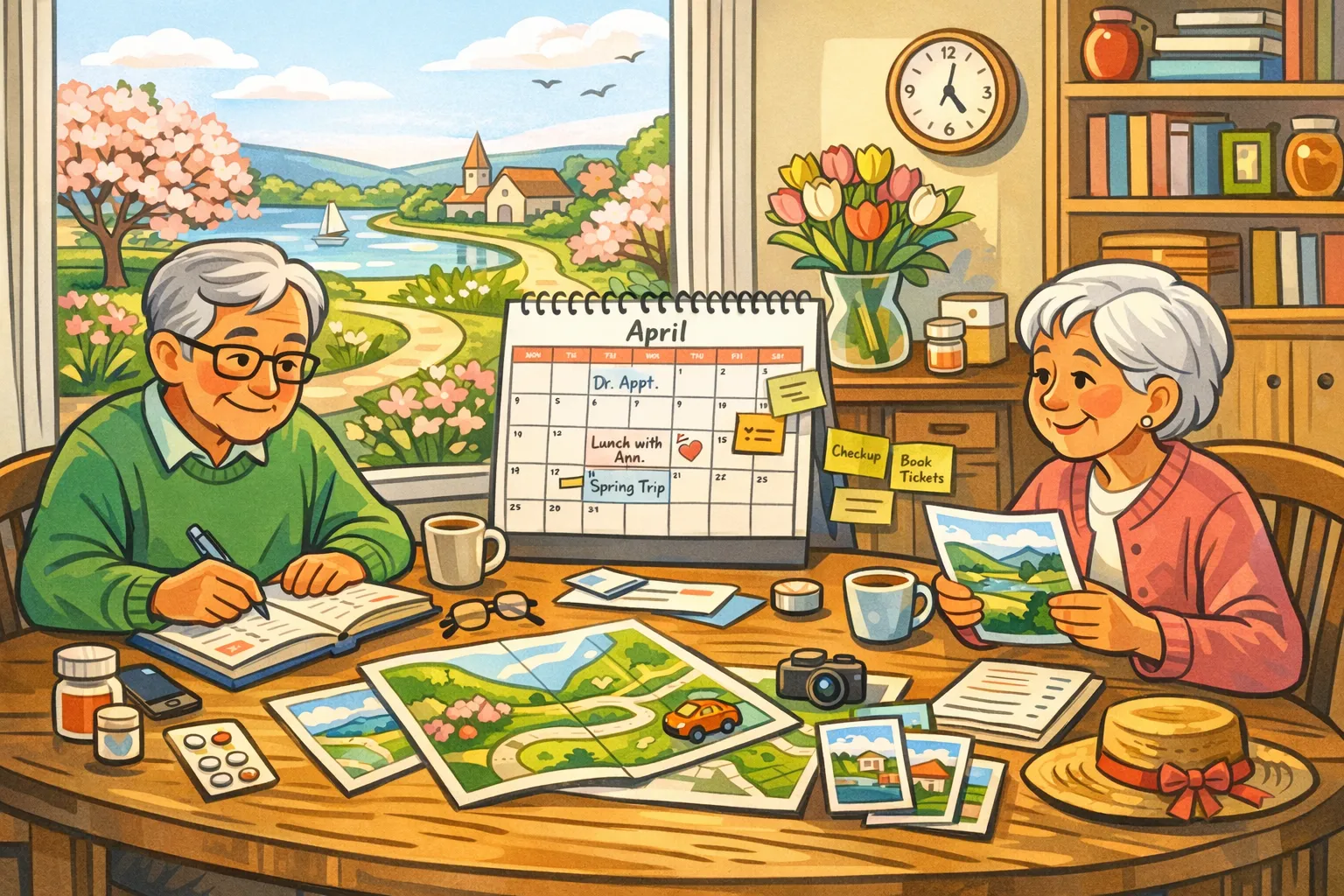
Older adults planning spring appointments and a small trip at a cozy table with calendar, travel notes, and flowers in a bold-line pastel cartoon panorama illustration.
Cindy’s Column × Senior AI Money
Spring can feel like life suddenly speeds up.
The weather improves. Appointments pile back onto the calendar. Family events restart. Gardening begins. Short trips sound appealing again. House projects reappear. Everyone seems to want to “make the most” of the season.
That sounds positive.
But for many adults over 55, spring can also become one of the most overloaded times of year.
One doctor visit turns into three. A simple day trip becomes a full week of errands. A family plan lands next to a dental check, a car service appointment, and a home repair window. What should feel fresh starts to feel crowded.
The problem is usually not poor motivation.
It is poor spacing.
A lot of retirees and older adults are no longer dealing with office deadlines, but they are still dealing with limited energy, appointment coordination, transportation time, health routines, recovery time, and the mental cost of too many “small” commitments landing too close together.
That is why good spring planning is not about doing more.
It is about arranging the season so your calendar still feels livable.
This guide is for adults 55+ who want to handle appointments, errands, small trips, and social plans without turning spring into a month of constant catch-up.
Why spring gets crowded so fast
Spring planning problems are rarely caused by one giant event.
They come from stacking.
Individually, each plan feels reasonable:
a checkup a specialist follow-up a lunch with friends a short family visit a garden center stop a car inspection a local trip a community event
But when they all land in the same two weeks, life starts to feel cramped.
That matters more after 55 because the “cost” of an outing is not just the hour on the calendar.
It often includes:
getting ready driving or arranging a ride parking walking waiting sitting in uncomfortable chairs eating at odd times taking medications on schedule recovering energy afterward
A one-hour appointment can easily behave like a three-hour energy event.
That is why many older adults feel confused by their own calendars.
They look at the week and think,
“This doesn’t even seem that busy.”
But it feels busy because the events are not spaced for reality.
The spring planning rule
Schedule by energy, not by empty spaces on the calendar.
That is the difference between a realistic plan and an overloaded one.
An empty Tuesday afternoon does not automatically mean you should put something there.
The better question is:
What does this week already ask of my body, attention, transportation, and recovery time?
That shift changes everything.
Instead of planning from available time, you plan from total load.
That makes your schedule calmer and much more sustainable.
Part 1: Sort plans into three levels
One of the best ways to reduce spring overload is to stop treating every commitment like it belongs in the same category.
Not all plans cost the same amount of effort.
A practical system is to sort your spring plans into three levels:
Level 1: Must-Happen Plans Medical appointments insurance deadlines tax-related tasks medication refills necessary home or car service family obligations that are truly fixed
Level 2: Helpful but Flexible Plans routine errands social lunches seasonal shopping home projects garden center visits haircuts community activities
Level 3: Joy Plans day trips museum days lunch outings family fun short travel spring events that add pleasure rather than pressure
This matters because many people put joy plans directly on top of must-happen plans and then wonder why even the fun things feel tiring.
The real solution is not to remove joy.
It is to place joy where it can actually be enjoyed.
Part 2: Use “anchor days” instead of filling every gap
A calmer spring calendar usually has structure.
One of the easiest structures is the anchor-day method.
Pick certain kinds of days for certain kinds of tasks.
For example:
Monday = admin and phone calls Tuesday = appointments Wednesday = home and rest Thursday = errands or social plans Friday = flexible or fun Weekend = family or recovery
This does not need to be rigid.
It simply reduces the constant mental work of deciding everything from scratch.
When the calendar has anchors, the week feels easier to steer.
You stop scattering appointments randomly.
You stop putting a doctor visit and a lunch outing on the same day just because “it fit.”
You stop creating accidental marathon days.
Table 1. A simple spring week structure for seniors
Day Type
Best Use
Why It Helps
Appointment day
Doctor, dentist, labs, car service
Keeps logistics grouped
Recovery day
Rest, light chores, quiet home time
Protects energy
Errand day
Grocery, pharmacy, bank, seasonal supplies
Prevents small tasks from spreading everywhere
Social day
Lunch, family visit, club, coffee
Leaves space to enjoy people
Flexible day
Backup plans, weather shifts, rescheduling
Reduces calendar stress
Joy day
Day trip, garden outing, museum, scenic drive
Keeps spring from becoming all obligation
This is not about making retirement feel like work.
It is about preventing the week from feeling shapeless and crowded at the same time.
Part 3: Never stack two “energy events” back to back if you can avoid it
An older adult’s schedule should be planned not only by clock time but by energy demand.
Some activities are low-load.
Others look small on paper but are high-load.
Examples of high-load events:
medical appointments long drives large family gatherings days with lots of walking bureaucratic tasks home-repair visits that require waiting around anything involving uncertainty or delays
If you put two high-load events back to back, spring starts feeling like a series of little crashes.
For example:
Tuesday: specialist visit Wednesday: family lunch across town Thursday: car service wait and pharmacy stop
None of these is outrageous.
Together, they are tiring.
That is why spacing matters more than ambition.
A better version might be:
Tuesday: specialist visit Wednesday: light home day Thursday: family lunch Friday: flexible or quiet errand day
The second version often feels dramatically easier even though the same tasks still happen.
Part 4: Build your trips around what week you are already having
Many people plan spring trips as if travel exists outside real life.
It does not.
A day trip or overnight outing lands on top of your actual week.
That means the best time for a small spring trip is not simply when the weather looks nice.
It is when the surrounding days are light enough to hold it.
Before adding a trip, ask:
Do I already have appointments this week? Will I need recovery time after the trip? Is there a refill, lab visit, delivery window, or service appointment nearby? Will this trip compete with sleep, meal routine, or medications? Do I actually want the outing, or do I just feel like I “should get out more”?
That last question is important.
Not every open day needs to become a trip.
And not every beautiful spring weekend needs to be used.
The best trip weeks are the weeks with room around them.
Part 5: Plan spring in blocks, not one date at a time
A lot of calendar stress comes from planning one thing at a time.
You agree to lunch.
Then schedule an appointment.
Then add a day trip.
Then remember a blood test.
Then book a haircut.
Then realize the same week now feels too full.
A better method is to look at spring in blocks.
Try reviewing the next 2 to 4 weeks at once.
Ask:
Which week already has the most obligations? Which week looks lighter? Where are the likely transportation-heavy days? Where can I place one enjoyable outing without crowding the rest?
This is especially useful in spring because seasonal tasks can arrive in clusters.
Examples:
garden prep tax wrap-up medical follow-ups house airing and cleaning family holiday plans spring clothing or shoe replacements local events opening back up
When you see the month in blocks, overload becomes easier to prevent.
Table 2. Spring planning mistakes vs. better choices
Common Mistake
Better Choice
Why It Works
Putting appointments wherever they fit
Group them into one or two likely days
Reduces mental clutter
Scheduling fun after a tiring appointment
Put fun on lighter days
Protects enjoyment
Treating every outing like “just one more thing”
Count travel and recovery too
Reflects real energy cost
Filling every good-weather day
Leave some open
Prevents resentment and fatigue
Planning week by week only
Look ahead 2 to 4 weeks
Helps balance the season
Saying yes before checking your full load
Pause and review the week first
Lowers overcommitment
Part 6: The “one big thing” limit
A very useful rule for spring is this:
Do not place more than one big thing in a day, and often not more than one big thing in a week section.
A “big thing” can be:
a medical appointment across town a long lunch visit a museum outing a home contractor window a family gathering a long errand loop a day trip
This does not mean your life has to become small.
It means you stop underestimating how much bandwidth ordinary life already uses.
For many retirees, a much calmer spring rhythm looks like this:
one main appointment day one errand block one social or fun plan everything else light
That may sound modest.
But it is often exactly what makes the season feel good instead of rushed.
Part 7: Use a “spring buffer list”
Some plans do not need a date yet.
That is where a spring buffer list helps.
This is a short list of things you want to do soon, but not necessarily this week.
Examples:
visit the garden center take a scenic drive plan an overnight visit with family go to the farmers market clean the porch schedule eye exam replace walking shoes book a local museum day
The buffer list matters because it prevents false urgency.
You stop treating every good idea like an immediate calendar event.
Instead, you hold it in a visible place and choose from it when the week actually has room.
This is one of the best ways to enjoy spring without turning it into a race.
Part 8: Real examples
Elaine, 71
Elaine kept feeling like her spring calendar was “mysteriously exhausting.” She had not scheduled anything dramatic. But once she looked closely, she realized she was putting appointments, social plans, and seasonal errands on consecutive days. She switched to appointment Tuesdays, quiet Wednesdays, and optional Fridays for joy plans. Within two weeks, the same amount of activity felt much easier because it was spaced better.
Robert, 67
Robert likes to make the most of good weather, so he kept adding extra errands to outing days. A simple dermatologist appointment would become lunch out, a hardware stop, grocery shopping, and a car wash. By evening he was wiped out. His fix was simple: one purpose per outing day, with one optional add-on only if energy still felt good. He said the biggest surprise was how much calmer his weeks felt.
Marsha, 64
Marsha wanted to take more spring day trips but kept choosing busy weeks. She would plan a scenic outing and then realize it was sitting next to dental work, a prescription refill run, and a family birthday. She started scanning each month for one “light week” and placed travel there first. Her trips immediately felt more restorative because they stopped competing with everything else.
Part 9: Use “good enough” planning, not perfect planning
A lot of spring overload comes from trying to optimize every week.
Perfect weather. Perfect timing. Perfect attendance. Perfect use of retirement freedom.
That pressure is part of the problem.
You do not need the perfect spring calendar.
You need a workable one.
Good enough planning looks like this:
appointments are visible trip weeks are not crowded recovery time exists there is room for joy not every day is spoken for you can still say yes without paying for it three days later
That is success.
Part 10: What a well-planned spring should feel like
A good spring plan should not look impressive.
It should feel breathable.
You should be able to look at the week and know:
when you need to leave the house when you can rest when you can enjoy something when you should not add one more thing where the margin is
This is what many older adults actually want from planning:
not maximum activity,
but steadiness.
Checklist: Spring Planning Without Overloading Yourself
✔ Write down all fixed appointments first ✔ Separate must-happen plans from flexible plans ✔ Put joy plans in the calendar only after checking total load ✔ Avoid stacking two high-energy events on back-to-back days ✔ Use anchor days for appointments, errands, and rest ✔ Leave at least one true buffer day most weeks ✔ Check the next 2 to 4 weeks before saying yes ✔ Keep a spring buffer list for nice ideas that do not need a date yet ✔ Count drive time and recovery time as real calendar cost ✔ Limit each day to one main event when possible ✔ Place trips in lighter weeks, not crowded ones ✔ Use weather windows wisely but do not chase every good day ✔ Protect medication, meals, and rest routines ✔ Review the calendar once a week instead of constantly adjusting it ✔ Aim for a breathable season, not a packed one
EEAT note
This article is practical planning guidance for older adults and is designed to help readers manage appointments, travel, and seasonal commitments more comfortably. It is not medical or mental health treatment. Adults managing fatigue, chronic illness, mobility changes, cognitive strain, or recent health events may need to plan with even more spacing and should use personalized guidance when appropriate.
Final thought
Spring should feel like re-entry, not overload.
The best calendar is not the fullest one.
It is the one that lets you handle what matters, enjoy what is good, and still have enough energy left to feel like the season belongs to you.
Space is part of the plan.
And in spring, spacing is often what makes everything else work.
Disclaimer
This article is for general educational purposes only and does not provide medical, mental health, transportation, or legal advice. Individual health status, mobility, driving tolerance, medication schedules, caregiving duties, and family obligations vary. Readers should plan according to their real needs and consult qualified professionals when scheduling around important health or safety concerns.
A well-planned day trip for older adults focuses on one enjoyable destination, easy pacing, rest stops, and comfort from start to finish.
Cindy’s Column × Senior AI Money
A lot of retirement travel advice sounds exciting on paper and exhausting in real life.
Leave early. See everything. Fit in lunch, a museum, a scenic drive, a shopping stop, a special dinner, and maybe one more attraction before heading home.
That kind of itinerary may look productive.
But for many adults over 55, it is not restful.
It is not memorable in a good way.
And it is not the kind of trip that leaves you feeling refreshed.
The better plan is often much simpler:
one great day trip,
one clear destination,
one easy pace,
and enough margin that the day still feels kind to your body by the time you get home.
That idea fits well with current travel guidance for older adults. The CDC emphasizes planning ahead, packing medications carefully, thinking through chronic conditions, and making a health-care plan before travel. AARP’s recent travel coverage also leans toward slower-paced, restorative trips rather than overpacked itineraries.
This guide is for retirees and older adults who want a day trip that feels enjoyable, manageable, and worth repeating.
What makes a senior-friendly day trip work
A good day trip is not measured by how much you squeezed in.
It is measured by how the whole day felt.
Did you enjoy the drive?
Did you have enough time to sit?
Was the bathroom access easy?
Did you stay hydrated?
Did the walking feel reasonable?
Did you come home pleasantly tired rather than completely wiped out?
That matters because travel can be physically demanding even when the destination is close. The CDC notes that older adults and travelers with chronic conditions should plan around their health needs, medication access, and the realities of getting care if something goes wrong.
The senior day-trip rule
Plan for comfort first, scenery second, extras third.
That order may sound unromantic, but it is exactly what makes the day enjoyable.
If comfort is ignored, the scenery becomes harder to enjoy.
If extras take over, the day becomes tiring.
If the plan is too tight, one delay can ruin the mood.
A strong day trip after 60 usually has five traits:
a short and realistic travel window easy parking or simple transportation good bathroom access a built-in rest stop or seated activity one main highlight instead of five competing highlights
That is the difference between a day you remember fondly and a day you need two recovery days from.
Part 1: Choose the right kind of destination
Not every good destination is a good day-trip destination.
For older adults, the best day trips often have a mix of beauty, convenience, and flexibility.
That usually means places like:
a lakeside town a botanical garden a scenic train ride a waterfront boardwalk a historic district with benches and cafés a museum plus lunch plan a state park visitor center with accessible walking options a farm market or garden center outing a slow scenic drive with two planned stops a beach town in the off-season
AARP’s travel coverage on microvacations, slower-paced trips, and off-season travel all point in the same direction: less crowding, fewer transitions, and a gentler pace usually create a better travel experience.
The ideal destination has one main “yes.”
Not ten partial maybes.
For example:
“Yes, this place has a beautiful waterfront and several benches.” “Yes, this museum has an elevator, a café, and manageable size.” “Yes, this scenic town has parking near the main street and easy lunch options.”
That is enough.
A day trip should feel clear before it begins.
Part 2: Build the day around energy, not ambition
A common mistake is planning from the destination outward.
A better method is to plan from your energy inward.
Ask:
What time of day do I feel best? How long can I sit in the car comfortably? How much walking feels pleasant, not dutiful? Do I need a meal break before I get tired? Will heat, stairs, noise, or long lines reduce my enjoyment?
These are not “older adult limitations.”
They are smart planning questions.
The CDC advises older travelers to think ahead about their own health status, medicines, and destination demands before they go. That same logic works beautifully for day trips: build the plan around your real needs, not your fantasy self.
A practical rhythm for many retirees looks like this:
leave after morning rush arrive before lunch crowds enjoy one main activity sit down for a calm meal do one small second stop only if energy still feels good head home before late-afternoon fatigue builds
This kind of pacing often feels better than an early start followed by over-scheduling.
Table 1. Senior-friendly day trip structure
Trip Element
Best Target
Why It Works
Drive time each way
45 to 90 minutes
Far enough to feel like an outing, short enough to stay comfortable
Main destination
1 clear highlight
Reduces decision fatigue
Walking
Light to moderate
Preserves energy for enjoyment
Meal plan
One seated lunch or café stop
Builds in rest and hydration
Backup plan
1 simple alternative
Keeps the day from feeling fragile
Return time
Before heavy evening fatigue
Makes recovery easier
This table is a practical planning framework based on slower-paced travel guidance and health-first travel preparation advice for older adults.
Part 3: Pack like the day might get longer than planned
A day trip feels different when you know you are prepared.
You do not need a giant bag.
But you do need a few things that protect comfort.
The CDC advises travelers to prepare before leaving, and NIA and CDC materials stress medication safety, hydration, and planning around ongoing health needs.
A smart senior day-trip bag often includes:
water medications you may need during the day a written medication list snack with protein or steady energy hat or light layer phone charger or power bank sunglasses hand sanitizer tissues simple first-aid basics mobility aid if normally useful small paper with emergency contact numbers
That is not being overly cautious.
It is what lets the day stay easy.
You are much more relaxed when you do not have to improvise around something basic.
Part 4: Heat, weather, and timing matter more than people think
A beautiful plan can still become a hard day if the weather turns against you.
That is especially true for older adults in heat, humidity, or long stretches outdoors.
NIA advises older adults to drink plenty of fluids in hot weather, avoid alcohol and caffeine when heat is a concern, and pay attention to heat-related symptoms. NIA’s outdoor safety guidance also emphasizes water, breathable clothing, and sun protection.
That means a good day trip plan should answer these questions before you leave:
Where will we sit in shade or indoors? Where are the bathrooms? Do we need extra water? Is the main walking portion best done earlier in the day? Do we need hats, sunscreen, or a cooler car return plan?
Sometimes the best upgrade is not a fancier destination.
It is simply choosing the right season, the right weekday, or the right time of day.
Off-season and off-peak travel can mean fewer crowds and a slower pace, which AARP specifically highlights as one of the benefits of smarter trip timing.
Part 5: Pick one “anchor moment”
Many people accidentally plan day trips as a list.
A better way is to plan one anchor moment.
That is the thing the day is really built around.
Examples:
the lakefront lunch the rose garden in bloom the slow scenic ferry ride the historic main street and bakery the waterfall overlook the museum exhibit you genuinely want to see the picnic with one beautiful view
Everything else should support that anchor, not compete with it.
This matters because memory works differently than checklists.
You are far more likely to remember one lovely, unhurried highlight than six rushed stops.
A slower, sensory, nature-connected pace is also consistent with recent AARP reporting about travel that supports well-being and longevity.
Part 6: Use the “sit-down test”
This is one of the simplest travel filters for older adults.
Before saying yes to a day trip, ask:
Can I sit comfortably every 60 to 90 minutes if I want to? Is there a real lunch or coffee option nearby? If my legs get tired, can the day still continue pleasantly? If the answer is no, the plan may be too demanding.
A senior-friendly outing should not depend on being “tough.”
It should support enjoyment without requiring you to prove anything.
That is especially important for travelers managing arthritis, heart or lung issues, diabetes, balance concerns, or general fatigue. The CDC’s older-adult and chronic-illness travel guidance is clear that planning around underlying conditions is part of smart travel, not a sign to avoid travel altogether.
Part 7: Food, meds, and motion comfort can make or break the day
A surprising number of day trips go wrong for very ordinary reasons:
someone got hungry too late someone missed a medication time the car ride became uncomfortable the boat or winding road caused motion sickness everyone waited too long for a bathroom break
The CDC advises travelers to think ahead about medicine schedules and to prepare for common health issues such as motion sickness and food or drink safety.
That is why the best day-trip routine is simple:
eat before you are ravenous drink before you feel behind rest before you are worn out stop before you are desperate for a bathroom turn back before the drive home feels like a chore
This is not less adventurous.
It is what keeps the day pleasant.
Table 2. Easy day trip formats that usually work well for seniors
Day Trip Type
Best For
Built-In Advantage
Garden + lunch
Calm walkers, spring and fall outings
Beauty with natural rest points
Scenic drive + overlook + café
Lower walking tolerance
High reward with low strain
Small museum + early lunch
Culture lovers
Indoor comfort and seating
Lakefront town + boardwalk
Couples or friends
Easy pace and pleasant scenery
Farmers market + picnic
Budget-friendly outings
Flexible timing
Scenic train or ferry
People who enjoy movement without walking much
Travel itself becomes the attraction
These formats are practical extensions of slower-paced travel advice and health-conscious preparation guidance for older adults.
Part 8: Real examples
Linda, 69
Linda loved the idea of day trips but kept coming home overly tired. She realized the problem was not travel itself. It was that she planned each outing like a younger version of herself. She switched to a simple formula: one garden, one lunch, one scenic drive home. Her favorite trip ended up being only 70 minutes away, with a botanical garden, a quiet café, and a farm stand on the return route. She said it was the first trip in months that felt restorative instead of “successful.”
James, 74
James has mild arthritis and was beginning to assume day trips were more trouble than they were worth. His daughter suggested choosing destinations by parking convenience and seating access rather than by hype. He and a friend started taking monthly waterfront outings with one museum or visitor center and an early lunch. His words were simple: “I stopped trying to prove I could still do a hard day.”
Patricia, 66
Patricia enjoys travel but gets motion sick on winding roads and crowded boats. She now builds every trip around what she calls the calm-body rule: stable ride, water packed, one proper meal, and a return time before late-afternoon drain. She still takes frequent outings. They just feel better because she plans for her body instead of against it.
Part 9: The best day trip may be closer than you think
Many retirees assume a good outing must feel big.
It usually does not.
Some of the best day trips are surprisingly local:
the next county the nearby lake the quieter museum the town you usually drive through the state park with a visitor center you have never actually visited the waterfront café on a weekday the scenic drive in shoulder season
That is one reason microvacations and shorter trips have become more appealing in recent travel writing: they are easier to fit into real schedules, easier to recover from, and often easier to enjoy fully.
You do not need a grand plan to feel refreshed.
You need a day with shape, comfort, and one good reason to go.
Checklist: Senior-Friendly Day Trip Plan
✔ Pick one main destination, not several ✔ Keep drive time realistic for your body ✔ Check parking and bathroom access ahead of time ✔ Plan one seated meal or café stop ✔ Pack water, medications, and a simple snack ✔ Bring a hat, layer, or sun protection if needed ✔ Build in one rest window before you feel tired ✔ Choose the cooler or quieter part of the day when possible ✔ Keep a backup option in case weather changes ✔ Avoid stacking too many walking stops ✔ Think about motion sickness or winding roads in advance ✔ Make sure your phone is charged ✔ Carry emergency contacts and medication information ✔ Head home while energy still feels steady ✔ Judge the trip by comfort and enjoyment, not by mileage
EEAT note
This guide is practical travel-planning content for older adults and is not a substitute for individualized medical advice. It is based on current travel-health guidance for older adults, medication planning, chronic-condition planning, hot-weather safety, and slower-paced travel recommendations from authoritative health and senior travel sources.
Final thought
A great day trip after 60 should not leave you feeling like you survived something.
It should feel gentle enough to enjoy while it is happening.
One good view. One good meal. One comfortable pace. One day that still feels kind by evening.
That is not “less travel.”
That is smarter travel.
Disclaimer
This article is for general educational purposes only and does not provide medical, mobility, transportation, or travel-safety advice for any specific person. Day-trip decisions should reflect your health status, medications, mobility, weather conditions, destination safety, and transportation needs. Adults with chronic health conditions, heat sensitivity, balance concerns, or recent illness should consider personalized guidance from a qualified healthcare professional before more demanding travel plans.
A joy budget helps retirees enjoy hobbies, outings, and small pleasures without letting random spending take over the month.
Cindy’s Column × Senior AI Money
Retirement money advice often sounds serious for a reason.
Protect your savings. Control fixed expenses. Watch inflation. Plan for healthcare. Avoid lifestyle creep.
All of that matters.
But there is another truth that matters too:
If your budget only protects survival and never protects joy, it starts to feel like punishment.
A lot of retirees do not overspend because they are careless. They overspend because they never gave fun a proper place in the plan.
So the spending happens in a scattered way:
a lunch here a gift there an impulse day trip another streaming subscription a hobby purchase that “doesn’t count” a weekend away that somehow ends up on the credit card
That is exactly why a joy budget works.
A joy budget is not reckless spending.
It is a small, intentional part of your retirement plan that gives money a job beyond bills, groceries, medication, and maintenance. It lets you enjoy retirement without pretending enjoyment is irresponsible.
That matters because housing and transportation still take a large share of household spending overall, and retiree households have historically spent a higher share of income on healthcare than average. At the same time, AARP notes that people in early retirement often spend 10 to 20 percent more on discretionary items than they expected.
The goal is not to spend more.
The goal is to spend on purpose.
What a joy budget really means
A joy budget is a pre-decided amount of money for things that make life feel lighter, warmer, more meaningful, or more enjoyable.
That can include:
coffee dates hobby supplies lunch out movie tickets short trips gardening upgrades family outings craft classes museum days seasonal treats small comforts that help you feel like life is still being lived
This is not the same as “miscellaneous.”
Miscellaneous spending usually leaks.
Joy spending should be named.
That is the key shift.
When joy gets named, it becomes easier to control.
When it is unnamed, it often becomes emotional spending disguised as “just this once.”
Why retirees need a joy budget
Retirement is not only a math problem.
It is also a lifestyle transition.
Your time changes.
Your routines change.
Your sense of reward changes.
For many people, work once provided structure, identity, and built-in treats:
the drive for coffee,
the lunch out,
the trip after a busy quarter,
the excuse to buy something useful.
Once retirement begins, spending can get strange.
Some retirees become so cautious that they stop enjoying money they can responsibly use.
Others swing the other way and spend freely because retirement feels like a long-delayed reward.
Neither extreme feels steady.
A joy budget helps because it creates permission with limits.
You do not have to ask every week:
“Can I afford this?”
“Should I feel guilty about this?”
“Am I being too tight?”
“Am I being irresponsible?”
You already decided.
That makes the spending calmer.
The joy budget rule
Fund joy after essentials, before random spending.
That order matters.
If joy comes before essentials, the budget becomes unstable.
If joy comes after random spending, joy disappears.
So the basic order is:
essentials savings buffer planned joy everything else
This is especially useful in retirement because income may be fixed while spending is uneven.
Some months are calm.
Other months bring home repairs, healthcare bills, travel invitations, birthdays, or sudden family expenses.
A joy budget helps you protect a small quality-of-life amount without pretending every month will feel identical.
Part 1: Start with the real floor, not the fantasy floor
Before you can build a joy budget, you need a clear view of what your month already requires.
That means your true non-negotiables:
housing utilities groceries insurance medications transportation minimum debt payments phone and internet basic household supplies
Be honest here.
A lot of retirees underestimate their monthly floor because they forget irregular necessities like:
car registration co-pays home maintenance gifts pet care seasonal clothing annual subscriptions appliance replacement
A joy budget only works when it sits on a realistic base.
If the base is too optimistic, joy money will get blamed later for problems it did not create.
Part 2: Decide what “joy” actually means to you
A useful joy budget is personal.
Not all retirees want the same things.
For one person, joy is travel.
For another, it is lunch with friends twice a month.
For another, it is taking grandchildren out for ice cream.
For another, it is fresh flowers, better coffee, art supplies, books, or music events.
That is why copying someone else’s retirement lifestyle is expensive.
The better question is:
What spending makes me feel most alive, most connected, or most restored?
Some joy spending gives a high emotional return for a low dollar amount.
Examples:
library café date local garden center visit baking supplies museum membership monthly breakfast with a friend craft materials small upgrades to a favorite hobby
Some joy spending is larger and needs planning.
Examples:
weekend travel family reunion trip concert tickets seasonal classes major hobby equipment
The point is not to eliminate joy.
The point is to choose the joy that matters most.
Table 1. Common joy categories for retirees
Joy Category
Small Monthly Version
Planned Larger Version
Why It Works
Social joy
Coffee, lunch, cards, local meetups
Birthday dinner, small gathering
Supports connection
Hobby joy
Yarn, seeds, books, art supplies
Class series, equipment, workshop
Keeps the week interesting
Comfort joy
Better coffee, flowers, streaming, bakery treats
Recliner upgrade, patio refresh
Improves daily life
Experience joy
Museum day, day trip, movie
Weekend getaway, event tickets
Creates memories
Family joy
Treats for grandkids, shared meals
Holiday outing, family travel
Builds meaning
Health-linked joy
Pool pass, walking shoes, yoga class
Wellness retreat, fitness program
Supports energy and routine
Part 3: Set one number, not ten vague promises
This is where many people get stuck.
They say things like:
I’ll just be careful.
I won’t eat out too much.
I’ll see how the month goes.
I’ll only spend when it feels worth it.
That sounds responsible, but it is not a real system.
A joy budget needs a number.
It can be monthly or annual.
Examples:
$100 a month
$250 a month
$400 a month
$1,200 a year for day trips
$2,400 a year for travel and fun
There is no magic number.
The right number depends on your cash flow, obligations, emergency cushion, and priorities.
A practical starting point is to choose a number small enough to feel safe and large enough to feel real.
If it is too tiny, you will ignore it.
If it is too big, you will not trust it.
AARP budgeting advice for older adults emphasizes separating discretionary from nondiscretionary expenses and building contingency room, which fits this approach well.
Part 4: Use “joy buckets” so fun spending does not sprawl
One joy budget can still feel messy unless you divide it.
Try three simple buckets:
Everyday Joy Small weekly or monthly treats
Social Joy Meals, coffees, outings, small gifts, events with others
Big Joy Trips, tickets, larger hobby costs, family experiences
This matters because not all fun spending should compete with itself.
If one restaurant dinner wipes out the entire month’s fun money, the budget starts to feel harsh again.
Buckets make it easier to balance:
small pleasures now,
larger pleasures later.
Example:
$250 monthly joy budget
$80 Everyday Joy $70 Social Joy $100 Big Joy sinking fund
That means not every dollar must be spent this month.
Some of it can wait for the thing you truly care about.
Part 5: Stop guilt-spending and stop revenge-spending
Retirees often fall into one of two patterns.
Guilt-spending:
You buy something enjoyable, then feel uneasy, then over-correct by becoming extremely restrictive.
Revenge-spending:
You have been too strict for too long, then suddenly decide, “I’m retired. I deserve this,” and spend without structure.
Neither pattern is really about the item purchased.
It is about the absence of a plan.
A joy budget helps because it turns emotion into policy.
You no longer have to negotiate every pleasure from scratch.
You simply check:
Is it within the joy budget?
Does it fit this month’s plan?
Would I rather save this amount for a better joy purchase later?
That is a much steadier conversation.
Part 6: Use the “best memory per dollar” test
Not all joy spending is equal.
Some purchases feel expensive and forgettable.
Others feel modest and meaningful.
A strong retirement budget favors high-memory, high-value spending.
Ask:
Will I remember this next month?
Does this improve my week or just my mood for 20 minutes?
Does this fit my actual energy level?
Would I enjoy a simpler version just as much?
Am I buying joy or buying relief from stress?
That last question matters.
Buying joy and buying relief are not always the same thing.
If you are bored, lonely, anxious, or restless, spending can briefly feel like emotional treatment.
That is when the budget starts drifting.
The better goal is not “never spend emotionally.”
It is “notice what kind of spending this really is.”
Part 7: Real examples
Elaine, 68
Elaine and her husband were doing fine financially, but she felt guilty every time they spent money on anything “nonessential.” That created a strange pattern: months of extreme restraint followed by expensive restaurant weekends. They switched to a joy budget of $300 per month. They used $120 for social meals, $80 for local outings, and $100 for a travel sinking fund. After four months, Elaine said the biggest change was not the spending itself. It was the lack of self-argument.
David, 72
David lived alone and realized his random spending was not on luxury. It was on boredom. Convenience food, subscriptions he barely used, and impulse hobby purchases were quietly adding up. He replaced that with a $150 joy budget: $40 for coffee and reading outings, $35 for gardening, $25 for music, and $50 saved monthly for small trips. His spending became lower, but his enjoyment became higher because it was chosen.
Marsha, 64
Marsha had recently retired and wanted travel to be part of her life, but she did not want every trip to trigger anxiety. She created two levels of joy spending: $200 monthly for ordinary fun and a separate annual travel goal funded automatically. She discovered that small weekly pleasures actually reduced her urge for expensive “escape spending.” Her words were simple: “I stopped acting like joy had to be huge to count.”
Part 8: Plan joy around the calendar, not just the month
Some retirement spending is seasonal.
Spring may bring gardening and travel.
Summer may bring family outings.
Fall may bring hobbies, classes, and local events.
December may bring gifts and gatherings.
That means monthly budgeting alone can be too flat.
A better system is to look ahead 3 to 6 months.
Ask:
What fun expenses are likely coming?
Which ones matter most?
Which ones can I fund slowly?
This is especially relevant in 2026 because older adults continue to prioritize discretionary spending like travel while still being cost-conscious about it, according to AARP’s 2026 travel trends reporting.
So instead of pretending that joy is spontaneous, plan for it.
Planned joy usually feels better than panicked joy.
Table 2. Example joy budget by monthly income comfort level
Monthly Cash-Flow Comfort
Suggested Joy Budget Range
Best Structure
Tight
$50–$125
Focus on small recurring treats and free/low-cost outings
Moderate
$125–$300
Mix of monthly joy and one sinking fund
Comfortable
$300–$600
Social, hobby, and travel buckets
Very Comfortable
$600+
Layered approach with annual experience planning
This is not a rule.
It is a planning guide.
The best number is the one that protects both stability and enjoyment.
Checklist: Joy Budget Setup for Retirees
✔ List your true monthly essentials first ✔ Include irregular necessary costs before setting joy money ✔ Define what “joy” means for your life, not someone else’s ✔ Choose one monthly joy number ✔ Split joy into small buckets if needed ✔ Create a sinking fund for bigger experiences ✔ Track joy spending separately from groceries and bills ✔ Use low-cost joy on tired or quiet weeks ✔ Plan seasonal fun ahead of time ✔ Ask which purchases create the best memory per dollar ✔ Notice when spending is really stress relief ✔ Review the joy budget once a month without guilt ✔ Increase or reduce the number based on reality, not shame ✔ Protect emergency savings and major essentials first ✔ Let joy be intentional, not accidental
Part 9: What not to do
Do not call every unplanned purchase “joy.”
That turns the category into an excuse.
Do not make the joy budget so strict that it feels like punishment.
That usually causes backlash spending.
Do not compare your joy spending to wealthier retirees.
Someone else’s cruise habit is not your budget.
Do not assume low-cost joy is lesser joy.
For many retirees, routine pleasures create more happiness than occasional big expenses.
Do not forget that companionship, novelty, beauty, movement, and creativity all count as joy.
It is not only about travel.
EEAT note
This article is practical budgeting guidance for older adults and is meant to support thoughtful retirement spending, not replace individualized financial planning. It draws on current consumer spending data and retirement budgeting guidance showing that essentials remain heavy, healthcare can take a larger share for retirees, and discretionary spending can rise unexpectedly without a plan.
Final thought
A good retirement budget does not only keep you safe.
It keeps you human.
It makes room for connection, curiosity, pleasure, and memory.
A joy budget is not careless.
It is one of the cleanest ways to enjoy what you have without letting enjoyment quietly run the month.
Spend on purpose.
Save on purpose.
Enjoy on purpose.
Disclaimer
This article is for general educational purposes only and does not provide individualized financial, tax, investment, retirement-income, or legal advice. Retirement budgets vary based on income sources, savings, debt, health costs, family obligations, and risk tolerance. Readers should review their situation carefully and consult a qualified financial professional when making major spending or withdrawal decisions.