Cindy’s Column × Senior AI Money
A lot of home exercise plans fail for the same reason.
They start with enthusiasm and end with soreness, frustration, or a quietly abandoned routine.
One day you do too much because you feel motivated.
The next day your knees complain, your back feels tight, or your energy drops.
Then you “rest” for several days.
Then restarting feels harder than beginning did.
That is why exercise progress after 55 is usually not a motivation problem.
It is a pacing problem.
For older adults, the real goal is not to crush a workout.
It is to build a routine your body can trust.
That matters because official healthy-aging guidance points in the same direction: older adults benefit from a mix of aerobic, muscle-strengthening, and balance activity, and regular movement supports thinking, independence, and fall prevention. CDC’s current guidance for older adults says adults 65+ should aim for at least 150 minutes of moderate aerobic activity each week, plus muscle-strengthening on at least 2 days and balance activities as part of weekly movement. NIA also emphasizes aerobic, strength, and balance work, while WHO recommends varied multicomponent activity that emphasizes functional balance and strength for older adults.
This guide is for adults 55+ who want home exercise to become steadier, safer, and more repeatable.
What progress really means at home
A lot of people define exercise progress too narrowly.
They think progress means:
more reps,
heavier weights,
longer walks,
harder routines,
more sweat,
more soreness.
Sometimes that is true.
But for many older adults, real progress looks like this:
you show up three times this week instead of once
you stop needing three recovery days after each workout
you finish feeling energized instead of defeated
your balance feels steadier getting up from a chair
you trust yourself to keep going next week
That counts.
In fact, it counts a lot.
Because the most valuable exercise plan is not the one that looks ambitious.
It is the one that survives ordinary life.
The consistency rule
Build the habit first. Build the challenge second.
That is the rule that keeps people from getting hurt.
A routine that is slightly too easy at first is usually much better than one that is slightly too hard.
NIA specifically notes that activity can be done through many kinds of movement, including structured exercise, chores, errands, walking, or leisure activity, and that older adults should include a combination of aerobic, muscle-strengthening, and balance work each week. NIA also notes that variety can make movement more enjoyable and may reduce overuse injury risk.
That means the best home exercise plan is not a punishment plan.
It is a repeat plan.
Part 1: Start with the three-part foundation
Home exercise goes better when you stop asking one routine to do everything.
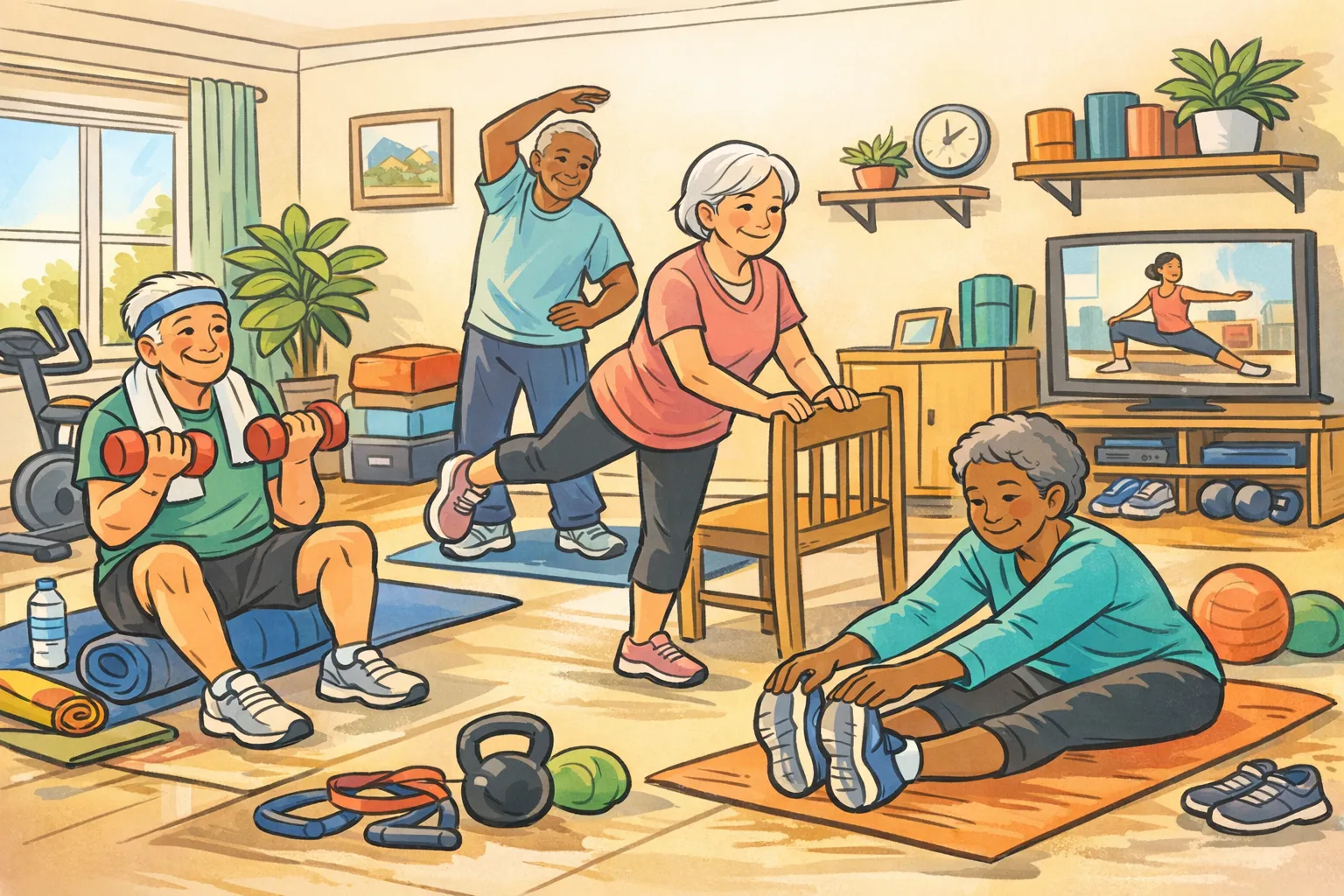
A strong weekly plan for seniors usually includes three types of movement:
- Aerobic work
Walking in place, easy marching, indoor cycling, light stepping, short walking sessions - Strength work
Chair stands, wall push-ups, resistance bands, light dumbbells, sit-to-stand practice - Balance work
Heel-to-toe standing, one-leg support with a chair nearby, side stepping, standing from a chair with control
This matters because aging well is not only about endurance.
It is also about staying steady, strong, and independent.
NIA states that older adults benefit from aerobic, muscle-strengthening, and balance exercise, and its exercise materials note that balance training can help prevent falls and fall-related injuries. CDC’s older-adult guidance likewise includes aerobic, strength, and balance activity as part of the weekly recommendation.
If you are only walking, you may be missing strength and balance.
If you are only doing light weights, you may be missing endurance.
If you are only stretching, you may be missing enough challenge to build real function.
The answer is not more intensity.
It is better balance across the week.
Table 1. A simple home exercise structure for older adults
| Exercise Type | Examples at Home | Main Benefit |
|---|---|---|
| Aerobic | Walking, indoor marching, step-touch, stationary bike | Supports endurance and heart health |
| Strength | Chair stands, wall push-ups, resistance bands, dumbbells | Supports muscle, mobility, and independence |
| Balance | Supported single-leg practice, heel-to-toe, side steps | Helps stability and fall prevention |
| Mobility / flexibility | Gentle range of motion, calf stretch, shoulder circles | Helps movement feel easier |
| Recovery movement | Easy walk, light stretching, relaxed mobility | Helps you stay consistent |
Part 2: Progress by adding small pieces, not giant jumps
One of the biggest injury mistakes is jumping too fast.
People often do this in one of three ways:
they suddenly double the time
they add weight too fast
they do the same movement too often because they think “more is better”
Usually, better progress looks smaller.
Examples of safe-feeling progress:
10 minutes becomes 12
1 set becomes 2
5 chair stands becomes 7
one balance drill becomes two short balance drills
two workouts per week becomes three moderate sessions
That is enough.
Older adults often benefit more from slow, repeatable increases than from dramatic upgrades. CDC’s fall-prevention program materials note that building strength and balance takes time, and NIA’s exercise guidance emphasizes staying active regularly rather than treating exercise as a burst-and-crash effort.
A useful rule is this:
Change only one thing at a time.
Not all three.
So if you add time this week, keep the exercise selection the same.
If you add a little resistance, keep the number of sets stable.
If you add a third workout day, keep the sessions shorter.
That is how progress feels manageable instead of risky.
Part 3: Use the “finish feeling capable” test
A lot of home workouts are judged the wrong way.
People ask:
Did I do enough?
Was that hard enough?
Should I feel more sore?
A better question is:
How did I feel at the end?
For most seniors exercising at home, a good session should end with:
“I could probably do a little more, but stopping here feels smart.”
That is the sweet spot.
If you finish completely drained, your plan may be too aggressive.
If you regularly ache for days, the dose may be too high.
If you dread the next session, the routine may not be sustainable.
NIA’s exercise safety materials encourage older adults to listen to the body, use good form, and build activity in a way they can maintain. Its public guidance repeatedly frames movement as part of healthy aging, not as an all-out performance test.
That is why “finish feeling capable” is such a powerful rule.
It protects tomorrow, not just today.
Part 4: The week matters more than one workout
Many people think of exercise one workout at a time.
A better method is to think in weeks.
Why?
Because the body does not only respond to Tuesday.
It responds to the pattern of Monday through Sunday.
A smart home week for many older adults looks something like this:
2 strength sessions
3 to 5 moderate movement days
2 to 3 short balance sessions
1 or more easier recovery days
This does not mean every session has to be long.
In fact, short sessions often work better.
CDC’s older-adult activity guidance says the weekly goal can be spread across the week and that movement can be accumulated in realistic ways. NIA also emphasizes combining different activity types across the week, not relying on one single form of exercise.
So instead of trying to “make up for” missed exercise with one heroic session, build a week that feels believable.
Believable beats perfect.
Part 5: Pain, soreness, and warning signs are not the same thing
This is where a lot of older adults get confused.
Some exercise discomfort is normal.
Sharp or worsening pain is not.
Mild muscle fatigue after strength work can be expected.
Needing three days to recover every time is a clue something needs adjusting.
A little challenge is useful.
A pattern of flare-ups is not.
NIA’s guidance for exercise with aging and chronic conditions emphasizes adjusting activity to your body and health needs, and public-health guidance for older adults consistently encourages activity while also recognizing that chronic conditions, balance concerns, and other limitations may require modifications.
Practical red flags to respect:
pain that changes the way you move
joint pain that gets worse during the session
dizziness
chest pain
shortness of breath beyond expected effort
swelling that seems unusual
a “bad soreness” pattern that keeps returning
These are not signs to push harder.
They are signs to step back and reassess.
Part 6: The best progress often comes from boring repetition
This may be the least glamorous truth in exercise.
The things that help older adults most are often very ordinary:
chair stands
supported balance practice
light dumbbell work
step-ups at a safe height
walking
band rows
wall push-ups
slow marching
controlled sit-to-stand movements
These exercises may not look exciting.
But they transfer well to daily life.
They help you stand up, walk better, steady yourself, carry things, and keep confidence in your body.
NIA’s strength and balance guidance highlights exactly these kinds of basic, functional movements as important for healthy aging and fall prevention. WHO’s guidance for older adults similarly emphasizes multicomponent activity with functional balance and strength.
That means your home plan does not need novelty every week.
It needs usefulness.
Table 2. Common home exercise mistakes and better fixes
| Common Mistake | What Usually Happens | Better Fix |
|---|---|---|
| Starting too hard | Soreness, skipped days, loss of confidence | Start shorter and lighter than your motivation wants |
| Doing only walking | Endurance improves but strength/balance lag | Add two strength days and short balance practice |
| Progressing everything at once | Fatigue or pain spikes | Change only one variable at a time |
| Exercising only when motivated | Inconsistent routine | Use a weekly structure instead of mood |
| Chasing soreness | Recovery gets harder | Judge success by steadiness and form |
| Repeating painful movements | Symptoms worsen | Modify, reduce, or stop and reassess |
Part 7: Real examples
Elaine, 70
Elaine started a home routine with online videos and quickly did too much. She liked the feeling of “finally getting serious,” but her knees and hips disagreed. She switched to a simpler structure: walking indoors or outside on most days, chair stands twice a week, light dumbbell work twice a week, and short balance practice after brushing her teeth. Three months later, she was doing less per session than before, but much more across the month.
James, 74
James believed that if exercise was not hard, it was not working. So every home session turned into a test. He would do extra reps whenever he felt good, then disappear from exercise for four days. Once he started using the finish-feeling-capable rule, his routine stabilized. He kept each session moderate enough that he could repeat it. That changed everything.
Marsha, 66
Marsha already walked regularly but noticed she still felt unsteady stepping backward or getting up from low chairs. She added brief strength and balance work at home three times a week. Nothing dramatic happened in one week, but six weeks later she felt more confident moving around the house and handling ordinary tasks. Her progress came from targeted consistency, not intensity.
Part 8: A simple weekly model that actually works
Here is a realistic home model many older adults can adapt:
Monday
Strength + short walk
Tuesday
Easy movement or recovery walk
Wednesday
Balance + light aerobic session
Thursday
Recovery or mobility day
Friday
Strength + short walk
Saturday
Longer easy walk, dance, or active chores
Sunday
Rest or gentle mobility
This is only a model.
The important part is the rhythm:
challenge,
recovery,
repeat.
Not every day needs to feel productive.
It needs to fit the whole week.
Checklist: Home Exercise Progress Without Injury
✔ Start with a weekly plan, not random workouts
✔ Include aerobic, strength, and balance work
✔ Begin slightly easier than your motivation wants
✔ Progress only one thing at a time
✔ Keep at least one recovery or lighter day in the week
✔ Use chair, wall, or counter support when needed
✔ Stop chasing soreness as proof
✔ Judge workouts by form and repeatability
✔ Keep sessions short enough to finish feeling capable
✔ Respect pain that changes the way you move
✔ Add balance work even if walking already feels fine
✔ Use simple, functional exercises you can repeat
✔ Build around your real energy, not your ideal self
✔ Track consistency first, intensity second
✔ Let steady weeks count as real progress
EEAT note
This article is educational guidance for older adults who want a safer, more repeatable home exercise routine. It does not claim that one routine prevents all injury or replaces individualized medical care. The strongest current public-health guidance supports a mix of aerobic, strengthening, and balance activity, with consistency and gradual progression playing a major role in healthy aging.
Final thought
The best home exercise plan is not the hardest one.
It is the one that keeps you moving next week.
And the week after that.
And the month after that.
Progress after 55 is often quieter than people expect.
Less drama.
More rhythm.
Less punishment.
More trust.
That is how consistency gets built without injury.
Disclaimer
This article is for general educational purposes only and does not provide medical, physical therapy, rehabilitation, or fall-risk advice for any specific person. Exercise choices should reflect your health conditions, pain level, mobility, medications, balance, and medical history. Anyone with chest pain, dizziness, recent injury, worsening joint pain, falls, or significant changes in function should consult a qualified healthcare professional before changing exercise routines.
“`html id=”n6rpt2″ “`