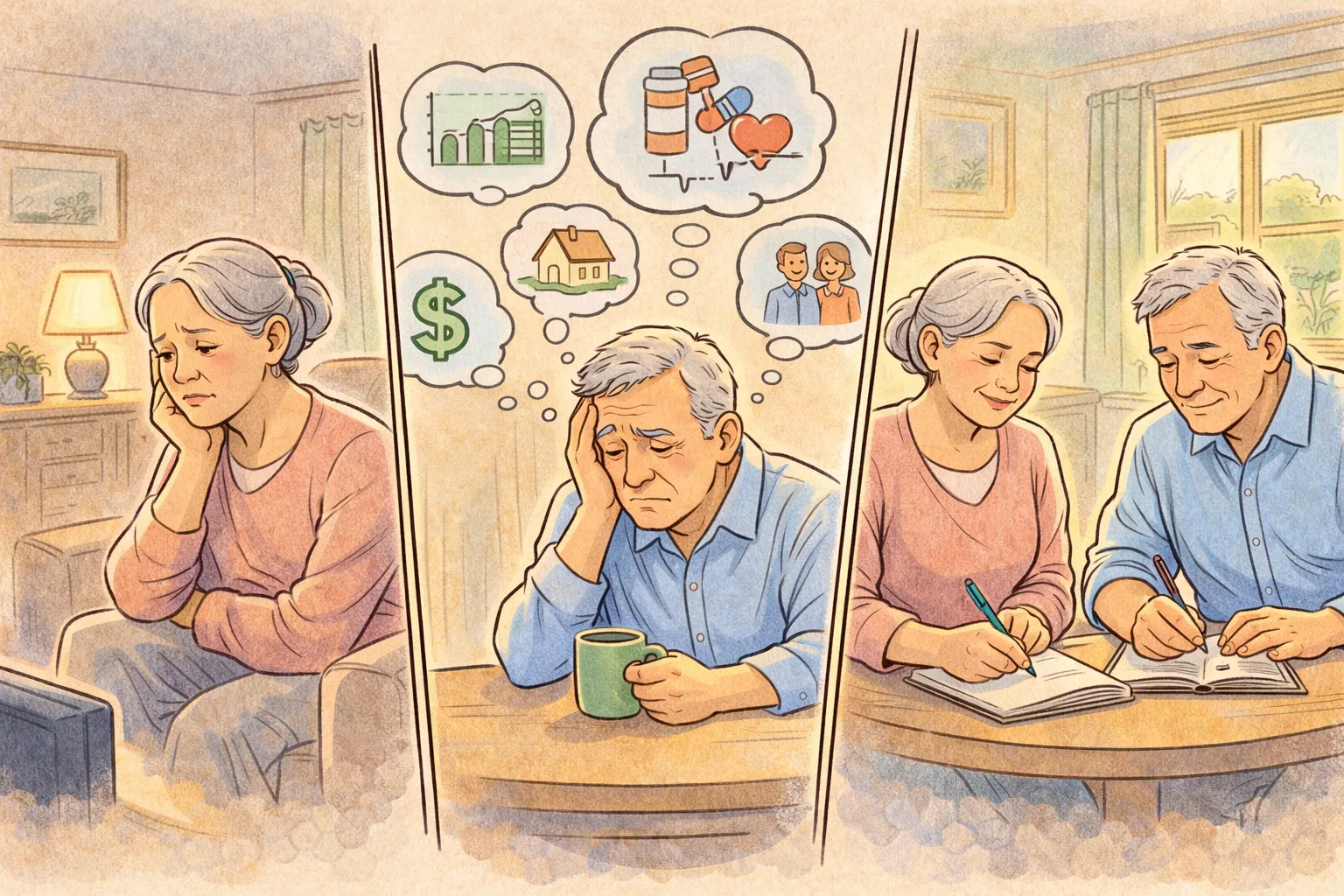
Panoramic comic-style illustration showing seniors experiencing quiet stress with thought bubbles versus finding calm through writing and reflection
“I’m not overwhelmed… but I don’t feel fully at ease either.”
This is a kind of stress many retirees experience.
It’s not loud.
It doesn’t feel urgent.
It doesn’t look serious from the outside.
But it’s there.
Every day.
In small ways.
1. What “quiet stress” really means
Quiet stress is not obvious pressure.
It’s not deadlines. Not emergencies. Not visible problems.
It’s a background feeling.
Something like:
low-level tension
subtle unease
constant thinking
mild restlessness
It’s easy to ignore.
But hard to fully relax with.
2. Why it shows up after retirement
Retirement removes obvious stress.
But it also removes structure.
That creates space.
And in that space, small thoughts grow.
Things like:
“Am I doing enough?”
“Is this how my days should feel?”
“What happens later?”
These are not urgent questions.
But they don’t disappear.
3. It’s not one problem—it’s many small ones
Quiet stress is rarely caused by one big issue.
It usually comes from:
small uncertainties
unfinished thoughts
low-level decisions
subtle worries
Each one is manageable.
Together, they create mental weight.
4. The “always thinking” pattern
Many retirees notice this:
You are not busy…
But your mind is.
Thinking about:
health
money
family
future
small tasks
Not intensely.
Just constantly.
5. Why it’s easy to overlook
Quiet stress doesn’t interrupt your day.
You can still:
eat normally
sleep okay
go about your routine
That’s why it goes unnoticed.
But over time, it can lead to:
mental fatigue
low energy
reduced enjoyment
feeling slightly “off”
6. The emotional impact
Quiet stress often feels like:
you can’t fully relax
you’re slightly on edge
something is unresolved
your mind doesn’t fully settle
It’s subtle.
But persistent.
7. The hidden sources
Common sources include:
financial uncertainty
health awareness
family concerns
lack of daily structure
too much unplanned time
low social interaction
None of these alone feel overwhelming.
But together, they add up.
8. Why “doing more” doesn’t fix it
Many people try to fix this by:
staying busy
adding tasks
filling the day
But quiet stress is not about activity.
It’s about mental clarity.
9. A better way to reduce it
You don’t need a big solution.
You need small mental resets.
Try:
writing down lingering thoughts
limiting overthinking time
creating small daily anchors
having one clear plan for the day
talking things out
Clarity reduces pressure.
10. The “one clear thing” method
Each day, choose:
One thing that matters.
Not ten things.
Not a full list.
Just one.
This gives your mind:
direction
completion
relief
11. Real-life examples
Helen, 72:
“I wasn’t stressed… but I wasn’t relaxed either.”
She started writing down her thoughts each morning.
Her words:
“It cleared my head more than I expected.”
James, 69:
“I kept thinking about small things all day.”
He started choosing one daily focus.
That alone reduced his mental noise.
12. Signs you may have quiet stress
you feel slightly tense without a clear reason
your mind keeps running in the background
you struggle to fully relax
you feel mentally tired without doing much
you feel “off” but can’t explain why
If this feels familiar, you’re not alone.
Quick checklist
did I clear my thoughts today?
did I focus on one thing?
did I reduce mental clutter?
did I pause instead of overthinking?
Small changes matter.
The key insight
Not all stress is loud.
Some of it is quiet.
And quiet stress is often the one that stays the longest.
Conclusion
Retirement removes pressure.
But it doesn’t remove thinking.
And sometimes, thinking becomes the new source of stress.
The solution is not to fill your life with more activity.
It’s to create more mental clarity.
That’s what brings real calm.
Disclaimer
This content is for general educational purposes only and does not address individual psychological or medical conditions. If persistent anxiety, stress, or mood changes occur, consult a qualified pr
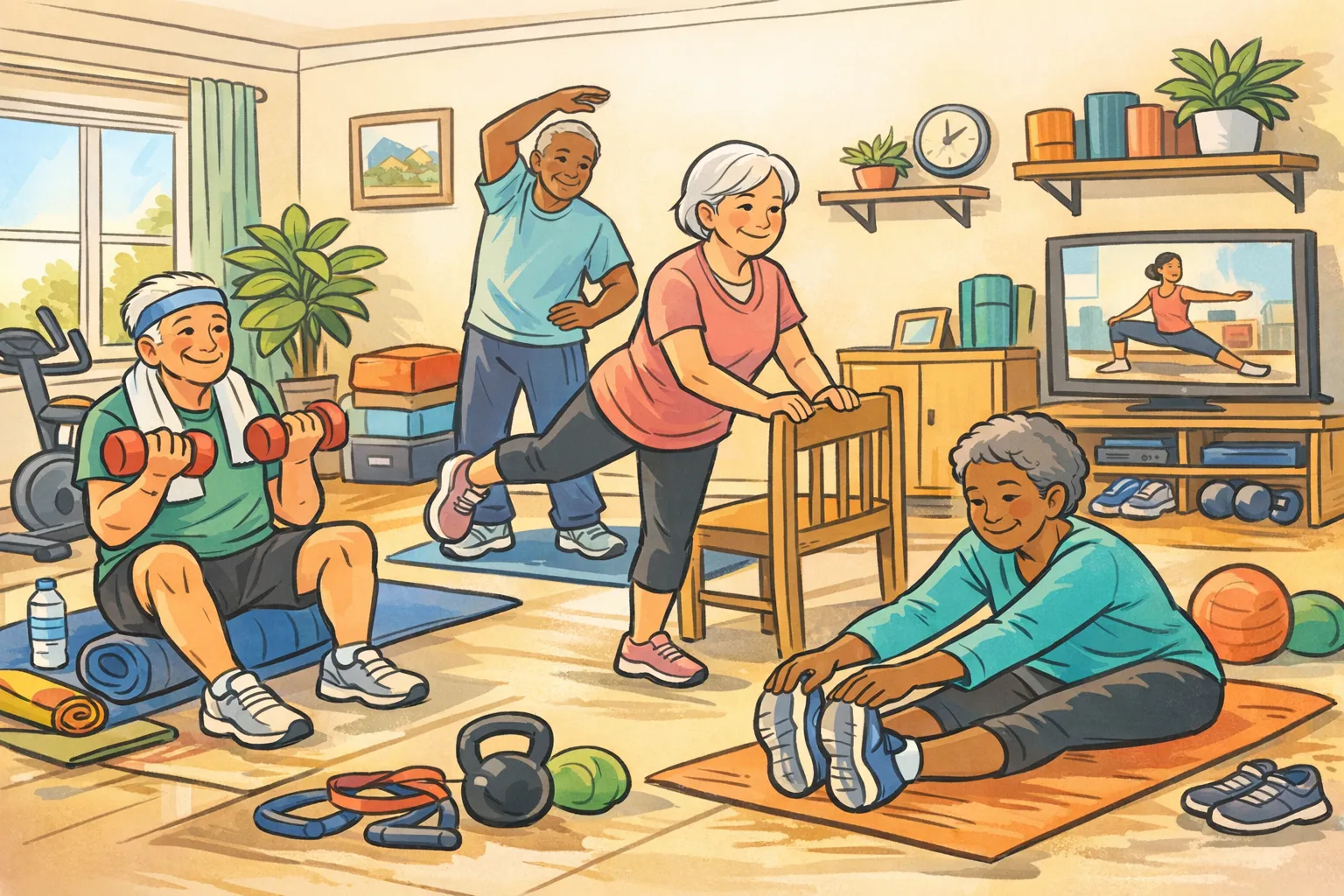
Home exercise progress for seniors works best when strength, balance, and gentle movement are built gradually enough to repeat without injury.
Cindy’s Column × Senior AI Money
A lot of home exercise plans fail for the same reason.
They start with enthusiasm and end with soreness, frustration, or a quietly abandoned routine.
One day you do too much because you feel motivated. The next day your knees complain, your back feels tight, or your energy drops. Then you “rest” for several days. Then restarting feels harder than beginning did.
That is why exercise progress after 55 is usually not a motivation problem.
It is a pacing problem.
For older adults, the real goal is not to crush a workout.
It is to build a routine your body can trust.
That matters because official healthy-aging guidance points in the same direction: older adults benefit from a mix of aerobic, muscle-strengthening, and balance activity, and regular movement supports thinking, independence, and fall prevention. CDC’s current guidance for older adults says adults 65+ should aim for at least 150 minutes of moderate aerobic activity each week, plus muscle-strengthening on at least 2 days and balance activities as part of weekly movement. NIA also emphasizes aerobic, strength, and balance work, while WHO recommends varied multicomponent activity that emphasizes functional balance and strength for older adults.
This guide is for adults 55+ who want home exercise to become steadier, safer, and more repeatable.
What progress really means at home
A lot of people define exercise progress too narrowly.
They think progress means:
more reps,
heavier weights,
longer walks,
harder routines,
more sweat,
more soreness.
Sometimes that is true.
But for many older adults, real progress looks like this:
you show up three times this week instead of once you stop needing three recovery days after each workout you finish feeling energized instead of defeated your balance feels steadier getting up from a chair you trust yourself to keep going next week
That counts.
In fact, it counts a lot.
Because the most valuable exercise plan is not the one that looks ambitious.
It is the one that survives ordinary life.
The consistency rule
Build the habit first. Build the challenge second.
That is the rule that keeps people from getting hurt.
A routine that is slightly too easy at first is usually much better than one that is slightly too hard.
NIA specifically notes that activity can be done through many kinds of movement, including structured exercise, chores, errands, walking, or leisure activity, and that older adults should include a combination of aerobic, muscle-strengthening, and balance work each week. NIA also notes that variety can make movement more enjoyable and may reduce overuse injury risk.
That means the best home exercise plan is not a punishment plan.
It is a repeat plan.
Part 1: Start with the three-part foundation
Home exercise goes better when you stop asking one routine to do everything.
A strong weekly plan for seniors usually includes three types of movement:
Aerobic work Walking in place, easy marching, indoor cycling, light stepping, short walking sessions
Strength work Chair stands, wall push-ups, resistance bands, light dumbbells, sit-to-stand practice
Balance work Heel-to-toe standing, one-leg support with a chair nearby, side stepping, standing from a chair with control
This matters because aging well is not only about endurance.
It is also about staying steady, strong, and independent.
NIA states that older adults benefit from aerobic, muscle-strengthening, and balance exercise, and its exercise materials note that balance training can help prevent falls and fall-related injuries. CDC’s older-adult guidance likewise includes aerobic, strength, and balance activity as part of the weekly recommendation.
If you are only walking, you may be missing strength and balance.
If you are only doing light weights, you may be missing endurance.
If you are only stretching, you may be missing enough challenge to build real function.
The answer is not more intensity.
It is better balance across the week.
Table 1. A simple home exercise structure for older adults
Exercise Type
Examples at Home
Main Benefit
Aerobic
Walking, indoor marching, step-touch, stationary bike
Supported single-leg practice, heel-to-toe, side steps
Helps stability and fall prevention
Mobility / flexibility
Gentle range of motion, calf stretch, shoulder circles
Helps movement feel easier
Recovery movement
Easy walk, light stretching, relaxed mobility
Helps you stay consistent
Part 2: Progress by adding small pieces, not giant jumps
One of the biggest injury mistakes is jumping too fast.
People often do this in one of three ways:
they suddenly double the time they add weight too fast they do the same movement too often because they think “more is better”
Usually, better progress looks smaller.
Examples of safe-feeling progress:
10 minutes becomes 12 1 set becomes 2 5 chair stands becomes 7 one balance drill becomes two short balance drills two workouts per week becomes three moderate sessions
That is enough.
Older adults often benefit more from slow, repeatable increases than from dramatic upgrades. CDC’s fall-prevention program materials note that building strength and balance takes time, and NIA’s exercise guidance emphasizes staying active regularly rather than treating exercise as a burst-and-crash effort.
A useful rule is this:
Change only one thing at a time.
Not all three.
So if you add time this week, keep the exercise selection the same.
If you add a little resistance, keep the number of sets stable.
If you add a third workout day, keep the sessions shorter.
That is how progress feels manageable instead of risky.
Part 3: Use the “finish feeling capable” test
A lot of home workouts are judged the wrong way.
People ask:
Did I do enough?
Was that hard enough?
Should I feel more sore?
A better question is:
How did I feel at the end?
For most seniors exercising at home, a good session should end with:
“I could probably do a little more, but stopping here feels smart.”
That is the sweet spot.
If you finish completely drained, your plan may be too aggressive.
If you regularly ache for days, the dose may be too high.
If you dread the next session, the routine may not be sustainable.
NIA’s exercise safety materials encourage older adults to listen to the body, use good form, and build activity in a way they can maintain. Its public guidance repeatedly frames movement as part of healthy aging, not as an all-out performance test.
That is why “finish feeling capable” is such a powerful rule.
It protects tomorrow, not just today.
Part 4: The week matters more than one workout
Many people think of exercise one workout at a time.
A better method is to think in weeks.
Why?
Because the body does not only respond to Tuesday.
It responds to the pattern of Monday through Sunday.
A smart home week for many older adults looks something like this:
2 strength sessions 3 to 5 moderate movement days 2 to 3 short balance sessions 1 or more easier recovery days
This does not mean every session has to be long.
In fact, short sessions often work better.
CDC’s older-adult activity guidance says the weekly goal can be spread across the week and that movement can be accumulated in realistic ways. NIA also emphasizes combining different activity types across the week, not relying on one single form of exercise.
So instead of trying to “make up for” missed exercise with one heroic session, build a week that feels believable.
Believable beats perfect.
Part 5: Pain, soreness, and warning signs are not the same thing
This is where a lot of older adults get confused.
Some exercise discomfort is normal.
Sharp or worsening pain is not.
Mild muscle fatigue after strength work can be expected.
Needing three days to recover every time is a clue something needs adjusting.
A little challenge is useful.
A pattern of flare-ups is not.
NIA’s guidance for exercise with aging and chronic conditions emphasizes adjusting activity to your body and health needs, and public-health guidance for older adults consistently encourages activity while also recognizing that chronic conditions, balance concerns, and other limitations may require modifications.
Practical red flags to respect:
pain that changes the way you move joint pain that gets worse during the session dizziness chest pain shortness of breath beyond expected effort swelling that seems unusual a “bad soreness” pattern that keeps returning
These are not signs to push harder.
They are signs to step back and reassess.
Part 6: The best progress often comes from boring repetition
This may be the least glamorous truth in exercise.
The things that help older adults most are often very ordinary:
chair stands supported balance practice light dumbbell work step-ups at a safe height walking band rows wall push-ups slow marching controlled sit-to-stand movements
These exercises may not look exciting.
But they transfer well to daily life.
They help you stand up, walk better, steady yourself, carry things, and keep confidence in your body.
NIA’s strength and balance guidance highlights exactly these kinds of basic, functional movements as important for healthy aging and fall prevention. WHO’s guidance for older adults similarly emphasizes multicomponent activity with functional balance and strength.
That means your home plan does not need novelty every week.
It needs usefulness.
Table 2. Common home exercise mistakes and better fixes
Common Mistake
What Usually Happens
Better Fix
Starting too hard
Soreness, skipped days, loss of confidence
Start shorter and lighter than your motivation wants
Doing only walking
Endurance improves but strength/balance lag
Add two strength days and short balance practice
Progressing everything at once
Fatigue or pain spikes
Change only one variable at a time
Exercising only when motivated
Inconsistent routine
Use a weekly structure instead of mood
Chasing soreness
Recovery gets harder
Judge success by steadiness and form
Repeating painful movements
Symptoms worsen
Modify, reduce, or stop and reassess
Part 7: Real examples
Elaine, 70
Elaine started a home routine with online videos and quickly did too much. She liked the feeling of “finally getting serious,” but her knees and hips disagreed. She switched to a simpler structure: walking indoors or outside on most days, chair stands twice a week, light dumbbell work twice a week, and short balance practice after brushing her teeth. Three months later, she was doing less per session than before, but much more across the month.
James, 74
James believed that if exercise was not hard, it was not working. So every home session turned into a test. He would do extra reps whenever he felt good, then disappear from exercise for four days. Once he started using the finish-feeling-capable rule, his routine stabilized. He kept each session moderate enough that he could repeat it. That changed everything.
Marsha, 66
Marsha already walked regularly but noticed she still felt unsteady stepping backward or getting up from low chairs. She added brief strength and balance work at home three times a week. Nothing dramatic happened in one week, but six weeks later she felt more confident moving around the house and handling ordinary tasks. Her progress came from targeted consistency, not intensity.
Part 8: A simple weekly model that actually works
Here is a realistic home model many older adults can adapt:
Monday Strength + short walk
Tuesday Easy movement or recovery walk
Wednesday Balance + light aerobic session
Thursday Recovery or mobility day
Friday Strength + short walk
Saturday Longer easy walk, dance, or active chores
Sunday Rest or gentle mobility
This is only a model.
The important part is the rhythm:
challenge,
recovery,
repeat.
Not every day needs to feel productive.
It needs to fit the whole week.
Checklist: Home Exercise Progress Without Injury
✔ Start with a weekly plan, not random workouts ✔ Include aerobic, strength, and balance work ✔ Begin slightly easier than your motivation wants ✔ Progress only one thing at a time ✔ Keep at least one recovery or lighter day in the week ✔ Use chair, wall, or counter support when needed ✔ Stop chasing soreness as proof ✔ Judge workouts by form and repeatability ✔ Keep sessions short enough to finish feeling capable ✔ Respect pain that changes the way you move ✔ Add balance work even if walking already feels fine ✔ Use simple, functional exercises you can repeat ✔ Build around your real energy, not your ideal self ✔ Track consistency first, intensity second ✔ Let steady weeks count as real progress
EEAT note
This article is educational guidance for older adults who want a safer, more repeatable home exercise routine. It does not claim that one routine prevents all injury or replaces individualized medical care. The strongest current public-health guidance supports a mix of aerobic, strengthening, and balance activity, with consistency and gradual progression playing a major role in healthy aging.
Final thought
The best home exercise plan is not the hardest one.
It is the one that keeps you moving next week.
And the week after that.
And the month after that.
Progress after 55 is often quieter than people expect.
Less drama. More rhythm. Less punishment. More trust.
That is how consistency gets built without injury.
Disclaimer
This article is for general educational purposes only and does not provide medical, physical therapy, rehabilitation, or fall-risk advice for any specific person. Exercise choices should reflect your health conditions, pain level, mobility, medications, balance, and medical history. Anyone with chest pain, dizziness, recent injury, worsening joint pain, falls, or significant changes in function should consult a qualified healthcare professional before changing exercise routines.
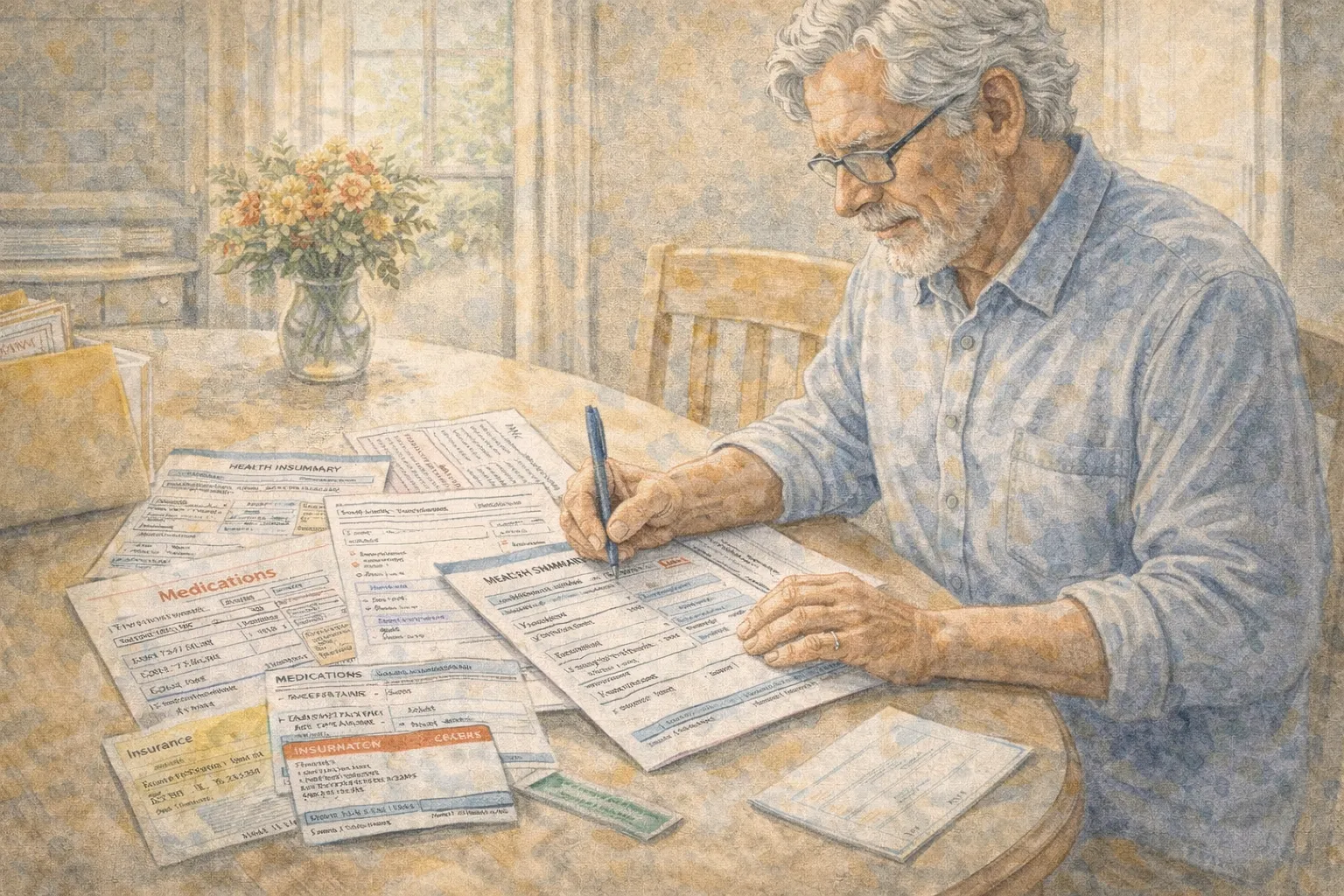
A simple one-page health summary helps seniors organize medical information and reduce stress during doctor visits or emergencies.
Cindy’s Column × Senior AI Money
Many adults over 55 keep important medical information in many different places.
Some documents are in drawers. Some are in folders. Some are on a phone or computer.
During a calm day this may not feel like a problem.
But during a stressful moment— a doctor visit, an emergency, or a sudden health question— finding the right information quickly can become difficult.
That is why many healthcare professionals recommend something simple:
A one-page health summary.
It is not complicated paperwork.
It is simply a clear snapshot of the most important medical information in one place.
Why medical paperwork becomes stressful after 55
Healthcare often becomes more complex with age.
Adults over 55 may manage:
multiple prescriptions
several healthcare providers
insurance information
past medical procedures
emergency contacts
Without a clear system, this information can become scattered.
A one-page summary helps bring calm and clarity.
The One-Page Health Summary Rule
If a doctor or family member needed key health information in one minute, it should all fit on one page.
This does not replace medical records.
It simply creates a quick reference document.
Table: Information to Include in a Health Summary
Category
Example Information
Basic details
Name, birthdate, blood type
Emergency contacts
Family member or trusted friend
Medications
Current prescriptions and doses
Allergies
Medication or food allergies
Doctors
Primary doctor and specialists
Insurance
Provider and policy number
This small summary can prevent confusion.
Part 1: Medication list
Medication errors are one of the most common healthcare issues for older adults.
Your summary should include:
medication name
dosage
frequency
prescribing doctor
Example:
Medication
Dose
Purpose
Lisinopril
10 mg daily
Blood pressure
Atorvastatin
20 mg nightly
Cholesterol
Keep the list updated.
Part 2: Emergency contacts
Include at least two contacts.
Examples:
adult child
close friend
neighbor
caregiver
This helps healthcare providers reach someone quickly if needed.
Part 3: Important medical history
You do not need to list everything.
Focus on key events such as:
surgeries
chronic conditions
major diagnoses
implanted devices
Clarity is more helpful than detail.
Table: Example One-Page Health Summary Layout
Section
Information
Personal Info
Name, birthdate
Emergency Contact
Name and phone
Medications
Name and dose
Allergies
Medication allergies
Doctors
Primary care contact
Insurance
Provider and ID
Keeping everything on one page improves accessibility.
Part 4: Where to store your summary
The goal is accessibility.
Consider placing copies:
in a medical folder at home
inside your wallet or bag
on the refrigerator (common for emergency responders)
shared with a trusted family member
Some seniors also keep a digital copy.
Part 5: When to update your summary
Review the document whenever:
medication changes
a new doctor is added
insurance updates occur
a medical condition changes
Many people review it every six months.
Real-life examples
Janet, 70
“My doctor asked for my medication list. Having it on one page made the appointment easier.”
Robert, 74
“When I visited urgent care, my summary helped them understand my medications quickly.”
Ellen, 67
“I shared my health summary with my daughter so she could help if something happened.”
Printable Health Summary Checklist
✔ basic personal details ✔ emergency contacts ✔ medication list ✔ allergies ✔ doctor contacts ✔ insurance information
Keep the document clear and easy to read.
The goal of a health summary
A one-page summary does not replace your medical records.
It simply creates calm organization during stressful moments.
Prepared information can make healthcare conversations smoother and safer.
Disclaimer
This article is for general educational purposes only and does not provide medical, legal, or insurance advice. Health conditions and documentation needs vary. Readers should consult healthcare providers or qualified professionals for guidance related to personal medical records or emergency preparedness.
Die richtige Krankenversicherung im Ruhestand: Vergleich, Kosten und strategische Entscheidungen für Ihre Gesundheitsversorgung Visual Art by Artani Paris | Pioneer in Luxury Brand Art since 2002
Die Wahl der Krankenversicherung im Ruhestand gehört zu den folgenreichsten Finanzentscheidungen für deutsche Rentner, da sie durchschnittlich 15-25% der Rentenbezüge beansprucht und die Gesundheitsversorgungsqualität direkt beeinflusst. 2026 stehen etwa 18,2 Millionen Rentner vor dieser Entscheidung: Verbleib in der gesetzlichen Krankenversicherung (GKV) mit einkommensabhängigen Beiträgen oder Fortsetzung der privaten Krankenversicherung (PKV) mit altersabhängigen Prämien. Untersuchungen des Bundesgesundheitsministeriums zeigen, dass 43% der Rentner ihre Krankenversicherungssituation nicht vollständig verstehen und dadurch jährlich 800-2.400 Euro durch suboptimale Entscheidungen verlieren. Die Komplexität entsteht durch Pflichtversicherungsgrenzen, Rückkehrrechte, Familienversicherungsmöglichkeiten, Zusatzbeitragssätze und die fundamentale Frage: Welches System bietet besseres Preis-Leistungs-Verhältnis im Alter? Dieser umfassende Leitfaden erklärt beide Systeme, ihre Vor- und Nachteile für Rentner, Kostenvergleiche bei verschiedenen Einkommensniveaus, Wechselmöglichkeiten und -beschränkungen, Strategien zur Beitragsoptimierung, sowie konkrete Entscheidungshilfen für Ihre individuelle Situation. Ob Sie kurz vor der Rente stehen, bereits Rentner sind, zwischen Systemen wählen können oder Ihre bestehende Versicherung optimieren möchten – dieser Leitfaden bietet das Wissen für fundierte Entscheidungen über Ihre Gesundheitsversorgung und Finanzen im Ruhestand.
Grundlagen: GKV und PKV im Rentneralter verstehen
Die gesetzliche Krankenversicherung (GKV) und private Krankenversicherung (PKV) funktionieren nach grundlegend verschiedenen Prinzipien, die im Rentenalter besondere Relevanz entfalten. GKV basiert auf Solidarprinzip und Umlageverfahren: Beiträge richten sich nach Einkommen (nicht Gesundheitszustand), und aktive Zahler finanzieren aktuelle Leistungen. PKV basiert auf Äquivalenzprinzip und Kapitaldeckung: Beiträge richten sich nach individuellem Risiko bei Eintritt, und Altersrückstellungen sollen Beitragssteigerungen im Alter dämpfen.
Für Rentner in der GKV gilt 2025: Der allgemeine Beitragssatz beträgt 14,6% plus kassenindividueller Zusatzbeitrag (durchschnittlich 1,7%, gesamt also 16,3%). Auf gesetzliche Rente zahlen Sie vollen Beitrag, wobei Rentenversicherung die Hälfte übernimmt (Sie zahlen 8,15% inklusive durchschnittlichem Zusatzbeitrag). Auf Betriebsrenten, private Renten und Kapitalerträge zahlen Sie vollen Beitragssatz ohne Arbeitgeberanteil (16,3%). Der Pflegeversicherungsbeitrag kommt hinzu: 3,4% für Kinderlose über 23, 3,05% für Eltern (halbe Übernahme durch Rentenversicherung bei gesetzlicher Rente).
Für Rentner in der PKV: Beiträge hängen ab von Eintrittsalter, Gesundheitszustand bei Eintritt, gewähltem Tarif und Selbstbehalt. Im Alter steigen Beiträge trotz Altersrückstellungen oft erheblich durch: medizinischen Fortschritt (neue teure Behandlungen), steigende Lebenserwartung (längere Leistungsdauer), und allgemeine Kostenentwicklung im Gesundheitswesen. Viele PKV-Versicherte erleben Beitragsverdopplungen zwischen 55 und 75 Jahren. Jedoch gibt es Beitragsentlastungen im Alter: Wegfall der gesetzlichen Krankentagegeldversicherung (entfällt mit Renteneintritt), und optional gebuchte Altersrückstellungstarife zur Beitragsstabilisierung.
Ein fundamentaler Unterschied: In der GKV sind Ehepartner und Kinder oft beitragsfrei mitversichert (Familienversicherung), wenn sie kein eigenes Einkommen über 520 Euro monatlich haben. In der PKV muss jedes Familienmitglied separat versichert werden, was für Familien erhebliche Mehrkosten bedeutet. Für Rentner-Ehepaare kann dies entscheidend sein: Verdient ein Partner deutlich weniger, ist beitragsfreie Mitversicherung in GKV wertvoll. In PKV zahlen beide volle Beiträge unabhängig vom Einkommen.
Leistungsunterschiede: GKV bietet gesetzlich definierte Regelversorgung – ausreichend, zweckmäßig, wirtschaftlich. Alle Kassen bieten praktisch identische Grundleistungen (99% Leistungsüberschneidung). PKV bietet vertraglich vereinbarte Leistungen, oft umfassender: Einbettzimmer, Chefarztbehandlung, innovative Behandlungen, kürzere Wartezeiten. Jedoch: Im Alter sind umfassende Leistungen weniger relevant als im Erwerbsleben – für Rentner zählt verlässliche Grundversorgung mehr als Komfortoptionen.
Wichtig für Rentner: In der GKV gibt es keine Gesundheitsprüfung bei Eintritt oder Rückkehr (wenn Voraussetzungen erfüllt), und keine Leistungsausschlüsse für Vorerkrankungen. In der PKV sind Vorerkrankungen bei Vertragsbeginn entweder ausgeschlossen oder mit Risikozuschlägen belegt. Da Rentner zwangsläufig mehr Vorerkrankungen haben als junge Menschen, ist dieser Aspekt kritisch: Neuabschluss einer PKV im Rentenalter ist praktisch unmöglich oder unbezahlbar teuer. Wer mit 65 von GKV zu PKV wechseln wollte, würde prohibitive Prämien zahlen oder Ablehnung erfahren.
Grundlegende Unterschiede zwischen gesetzlicher und privater Krankenversicherung für Rentner Visual Art by Artani Paris
Vergleichskriterium
Gesetzliche KV (GKV)
Private KV (PKV)
Relevanz für Rentner
Beitragsberechnung
Einkommensabhängig (16,3% durchschnittlich)
Risikoabhängig + Altersabhängig
GKV günstiger bei niedrigen Renten
Familienversicherung
Beitragsfrei für Ehepartner/Kinder
Jede Person separat versichert
GKV erheblicher Vorteil für Familien
Leistungsumfang
Gesetzlich definierte Regelversorgung
Vertraglich vereinbart, oft umfassender
Grundversorgung meist ausreichend
Beitragsentwicklung
Stabil proportional zu Rentensteigerungen
Oft stark steigend im Alter (trotz Rückstellungen)
GKV berechenbarer für Budgetplanung
Gesundheitsprüfung
Keine (bei Rückkehrrecht)
Umfassend, Vorerkrankungen problematisch
GKV zugänglicher mit Alterserkrankungen
Wechselmöglichkeit
Zu PKV nur bis 55 und unter Bedingungen
Zu GKV nur unter strengen Voraussetzungen
Eingeschränkte Flexibilität im Alter
Kernunterschiede zwischen GKV und PKV mit Fokus auf Rentnerrelevanz (Stand: 2025)
Kostenvergleich: Wer zahlt in welchem System weniger?
Die entscheidende Frage für die meisten Rentner: In welchem System zahle ich weniger Beiträge bei vergleichbarer Versorgung? Die Antwort hängt kritisch von Ihrem Einkommensniveau, Familienstand und Gesundheitszustand ab. Pauschale Aussagen wie “PKV ist immer teurer im Alter” oder “GKV ist für alle Rentner günstiger” sind irreführend – die Realität ist differenziert und erfordert individuelle Berechnung.
Für Rentner mit niedriger gesetzlicher Rente (unter 1.500 Euro monatlich) ist GKV fast immer günstiger. Beispiel: Bei 1.200 Euro monatlicher gesetzlicher Rente zahlen Sie in GKV etwa 98 Euro monatlich (8,15% von 1.200 Euro, da Rentenversicherung die andere Hälfte trägt) plus etwa 18 Euro Pflegeversicherung, gesamt 116 Euro. In der PKV würden Sie als 65-jähriger Mann mit durchschnittlichem Gesundheitszustand mindestens 400-600 Euro monatlich zahlen, oft mehr. Der Unterschied von 300-500 Euro monatlich macht GKV eindeutig überlegen für Geringverdiener.
Für Rentner mit mittleren Einkommen (1.500-3.000 Euro) wird der Vergleich komplexer. Bei 2.200 Euro monatlicher Rente zahlen Sie in GKV etwa 179 Euro (8,15% von 2.200) plus 33 Euro Pflege, gesamt 212 Euro. Haben Sie zusätzlich Betriebsrente von 800 Euro, zahlen Sie darauf vollen Beitragssatz ohne Arbeitgeberanteil: 130 Euro (16,3% von 800), plus weitere 27 Euro Pflege. Gesamtbeitrag GKV: etwa 369 Euro monatlich. In PKV zahlen Sie altersabhängige Beiträge unabhängig vom Einkommen – bei guten Tarifen 450-650 Euro, bei teuren Tarifen oder Vorerkrankungen 700-900 Euro. Hier kann PKV günstiger oder teurer sein je nach spezifischem Tarif.
Für Rentner mit hohen Einkommen (über 3.000 Euro monatlich plus Kapitaleinkünfte) kann PKV günstiger werden. GKV-Beiträge steigen proportional bis zur Beitragsbemessungsgrenze (2025: 5.175 Euro monatlich). Bei Erreichen dieser Grenze zahlen Sie maximal etwa 842 Euro GKV-Beitrag plus 158 Euro Pflege, gesamt etwa 1.000 Euro monatlich. PKV-Beiträge hängen nicht vom Einkommen ab – ein gut verdienender Rentner zahlt den gleichen PKV-Beitrag wie bei mittlerem Einkommen (450-700 Euro bei guten Verträgen). Ab etwa 4.000-5.000 Euro Gesamteinkommen kann PKV günstiger sein, vorausgesetzt Sie haben einen kostenstabilen Tarif.
Familienversicherung verändert die Rechnung dramatisch: Hat Ihr Ehepartner kein eigenes Einkommen über 520 Euro monatlich, ist er in GKV beitragsfrei mitversichert – faktisch zahlen Sie für zwei Personen nur Ihren eigenen Beitrag. In PKV zahlt jeder Partner separat, verdoppelt also Kosten. Beispiel: Ehepaar, ein Partner 2.000 Euro Rente, anderer Partner keine eigene Rente. GKV: etwa 163 Euro monatlich für beide. PKV: je 500 Euro, gesamt 1.000 Euro für beide. Differenz: 837 Euro monatlich, über 10.000 Euro jährlich – ein gewaltiger finanzieller Unterschied zugunsten GKV.
Berücksichtigen Sie versteckte Kosten: In PKV können Selbstbehalte (oft 600-2.000 Euro jährlich) die nominalen Beiträge reduzieren, aber Sie tragen dieses Risiko selbst. Häufige Arztbesuche im Alter können diese Selbstbehalte schnell ausschöpfen. GKV hat gesetzlich begrenzte Zuzahlungen (maximal 2% des Bruttoeinkommens jährlich, 1% bei chronischen Erkrankungen), was bei niedrigen Renten nur 200-400 Euro jährlich bedeutet. In PKV können chronische Erkrankungen trotz Versicherung zu erheblichen Eigenkosten führen wenn Selbstbehalte hoch sind.
Beitragsentwicklung über Zeit: GKV-Beiträge steigen proportional zu Rentensteigerungen – etwa 1-3% jährlich entsprechend Rentenanpassungen. PKV-Beiträge steigen oft deutlich stärker: 4-8% jährlich sind nicht ungewöhnlich, in manchen Jahren auch zweistellig. Ein PKV-Beitrag von 500 Euro mit 65 Jahren kann bei 6% jährlicher Steigerung auf 896 Euro mit 75 Jahren steigen (79% Erhöhung), auf 1.606 Euro mit 85 Jahren. Diese exponentiellen Steigerungen belasten Rentner mit fixem Einkommen erheblich. GKV-Beiträge bleiben relativ stabil proportional zum Einkommen.
Nutzen Sie Online-Rechner für individuelle Berechnung: Websites der Krankenkassen, Verbraucherzentrale und unabhängige Vergleichsportale bieten Rechner, die Ihre spezifische Situation berücksichtigen. Eingabe von: aktuelles Alter, Rentenhöhe, zusätzliche Einkommen, Familienstand, aktueller PKV-Beitrag (falls vorhanden). Der Rechner vergleicht Kosten in beiden Systemen über verschiedene Zeiträume. Diese Simulationen offenbaren oft überraschende Ergebnisse – was kurzfristig günstiger erscheint, kann langfristig teurer werden und umgekehrt.
Berücksichtigen Sie nicht nur Kosten, sondern auch Leistungsqualität und Zugänglichkeit: PKV bietet oft kürzere Wartezeiten für Facharzttermine und bestimmte Behandlungen. Im Alter, wenn Gesundheitsprobleme häufiger werden, kann dies wertvoll sein. GKV hat gleiche Behandlungsqualität (gleiche Ärzte, gleiche Krankenhäuser), aber möglicherweise längere Wartezeiten für nicht-dringende Behandlungen. Wägen Sie ab: Rechtfertigt schnellerer Zugang höhere Kosten? Bei dringenden Behandlungen (Herzinfarkt, Krebs) gibt es keine Unterschiede – beide Systeme behandeln sofort und umfassend.
Realistische Beispielrechnung über 20 Jahre (65-85): Rentner mit 2.500 Euro monatlicher Gesamtrente. GKV: Start 265 Euro monatlich, mit 3% jährlicher Steigerung bei 85: 437 Euro, Durchschnitt über 20 Jahre etwa 340 Euro, Gesamtkosten etwa 81.600 Euro. PKV: Start 550 Euro, mit 6% jährlicher Steigerung bei 85: 1.538 Euro, Durchschnitt etwa 930 Euro, Gesamtkosten etwa 223.200 Euro. Differenz: 141.600 Euro über 20 Jahre – fast das Dreifache. Diese Rechnung zeigt: Für durchschnittliche Rentner ist GKV finanziell massiv überlegen, es sei denn PKV-Beiträge bleiben ungewöhnlich stabil.
Wechselmöglichkeiten und rechtliche Rahmenbedingungen
Die Möglichkeit zwischen GKV und PKV zu wechseln ist im Rentenalter stark eingeschränkt durch gesetzliche Regelungen zum Schutz des Solidarsystems. Diese Beschränkungen verhindern “Rosinenpickerei” – junge gesunde Menschen in PKV, im Alter zurück zu GKV – würden das GKV-System finanziell destabilisieren. Verständnis dieser Regeln ist essentiell, da falsche Annahmen über Wechselmöglichkeiten zu irreversiblen Fehlentscheidungen führen.
Rückkehr von PKV zu GKV ist nach Vollendung des 55. Lebensjahres praktisch ausgeschlossen, außer Sie werden versicherungspflichtig (z.B. durch Aufnahme sozialversicherungspflichtiger Beschäftigung über 520 Euro monatlich). Als Rentner ohne Erwerbstätigkeit haben Sie keine Möglichkeit mehr, von PKV zu GKV zu wechseln – diese Entscheidung ist endgültig. Dies ist fundamentaler Punkt: Wer mit 55 in PKV ist, bleibt lebenslang dort, unabhängig davon wie stark Beiträge steigen oder finanzielle Situation sich verschlechtert.
Vor dem 55. Lebensjahr ist Rückkehr zu GKV möglich durch: Aufnahme versicherungspflichtiger Beschäftigung (Einkommen unter Versicherungspflichtgrenze von 69.300 Euro jährlich in 2025), oder Arbeitslosigkeit mit ALG-Bezug. Nach 55 schließt sich dieses Fenster. Personen zwischen 50-55 mit PKV sollten diese Option sehr bewusst prüfen: Ist absehbar, dass PKV-Beiträge im Alter untragbar werden? Dann könnte strategische Rückkehr zu GKV vor 55 sinnvoll sein, auch wenn dies kurzfristig nachteilig erscheint. Nach 55 gibt es kein Zurück mehr.
Wechsel von GKV zu PKV im Rentenalter ist theoretisch möglich, praktisch aber unsinnig: Sie müssten Gesundheitsprüfung bestehen (mit 65+ und üblichen Alterserkrankungen praktisch unmöglich ohne massive Risikozuschläge oder Ausschlüsse), und Beiträge wären aufgrund Eintrittsalter prohibitiv hoch (1.500-3.000 Euro monatlich für 65-jährigen Neueinsteiger). Keine Versicherung will 65-jährige Neukunden – diese verursachen sofort hohe Kosten ohne jahrzehntelange Beitragszahlungen zur Kompensation. Faktisch: Wer als Rentner in GKV ist, bleibt dort.
Innerhalb der PKV können Sie Tarife wechseln: Zu günstigeren Tarifen Ihres Anbieters ohne erneute Gesundheitsprüfung (gesetzliches Recht seit 2009), oder zum Basistarif (äquivalent zu GKV-Leistungen, oft günstiger als Volltarife). Tarifwechsel innerhalb PKV ist wichtigste Optimierungsoption für Rentner mit steigenden Beiträgen. Standardtarif (für vor 2009 Versicherte) und Basistarif (ab 2009) bieten reduzierte Leistungen zu gedeckelten Beiträgen (maximal GKV-Höchstbeitrag). Diese “Nottarife” sind Auffangnetze für finanzielle Notlagen.
Die Krankenversicherung der Rentner (KVdR) ist eigene Versicherungsform innerhalb GKV für Rentner, die mindestens 90% der zweiten Hälfte ihres Erwerbslebens gesetzlich versichert waren (9/10-Regelung). KVdR bietet Vorteil, dass Rentenversicherung Arbeitgeberanteil übernimmt. Erfüllen Sie diese Voraussetzung nicht, werden Sie freiwillig versichert in GKV mit höheren Beiträgen (auf alle Einkünfte voller Beitragssatz ohne Arbeitgeberanteil). Die 9/10-Regelung betrifft oft PKV-Rückkehrer: Jahre in PKV zählen nicht als GKV-Zeiten, was Erfüllung der Voraussetzung verhindert.
Familienversicherung endet mit Renteneintritt falls Sie selbst Rente beziehen – dann werden Sie pflicht- oder freiwillig versichert je nach Vorversicherungszeiten. Jedoch kann Ihr Ehepartner in Ihrer GKV-Familienversicherung bleiben wenn dessen Einkommen unter 520 Euro monatlich liegt. In PKV gibt es keine Familienversicherung – jeder zahlt separat unabhängig von Familienstand. Rentner-Ehepaare in PKV können nicht zu gemeinsamer Versicherung wechseln; jeder bleibt in eigenem Vertrag.
Sonderfälle: Beamte haben besondere Regelungen durch Beihilfeanspruch (Staat übernimmt 50-70% der Krankheitskosten, PKV ergänzt Rest). Beamte im Ruhestand behalten Beihilfe und bleiben fast immer in PKV, da diese speziell auf Beihilfe-Ergänzung ausgerichtet ist. Für Beamte ist GKV meist nachteilig, da sie vollen Beitrag zahlen ohne Arbeitgeberanteil und ohne Beihilfe-Vorteil. Selbstständige Rentner (früher selbstständig, jetzt Rente) können oft zwischen GKV und PKV wählen wenn sie unter 55 sind – über 55 bleiben sie in bisherigem System.
Internationale Aspekte: EU-Bürger können Krankenversicherung in EU-Heimatland behalten auch bei Wohnsitz in Deutschland. Deutsche Rentner mit Wohnsitz in EU-Ausland behalten ihre deutsche Krankenversicherung (GKV oder PKV) und erhalten Behandlung im Wohnland durch bilaterale Abkommen. Jedoch: Bei Umzug in Nicht-EU-Länder (Schweiz, Thailand, USA etc.) kann GKV-Schutz entfallen oder eingeschränkt sein. PKV behält meist weltweiten Schutz, aber prüfen Sie Vertragsdetails bei Auswanderungsabsichten.
Praktische Empfehlung: Wenn Sie zwischen 50-55 sind, in PKV mit steigenden Beiträgen, und niedrige Renten erwarten, erwägen Sie Rückkehr zu GKV vor 55 solange noch möglich. Nach 55 gibt es keine Option mehr bei problematischer PKV-Beitragsentwicklung außer Wechsel zu günstigeren PKV-Tarifen (Basis- oder Standardtarif). Diese strategische Entscheidung erfordert vorausschauende Planung – warten Sie nicht bis finanzielle Not akut wird, dann ist es zu spät für Systemwechsel.
Wechseloptionen zwischen Krankenversicherungssystemen sind altersabhängig stark eingeschränkt Visual Art by Artani Paris
Optimierungsstrategien: Beiträge senken in beiden Systemen
Unabhängig davon, ob Sie in GKV oder PKV versichert sind, existieren Strategien zur Beitragsoptimierung, die jährlich hunderte bis tausende Euro einsparen können. Diese Optimierungen erfordern aktives Handeln – passive Hinnahme der Situation führt zu überhöhten Kosten. Die meisten Rentner nutzen Optimierungspotenziale nicht, weil sie ihre Optionen nicht kennen oder Aufwand scheuen. Jedoch ist Rendite der investierten Zeit außerordentlich hoch.
In der GKV: Kassenwechsel zu günstiger Krankenkasse mit niedrigem Zusatzbeitrag. Zusatzbeiträge variieren 2025 zwischen 0,9% und 2,7% – bei gleichem Grundleistungskatalog. Bei 2.000 Euro monatlicher Rente spart Wechsel von Kasse mit 2,0% Zusatzbeitrag zu Kasse mit 1,0% etwa 20 Euro monatlich, 240 Euro jährlich, über 10 Jahre 2.400 Euro. Kassenwechsel ist unkompliziert: Kündigungsfrist 2 Monate zum Monatsende nach 12 Monaten Mitgliedschaft. Neue Kasse übernimmt Formalitäten. Prüfen Sie jährlich die Zusatzbeitragssätze und wechseln Sie bei Erhöhung oder besseren Alternativen.
Nutzen Sie Wahltarife und Bonusprogramme in GKV: Manche Kassen bieten Wahltarife mit Selbstbehalt (Sie tragen erste 200-1.000 Euro jährlich selbst) gegen Beitragsrückerstattung. Für gesunde Rentner mit geringen Gesundheitskosten kann dies lohnend sein. Bonusprogramme belohnen gesundheitsbewusstes Verhalten (Vorsorgeuntersuchungen, Sport, Nichtrauchen) mit Bonuszahlungen 50-250 Euro jährlich. Prüfen Sie Ihr Nutzungsverhalten: Bei jährlichen Gesundheitskosten unter 200 Euro lohnt Selbstbehalt-Tarif; über 1.000 Euro lohnt er nicht.
Minimieren Sie beitragspflichtige Einkünfte in GKV wo legal möglich: Versorgungsbezüge (Betriebsrenten) sind voll beitragspflichtig. Kapitalerträge über Freibetrag (1.000 Euro jährlich für Alleinstehende) sind beitragspflichtig wenn Sie freiwillig versichert sind. Strategische Vermögensstrukturierung kann Beitragslast reduzieren: Vermögen in nicht-beitragspflichtige Formen überführen (z.B. Immobilien statt Kapitalanlagen), oder Erträge unter Freibeträgen halten. Achtung: Steuerliche und sozialversicherungsrechtliche Optimierung können konfligieren – Gesamtbetrachtung nötig.
In der PKV: Tarifwechsel zu günstigeren Tarifen Ihres Anbieters ohne Gesundheitsprüfung. Seit 2009 haben Sie gesetzliches Recht, alle zwei Jahre zu gleichwertigem oder niedrigerem Leistungsumfang zu wechseln unter Mitnahme Ihrer Altersrückstellungen. Viele PKV-Versicherte wissen dies nicht und bleiben in teuren Altvertragen. Fordern Sie bei Ihrem Versicherer Übersicht aller verfügbaren Tarife an. Oft können 20-40% Beitragsreduktion erreicht werden bei nur marginal reduzierten Leistungen (z.B. Wechsel von Zweibett- zu Mehrbettzimmer, Verzicht auf Chefarztgarantie die im Alter seltener relevant ist).
Erhöhen Sie Selbstbehalte in PKV wenn Sie finanzielle Reserven für Gesundheitskosten haben. Höherer Selbstbehalt (z.B. Erhöhung von 600 auf 1.500 Euro jährlich) reduziert Monatsbeiträge oft um 100-200 Euro. Bei guter Gesundheit und seltenem Arztbesuch zahlen Sie den Selbstbehalt nicht voll aus, sparen aber vollen Beitragsvorteil. Rechenbeispiel: 150 Euro monatliche Ersparnis (1.800 Euro jährlich) bei 900 Euro zusätzlichem Selbstbehalt = Nettoersparnis 900 Euro falls Sie gesund bleiben, Break-even bei Ausschöpfung halben Selbstbehalts. Bei chronischen Erkrankungen mit regelmäßigen Kosten ist diese Strategie unvorteilhaft.
Wechseln Sie zum Basistarif wenn Beiträge untragbar werden. Der Basistarif ist gesetzliche Auffangoption in PKV mit GKV-ähnlichen Leistungen zu gedeckelten Beiträgen (maximal GKV-Höchstbeitrag, bei Bedürftigkeit bis zu 50% Ermäßigung). Voraussetzungen: 55 Jahre alt, oder hilfebedürftig im Sinne SGB XII (Grundsicherung), oder PKV-Versichert mindestens 10 Jahre. Basistarif ist “Versicherung zweiter Klasse” in PKV – reduzierte Leistungen, aber für finanzielle Notlagen unverzichtbar. Nutzen Sie diese Option rechtzeitig statt sich zu verschulden für PKV-Beiträge.
Vermeiden Sie Beitragsschulden: Sowohl in GKV als auch PKV führen ausstehende Beiträge zu Mahngebühren, Säumniszuschlägen und im Extremfall zu Leistungseinschränkungen. PKV kann Leistungen auf Notfallversorgung beschränken bei längeren Beitragsrückständen. GKV kann Vollstreckungsmaßnahmen einleiten. Wenn Beitragszahlung schwierig wird, kontaktieren Sie umgehend Ihre Versicherung: Ratenzahlungen, Stundungen oder Tarifwechsel sind oft möglich, aber nur bei proaktiver Kommunikation. Ignorieren Sie Zahlungsprobleme nicht bis Schulden untragbar sind.
Nutzen Sie Härtefallregelungen bei nachweisbarer Bedürftigkeit: In GKV können Zuzahlungen bei chronischen Erkrankungen auf 1% der Bruttoeinnahmen begrenzt werden (statt 2%) mit Attest. In PKV existieren Notlagentarife und Beitragsermäßigungen für Bezieher von Grundsicherung oder mit Einkommen unter Grundsicherungsniveau. Diese Regelungen sind oft unbekannt, aber legal und vorgesehen für echte Notfälle. Scheuen Sie sich nicht, diese zu beantragen wenn Sie Voraussetzungen erfüllen – es ist kein “Sozialschmarotzen” sondern Nutzung vorgesehener Sicherheitsnetze.
Vergleichen Sie regelmäßig: Sowohl GKV-Zusatzbeiträge als auch PKV-Tarife ändern sich jährlich. Was letztes Jahr optimal war, kann dieses Jahr suboptimal sein. Investieren Sie jährlich 2-3 Stunden in Vergleich: GKV-Zusatzbeiträge aller Kassen, PKV-Tarife innerhalb Ihres Versicherers, mögliche Optimierungen. Nutzen Sie Online-Vergleichsportale oder lassen Sie sich von unabhängigen Versicherungsberatern (nicht Versicherungsvertretern!) beraten. Diese regelmäßige Überprüfung verhindert graduelles “Einschlafen” in teuren Verträgen während günstigere Optionen verfügbar wären.
Dokumentieren Sie Optimierungsmaßnahmen: Führen Sie Akte mit Vertragsunterlagen, Beitragsrechnungen, Korrespondenz und Optimierungsentscheidungen. Dies erleichtert zukünftige Überprüfungen und verhindert Wiederholung unnötiger Recherchen. Notieren Sie jährlich: aktueller Beitrag, durchgeführter Vergleich, Gründe für Verbleib oder Wechsel. Diese Dokumentation schützt auch bei Streitigkeiten mit Versicherungen – Sie können Entwicklung Ihrer Versicherungssituation nachweisen.
Optimierungsstrategie
Einsparpotenzial jährlich
Aufwand
Geeignet für
GKV: Kassenwechsel zu günstiger Kasse
200-400 €
Niedrig (2 Stunden)
Alle GKV-Versicherten
GKV: Wahltarif mit Selbstbehalt
100-300 €
Mittel (Risikoabwägung)
Gesunde mit geringen Kosten
GKV: Bonusprogramme nutzen
50-150 €
Mittel (Aktivitäten)
Gesundheitsbewusste
PKV: Tarifwechsel innerhalb Anbieter
1.200-4.800 €
Mittel (Beratung)
Alle PKV-Versicherten
PKV: Selbstbehalt erhöhen
900-1.800 €
Niedrig
Gesunde mit Rücklagen
PKV: Wechsel zu Basistarif
3.000-10.000 €
Niedrig
Bei finanzieller Not
Konkrete Optimierungsmaßnahmen mit Einsparpotenzial und Aufwand (2025 Durchschnittswerte)
Praktische Entscheidungshilfe: Welches System passt zu Ihnen?
Die “richtige” Krankenversicherung hängt von Ihrer individuellen Situation ab: Einkommen, Familienstand, Gesundheitszustand, Vermögenslage und persönlichen Prioritäten. Pauschale Empfehlungen sind irreführend – was für Ihren Nachbarn optimal ist, kann für Sie suboptimal sein. Dieser Entscheidungsbaum hilft Ihnen, systematisch die für Sie passende Option zu identifizieren.
Wenn Sie bereits GKV-versichert sind: Bleiben Sie in GKV. Wechsel zu PKV im Rentenalter ist praktisch unmöglich und wäre falls möglich prohibitiv teuer. Optimieren Sie stattdessen innerhalb GKV: Wählen Sie Kasse mit niedrigem Zusatzbeitrag, nutzen Sie Bonusprogramme, prüfen Sie Wahltarife. GKV bietet für die allermeisten Rentner besseres Preis-Leistungs-Verhältnis als PKV, besonders bei niedrigen bis mittleren Einkommen. Die Familienversicherungsoption allein ist für Ehepaare oft tausende Euro Vorteil jährlich gegenüber PKV.
Wenn Sie bereits PKV-versichert sind und unter 55 Jahre alt: Prüfen Sie sorgfältig, ob Rückkehr zu GKV vor 55 sinnvoll ist. Berechnen Sie Ihre voraussichtliche Rentenhöhe. Haben Sie hohe Rente (über 4.000 Euro monatlich), gute PKV-Tarife (unter 600 Euro Beitrag) und keine Familienversicherungsbedarf? Dann kann PKV vorteilhaft bleiben. Haben Sie niedrige erwartete Rente (unter 2.500 Euro), steigende PKV-Beiträge (über 700 Euro aktuell) oder benötigen Sie Familienversicherung? Dann erwägen Sie Rückkehr zu GKV solange noch möglich. Nach 55 gibt es kein Zurück mehr.
Wenn Sie bereits PKV-versichert sind und über 55 Jahre alt: Sie müssen in PKV bleiben, aber können optimieren. Fordern Sie Tarifvergleich von Ihrem Versicherer an. Wechseln Sie zu günstigerem Tarif mit akzeptablem Leistungsumfang. Wenn Beiträge trotzdem untragbar werden, nutzen Sie Basistarif. Planen Sie PKV-Beiträge in Ihre Rentenfinanzplanung ein – diese werden vermutlich erheblicher Kostenfaktor sein. Erwägen Sie Nebenverdienst im Ruhestand oder frühzeitigen Vermögensaufbau zur Deckung steigender PKV-Beiträge.
Für Beamte: Bleiben Sie in PKV aufgrund Beihilfe-Ergänzung. GKV wäre für Beamte nachteilig, da Sie vollen Beitrag zahlen ohne Arbeitgeberanteil und ohne Beihilfe-Koordination. PKV-Tarife für Beamte sind speziell auf Beihilfe-Ergänzung ausgerichtet (oft “50% Tarife”) und dadurch günstiger als Voll-Tarife. Ihre Gesamtkosten (Beihilfe-Eigenanteil plus PKV-Beitrag) sind meist niedriger als GKV-Beiträge. Optimieren Sie innerhalb PKV durch Tarifvergleiche und Anpassung an veränderte Beihilfesätze im Ruhestand.
Für Ehep aare mit großem Einkommensunterschied: GKV ist fast immer überlegen durch Familienversicherung. Verdient ein Partner deutlich mehr (gesetzliche Rente plus Betriebsrente), der andere wenig oder nichts (nur kleine gesetzliche Rente oder keine), ist der geringverdienende Partner in GKV beitragsfrei mitversichert. In PKV zahlt jeder separat unabhängig vom Einkommen. Diese Konstellation – häufig bei Ehepaaren wo ein Partner Hauptverdiener war und anderer Hausarbeit/Teilzeit machte – favorisiert GKV massiv. Differenz kann 6.000-12.000 Euro jährlich betragen.
Für Singles mit hohem Renteneinkommen: PKV kann konkurrenzfähig sein wenn Sie gute Tarife haben. Ab etwa 4.500-5.000 Euro monatlichem Gesamteinkommen zahlen Sie in GKV Höchstbeitrag (etwa 1.000 Euro monatlich). PKV-Beiträge hängen nicht vom Einkommen ab – sind sie deutlich unter 1.000 Euro (unter 800 Euro), kann PKV günstiger sein. Jedoch nur bei stabilen Tarifen – stark steigende Beiträge eliminieren diesen Vorteil schnell. Berechnen Sie nicht nur aktuelle Kosten, sondern projizieren Sie 10-20 Jahre voraus mit realistischen Beitragssteigerungsraten (5-7% jährlich für PKV, 2-3% für GKV).
Für Menschen mit chronischen Erkrankungen: GKV ist meist vorteilhafter. Zuzahlungsbegrenzung auf 1% des Einkommens bei chronischen Erkrankungen schützt vor hohen Eigenkosten. PKV kann trotz Vollversicherung zu erheblichen Eigenkosten führen wenn: Selbstbehalte hoch sind, bestimmte Behandlungen ausgeschlossen sind, oder neue Behandlungsmethoden nicht im Vertrag enthalten sind. GKV passt Leistungskatalog laufend an medizinischen Fortschritt an (gesetzlich verpflichtet), während PKV-Verträge statisch sind. Für chronisch Kranke ist GKV-Schutz meist umfassender und berechenbarer.
Nutzen Sie professionelle Beratung für Ihre Entscheidung: Die Verbraucherzentrale bietet unabhängige Versicherungsberatung (Kostenpunkt 100-200 Euro für umfassende Beratung). Unabhängige Versicherungsberater (nicht Versicherungsvertreter mit Verkaufsinteresse!) können Ihre Situation analysieren und Empfehlungen geben. Die Deutsche Rentenversicherung berät kostenlos zu Krankenversicherung im Ruhestand. Investieren Sie in diese Beratung – die Entscheidung betrifft 20-30 Jahre Ihres Lebens und tausende Euro jährlich. 200 Euro Beratungskosten sind minimal verglichen mit Folgekosten falscher Entscheidungen.
Überprüfen Sie Ihre Entscheidung nicht nur einmalig, sondern regelmäßig: Alle 3-5 Jahre sollten Sie Ihre Krankenversicherungssituation neu bewerten. Haben sich Ihre Umstände geändert (Verwitwung, Einkommensänderungen, Gesundheitszustand)? Gibt es neue Optimierungsoptionen (neue Tarife, geänderte Gesetzgebung)? Diese regelmäßige Überprüfung verhindert, dass Sie in suboptimalen Arrangements verharren während bessere Optionen verfügbar werden. Krankenversicherung ist kein “einmal entscheiden und vergessen” Thema – es erfordert aktives Management.
Reale Fälle: Rentner teilen ihre Krankenversicherungserfahrungen
Fall 1: Erfolgreiche Rückkehr zur GKV vor 55 – Düsseldorf, Nordrhein-Westfalen
Michael Schneider (heute 68 Jahre) – ehemaliger IT-Berater
Michael war ab 35 privat versichert aufgrund Selbstständigkeit und damals hohem Einkommen (PKV-Beitrag: 380 Euro monatlich mit 35). Mit 52, nach Projektauslauf, nahm er befristete Anstellung unter Versicherungspflichtgrenze an (absichtlich!), um vor 55 zurück zu GKV zu wechseln. Grund: Seine Frau hatte nie gearbeitet, seine drei Kinder waren noch nicht selbstständig – in PKV zahlte er für fünf Personen (5 x 450 Euro = 2.250 Euro monatlich mit 52 Jahren). Er erkannte, dass dies im Ruhestand untragbar würde bei erwarteter Rente von 2.400 Euro.
Durch die Anstellung unter Pflichtgrenze wurde er und seine Familie pflichtversichert in GKV. Nach einem Jahr kehrte er zu Selbstständigkeit zurück, blieb aber freiwillig in GKV. Mit 67 in Rente: GKV-Beitrag etwa 265 Euro monatlich (auf 2.400 Euro Rente), seine Frau beitragsfrei familienversichert. Wäre er in PKV geblieben: geschätzte 2 x 950 Euro = 1.900 Euro monatlich für beide mit 67 (basierend auf Beitragsentwicklung seiner alten PKV laut Freunden).
Ergebnis nach 15 Jahren Rente (68-83):
Monatliche Ersparnis: etwa 1.635 Euro (1.900 PKV minus 265 GKV)
Jährliche Ersparnis: etwa 19.620 Euro
Gesamtersparnis über 15 Jahre: etwa 294.300 Euro
Michael: “Die strategische Rückkehr war beste finanzielle Entscheidung meines Lebens”
“Freunde haben mich für verrückt erklärt: PKV mit guten Leistungen aufgeben für GKV-Regelversorgung? Aber ich rechnete durch: Mit fünf Personen in PKV, steigenden Beiträgen und überschaubarer Rente wäre ich mit 70 pleite gewesen. Die GKV ist nicht perfekt, aber sie ruiniert mich nicht finanziell. Und ehrlich: Die Behandlungsqualität ist praktisch identisch.” – Michael Schneider
Fall 2: Gefangen in PKV mit steigenden Beiträgen – Stuttgart, Baden-Württemberg
Helga Bauer (74 Jahre) – ehemalige Apothekerin
Helga war seit 30 Jahren privat versichert (Berufszugang ermöglichte PKV). Mit 60 betrug ihr Beitrag 520 Euro monatlich. Sie ging mit 65 in Rente (2.100 Euro monatlich aus Apothekenkammer-Versorgungswerk). Über 55, konnte sie nicht mehr zu GKV wechseln. Ihre PKV-Beiträge stiegen dramatisch: mit 65: 720 Euro, mit 70: 985 Euro, mit 74: 1.285 Euro – trotz gleichbleibender Leistungen. Ihre Rente stieg nur auf 2.350 Euro. Von 2.350 Euro zahlte sie 1.285 Euro Krankenversicherung (55% der Rente!) plus 95 Euro Pflegeversicherung.
Helga hatte kein Sondervermögen – ihre Apotheke hatte sie mit Verlust verkaufen müssen. Mit 72 konnte sie Beiträge kaum noch zahlen. Ihre Versicherung bot Tarifwechsel an: Sie wechselte zum Standardtarif (äquivalent zu GKV-Leistungen) mit Beitrag von 835 Euro monatlich – immer noch 35% ihrer Rente, aber tragbarer. Sie bereut zutiefst, nicht vor 55 zu GKV gewechselt zu sein, als Kolleginnen sie dazu rieten. Damals schien PKV günstiger und besser.
Vergleich zu hypothetischer GKV:
Aktueller PKV-Standardtarif: 835 Euro monatlich
Hypothetischer GKV-Beitrag bei gleichem Einkommen: etwa 265 Euro monatlich
Monatlicher Mehraufwand PKV: 570 Euro, jährlich 6.840 Euro
Helga: “Ich hätte nie gedacht, dass PKV mich in finanzielle Bedrängnis bringen würde”
“Mit 30 war PKV toll – schnelle Termine, beste Behandlung, günstiger als GKV. Niemand sagte mir, dass Beiträge im Alter explodieren würden. Mit 74 zahle ich ein Vielfaches, für schlechtere Leistungen als damals (Standardtarif). Hätte ich mit 54 gewusst, was kommt, wäre ich sofort zu GKV zurück. Aber mit über 55 war ich gefangen. Warnung an alle jüngeren PKV-Versicherten: Überlegen Sie Rückkehr vor 55!” – Helga Bauer
Fall 3: GKV-Optimierung durch Kassenwechsel – Berlin
Klaus und Renate Fischer (beide 71 Jahre) – Ehepaar im Ruhestand
Klaus (ehemali ger Handwerksmeister, 2.200 Euro Rente) und Renate (Hausfrau, keine eigene Rente, familienversichert) waren seit 40 Jahren bei derselben Krankenkasse. Ihr Zusatzbeitrag stieg 2024 auf 2,5% – einer der höchsten deutschlandweit. Klaus zahlte etwa 408 Euro monatlich Krankenversicherung (18,1% von 2.200 Euro inkl. 2,5% Zusatzbeitrag), plus 74 Euro Pflege, gesamt 482 Euro. Renate war beitragsfrei.
Ihr Enkel, BWL-Student, zeigte ihnen 2024 einen Krankenkassenvergleich: Die günstigste überregionale Kasse hatte nur 1,0% Zusatzbeitrag bei identischem Leistungskatalog (gesetzlich vorgeschrieben). Klaus wechselte zur günstigeren Kasse. Neuer Beitrag: etwa 360 Euro monatlich (16,6% von 2.200 Euro), plus 74 Euro Pflege, gesamt 434 Euro. Ersparnis: 48 Euro monatlich, 576 Euro jährlich, ohne jegliche Leistungseinbußen.
Ergebnis nach 3 Jahren:
Gesamtersparnis: 1.728 Euro über 3 Jahre
Hochgerechnet auf 15 Jahre Restlebenserwartung: 8.640 Euro Ersparnis
Aufwand für Wechsel: 1 Stunde Recherche, 30 Minuten Antrag
Klaus: “Ich hätte nie gedacht, dass Krankenkassen so unterschiedlich teuer sein können”
“40 Jahre bei derselben Kasse – wir dachten, das wäre Loyalität. Unser Enkel öffnete uns die Augen: Alle Kassen bieten fast identische Leistungen, aber Zusatzbeiträge variieren enorm. Der Wechsel war völlig unkompliziert. Unsere alte Kasse hatte uns nie informiert, dass wir günstiger woanders versichert sein könnten. Jetzt wechseln wir alle zwei Jahre wenn nötig – diese falsche Loyalität kostete uns tausende Euro.” – Klaus Fischer
Häufig gestellte Fragen
Kann ich als Rentner noch von PKV zu GKV wechseln?
Nach Vollendung des 55. Lebensjahres ist Rückkehr zu GKV praktisch ausgeschlossen außer durch versicherungspflichtige Beschäftigung (sehr selten bei Rentnern). Vor 55 ist Rückkehr möglich durch Aufnahme versicherungspflichtiger Beschäftigung oder Arbeitslosigkeit. Als Rentner über 55 haben Sie keine Wechseloption mehr. Diese Entscheidung ist endgültig. Deshalb ist Planung vor 55 kritisch – danach sind Sie in PKV “gefangen” unabhängig von Beitragsentwicklung.
Was passiert mit meiner Krankenversicherung wenn ich ins Ausland ziehe?
Bei Wohnsitz in EU/EWR-Land: GKV-Schutz bleibt bestehen, Behandlung im Wohnland durch bilaterale Abkommen. PKV behält Schutz je nach Vertragsbedingungen. Bei Wohnsitz in Nicht-EU-Land (USA, Thailand, Schweiz etc.): GKV-Leistung kann entfallen oder eingeschränkt sein, Sie müssen möglicherweise lokale Versicherung abschließen. PKV bietet meist weltweiten Schutz, aber prüfen Sie Vertragsdetails. Bei Auswanderungsabsichten unbedingt vor Umzug klären – nachträgliche Versicherung im Ausland kann schwierig oder teuer sein.
Lohnt sich private Zusatzversicherung in der GKV?
Für Rentner oft fraglich. Zusatzversicherungen (Zahnersatz, Einbettzimmer, Heilpraktiker) kosten 30-100 Euro monatlich. Fragen Sie: Nutze ich diese Leistungen wirklich? Zahnzusatzversicherung lohnt bei absehbarem Zahnersatzbedarf (Break-even nach 3-5 Jahren Beitragszahlung). Einbettzimmer-Zusatzversicherung ist Komfortfrage – medizinisch nicht nötig. Für Rentner mit knappem Budget sind Zusatzversicherungen meist Luxus. Priorität hat Grundversorgung-Sicherstellung, nicht Komfortoptimierung. Berechnen Sie genau: Eingesparte Beiträge angespart für Selbstzahlung bei Bedarf oft günstiger als lebenslange Zusatzversicherung.
Was ist besser: Gesetzliche oder private Pflegeversicherung?
Bei Krankenversicherung in GKV sind Sie automatisch in sozialer Pflegeversicherung (3,4% für Kinderlose, 3,05% für Eltern). Bei PKV müssen Sie private Pflegepflichtversicherung abschließen (ähnliche Beiträge wie soziale Pflegeversicherung). Leistungen sind weitgehend identisch (gesetzlich vorgegeben seit 1995). Hauptunterschied: Soziale Pflegeversicherung ist einkommensabhängig, private ist festbeitrag. Bei niedrigem Einkommen ist soziale günstiger, bei hohem kann private günstiger sein. Zusätzlich können Sie private Pflegezusatzversicherungen abschließen (in beiden Systemen) für bessere Leistungen – aber Kosten-Nutzen prüfen.
Muss ich als Rentner weiter Krankenkassenbeiträge zahlen?
Ja, Krankenversicherungspflicht besteht lebenslang in Deutschland. Als Rentner zahlen Sie Beiträge auf Ihre Renten und andere Einkünfte. Bei gesetzlicher Rente übernimmt Rentenversicherung die Hälfte, bei Betriebsrenten, privaten Renten und Kapitaleinkünften zahlen Sie vollen Beitragssatz. In GKV gibt es Mindestbemessungsgrundlage (auch bei sehr niedriger Rente Mindestbeitrag), aber auch Beitragsbemessungsgrenze (Höchstbeitrag bei hohen Einkommen). In PKV zahlen Sie festgelegten Beitrag unabhängig von Rentenhöhe. Es gibt keine “Krankenversicherungsfreiheit” im Ruhestand.
Kann ich meine Kinder/Enkel in meiner Familienversicherung mitversichern?
In GKV: Kinder bis 18 (bzw. 23 bei Schule/Ausbildung, 25 bei Studium) sind beitragsfrei familienversichert wenn Einkommen unter 520 Euro monatlich. Enkel nur wenn Sie sorgeberechtigt sind (sehr selten). In PKV gibt es keine Familienversicherung – jedes Familienmitglied benötigt eigenen Vertrag. Erwachsene Kinder können nicht mehr familienversichert werden (auch nicht arbeitslose). Verheiratete Kinder sind über eigenen oder Ehepartner-Vertrag versichert. Familienversicherung ist einer der größten GKV-Vorteile – spart tausende Euro jährlich verglichen mit PKV-Individualverträgen für jedes Familienmitglied.
Was passiert wenn ich meine PKV-Beiträge nicht mehr zahlen kann?
Bei Zahlungsschwierigkeiten kontaktieren Sie sofort Ihren Versicherer: Tarifwechsel zu günstigerem Tarif, Ratenzahlung, oder Stundung können vereinbart werden. Längere Beitragsrückstände (über 3 Monate) führen zu Leistungseinschränkung auf Notfallversorgung. Bei nachweisbarer Hilfebedürftigkeit (Grundsicherungsbezug oder Einkommen darunter) haben Sie Anspruch auf Wechsel zum Basistarif mit reduzierten Beiträgen (bis 50% Ermäßigung). Vermeiden Sie Beitragsschulden – diese akkumulieren mit Säumniszuschlägen und Mahngebühren. Rechtzeitige Kommunikation mit Versicherer findet meist Lösungen.
Sind Vorsorgeuntersuchungen in GKV und PKV gleich?
GKV bietet gesetzlich definierte Vorsorgeuntersuchungen ab 35: alle 2 Jahre Gesundheits-Check-up, Hautkrebs-Screening, bei Frauen Mammographie-Screening, bei Männern Prostatakrebs-Früherkennung, Darmkrebs-Screening ab 50. PKV-Verträge enthalten meist umfassendere Vorsorgeleistungen, aber konkrete Leistungen sind vertragsabhängig. Praktisch: GKV-Vorsorgeangebot ist medizinisch ausreichend für frühzeitige Erkennung wichtiger Erkrankungen. PKV-Mehrleistungen (jährlich statt zweijährlich, mehr Tests) sind medizinisch oft nicht notwendig. Für Rentner ist das GKV-Vorsorgeangebot vollkommen adäquat.
Kann ich im Krankenhaus zwischen GKV- und PKV-Ärzten wählen?
Nein, diese Vorstellung ist Mythos. In Deutschland behandeln die gleichen Ärzte GKV- und PKV-Patienten. Unterschied: PKV-Versicherte mit Wahlarzt-Tarif können Chefarztbehandlung wählen (dieser erhält Zusatzhonorierung), und Unterbringung in Ein- oder Zweibettzimmer wählen (Komfort, nicht medizinisch). Die medizinische Behandlungsqualität ist identisch – gleiche Ärzte, gleiche Standards, gleiche Geräte, gleiche Medikamente. GKV-Patienten auf Normalstationen erhalten medizinisch gleichwertige Versorgung wie PKV-Patienten auf Privatstationen. Der Unterschied ist Komfort (Zimmergröße, Service), nicht medizinische Qualität.
Was ist der Unterschied zwischen Standard- und Basistarif in PKV?
Beide sind Notfalltarife für PKV-Versicherte, die Vollversicherung nicht mehr zahlen können. Standardtarif: für vor 2009 privat Versicherte, Leistungen ähnlich GKV, Höchstbeitrag entspricht GKV-Höchstbeitrag. Basistarif: für ab 2009 privat Versicherte, ebenfalls GKV-ähnliche Leistungen, Höchstbeitrag GKV-Höchstbeitrag, bei Hilfebedürftigkeit bis 50% ermäßigt. Praktisch sehr ähnlich. Zugang: ab 55 Jahren oder bei nachweisbarer Hilfebedürftigkeit. Diese Tarife sind Sicherheitsnetz – reduzierte Leistungen, aber bezahlbar. Wechsel ist freiwillig, niemand wird gezwungen, aber bei finanzieller Not oft einzige Option außer Verschuldung.
Wie wirkt sich Heirat/Scheidung auf Krankenversicherung aus?
Heirat in GKV: Ehepartner ohne eigenes Einkommen über 520 Euro wird beitragsfrei familienversichert über versicherungspflichtigen Partner – erheblicher Vorteil. Heirat in PKV: keine Änderung, jeder bleibt in eigenem Vertrag. Scheidung in GKV: Familienversicherung endet, Ex-Partner muss sich selbst versichern (oft freiwillig in GKV, Beiträge nach eigenem Einkommen). Scheidung in PKV: keine Änderung, jeder hatte ohnehin eigenen Vertrag. Für Rentner-Paare mit großem Einkommensunterschied ist GKV-Familienversicherung extrem wertvoll – spart 300-700 Euro monatlich verglichen mit PKV wo beide separat versichert sein müssten. Dies sollte bei Heirats- und Versicherungsentscheidungen berücksichtigt werden.
Handlungsschritte: Optimieren Sie Ihre Krankenversicherung jetzt
Bestandsaufnahme: Dokumentieren Sie Ihre aktuelle Versicherungssituation vollständig – Sammeln Sie: aktuelle Versicherungspolice, letzte Beitragsrechnung, Leistungskatalog, Vertragsunterlagen. In GKV: Welche Kasse, welcher Zusatzbeitrag, sind Sie pflicht- oder freiwillig versichert, ist Ehepartner familienversichert? In PKV: Welcher Tarif, aktueller Beitrag, Selbstbehalt, Leistungsumfang, Beitragsentwicklung letzte 5 Jahre? Diese Bestandsaufnahme ist Grundlage für alle Optimierungen. Ohne vollständige Kenntnis Ihrer Situation können Sie nicht beurteilen, ob Änderungen sinnvoll sind. Investieren Sie 2-3 Stunden in diese Dokumentation.
Berechnen Sie Ihre voraussichtlichen Alterseinkünfte und Krankenversicherungskosten – Listen Sie alle Rentenquellen auf: gesetzliche Rente, Betriebsrenten, private Renten, Kapitalerträge, Mieteinnahmen. Berechnen Sie GKV-Beiträge auf diese Einkünfte (Online-Rechner der Deutschen Rentenversicherung nutzen). Wenn Sie in PKV sind, projektieren Sie Beitragsentwicklung 10-20 Jahre voraus mit realistischen Steigerungsraten (5-7% jährlich). Diese Projektion offenbart oft, dass vermeintlich günstige aktuelle Situation in Zukunft problematisch wird. Zahlen lügen nicht – rechnen Sie ehrlich.
Prüfen Sie ob Sie Wechseloptionen haben und ob diese sinnvoll sind – Unter 55 und in PKV: Ist Rückkehr zu GKV möglich und vorteilhaft? Berechnen Sie Kosten beider Systeme über Restlebenszeit. Über 55 in PKV: Keine Wechseloption zu GKV, aber Tarifwechsel innerhalb PKV möglich. In GKV: Kassenwechsel zu günstigerem Anbieter lohnend? Diese Prüfung erfordert Recherche und möglicherweise Beratung. Verschieben Sie diese Entscheidung nicht – besonders nicht wenn Sie sich 55 nähern. Fenster schließt sich unwiderruflich.
Nutzen Sie konkrete Optimierungsmaßnahmen in Ihrem System – In GKV: Wechseln Sie zu Kasse mit niedrigstem Zusatzbeitrag (Liste der Zusatzbeiträge auf GKV-Spitzenverband Website), prüfen Sie Bonusprogramme, erwägen Sie Wahltarif mit Selbstbehalt bei guter Gesundheit. In PKV: Fordern Sie Tarifvergleich von Ihrem Versicherer an, wechseln Sie zu günstigerem Tarif unter Mitnahme Altersrückstellungen, erhöhen Sie Selbstbehalt wenn Sie Rücklagen haben, erwägen Sie Basistarif bei finanzieller Not. Diese konkreten Schritte sparen oft 200-500 Euro monatlich.
Planen Sie Krankenversicherungskosten in Ihre Ruhestandsfinanzplanung ein – Krankenversicherung ist für Rentner oft zweitgrößter Ausgabenposten nach Wohnen (15-25% der Einkünfte). Behandeln Sie diese Kosten nicht als unveränderbar, sondern als optimierbaren Budgetposten. Erstellen Sie Monats- und Jahresbudgets unter verschiedenen Szenarien. Was wenn PKV-Beiträge um weitere 50% steigen? Haben Sie Reserven? Müssen Sie Vermögen auflösen? Diese Planung verhindert finanzielle Notlagen im hohen Alter wenn Anpassungsfähigkeit eingeschränkt ist.
Lassen Sie sich professionell beraten bei komplexen Entscheidungen – Verbraucherzentrale bietet unabhängige Versicherungsberatung (100-200 Euro). Deutsche Rentenversicherung berät kostenlos zu Krankenversicherung im Ruhestand. Unabhängige Versicherungsberater können Gesamtsituation analysieren. Bei Entscheidung über Systemwechsel (PKV zu GKV vor 55) ist Beratungsinvestition minimal verglichen mit lebenslangen Konsequenzen. 200 Euro Beratung können 50.000-200.000 Euro Lebenszeit-Ersparnis bewirken. Sparen Sie nicht an falscher Stelle – fundierte Entscheidung ist unbezahlbar.
Haftungsausschluss Dieser Artikel dient ausschließlich Informationszwecken und stellt keine Rechts-, Versicherungs- oder Finanzberatung dar. Krankenversicherungsregelungen sind komplex und individuell. Für verbindliche Auskünfte zu Ihrer spezifischen Situation konsultieren Sie bitte Ihre Krankenkasse, einen Versicherungsberater oder die Deutsche Rentenversicherung. Alle Angaben wurden nach bestem Wissen erstellt, jedoch wird keine Gewähr für Vollständigkeit und Richtigkeit übernommen. Versicherungsentscheidungen sollten nur nach gründlicher persönlicher Beratung getroffen werden. Stand der Informationen: 02.10.2025. Gesetzliche Regelungen können sich ändern.
Kostenloser Gesundheitsvorsorge-Newsletter
Erhalten Sie monatlich aktuelle Informationen zu Krankenversicherung, Pflegeversicherung und Gesundheitsversorgung im Alter – kostenlos in Ihr Postfach.
A 2026 emergency folder system: quick info, calmer decisions, and privacy-first preparedness for adults 55+.
Cindy’s Column × Senior AI Money Practical, senior-friendly guides for a calmer, safer life.
Most “emergency planning” advice feels like it was written for people who have endless energy, perfect families, and a love of paperwork.
Real life is different.
Real life is: a confusing medical bill, a surprise ER visit, a winter storm, a lost wallet, a phone call that starts with “I’m sorry to bother you, but…”—and suddenly someone needs information you do have… but it’s scattered across drawers, emails, portals, and half-remembered passwords.
A 2026 Emergency Binder is not about fear. It’s about reducing chaos.
This guide shows you how to build a one-pocket emergency file that:
helps you get the right care faster
protects your money (fewer “we couldn’t find it” mistakes)
reduces family stress without handing over your privacy
keeps your life running if you’re sick, traveling, or tired
It’s designed for people who hate complicated systems. You can do a “good enough” version in 45–90 minutes.
What an Emergency Binder is (and what it is NOT)
It IS:
A simple, centralized set of pages that answers urgent questions quickly:
Who is this person’s doctor?
What medications do they take?
Who should we call?
Where is the insurance information?
What bills must be paid this month?
What should we do if they’re confused, dizzy, or can’t speak for themselves?
It is NOT:
a place to store every document you’ve ever owned
a binder full of originals you’re terrified to lose
a system that requires you to “maintain it weekly forever”
Think “one-pocket file with the essentials,” not “paper museum.”
Why this matters more after 55
Because the cost of confusion goes up with age.
When information is missing, people make expensive choices:
duplicate medical tests
missed medication details
late fees and stopped services
insurance claim confusion
family panic spending (overnight flights, last-minute care decisions)
A small binder prevents big messes.
The 2026 “Privacy-First” rule (so you don’t feel exposed)
You do not need to put every password in your binder.
You do not need to write sensitive account numbers in full.
Instead, use this rule:
Share access, not everything.
Your binder should make it possible for someone to help—without giving them your entire life.
A safe approach:
partial account identifiers (last 4 digits only)
“where to find it” instructions
official phone numbers
your preferred emergency contact plan
a separate sealed envelope for anything sensitive (optional)
What you need (simple supplies)
Pick one:
Option A: 1 sturdy folder with pockets
Option B: thin binder + plastic sleeves
Option C: accordion file (easy if you like sections)
Also:
15–25 sheets of paper
pen + highlighter
optional: one sealed envelope labeled “Open Only If Needed”
That’s it.
The 8-page Emergency Binder (the simplest version that still works)
If you only do these pages, you’re already ahead of most people.
Page 1: Emergency contacts + “who decides what”
This is the page paramedics, hospitals, and family need first.
Include:
Full name, DOB, address
Primary emergency contact + 2 backups
Your preferred hospital (if you have one)
Who has keys to your home
Who should be notified (and who should NOT be notified)
Table 1: Emergency Contact Page (copy this)
Item
Fill in
Full name + DOB
Address
Emergency contact #1
Name / relationship / phone
Backup contact #2
Name / relationship / phone
Backup contact #3
Name / relationship / phone
Preferred hospital/clinic
Home key holder
Name + phone
Pets (if any) plan
Who feeds / where supplies are
Notes
Hearing aids, mobility device, etc.
Small but powerful: add a note like “Please speak slowly; I wear hearing aids,” or “Dizziness risk—help me stand.”
Page 2: Medication list (including OTC and supplements)
This is one of the highest-impact pages.
Include:
medication name
dose
when you take it
what it’s for (short note)
pharmacy name + phone
Table 2: Medication & Pharmacy Page
Medication
Dose
When
Why
Notes
Pharmacy:
Name:
Phone:
Address (optional):
Page 3: Doctors + medical info snapshot
Keep it short. The goal is speed.
Include:
Primary care doctor
Key specialist(s)
Allergies
Major conditions (plain language)
Assistive devices used
Any implanted devices (pacemaker, etc.)
Page 4: Insurance + ID quick info (no over-sharing)
Include:
Medicare / supplemental / Advantage plan name (or private insurance)
Member ID (you can use partial + “card is in sleeve”)
Customer service phone number (official number on card)
Prescription coverage info (if separate)
Tip: Put photocopies of the front/back of insurance cards in a sleeve.
Page 5: “If I can’t speak for myself” preferences (simple version)
This is not a legal document. It’s guidance.
Include:
who should speak for you (and how to reach them)
a short sentence about your values (examples below)
where legal documents live (not necessarily in the binder)
Examples:
“Comfort matters to me. Please explain options clearly.”
“I want my daughter present for major decisions.”
“Please call my spouse before making changes.”
If you already have advance directives, you can note:
“Advance directive is in: top drawer / safe / attorney file / hospital file”
(And optionally include a copy.)
Page 6: Monthly bills that must be paid to keep life stable
This is the page that prevents late fees and service shutoffs.
Include only essentials:
housing payment
utilities
phone/internet
insurance premiums
credit card minimums (if any)
You do NOT need to list every subscription here.
Table 3: “Keep Life Running” Bills Page
Bill
Usual Amount
Due Window
How Paid
Where info is
Rent/mortgage/HOA
autopay / manual
folder / online portal
Electric/gas
Water/trash
Phone/internet
Insurance
Privacy tip: For “Where info is,” write things like:
“Bank bill-pay”
“Card on file”
“Portal bookmark on laptop” No passwords required.
Page 7: Home map + “where important things are”
This helps someone help you without tearing your house apart.
Include:
spare keys location (or who has them)
breaker box location
shut-off valves (water/gas)
where meds are stored
where pet supplies are stored
where you keep the folder (yes—label it!)
Page 8: The “24-hour plan” checklist
This is the page people follow when emotions are high.
Call clinic; write symptoms + start time; bring med list
Power outage / storm
Flashlight; water + meds; call check-in person
You’re traveling and get sick
Call travel contact; use medication list; find nearest urgent care
You’re confused/anxious
Sit, hydrate, call trusted person; avoid big decisions
Keep this page simple enough that anyone can follow it.
The “Sealed Envelope” option (for sensitive info)
If you want extra readiness, add an envelope labeled:
“Open Only If Needed”
What can go inside:
a list of where passwords are stored (example: “Password manager on phone, help contact #1 access”)
attorney contact info
safe combination (optional, only if you’re comfortable)
one spare house key (if safe in your home context)
This is optional. Many people skip it—and the binder still works.
How to set this up in one weekend (realistic pacing)
Day 1 (30–60 minutes): Build the core pages
Page 1 (contacts)
Page 2 (medications)
Page 4 (insurance cards)
Page 8 (24-hour plan)
That alone covers most emergencies.
Day 2 (20–45 minutes): Add stability pages
bills page
“where things are” page
doctor list page
Day 3 (10 minutes): Share the plan
Tell one trusted person:
where the binder lives
what it’s for
what you do and do not want shared
The conversation script (so it’s not awkward)
If you don’t want to make it dramatic, say:
“I made a small emergency folder so nobody has to scramble if I’m sick or traveling. It’s not about worry—it’s about convenience. If something happens, here’s where it is.”
That’s it. Calm. Adult. No fear speech required.
Common mistakes (and the fixes)
Mistake 1: Making it too big
Fix: keep only essentials. Add later if needed.
Mistake 2: Storing originals you’re afraid to lose
Fix: use copies. Keep originals elsewhere.
Mistake 3: Sharing too much
Fix: privacy-first rule + sealed envelope option.
Mistake 4: Not telling anyone the binder exists
Fix: tell one trusted person. One.
Mistake 5: Never updating it
Fix: update twice per year—January and July—like changing a smoke alarm battery habit.
Real-life examples (with realistic outcomes)
Example 1: “We avoided a medication mess” (Nora, 76)
Nora had an urgent clinic visit while traveling. Her daughter used Nora’s binder photo (med list page) to confirm medications quickly. Outcome: fewer questions, faster care, less stress. Not a miracle—just clarity at the right moment.
Example 2: “Bills didn’t fall apart while I was hospitalized” (Ray, 71)
Ray had a short hospitalization. His spouse used the bills page to confirm what needed to be paid and what was on autopay. Outcome: no late fees, no service shutoff anxiety, fewer frantic calls.
Example 3: “Privacy stayed intact” (Mei, 68)
Mei wanted preparedness but didn’t want to share passwords. She wrote “Where to find it” instructions and used a sealed envelope for one sensitive item. Outcome: family could help without full access to everything.
Printable-friendly master checklist (paste into your post)
Choose folder/binder and label it clearly
Page 1: Emergency contacts + key holder + pets plan
Page 2: Full medication list + pharmacy
Page 3: Doctors + allergies + key medical notes
Page 4: Insurance card copies + official phone numbers
Page 5: Simple preferences + where legal docs live
Page 6: Essential bills + due windows
Page 7: Home map + where important items are
Page 8: 24-hour plan checklist
Optional: sealed envelope for sensitive info
Tell one trusted person where it is
Put a reminder to review in 6 months
Disclaimer
This article is for general educational purposes only and does not provide medical, legal, or financial advice. Individual needs and circumstances vary. For medical decisions, consult qualified healthcare professionals. For legal planning (advance directives, powers of attorney, wills), consult a qualified attorney in your jurisdiction. Protect sensitive personal and financial information and use official contact channels for insurance and billing questions.
Choose three 2026 retirement hobbies that fit your energy, budget, and space—body, mind, and heart.
Cindy’s Column × Senior AI Money Practical, senior-friendly guides for a calmer, safer life.
Retirement is supposed to feel lighter. But many adults 55+ discover an unexpected problem: too much time can create pressure.
You finally have freedom… and suddenly you feel you should be doing something meaningful, productive, healthy, social, creative, and enriching—preferably all at once. Add online ads and “new hobby” trends, and it’s easy to end up with a closet full of supplies you don’t use and a quiet feeling of, “Why can’t I stick with anything?”
Here’s a calmer way to approach hobbies in 2026:
You don’t need ten hobbies.
You don’t need the “perfect” hobby.
You don’t need to buy your way into a new identity.
You need three interests that fit your real life—your energy, body, budget, space, and personality.
This guide will help you choose 3 hobbies that add joy without adding clutter, using a simple framework you can finish in one afternoon.
Why “3 hobbies” is the sweet spot (especially after 55)
Choosing “just one hobby” can feel like too much pressure. Choosing “all the hobbies” creates chaos.
Three works because it covers your needs without overloading you. Think of it as a balanced hobby “plate”:
A body hobby (keeps mobility and confidence)
A mind hobby (keeps curiosity and focus)
A heart hobby (keeps connection and meaning)
Not every hobby fits neatly into one category, but the structure prevents a common retirement trap: picking hobbies that look good on paper but don’t fit your day-to-day life.
The 2026 “No-Clutter Hobby Rule” (the one rule that saves most people)
Before you start, adopt this rule:
Rule: You don’t buy supplies until you do the “trial version” twice.
That’s it. Two tries.
Try #1 tells you if you feel curious.
Try #2 tells you if you’ll actually repeat it.
After two tries, you can decide if it deserves money and storage space.
This rule keeps hobbies from becoming expensive clutter projects.
Step 1: Pick your “energy truth” (the hobby must match your real body)
Many older adults quit hobbies because the hobby demands a version of them that only exists on a “good day.”
So begin with honesty. Circle one:
Green energy: I usually have steady energy most days.
Yellow energy: I’m up and down; pain/fatigue varies.
Red energy: I need gentle pacing; I tire easily.
Your hobby plan should still work on Yellow and Red days. That’s how it becomes sustainable.
Table 1: Matching hobbies to real energy levels
Energy Level
What works best
What often backfires
Green
Classes, longer sessions, projects
Too many commitments at once
Yellow
Short sessions, flexible schedules, “pause-friendly” hobbies
$25–$60/month: occasional class fees, craft supplies, club membership
$60–$120/month: regular classes, pool membership, special outings
The key is not the amount. The key is choosing it intentionally.
A helpful rule:
Spend money on repetition, not on fantasy. If you’ve done the hobby twice and want to keep going, it earns the budget.
Real-life examples (with realistic numbers)
Case 1: Diane, 66 — “I kept buying supplies, but I never started.”
Diane loved the idea of being “an art person.” Over two years she spent roughly $340 on watercolor sets, paper, and online courses—then felt guilty every time she saw the supplies.
In 2026 she tried the “try it twice” rule:
She did two 10-minute sketch sessions using a cheap notebook.
She discovered she enjoyed simple pencil sketching more than watercolor.
She kept one small art bin and set a $15/month joy budget for paper and pencils.
Result: more consistency, less guilt, and no expanding pile of unused supplies.
Case 2: Martin, 73 — “I needed connection, not more activities.”
Martin filled his week with errands and TV but still felt lonely. He chose a heart hobby:
a weekly community lunch group ($8–$12 each week)
a short volunteer shift twice a month
He said the biggest change wasn’t “being busy.” It was feeling known. His spending increased slightly, but his wellbeing improved enough that he called it “worth it.”
Case 3: Sandra, 79 — “My energy is unpredictable.”
Sandra has Yellow/Red energy days. She built a hobby stack that works even when she’s tired:
Body: 6-minute chair stretch routine
Mind: audiobook + simple puzzle book
Heart: one scheduled call every Sunday
Cost: mostly free/library-based. Result: hobbies that still exist when she’s not having a “perfect week.”
“What if I don’t know what I like anymore?”
This is more common than people admit.
After big life changes—retirement, caregiving, grief, relocation—your preferences can shift. You’re not broken. You’re updating.
Try these gentle discovery prompts:
What did I enjoy before life got busy?
What do I do that makes time pass faster?
What do I watch or read repeatedly?
What do I do after a hard day that actually helps?
Then test, not commit.
The retirement hobby traps (and how to avoid them)
Trap 1: Choosing hobbies to impress someone
If the hobby is more about identity than enjoyment, it won’t last.
Fix: choose hobbies that feel pleasant even if nobody sees them.
Trap 2: Choosing hobbies that require perfect health
If the hobby collapses the moment you have pain or fatigue, it’s fragile.
Fix: build a minimum version and a backup hobby.
Trap 3: Overbuying supplies
Shopping feels like progress. It’s not the same thing.
Fix: try it twice before buying.
Trap 4: Overcommitting socially
Too many obligations can create stress and resentment.
Fix: choose one heart hobby and keep it light.
A 2026 “Hobby Starter Menu” (easy trials you can do this week)
Pick any 3 and try each twice:
Body (choose one)
10-minute walk (or indoor mall walk)
chair stretch routine (5–10 minutes)
beginner tai chi video (10 minutes)
Mind (choose one)
library audiobook + 10 minutes listening
20-piece puzzle session
5-minute sketch of a mug/plant
Heart (choose one)
call one person you like (10 minutes)
attend one community event (even if you leave early)
join a low-pressure group once (book club, walking group)
You are not picking “the rest of your life.” You’re picking “this week’s experiments.”
Quick checklist (printable-friendly)
Circle your energy level (Green/Yellow/Red)
Choose 3-hobby stack (Body + Mind + Heart)
Apply the Try-It-Twice rule before buying supplies
Choose a one-container storage limit for hobby items
Define the minimum version of each hobby
Set a small monthly joy budget
Re-evaluate after 2 weeks: keep what repeats, drop what doesn’t
January Wellness Checklist for Seniors: a six-step visual guide to support your body, home, and mind.
A calm, practical way to support your health at the start of 2026
January is often treated like a fresh start — but for many seniors, it feels more like a recovery period.
Your body may still be tired from the holidays. Your routines may feel uneven. Your mood might be quieter, heavier, or simply slower than you expected.
That doesn’t mean something is wrong.
It means January is doing what it often does best: asking you to pay attention.
This January Wellness Checklist for Seniors is not about fixing yourself. It’s about supporting your body, home, and mind with small, realistic actions that make the rest of the year easier.
Who This January Wellness Checklist Is For
Adults 55+ who want a healthier start without extreme changes
Seniors managing energy limits, medications, or chronic conditions
Older adults living alone who want structure and reassurance
Anyone who wants wellness to feel calm, not demanding
How to Use This Checklist
You do not need to do everything.
Pick one or two items per week.
Each task is designed to take 5–20 minutes.
Stop when your body says stop.
Wellness that respects your limits is real wellness.
Part 1: Body Wellness (Gentle, Senior-Friendly)
Your body is your first home. January is the right time to check in — quietly, honestly, without judgment.
Body Wellness Checklist
Refresh your medication list Write down current medications, doses, and timing. Keep one copy in your wallet or bag.
Check refill timing Make sure you won’t run out during bad weather or holidays.
Schedule one health appointment Eye exam, hearing check, follow-up visit, or annual physical — just one.
Ask about winter vaccines Talk with your doctor or pharmacist about flu, COVID boosters, pneumonia, or RSV based on your age and health.
Notice hydration habits Cold weather reduces thirst. Aim to drink water regularly, even if you’re not thirsty.
Support joints and balance Gentle stretching, short walks, or chair exercises help prevent stiffness and falls.
Review sleep patterns Focus on consistent wake-up time rather than forcing early bedtime.
Check footwear Are your daily shoes supportive and non-slip? January is a good time to replace unsafe pairs.
Body Wellness Reminder
If you notice ongoing pain, dizziness, shortness of breath, low mood, or changes in appetite or sleep, talk to your doctor. January is not for “pushing through.” It’s for listening.
Part 2: Home Wellness (Safety, Comfort & Ease)
Your home should support you — not demand more effort than you can give.
January is ideal for small safety resets, especially in winter.
Home Wellness Checklist
Clear main walking paths Bed → bathroom → kitchen should be free of cords, rugs, boxes, or clutter.
Improve lighting Replace dim bulbs. Add night lights in hallways and bathrooms.
Test smoke & carbon monoxide detectors Replace batteries if needed.
Check heating safety Space heaters should be placed away from curtains and furniture and turned off before sleep.
Create a “warm corner” A chair, blanket, lamp, and small table for rest and comfort.
Prepare a small winter kit Flashlight, batteries, water, snack, emergency numbers, phone charger.
Review bathroom safety Non-slip mats, grab bars if needed, clear tub edges.
Simplify one surface Clear a counter, table, or nightstand so daily life feels calmer.
Home Wellness Reminder
You don’t need to renovate or reorganize everything. One safer, calmer area can change how your whole home feels.
Part 3: Mind & Emotional Wellness (Often Overlooked)
January can bring quiet — and with it, loneliness, reflection, or worry.
Mental wellness is not about “staying positive.” It’s about staying connected and supported.
Mind & Emotional Wellness Checklist
Choose one person to check in with regularly A weekly call or message can ground your week.
Limit news intake Try no news before breakfast or after dinner.
Create one daily calm ritual Tea, prayer, journaling, music, or sitting by the window.
Acknowledge post-holiday emotions Sadness, relief, emptiness, or gratitude — all are normal.
Write down 3 things you want less of this year Stress, clutter, rushing, noise — clarity matters.
Write down 3 things you want more of Rest, connection, simplicity, joy.
Notice mood changes If sadness, anxiety, or lack of interest lasts more than two weeks, tell your doctor.
Mental Wellness Reminder
You are not required to “feel excited” about a new year. Feeling steady is enough.
A Simple Weekly Wellness Rhythm for January
If you want structure without pressure:
Week 1: Body check-in (meds, sleep, hydration)
Week 2: Home safety & comfort
Week 3: Emotional & social reset
Week 4: Keep what works, release the rest
Wellness grows better when it’s spread out.
Common January Wellness Mistakes to Avoid
Trying to change diet, exercise, sleep, and mindset all at once
Ignoring pain or fatigue to “stay on track”
Comparing yourself to younger people or past versions of yourself
Treating wellness like a test you can fail
Your body and mind are not projects. They are partners.
30-Second Summary
January wellness for seniors is about support, not pressure
Focus on body, home, and mind — in that order
Small actions done consistently matter more than big plans
Safety and calm are forms of wellness
Listening to yourself is the healthiest habit of all
Editorial Disclaimer
This article provides general wellness and lifestyle information for older adults. It does not replace medical, mental health, or professional care advice. For questions about medications, chronic conditions, mental health, mobility, or safety, please consult your doctor or qualified health professional. If you experience sudden or severe symptoms, seek medical attention immediately.
A gentle, warm beginning to 2026 — one small, calm moment at a time.
A softer beginning for a year that doesn’t need to be perfect
Some years end loudly. Others end quietly. But almost every January begins the same way: with pressure.
Pressure to fix everything at once. Pressure to become someone new. Pressure to “catch up,” even when your body, heart, and life simply want a gentler start.
This January Reset is not a makeover or a challenge. It’s a warm, senior-friendly guide to making the first month of 2026 feel lighter — through small, 5–15 minute actions that protect your energy, your peace, and your home.
A reset doesn’t need to be big. It just needs to be kind.
A Soft Opening: Before You Begin
Before starting the 20 tasks, take a quiet moment and ask yourself:
What do I want less of in 2026?
What do I want more of?
How do I want my days to feel?
What did the last year teach me about my limits — and my strengths?
This is your emotional compass for the next 30 days. Keep it simple. Keep it close.
20 Simple January Reset Tasks (Calm, gentle, realistic)
Each task takes 5–20 minutes and does not require bending, lifting, or rushing. Pick one per day — or one per week. Your pace is the point.
1. Make a “January Table”
Clear one small surface — a table, a tray, or a corner — to be your January reset station. Add: a pen, notepad, glasses, charger, and any small thing that calms you.
2. Refresh Your Medications List
Write or print a simple medication list. Include dosage, timing, and pharmacy info. (Energy saver for future appointments.)
3. Replace One Night-Light Bulb
Winter mornings and nights are dimmer. One fresh bulb can prevent falls.
4. Clear the Pathway You Walk Most Often
From bed → bathroom → kitchen. Remove hazards: cords, boxes, small rugs, or shoes.
5. Organize Just One Drawer
Preferably a high drawer → no bending. Remove obvious trash, expired items, or duplicates.
6. Prepare a Mini Winter Kit
Place in an easy spot:
water bottle
small snack
flashlight
list of emergency contacts
charger
This alone can lower anxiety.
7. Choose One Relationship to Nurture in January
Call, text, or write to just one person. Connection is winter safety too.
8. Make a “5 Things I Want to Keep” List
Not objects — feelings, habits, or values you want in 2026. Short. Real. Yours.
9. Schedule One Health Appointment
Eye exam? Hearing check? Follow-up? Pick one. Just one. Your future self will love you for it.
10. Declutter One Paper Stack
Not the whole desk — just one stack. Recycle anything outdated. Keep only what supports your life today.
11. Create a Warm Corner
A blanket. A soft lamp. A chair or cushion. This becomes your “calm landing space” for hard days.
12. Wash or Replace Your Main Water Bottle
Hydration = better energy, balance, and mood. Small action, big return.
13. Set a Gentle Spending Boundary for January
Not a strict budget — a boundary. Example:
“Only one café drink per week.”
“No buying storage containers this month.”
“One treat, not five.”
This keeps finances calm without guilt.
14. Delete 20 Emails
Promos, spam, anything old. Feels cleaner in minutes.
15. Put One Kind Note on Your Fridge
Examples:
“You’ve survived harder days.”
“Go slowly — you’re not late.”
“Your pace is valid.”
This becomes your quiet cheerleader.
16. Choose Your January “Rest Day”
A weekly reset day: no errands, no guilt, no pressure. Only soft tasks — reading, stretching, warm drinks, family calls.
17. Refresh Your Bag or Wallet
Remove receipts, old papers, heavy or unnecessary items. Your shoulders and back will feel it immediately.
18. Tend to One Forgotten Space
The corner behind the door. The laundry basket top. The little table by the entrance. Bring it back to life.
19. Lighten Your Visual Load
Remove 2–3 decorations or objects that make a room feel “busy.” You’ll breathe easier with fewer visual demands.
20. End the Month with a “Small Wins List”
On January 31, write:
“Here are 5 small things I did that made life gentler.” Not achievements — moments that mattered.
This closes the month with grace, not pressure.
A Soft January Flow (Optional 1-Hour Reset)
If you want a guided reset:
10 minutes: clear your pathway
10 minutes: refresh your medications list
10 minutes: reset one drawer
15 minutes: organize one paper stack
15 minutes: choose your February priorities (max 3)
Done. You’ve just reset your month with zero overwhelm.
If January Feels Heavy
Sometimes winter brings loneliness, low mood, or a sense of “I can’t keep up.”
You are not failing — you are feeling. If heaviness lasts more than two weeks, please talk to your doctor. Winter depression is common and treatable, especially for older adults.
You deserve lightness, connection, and support.
30-Second Summary: January Reset 2026
One small action at a time is enough.
Choose tasks that reduce stress, not increase it.
Protect your path, your energy, and your heart.
January is not a race — it’s a landing.
A gentle year begins with a gentle month.
Editorial Disclaimer
This article offers general organization, emotional wellness, and lifestyle ideas for older adults. It is not medical, psychological, or emergency advice. For concerns about health, medications, mobility, depression, or safety, please speak with your doctor or care team. If you experience sudden weakness, chest pain, difficulty breathing, confusion, or thoughts of self-harm, seek emergency care immediately.
A gentle six-step visual guide showing how seniors can reset daily routines after the holidays without pressure or exhaustion.
A calm, realistic way to return to everyday life without exhaustion
After the holidays, many older adults feel a strange mix of relief and heaviness.
The visits are over. The decorations are coming down. The calendar suddenly looks empty again.
And yet, daily life doesn’t automatically fall back into place.
Sleep is off. Meals feel irregular. Energy comes and goes. Motivation feels quieter than it did before December.
If this sounds familiar, nothing is wrong with you.
Resetting daily routines after the holidays is especially important — and especially delicate — for seniors. This guide is designed to help you return to everyday rhythms slowly, safely, and without pressure.
Who This Guide Is For
Adults 55+ who feel “off schedule” after the holidays
Seniors who hosted, traveled, or had houseguests
Older adults living alone who feel the sudden quiet more strongly
Anyone who wants structure again — but not stress
Why Daily Routines Feel Harder After the Holidays
For seniors, the holidays disrupt more than just calendars.
They often affect:
Sleep patterns (late nights, early mornings, guests, travel)
Physical energy (too much stimulation, too little rest)
Emotional balance (company → quiet can feel abrupt)
Unlike when you were younger, your body may not “snap back” automatically.
That doesn’t mean you’ve lost resilience. It means your body is asking for gentler transitions.
The Golden Rule: Reset in Layers, Not All at Once
The biggest mistake seniors make after the holidays is trying to “fix everything” in one week.
Instead of resetting your entire life, focus on three layers, in this order:
Body rhythms
Home rhythms
Social rhythms
Everything else can wait.
Layer 1: Reset Your Body Rhythms First
Your body is the foundation of every routine. Without steady sleep, food, and movement, nothing else sticks.
1. Re-anchor Your Wake-Up Time (Not Your Bedtime)
Don’t force yourself to fall asleep earlier right away.
Instead:
Choose a gentle, consistent wake-up window (for example, between 7:00–7:30 a.m.)
Get up even if sleep wasn’t perfect
Let bedtime adjust naturally over 5–7 days
This is easier on older sleep cycles.
2. Create a “First 30 Minutes” Ritual
The first half hour of your day sets your nervous system.
Keep it simple:
light or lamp on
water or warm drink
medication if needed
one calm activity (music, stretching, prayer, journaling)
Avoid starting the day with news, email, or problem-solving.
3. Return Meals to Predictable Times
You don’t need perfect nutrition yet.
You need predictability.
Try:
breakfast within 1 hour of waking
lunch at roughly the same time daily
a lighter dinner 2–3 hours before bed
Your digestion and energy will stabilize faster than you expect.
Layer 2: Reset Your Home-Based Daily Routines
Once your body rhythms are steadier, turn to the home.
Not cleaning. Not organizing everything. Just daily flow.
4. Reclaim One “Everyday Surface”
Choose:
kitchen counter
small table
nightstand
Clear everything except daily-use items.
This becomes a visual anchor that says: “Life is returning to normal.”
5. Rebuild Your Morning–Evening Bookends
Holiday days often blur together.
Re-establish:
one morning signal (opening curtains, making tea, turning on a lamp)
one evening signal (washing mug, dimming lights, laying out tomorrow’s clothes)
These bookends help your brain shift gears again.
6. Choose One Small Household Task Per Day
Not a to-do list.
Just one task:
one load of laundry
one surface wipe
one trash bag out
Stop there. Consistency matters more than volume.
Layer 3: Reset Social and Mental Routines Gently
After the holidays, many seniors feel either:
overstimulated and tired of people, or
suddenly lonely.
Both are normal.
7. Choose “Connection Lite” Before Full Social Plans
Instead of big commitments:
one phone call
one short visit
one regular check-in text
Structure social contact without draining yourself.
8. Reset Your News and Media Intake
Holiday downtime often increases screen time.
Try:
no news before breakfast
no news after dinner
one set “check-in” time during the day
Mental calm is part of daily routine health.
9. Add One Purposeful Daily Activity
This is not about productivity.
It’s about meaning.
Examples:
watering plants
feeding birds
reading 10 pages
writing one paragraph
preparing one simple meal with care
Purpose steadies routine more than schedules alone.
A 7-Day Gentle Routine Reset Plan for Seniors
You don’t need to follow this perfectly.
It’s a suggestion, not a test.
Day 1–2
Set wake-up time
Restore regular meals
Day 3
Clear one daily surface
Add morning ritual
Day 4
Choose one daily household task
Reduce evening screen time
Day 5
Reconnect with one person
Adjust bedtime gently
Day 6
Add one purposeful activity
Review what feels better
Day 7
Rest
Keep what’s working
Let the rest go
Common Mistakes to Avoid
Trying to “catch up” on everything at once
Forcing early bedtimes before sleep is ready
Comparing your pace to younger people or past versions of yourself
Turning routines into rigid rules
A routine should support you — not control you.
If Routines Don’t Return Easily
If, after several weeks, you notice:
persistent low mood
loss of interest in daily life
major sleep disruption
appetite changes
Please talk with your doctor.
Post-holiday fatigue and winter blues are common among seniors — and treatable.
Asking for help is part of a healthy routine.
30-Second Summary
Reset daily routines in layers: body → home → social
Anchor wake-up time before bedtime
Use small rituals instead of strict schedules
Choose consistency over intensity
Let routines feel supportive, not demanding
After the holidays, your job is not to rush back into life. It’s to walk back in gently.
Editorial Disclaimer
This article provides general lifestyle and wellness information for older adults. It is not medical or mental health advice. If you have concerns about sleep, medications, depression, mobility, or health conditions, please consult your doctor or care provider.
You’ve been asked to give a speech at a family gathering, present at a community meeting, perform at a senior talent show, or lead a workshop. The opportunity excites you—but so does the knot in your stomach. Stage anxiety doesn’t discriminate by age, and many seniors face performance fear despite decades of life experience. The racing heart, sweaty palms, and voice trembling have nothing to do with your competence and everything to do with your nervous system’s response to perceived threat. This guide presents seven specific rehearsal protocols that some people have found helpful for managing performance anxiety. These aren’t generic “just relax” advice—they’re structured practices you can implement during preparation to potentially reduce anxiety when you step into the spotlight. Whether you’re speaking, performing, or presenting, these techniques offer practical approaches to transform nervous energy into focused preparation.
⚠️ Important Health & Mental Wellbeing Notice
This article provides educational information about managing performance anxiety through rehearsal techniques and does not constitute medical or mental health advice. Performance anxiety can range from mild nervousness to severe panic that may indicate an anxiety disorder requiring professional treatment. If your anxiety is severe, persistent, interferes significantly with daily life, or includes panic attacks, please consult a healthcare provider or mental health professional. The techniques described may help some people with mild to moderate performance anxiety but are not substitutes for professional treatment when needed. Individual responses vary widely—what helps one person may not help another or may even increase anxiety for some. Certain breathing techniques and physical exercises may not be appropriate for people with specific respiratory, cardiac, or other health conditions. If you’re taking medication for anxiety or other conditions, discuss these techniques with your healthcare provider before implementing them. Always prioritize your health and safety, and seek professional guidance if anxiety significantly impacts your wellbeing or if you’re unsure whether these techniques are appropriate for your situation.
Many seniors express surprise at experiencing stage anxiety: “I’m 70 years old—I should be past this by now!” But performance anxiety isn’t about lacking life experience or maturity. It’s a physiological response rooted in how your nervous system interprets situations where you’re being watched and evaluated.
What often happens physically during stage anxiety for many people:
The amygdala may perceive the performance situation as a potential threat
The sympathetic nervous system may activate (fight-or-flight response)
Stress hormones like adrenaline and cortisol may increase
Heart rate may increase, hands might shake, mouth may get dry
Blood flow may redirect to major muscle groups
Working memory may become temporarily less efficient (why you might forget your lines)
This response evolved to help humans survive actual physical threats—but your nervous system can’t always distinguish between facing a hungry predator and facing an expectant audience. Similar alarm responses may occur.
Important note: This is a simplified explanation of common anxiety patterns based on general neuroscience understanding. Individual physiological responses vary significantly. Some people experience different or additional symptoms. This explanation is for educational understanding, not medical diagnosis. If you’re concerned about your physical symptoms, consult a healthcare provider.
Why seniors may experience stage anxiety differently:
Some seniors report that performance anxiety feels more intense than when they were younger, while others report the opposite. Several factors might contribute to how you experience it now:
Higher stakes perception: “At my age, I should know better” thinking can increase pressure
Physical changes: Age-related changes in heart rate variability, medication effects, or other health factors may affect how anxiety manifests physically
Rustiness: If you haven’t performed publicly in years, the lack of recent experience can increase anxiety
Perfectionism: Decades of professional standards might make you more critical of your performance
Memory concerns: Worrying about age-related memory changes can become a self-fulfilling prophecy
The encouraging reality: Stage anxiety is manageable for many people. The rehearsal protocols below target specific aspects of the anxiety response, giving you practical tools to work with your nervous system rather than fighting against it.
Protocol 1: Progressive Exposure Rehearsal (The Gradual Audience Method)
The principle: Your anxiety response may calibrate based on repeated exposure. Practicing alone feels different than practicing with one person watching, which feels different than five people, which feels different than fifty. By gradually increasing your “audience” during rehearsals, you might help your nervous system adapt incrementally rather than facing the full anxiety all at once on performance day.
How to implement:
Week 1-2: Solo practice (Audience: 0) Practice your material alone until you know it well. Record yourself and watch the playback. This establishes baseline comfort with the content itself, separate from performance anxiety.
Week 3: Trusted person (Audience: 1) Perform for one person you trust completely—spouse, close friend, or adult child. Ask them to simply watch, not critique. You’re practicing being watched, not seeking feedback yet.
Week 4: Small group (Audience: 2-3) Perform for 2-3 people. This is where anxiety often spikes—you’re no longer in intimate one-on-one but not yet in “public performance” mode. Notice how it feels different. Do another run-through with this same group if possible.
Week 5: Medium group (Audience: 5-7) If your actual performance will have more than 10 people, practice with a slightly larger group. Invite friends, family, neighbors. This is your dress rehearsal. Notice that some anxiety remains—that’s normal and expected.
Performance day: You’ve now experienced being watched multiple times at increasing scales. Your nervous system has had opportunities to adjust. The actual performance will likely still trigger some anxiety, but potentially less than if you’d only practiced alone.
Important note: This protocol requires 4-5 weeks and willing helpers. Not everyone has these resources. If you have less time or fewer available people, even doing 2-3 steps of progressive exposure may help more than practicing alone exclusively. Some people find this progression helpful; others report that each audience feels equally anxious regardless of gradual exposure. Individual responses vary.
Protocol 2: Embodied Rehearsal (The Physical Memory Method)
The principle: Your body holds memory and patterns. By physically practicing not just your words but your breathing, posture, and movements in a calm state during rehearsal, you create physical patterns your body may potentially return to under stress. This approach draws on concepts from embodied cognition—the idea that your physical state can influence your mental and emotional state.
How to implement:
Step 1: Establish your power posture Before each rehearsal, spend 2 minutes in a confident physical position: feet shoulder-width apart, shoulders back but relaxed, hands at sides or clasped comfortably, chin level. Breathe slowly. Notice how this posture feels. This becomes your “anchor posture.”
Step 2: Rehearse in performance position Always practice standing (if you’ll be standing) or in the exact position you’ll use. Don’t rehearse sitting on your couch if you’ll be standing at a podium. Your body needs to practice the actual physical configuration.
Step 3: Link breathing to content Identify natural pause points in your material (end of paragraphs, between sections, before important points). At each pause point during rehearsal, take a slow, complete breath—in through nose for 4 counts, out through mouth for 6 counts. Do this every time you rehearse so it becomes automatic.
Step 4: Practice strategic movement If your performance space allows movement, plan 2-3 deliberate moves and practice them: walk to one side while making a particular point, gesture with your hands at specific moments, shift your weight purposefully. These planned movements give your nervous energy somewhere to go and provide structure that your body can remember.
Step 5: End rehearsal in calm After each practice session, return to your anchor posture for 2 minutes. Breathe slowly. Tell yourself “This is what it feels like to finish successfully.” You’re creating a physical-emotional memory of completion.
On performance day: Start with your anchor posture before you begin. Your body may recognize the physical pattern and activate some of the calm associated with rehearsal. Use your breath cues at the pause points you’ve practiced. Execute the movements you’ve practiced. Your body has done this before—now it’s doing it with an audience.
Reality check: This doesn’t eliminate anxiety. Your heart will still race, and hands might still shake. But some people report that having physical rituals they’ve practiced helps them feel slightly more grounded. Others find focusing on physical details increases their anxiety. Pay attention to your own response.
Health consideration: If you have cardiovascular conditions, respiratory issues, or other health concerns, consult your healthcare provider before using breathing techniques or physical exercises. What’s safe for one person may not be appropriate for another. The breathing pattern suggested (4-6 count) is gentle, but individual tolerances vary.
Visual Art by Artani Paris
Protocol 3: Worst-Case Scenario Rehearsal (The Anxiety Inoculation Method)
The principle: Much of stage anxiety comes from fear of “what if it goes wrong?” By deliberately practicing what to do when things go wrong, you might reduce the catastrophic thinking that can fuel anxiety. This approach draws on principles similar to exposure therapy, though it’s a simplified adaptation rather than clinical treatment.
How to implement:
Identify your specific worst-case scenarios:
“What if I forget my lines?”
“What if I start crying?”
“What if my voice shakes uncontrollably?”
“What if someone asks a question I can’t answer?”
“What if I need to use the bathroom mid-performance?”
Create recovery scripts for each scenario:
For forgetting: “I’ve lost my place for a moment. [Pause, breathe, look at notes if available] Let me continue with…” Practice saying this out loud during rehearsal. Actually forget on purpose, then use your recovery script.
For emotional overwhelm: “I need a moment. [Pause, take three breaths, take a sip of water] Thank you for your patience.” Practice this. Deliberately think of something emotional during rehearsal, notice the sensation, then use your script.
For voice shaking: “You might notice my voice trembling—I’m a bit nervous, and that’s okay. Let me continue.” Practice saying this with a shaky voice on purpose. Own it rather than hiding it.
For difficult questions: “That’s an excellent question, and I don’t have a complete answer right now. What I can tell you is…” Practice deflecting gracefully.
Actually rehearse the disasters: At least once, deliberately mess up during a rehearsal. Forget your lines on purpose. Make your voice shake intentionally. Then use your recovery script. This shows you that messing up isn’t fatal—there’s a path forward even when things go wrong.
Important consideration: For some people, rehearsing worst-case scenarios provides relief—”I know what I’ll do if that happens.” For others, it amplifies anxiety by making catastrophes feel more likely. Pay attention to whether this protocol helps or hurts. If practicing failures increases your worry, skip this protocol and use others instead.
Protocol 4: Overprepare-Then-Release (The Mastery-Flexibility Method)
The principle: Paradoxically, anxiety often decreases when you prepare so thoroughly that you can then give yourself permission to be imperfect. This protocol has two distinct phases that might seem contradictory but work together for some people.
Phase 1: Overprepare (Weeks 1-3)
Memorize beyond necessity: If you’re giving a speech, don’t just know your opening—know your opening so well you could recite it backwards. Know it so well that you’re slightly bored with it. This creates a foundation of certainty.
Practice until automatic: Rehearse until your mouth can say your opening paragraph while your mind thinks about your grocery list. You want the beginning so ingrained that your nervous system can run it even when your conscious mind is panicking.
Create multiple backup plans: Have your full script, an outline version, and index cards with just key points. Know your material in multiple formats so if one fails, you have others.
Phase 2: Release (Week 4)
Deliberately ad-lib: Once you’ve mastered the material, practice changing it. Deliberately rephrase sentences. Tell yourself “it doesn’t have to be perfect—it just has to be good enough.” Practice versions where you make small mistakes and keep going anyway.
Practice the “good enough” version: Run through your material in 75% of the time you’d planned, cutting what’s less essential. This shows you that even a shorter, imperfect version accomplishes your goal.
Why this might work for some people: The overprepare phase may provide confidence from mastery. The release phase may provide permission to be human. Together, they potentially create both security (“I know this thoroughly”) and flexibility (“I can adapt if needed”). However, this protocol requires significant time investment—4 weeks of regular practice. Not everyone has this time, and not everyone finds that overpreparing reduces anxiety. Some report it increases pressure to perform perfectly.
Protocol 5: Audience Reframe Rehearsal (The Perspective Shift Method)
Much stage anxiety stems from imagining the audience as critics waiting for you to fail. By systematically practicing alternative perspectives of your audience during rehearsal, you might change the threat perception that can trigger anxiety.
How to implement:
Rehearsal 1: Imagine they’re rooting for you While practicing, visualize each audience member as someone who genuinely wants you to succeed. See them with encouraging facial expressions, leaning forward with interest. Speak your material to these imagined supportive people. Notice how this changes your emotional state versus imagining critics.
Rehearsal 2: Imagine they’re distracted Next rehearsal, imagine the audience members are thinking about their own concerns—their grocery lists, their own anxieties, what they’ll have for dinner. They’re not deeply judging you; they’re half-present and mostly focused on themselves. Practice delivering your content to people who aren’t hyper-focused on evaluating you.
Rehearsal 3: Imagine they’re grateful Visualize audience members thinking “I’m glad someone else is doing this—I’d be terrified to be up there.” Practice speaking to people who are relieved they’re not in your position and appreciate that you’re willing to do what they can’t.
Rehearsal 4: Imagine one supportive face If you know someone supportive will be in the audience, practice the entire performance “speaking to” that one person. This narrows your focus from “everyone” to “one safe person.” Some performers use this technique by finding one friendly face in the actual audience and periodically returning to that person for grounding.
On performance day: Your rehearsals have created alternative narratives about who the audience is and what they’re thinking. You can consciously choose to adopt whichever perspective helps: “They’re rooting for me,” “They’re mostly thinking about themselves,” or “I’m speaking to that one supportive person.”
Reality check: This is cognitive reframing—changing the story you tell yourself. For some people, it genuinely shifts their emotional experience. For others, it feels like lying to themselves and doesn’t help. The audience’s actual attitudes vary—some are supportive, some are distracted, some are critical. This technique isn’t about truth; it’s about choosing a narrative that may help you function. Whether that’s helpful or feels dishonest varies by individual.
Protocol 6: Energy Channeling Rehearsal (The Transformation Method)
The principle: Anxiety and excitement create similar physiological states—racing heart, rapid breathing, heightened alertness. Some psychological studies have explored whether reinterpreting anxiety as excitement might help some people perform better, though results vary and more research is needed. This protocol practices that reinterpretation during rehearsal.
How to implement:
Recognize the physical similarity: During rehearsal, before you begin, do 20 jumping jacks or run in place for 30 seconds. Notice your physical state: elevated heart rate, faster breathing. Your body is activated—similar to anxiety. Now immediately begin your performance. You’re practicing performing while physically activated.
Practice the excitement script: When you notice anxiety symptoms during rehearsal, say out loud: “I’m excited. My body is getting me ready to perform well. This energy helps me.” Repeat this several times during different rehearsals. You’re attempting to create a new mental association with the physical sensations.
Channel the energy into performance: Rather than trying to calm down completely, practice using the activated energy. Speak slightly louder, gesture bigger, move more. Let the energy amplify your performance rather than fighting to suppress it. Some performers report that trying to be completely calm feels like swimming upstream, while accepting and using the energy feels more natural.
Create an “activation ritual”: Before each rehearsal (and eventually before the actual performance), do something that deliberately increases your heart rate slightly—stretching, deep squats, or energetic breathing. This may associate the activated state with the action of performing, making it a cue rather than a problem.
Important nuance: This isn’t “positive thinking” or pretending anxiety doesn’t exist. It’s attempting to reinterpret physiological arousal. Some research on anxiety reappraisal suggests this might work better than trying to calm down when anxiety is already high, though more research is needed and individual responses vary widely. However, this approach doesn’t work for everyone—some people find that reframing anxiety as excitement feels forced or impossible. If your anxiety includes significant dread or panic, simple relabeling might not be sufficient. This protocol may work better for moderate nervousness than severe anxiety.
Health consideration: If you have cardiovascular conditions or other health concerns, consult your healthcare provider before using physical activation exercises. The exercises suggested (jumping jacks, running in place) are brief but do temporarily elevate heart rate. What’s safe for one person may not be appropriate for another.
Visual Art by Artani Paris
Protocol 7: Recovery Rehearsal (The Resilience Method)
The principle: Some stage anxiety persists because we haven’t practiced what happens after the performance ends. By rehearsing the complete cycle—including coming down from the performance and processing it afterwards—you might reduce anxiety about the entire experience.
How to implement:
During rehearsal: Practice the full cycle
Don’t just run through your material and stop. Add these elements to each rehearsal:
1. The ending moment: After your last word, pause, breathe, say “thank you” (even if it’s just to your empty living room), and step away from your “stage” area deliberately. Practice the moment of completion, not just the performance itself.
2. The immediate aftermath: After finishing, set a timer for 5 minutes. Sit quietly. Notice your body’s state—heart rate gradually slowing, breathing returning to normal. This is what coming down from performance feels like. Practice experiencing it calmly rather than immediately distracting yourself.
3. The debrief: Write 3-5 sentences about the rehearsal: what went well, what you’d adjust, how you felt. This creates a processing ritual. You’re practicing how you’ll handle the real performance afterwards.
4. The release: Do something physically different—go for a walk, make tea, work in the garden. Practice transitioning from performance mode back to regular life. This signals to your nervous system that the performance has a clear ending.
On performance day: After the actual performance, use the same ritual: deliberate ending, 5 minutes of sitting with the aftermath, brief written debrief, then physical release activity. Your nervous system has practiced this cycle. You’re not just performing—you’re completing a full, rehearsed process.
Why this might help: Some anxiety comes from not knowing how you’ll handle the aftermath. By practicing the complete experience—including the comedown and processing—you might reduce fear of the unknown. You’ve been here before, at least in rehearsal.
Individual variation: Some people find this creates helpful closure and reduces anticipatory anxiety. Others find that adding post-performance rituals feels like overthinking. As with all protocols, pay attention to whether this helps or adds burden.
Protocol
Time Required
Main Focus
Best For
1. Progressive Exposure
4-5 weeks
Gradual audience increase
Those with time and willing helpers
2. Embodied Rehearsal
2-3 weeks
Physical memory patterns
Those comfortable with body awareness
3. Worst-Case Scenario
1-2 weeks
Error recovery
Those helped by facing fears directly
4. Overprepare-Release
4 weeks
Mastery then flexibility
Those with time for thorough prep
5. Audience Reframe
2-3 weeks
Perspective shifting
Those responsive to cognitive techniques
6. Energy Channeling
1-2 weeks
Anxiety as excitement
Those with moderate (not severe) anxiety
7. Recovery Rehearsal
2-3 weeks
Complete performance cycle
Those anxious about aftermath
Overview of seven rehearsal protocols (effectiveness varies by individual; not all will help everyone)
Combining Protocols: Creating Your Personal Rehearsal Plan
You don’t need to use all seven protocols. In fact, trying to use all of them might increase stress rather than reducing it. Here’s how to create a personalized approach:
If you have 1-2 weeks before performance: Focus on Protocols 3 (Worst-Case Scenario) and 6 (Energy Channeling). These can be implemented quickly and don’t require extensive time or resources.
If you have 3-4 weeks before performance: Combine Protocol 2 (Embodied Rehearsal) with Protocol 5 (Audience Reframe). You have time to build physical patterns and practice perspective shifts.
If you have 5+ weeks before performance: Consider Protocol 1 (Progressive Exposure) as your foundation, adding Protocol 4 (Overprepare-Release) and Protocol 7 (Recovery Rehearsal) for comprehensive preparation.
Assess as you go: After trying a protocol 2-3 times, honestly evaluate: Is this helping? Am I feeling slightly less anxious during rehearsals, or is this making things worse? There’s no shame in abandoning a protocol that doesn’t work for you. These are tools, not requirements.
When Protocols Aren’t Enough: Recognizing Severe Anxiety
These rehearsal protocols may help some people with mild to moderate performance anxiety. However, if you experience any of the following, consider consulting a healthcare provider or mental health professional:
Panic attacks when thinking about performing (rapid heartbeat, difficulty breathing, feeling of impending doom)
Anxiety so severe you consistently cancel performances or avoid opportunities
Physical symptoms that don’t improve with preparation (severe trembling, nausea, dizziness)
Anxiety that persists for days or weeks after a performance
Performance anxiety that’s affecting other areas of your life
Thoughts of extreme avoidance or self-harm related to performance situations
These signs might indicate an anxiety disorder that could benefit from professional treatment such as cognitive-behavioral therapy, medication, or other interventions. There’s no shame in seeking help—severe anxiety is a medical concern, not a character flaw. Professional treatment can be life-changing and may work far better than self-help techniques alone.
Frequently Asked Questions
Will these protocols eliminate my stage anxiety completely?
Most likely not. These protocols may help reduce anxiety for some people, but complete elimination of performance nervousness is neither common nor necessarily the goal. Some nervousness can actually enhance performance by keeping you alert and energized. The goal is managing anxiety to a level where it doesn’t prevent you from performing or significantly diminish your experience. If you’re expecting zero nervousness, you may be setting an unrealistic standard that actually increases pressure. Individual responses vary widely.
How do I know which protocol(s) to try?
Consider starting with whatever resonates most when you read the descriptions. If one protocol’s principle makes sense to you intuitively, try that one first. Also consider your available time and resources—some protocols require weeks and helpers, others can be done in days alone. Try one protocol consistently for at least a week before evaluating whether it helps. If it increases your anxiety or feels wrong, try a different one. There’s no single “right” protocol that works for everyone.
What if I try these and still feel very anxious?
Several possibilities: You might have more severe anxiety that needs professional treatment. You might need more time with the protocols than you’ve given them. The specific protocols you chose might not match your anxiety type or learning style. Or performance situations might genuinely not be right for you at this time in your life. All of these are valid, and none mean you’ve failed. If anxiety remains severe despite genuine effort with these techniques, that’s information to discuss with a healthcare provider.
Can I use these protocols for non-performance situations like job interviews or medical appointments?
Some of these protocols can adapt to other anxiety-producing situations, particularly the embodied rehearsal, worst-case scenario planning, and energy channeling approaches. However, the specific application might look different. The progressive exposure would need to be adapted (you can’t really practice a job interview with progressively larger audiences). If you’re experiencing anxiety in many life situations, that might warrant a conversation with a mental health professional about generalized anxiety management.
Is it normal to have more anxiety before some performances than others?
Yes, very normal. Several factors affect anxiety levels: how well you know the audience, how high the stakes feel, how much preparation time you had, your physical health that day, other stressors in your life, and simply random variation in nervous system responsiveness. Don’t interpret variable anxiety as evidence that protocols “aren’t working.” Even professional performers report that anxiety varies unpredictably. Consistency in applying protocols may help overall, but individual performances will still differ.
Should seniors approach performance anxiety differently than younger people?
The fundamental anxiety mechanisms are similar across ages, but some considerations are age-specific: You might need to account for health conditions that affect breathing or heart rate. You might have more life experience to draw on for perspective. You might have different physical stamina for lengthy rehearsal schedules. You might face different audience expectations or ageist assumptions that create additional pressure. Consider these factors when adapting protocols, but the core techniques can work across age groups. That said, if you have specific health concerns, discuss these techniques with your healthcare provider first.
What if the performance goes badly despite preparation?
First, “badly” is often a harsher judgment than the audience experienced—we’re typically more critical of ourselves than others are. Second, less-than-perfect performances are part of performing, even for professionals. Third, a difficult performance is valuable data: what went wrong? Was it insufficient preparation, extreme anxiety that needs professional help, or simply bad luck? Use the experience to inform future preparation, not as evidence that you “can’t” perform. Many successful performers have stories of early disasters that taught them important lessons. However, if you consistently find performances more harmful than rewarding despite preparation, it’s okay to decide performing isn’t for you.
Can anxiety medications interfere with these protocols?
If you’re taking medication for anxiety or other conditions, discuss these rehearsal techniques with your prescribing physician before implementing them. Some medications affect heart rate, breathing, or other physical responses that these protocols work with. Your doctor can advise whether any protocols should be modified or avoided based on your specific medications and health conditions. Never discontinue anxiety medication without medical supervision, even if you find these techniques helpful.
Final Thoughts: Progress Over Perfection
Stage anxiety doesn’t make you weak, unprepared, or unsuited for performing. It makes you human. Your nervous system is trying to protect you—it just hasn’t learned yet that an audience isn’t a predator. These protocols offer structured ways to potentially teach your nervous system new responses, but this learning takes time and patience.
Measure progress in small increments: Did you feel slightly less anxious in rehearsal four than in rehearsal one? Did you successfully use a recovery technique when you started to panic? Did you make it through the performance despite anxiety, rather than canceling? These are victories worth recognizing.
Remember also that choosing not to perform is a valid option. If your anxiety consistently feels overwhelming despite genuine effort with these techniques and professional help, there’s no shame in deciding that public performance isn’t necessary for a fulfilling life. Many people contribute meaningfully without ever stepping on stage.
For those who do choose to perform, these protocols offer starting points. Adapt them, combine them, discard what doesn’t work. Your relationship with performance anxiety is personal—your solution will be too.
Comprehensive Health Disclaimer This article provides educational information about managing performance anxiety and does not constitute medical, psychological, or therapeutic advice. Performance anxiety ranges from mild nervousness to severe panic disorder. The techniques described may help some people with mild to moderate anxiety but are not substitutes for professional treatment when needed. If you experience severe anxiety, panic attacks, or anxiety that significantly impairs your life, please consult a healthcare provider or mental health professional. Anxiety disorders are treatable medical conditions—seeking help is appropriate and recommended. Individual responses to these protocols vary dramatically—what helps one person may not help another or may even increase anxiety for some individuals. Certain breathing techniques, physical exercises, and other practices may not be appropriate for people with specific health conditions including (but not limited to) respiratory disorders, cardiac conditions, PTSD, or other medical concerns. If you’re taking medication for anxiety or other conditions, discuss these techniques with your prescribing physician before implementing them, as some medications may interact with the physical or psychological aspects of these protocols. The protocols described are educational suggestions based on general anxiety management principles, not personalized medical advice. Always prioritize your health and safety. If you’re unsure whether these techniques are appropriate for your situation, consult with a healthcare provider before implementing them. The author and publisher are not responsible for outcomes—positive or negative—from attempting these protocols. Professional treatment options including therapy and medication may be more effective than self-help techniques for moderate to severe anxiety. Information current as of October 2025. Research on anxiety management techniques continues to evolve.
Get Weekly Performance Confidence Tips
Join seniors learning to manage stage anxiety and perform with greater confidence. Weekly practical strategies, technique explanations, and encouragement. Unsubscribe anytime.