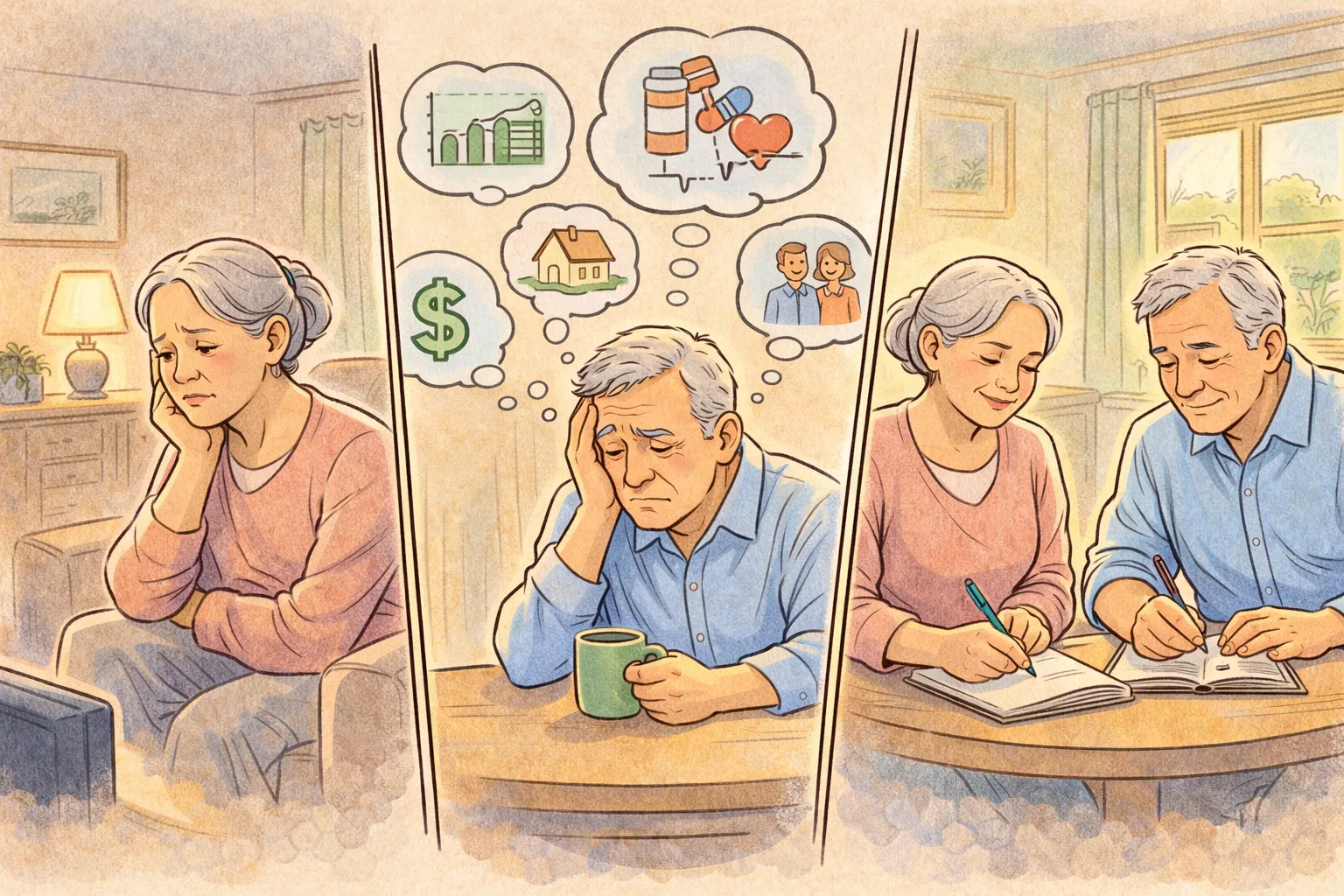
“I’m not overwhelmed… but I don’t feel fully at ease either.”
This is a kind of stress many retirees experience.
It’s not loud.
It doesn’t feel urgent.
It doesn’t look serious from the outside.
But it’s there.
Every day.
In small ways.
1. What “quiet stress” really means
Quiet stress is not obvious pressure.
It’s not deadlines.
Not emergencies.
Not visible problems.
It’s a background feeling.
Something like:
- low-level tension
- subtle unease
- constant thinking
- mild restlessness
It’s easy to ignore.
But hard to fully relax with.
2. Why it shows up after retirement
Retirement removes obvious stress.
But it also removes structure.
That creates space.
And in that space, small thoughts grow.
Things like:
- “Am I doing enough?”
- “Is this how my days should feel?”
- “What happens later?”
These are not urgent questions.
But they don’t disappear.
3. It’s not one problem—it’s many small ones
Quiet stress is rarely caused by one big issue.
It usually comes from:
- small uncertainties
- unfinished thoughts
- low-level decisions
- subtle worries
Each one is manageable.
Together, they create mental weight.
4. The “always thinking” pattern
Many retirees notice this:
You are not busy…
But your mind is.
Thinking about:
- health
- money
- family
- future
- small tasks
Not intensely.
Just constantly.
5. Why it’s easy to overlook
Quiet stress doesn’t interrupt your day.
You can still:
- eat normally
- sleep okay
- go about your routine
That’s why it goes unnoticed.
But over time, it can lead to:
- mental fatigue
- low energy
- reduced enjoyment
- feeling slightly “off”
6. The emotional impact
Quiet stress often feels like:
- you can’t fully relax
- you’re slightly on edge
- something is unresolved
- your mind doesn’t fully settle
It’s subtle.
But persistent.
7. The hidden sources
Common sources include:
- financial uncertainty
- health awareness
- family concerns
- lack of daily structure
- too much unplanned time
- low social interaction
None of these alone feel overwhelming.
But together, they add up.
8. Why “doing more” doesn’t fix it
Many people try to fix this by:
- staying busy
- adding tasks
- filling the day
But quiet stress is not about activity.
It’s about mental clarity.
9. A better way to reduce it
You don’t need a big solution.
You need small mental resets.
Try:
- writing down lingering thoughts
- limiting overthinking time
- creating small daily anchors
- having one clear plan for the day
- talking things out
Clarity reduces pressure.
10. The “one clear thing” method
Each day, choose:
One thing that matters.
Not ten things.
Not a full list.
Just one.
This gives your mind:
- direction
- completion
- relief
11. Real-life examples
Helen, 72:
“I wasn’t stressed… but I wasn’t relaxed either.”
She started writing down her thoughts each morning.
Her words:
“It cleared my head more than I expected.”
James, 69:
“I kept thinking about small things all day.”
He started choosing one daily focus.
That alone reduced his mental noise.
12. Signs you may have quiet stress
- you feel slightly tense without a clear reason
- your mind keeps running in the background
- you struggle to fully relax
- you feel mentally tired without doing much
- you feel “off” but can’t explain why
If this feels familiar, you’re not alone.
Quick checklist
- did I clear my thoughts today?
- did I focus on one thing?
- did I reduce mental clutter?
- did I pause instead of overthinking?
Small changes matter.
The key insight
Not all stress is loud.
Some of it is quiet.
And quiet stress is often the one that stays the longest.
Conclusion
Retirement removes pressure.
But it doesn’t remove thinking.
And sometimes, thinking becomes the new source of stress.
The solution is not to fill your life with more activity.
It’s to create more mental clarity.
That’s what brings real calm.
Disclaimer
This content is for general educational purposes only and does not address individual psychological or medical conditions. If persistent anxiety, stress, or mood changes occur, consult a qualified pr