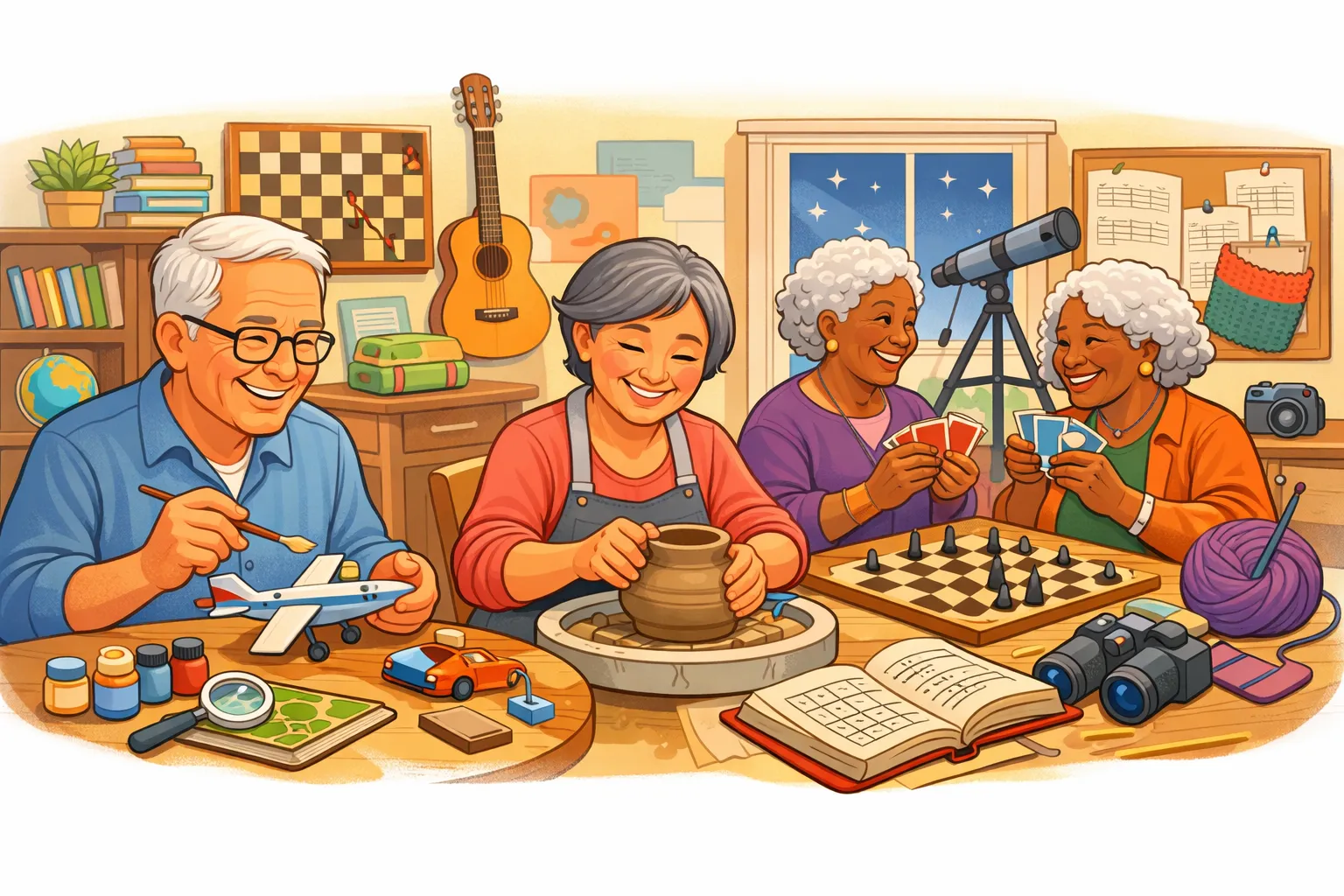
Cindy’s Column × Senior AI Money
When people talk about “brain health,” they often jump straight to puzzles.
Crosswords.
Memory games.
Brain apps.
Number drills.
Those can be fine.
But for many adults over 55, that advice is too narrow.
A healthier question is not,
“What puzzle should I do?”
It is,
“What kind of hobby helps me stay alert, interested, emotionally engaged, and likely to keep showing up?”
That is where the “Hands + Heart + Head” rule comes in.
The best hobby for brain health is usually not the one that looks the smartest.
It is the one that asks something from your hands, gives something to your heart, and keeps something active in your head.
That idea lines up well with current healthy-aging guidance. The National Institute on Aging says cognitive health is the ability to think, learn, and remember clearly, and it notes that hobbies and social activities may help lower risk for some health problems, including dementia. CDC guidance also says regular physical activity can help keep thinking, learning, and judgment skills sharp as you age, while social well-being and mental stimulation are part of healthy aging. The Alzheimer’s Association similarly recommends mentally challenging activities, learning new skills, and increasing social engagement as ways that may support brain health.
This guide is for older adults who want a hobby that feels useful in real life, not just impressive on paper.
What the “Hands + Heart + Head” rule means
Hands means the hobby involves doing, moving, making, handling, building, arranging, shaping, playing, or physically participating in some way.
Heart means the hobby feels enjoyable, meaningful, calming, social, creative, or emotionally rewarding enough that you actually want to return to it.
Head means the hobby asks for attention, memory, sequencing, learning, judgment, strategy, curiosity, or problem-solving.
When a hobby hits all three, it often becomes much easier to sustain.
And consistency matters more than intensity.
A hobby you enjoy three times a week is usually more helpful than a “perfect” hobby you abandon after ten days.
Why this matters after 55
Later adulthood changes time, energy, and routine.
You may have more freedom, but you may also have less built-in structure.
You may want stimulation, but not chaos.
You may want to keep your mind active, but not feel like every enjoyable thing has been turned into a health assignment.
That is why hobby advice has to be realistic.
The hobby has to fit your actual life:
your hands,
your schedule,
your budget,
your mobility,
your attention span,
your social comfort,
and your energy on an ordinary Tuesday.
The good news is that brain-supportive hobbies do not have to be complicated. NIA, CDC, and the Alzheimer’s Association all point in the same broad direction: brain health is supported by a mix of mental challenge, physical activity, social connection, and healthy routines, not one magic activity. The U.S. POINTER trial also reported improved cognition in older adults at risk of decline when multiple lifestyle factors were addressed together, with stronger benefits in the more structured intervention group.
The hobby rule for retirees and older adults
Do not ask, “Is this hobby good for the brain?”
Ask three better questions:
Does it make me use my hands?
Does it give me some emotional lift or meaning?
Does it keep me mentally involved enough that I am not running on autopilot?
If the answer is yes to at least two, it is probably worthwhile.
If the answer is yes to all three, it is especially strong.
Part 1: Why “hands” matters
Many adults assume brain hobbies must be seated, quiet, and purely mental.
But “hands” matters because physical participation often improves attention and follow-through.
When your hands are involved, the activity becomes more real.
You are shaping clay.
Shuffling cards.
Planting herbs.
Painting a model.
Practicing chords.
Arranging flowers.
Knitting a pattern.
Handling wood, paper, photos, fabric, or tools.
That combination can make the brain stay present in a different way than passive entertainment.
Physical activity also matters more broadly for brain health. CDC says regular physical activity can help keep thinking, learning, and judgment skills sharp as you age, and can also reduce anxiety, improve sleep, and support emotional balance. NIA likewise says physical activity is essential for healthy aging.
This does not mean you need strenuous exercise.
It means hobbies that involve the body, even gently, often have an advantage.
Good “hands” hobbies include:
gardening
knitting or crochet
pottery
woodworking
model building
cooking or baking
painting
birding with walking
beginner dance or tai chi classes
playing an instrument
photography walks
Part 2: Why “heart” matters
A hobby can be technically good for you and still fail if it feels dull, lonely, or joyless.
Heart is what makes you stay.
Heart can mean:
pleasure,
purpose,
beauty,
calm,
connection,
achievement,
nostalgia,
or simply the feeling that the hour was well spent.
NIA says participating in hobbies and other social activities may lower the risk of some health problems and is associated with positive feelings such as happiness, life satisfaction, and sense of purpose. NIA also notes that loneliness and social isolation are associated with higher risks for health problems including cognitive decline.
That matters because people do not continue hobbies just because they are “good for them.”
They continue hobbies because the activity gives something back.
One person feels soothed by gardening.
Another feels alive in a choir.
Another loves the quiet focus of watercolor.
Another enjoys card games because of the social laughter more than the game itself.
Heart keeps the hobby from turning into homework.
Part 3: Why “head” matters
Head means the activity still asks something of your mind.
It does not have to be hard in an academic way.
It simply has to keep you engaged enough that your brain is not asleep at the wheel.
That can include:
learning rules
remembering steps
trying a new technique
making decisions
planning ahead
solving little problems
adapting when something goes wrong
paying attention to detail
listening and responding
noticing patterns
The Alzheimer’s Association specifically recommends doing something new, learning a new skill, trying something artistic, or taking on mentally challenging activities that keep the brain working. It also notes that when an activity becomes too easy, adding something new can increase the challenge.
This is why some hobbies age well with you.
You can keep adjusting them.
If gardening becomes easy, try a new kind of planting plan.
If cards become automatic, learn a new strategy game.
If knitting is familiar, try a new stitch or more complex project.
If music is comfortable, learn a new piece instead of replaying only old favorites.
Table 1. Hobbies that fit the Hands + Heart + Head rule
| Hobby | Hands | Heart | Head | Why It Works |
|---|---|---|---|---|
| Gardening | High | High | Medium | Movement, routine, sensory reward, planning |
| Knitting / crochet | High | Medium to High | Medium | Pattern memory, hand use, calm focus |
| Painting / sketching | High | High | Medium | Creativity, attention, emotional expression |
| Choir / music group | Medium | High | High | Listening, memory, timing, connection |
| Card or board games | Medium | High | High | Strategy, social contact, novelty |
| Cooking / baking | High | High | Medium to High | Sequencing, measuring, sensory reward |
| Photography walks | Medium | High | Medium | Movement, visual attention, exploration |
| Pottery / crafts | High | High | Medium | Fine motor work, creativity, concentration |
Part 4: The best hobby is one you can repeat without resentment
This is where many people go wrong.
They choose the hobby that sounds most healthy rather than the hobby they can actually maintain.
A hobby is more likely to stick when it is:
easy to begin
not too expensive
close to home or low-friction
adaptable to your current energy
interesting enough that you want to improve a little
This matters because consistency beats intensity.
A 20-minute hobby done several times a week can have more value than an ambitious class you keep postponing.
So before you start something new, ask:
Can I do this at home or nearby?
Can I do it even on a lower-energy day?
Do I need a lot of gear?
Would I still like a smaller version of this?
Can I imagine doing this next month, not just this week?
Part 5: Beware of hobbies that are all “head” and no “heart”
Some older adults choose hobbies they think they should do.
That often sounds like:
I guess I should do memory puzzles.
I heard language learning is good for the brain.
I should probably use one of those brain apps.
There is nothing wrong with these.
But if the activity feels dutiful and emotionally flat, it often gets dropped.
That is why “heart” matters so much.
A hobby that makes you feel connected, proud, amused, soothed, or curious is often more sustainable than one that merely looks impressive.
You do not need the smartest hobby.
You need the hobby with the best return on attention.
Part 6: Social hobbies deserve more respect
People often treat social hobbies as “just social.”
But social engagement is one of the strongest reasons certain hobbies work so well.
A walking club,
a choir,
a craft group,
a volunteer shift,
a beginner art class,
a church study group,
a card group,
a dance class,
a community garden,
a ukulele circle.
All of these involve more than the activity itself.
You are remembering names.
Showing up on time.
Listening.
Responding.
Following turns.
Sharing interest.
Reading cues.
Telling stories.
Paying attention.
NIA says hobbies and social activities may lower the risk of certain health problems, and it links social connection with healthier aging. CDC also lists social well-being as part of healthy aging.
So if you enjoy people even a little, do not underestimate the brain value of group hobbies.
Part 7: Real examples
Elaine, 68
Elaine thought she needed a “brainier” hobby after retirement, so she bought several puzzle books and downloaded a memory app. She used both for two weeks and got bored. Then her daughter invited her to a beginner pottery class. Elaine loved it. It used her hands, demanded attention, and gave her a satisfying sense of progress. Six months later, she was still going every Thursday because the hobby felt restorative, not corrective.
James, 73
James worried that his world had become too passive: television, news, meals, and sleep. He joined a local birding group because it combined gentle walking with observation and small social contact. He said the hobby helped because it gave him a reason to notice things again. It was not only about birds. It was about being mentally present outdoors.
Marsha, 64
Marsha already knew how to knit, so at first she did not consider it a brain-health hobby. But once she joined a small knitting circle and started learning more complex patterns, the activity changed. It became social, mentally engaging, and emotionally grounding. What had been a quiet hand habit turned into a true Hands + Heart + Head hobby.
Part 8: How to choose your next hobby without overthinking it
Try this simple filter.
Choose hobbies that score well in at least three of these five areas:
easy to begin
uses your hands or body somehow
feels emotionally rewarding
contains novelty or learning
can include other people if you want it to
That short list usually points you in the right direction.
Examples of strong candidates:
gardening
photography walks
watercolor
choir
ukulele
pottery
cards or strategy games
craft classes
birding
woodworking
cooking projects
flower arranging
community volunteering with a hands-on task
Table 2. Common hobby problems and better fixes
| Problem | What Usually Happens | Better Fix |
|---|---|---|
| Hobby feels too solitary | You lose momentum | Add a class, group, or buddy layer |
| Hobby feels too hard | You avoid starting | Choose a beginner version |
| Hobby feels too passive | It does not hold attention | Add a skill or goal element |
| Hobby feels expensive | You quit from guilt | Use library, community center, or starter supplies |
| Hobby feels too familiar | Brain challenge fades | Learn a new technique or variation |
| Hobby feels like homework | Motivation drops | Choose something with more heart and less pressure |
Checklist: Hobbies for Brain Health
✔ Choose a hobby that uses your hands, body, or senses
✔ Make sure you actually enjoy it
✔ Look for some learning, novelty, or decision-making
✔ Prefer hobbies you can repeat weekly without strain
✔ Keep the startup cost low at first
✔ Pick a beginner version instead of an ideal version
✔ Add a social layer if loneliness is part of the problem
✔ Let the hobby be satisfying, not performative
✔ Increase difficulty only when it starts feeling too easy
✔ Use classes or groups for structure if needed
✔ Protect one or two regular hobby times each week
✔ Do not dismiss low-key hobbies that bring calm and focus
✔ Notice which activities leave you more alert afterward
✔ Drop hobbies that feel all duty and no reward
✔ Aim for consistency, not perfection
EEAT note
This article is practical healthy-aging guidance, not a promise that any single hobby prevents dementia or cognitive decline. The strongest public-health guidance points toward a mix of physical activity, social connection, mental stimulation, and enjoyable routine rather than one miracle activity.
Final thought
The best hobby for brain health is rarely the one that makes you feel virtuous.
It is the one that keeps you engaged enough to come back.
Hands to do.
Heart to care.
Head to stay awake.
That is a much better rule than chasing the “smartest” hobby in the room.
Disclaimer
This article is for general educational purposes only and does not provide medical, neurological, mental health, or rehabilitation advice. Brain health, memory changes, depression, mobility limits, and cognitive concerns vary widely. Anyone worried about noticeable changes in memory, judgment, mood, or daily functioning should speak with a qualified healthcare professional.
“`html id=”x8qk3m” “`