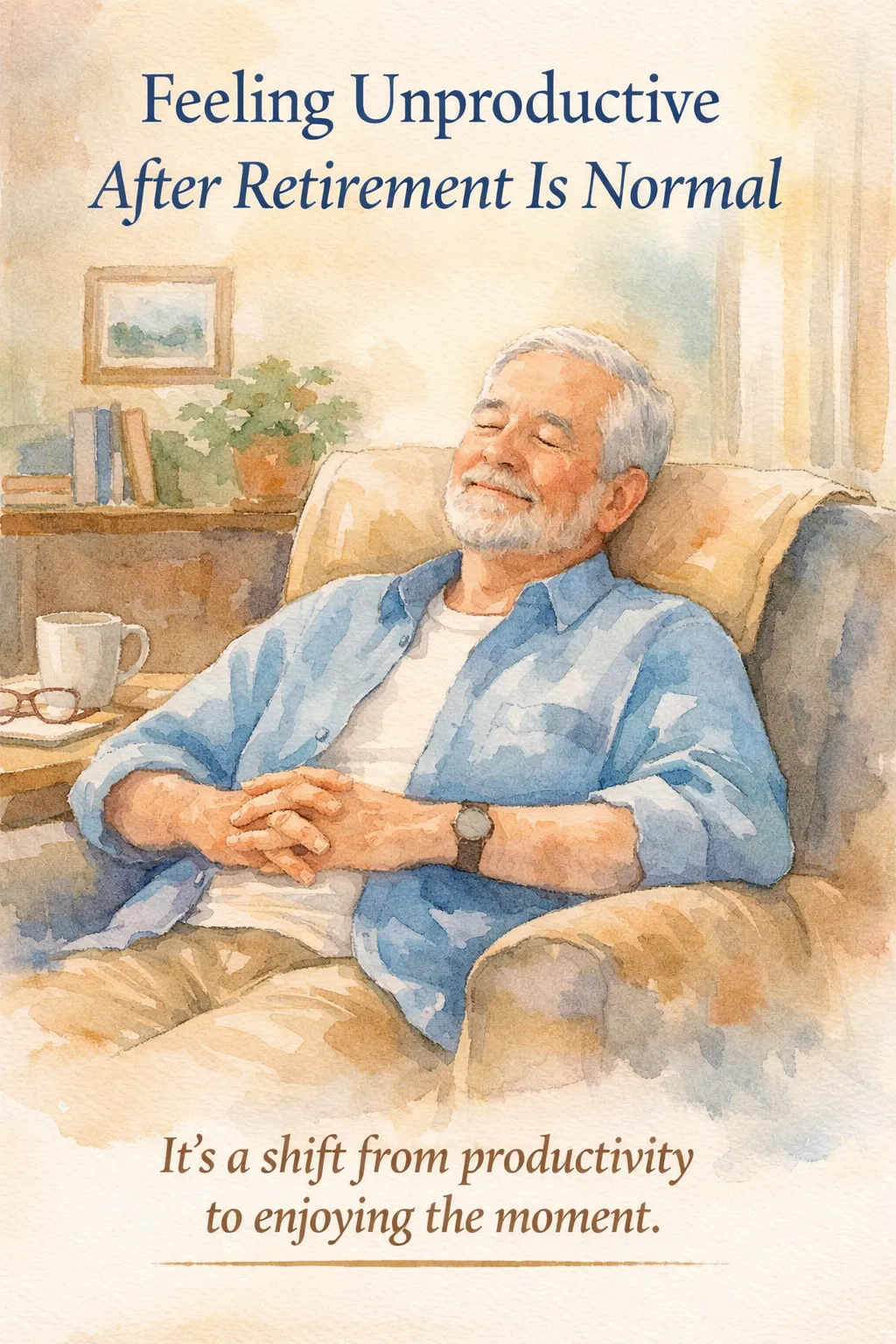
“I didn’t really do anything today.”
This thought shows up more often than people expect after retirement.
The strange part is this:
You may have had a calm day.
Nothing stressful happened.
You weren’t overwhelmed.
And yet…
You still feel slightly uncomfortable.
Like something is missing.
Like the day didn’t “count.”
This feeling is very common.
And more importantly—
It’s completely normal.
1. Why productivity used to define your day
For decades, life followed a pattern:
- tasks to complete
- work to finish
- responsibilities to manage
- goals to reach
At the end of the day, there was a clear question:
“Did I get things done?”
That question shaped how you felt.
Productivity = satisfaction
2. What changes after retirement
Retirement removes that structure.
There is no longer:
- a daily output requirement
- a performance expectation
- a clear definition of “done”
This creates a gap.
Not in time—
But in meaning.
3. The “invisible day” feeling
Many retirees experience this:
The day passes quietly.
But at the end, it feels like:
- nothing important happened
- nothing was completed
- nothing stands out
This creates the feeling of being unproductive.
Even if the day was peaceful.
4. Why this feeling is uncomfortable
Your brain has been trained for years to measure value through output.
So when output disappears, the brain reacts:
- “Was today useful?”
- “Did I waste time?”
- “Should I have done more?”
This is not a flaw.
It’s conditioning.
5. Rest is not the same as “nothing”
This is the key misunderstanding.
Rest is not empty.
Rest is active recovery.
But when you’re used to productivity, rest can feel like:
- laziness
- lack of purpose
- wasted time
That’s not true.
It just feels unfamiliar.
6. The hidden pressure retirees carry
Even without a job, many retirees feel internal pressure:
- “I should be doing something”
- “I shouldn’t waste my time”
- “I need to stay productive”
This pressure is often invisible.
But it shapes how your day feels.
7. A healthier way to define a “good day”
Instead of asking:
“What did I finish today?”
Try asking:
“Did today feel steady?”
or
“Did I take care of myself today?”
This is a different kind of success.
8. The 3 ways a day can be valuable
A good day in retirement can include:
- Maintenance
(simple tasks, small routines) - Enjoyment
(rest, hobbies, calm moments) - Connection
(conversation, interaction)
That’s enough.
9. Real-life examples
Susan, 68:
“I used to feel guilty for relaxing. Now I see it as part of my day—not a failure.”
Robert, 72:
“I stopped measuring my days by output. I started noticing how I felt instead.”
10. Signs you’re judging yourself too harshly
- you feel guilty for resting
- you compare today to your working years
- you feel like you “should have done more”
- you struggle to enjoy free time
- you measure value only through tasks
If this sounds familiar, you’re not doing retirement wrong.
You’re just using old rules.
11. What to do instead
You don’t need to become more productive.
You need a new definition of enough.
Try:
- one small task per day
- one enjoyable moment
- one form of connection
That’s a full day.
12. The mindset shift
Old mindset:
“I need to earn my rest.”
New mindset:
“Rest is part of a complete day.”
This shift removes pressure.
Quick checklist
- did I move a little today?
- did I have one calm moment?
- did I connect with someone (even briefly)?
- did I take care of myself?
If yes, the day counts.
The key insight
Feeling unproductive after retirement is not a problem.
It’s a transition.
You’re moving from a life measured by output…
To a life measured by experience.
Conclusion
Retirement is not about doing nothing.
It’s about doing what matters—at a different pace.
Some days will be quiet.
Some days will feel slow.
That doesn’t make them empty.
It makes them human.
Disclaimer
This content is for general educational purposes only and does not address individual psychological or medical conditions. If feelings of low motivation or mood persist, consult a qualified professional.