Energy after 50 improves when you shift from multitasking to focused, intentional work
“I didn’t do anything unusual… so why am I already tired?”
If you’ve had this thought recently, you’re not alone.
Many people in their 50s and 60s notice something subtle but important:
Your energy feels… different.
Not gone. Not dramatically worse.
Just different.
1. Why this feels confusing
You’re still active. You’re still working (in many cases). You’re not “old.”
So naturally, you expect:
👉 Same energy = same output
But that’s not how it works anymore.
2. Energy doesn’t decrease—it changes
This is the key point most people miss.
Your energy isn’t simply lower.
👉 It behaves differently.
Before:
energy was steady
recovery was quick
long effort was easier
Now:
energy comes in waves
recovery takes longer
mental fatigue appears faster
3. The biggest shift: mental energy
Physical tiredness is obvious.
But what really changes is:
👉 mental energy
You may notice:
focusing longer feels harder
decision-making drains you faster
switching tasks feels heavier
This is completely normal.
4. Why “doing less” can still feel tiring
This confuses many people.
You’re doing less than before…
But still feel tired.
Why?
Because:
👉 efficiency changes
Your brain now:
uses more effort per task
needs more recovery time
prefers fewer transitions
5. The hidden drain: constant switching
One of the biggest energy drains after 50:
👉 task switching
checking your phone
switching between tasks
reacting constantly
This drains energy faster than actual work.
6. The “flat energy” problem
Instead of highs and lows,
You may feel:
👉 “flat energy”
not exhausted
not energized
Just… low and steady
This is often caused by:
lack of movement
lack of variation
too much sitting
7. Why rest doesn’t always fix it
You might think:
“I just need more rest.”
But often:
👉 rest alone doesn’t restore energy
Because the issue isn’t exhaustion.
It’s:
👉 lack of energy flow
8. The real solution: energy management
After 50, energy is no longer automatic.
👉 It needs to be managed.
Not controlled.
Not forced.
Just guided.
9. The 3 energy rules that change everything
1. Work with your peaks
Do important tasks when energy is naturally higher.
2. Reduce switching
Stay with one task longer.
3. Add movement
Even small movement resets energy.
10. Simple daily example
Instead of:
multitasking
sitting all day
reacting constantly
Try:
1 focused task
short movement break
simple routine
11. Real-life examples
Mark, 56:
“I thought I was just getting tired.”
He reduced multitasking.
His energy improved within a week.
Linda, 61:
“I stopped pushing through low energy.”
She started working with her natural rhythm.
Everything felt easier.
12. Signs your energy is changing
you feel tired faster mentally
you need more breaks
switching tasks feels draining
your energy feels uneven
you feel “off” without reason
Quick checklist
did I reduce multitasking today?
did I move at least a little?
did I follow my energy instead of forcing it?
If yes, you’re already improving.
The key insight
Your energy isn’t worse.
👉 It’s different.
Conclusion
After 50, the goal is not:
👉 doing more
It’s:
👉 using your energy better
When you understand how your energy works now:
your days feel easier
your focus improves
your fatigue decreases
And most importantly—
You stop fighting yourself.
Disclaimer
This content is for general educational purposes only and does not consider individual health conditions. If you experience persistent fatigue or health concerns, consult a qualified healthcare professional.
A balanced weekly rhythm brings structure, energy, and fulfillment to retirement life
“My days are okay… but my weeks feel unbalanced.”
This is something many retirees notice.
Some days feel productive. Some feel slow. Some feel empty.
And the week as a whole?
It feels inconsistent.
1. Why weekly rhythm matters
Daily structure is important.
But weekly rhythm is what creates:
balance
variety
stability over time
Without it:
Days may feel fine…
But weeks feel uneven.
2. The hidden problem: random weeks
Without a weekly rhythm:
activities happen randomly
energy fluctuates
social time is inconsistent
important things get delayed
3. Why this leads to imbalance
Because your life needs:
repetition (for stability)
variation (for engagement)
A good week has both.
4. The goal is not a schedule—it’s a rhythm
A schedule is rigid.
A rhythm is flexible.
You don’t need exact times.
You need patterns.
5. The “5-part weekly rhythm”
A balanced retirement week includes:
movement day
social day
personal task day
light activity day
rest/reset day
6. What each day means
Movement day
walking
light exercise
outdoor activity
Social day
meeting someone
calling family
casual interaction
Personal task day
organizing
finances
home tasks
Light activity day
hobbies
reading
small projects
Rest/reset day
minimal activity
mental reset
quiet time
7. Why this works
Because it creates:
variety → prevents boredom
structure → prevents drifting
balance → improves well-being
8. Example weekly rhythm
Day
Focus
Monday
Movement
Tuesday
Personal tasks
Wednesday
Social
Thursday
Light activity
Friday
Movement
Saturday
Flexible
Sunday
Rest/reset
9. The biggest mistake
Trying to make every day “productive”
This leads to:
pressure
fatigue
inconsistency
Balance matters more than productivity.
10. Keep it simple
You don’t need:
strict timing
complex plans
detailed schedules
You just need:
👉 a pattern
11. Real-life examples
Susan, 70:
“I gave each day a purpose.”
Her weeks became calmer.
David, 73:
“I stopped guessing what to do.”
His energy became more stable.
12. Signs you need a weekly rhythm
your weeks feel inconsistent
some days feel empty
your energy fluctuates
you lack balance
your routine feels random
Quick checklist
did my week include movement?
did I connect with someone?
did I handle personal tasks?
did I rest properly?
If yes, your week is balanced.
The key insight
A good retirement life is not built day by day.
It’s built week by week.
Conclusion
Daily structure gives you stability.
Weekly rhythm gives you balance.
When both work together:
Retirement feels:
smoother
clearer
more fulfilling
Disclaimer
This content is for general educational purposes only and does not consider individual health or lifestyle conditions. For personalized planning, consult a qualified professional.
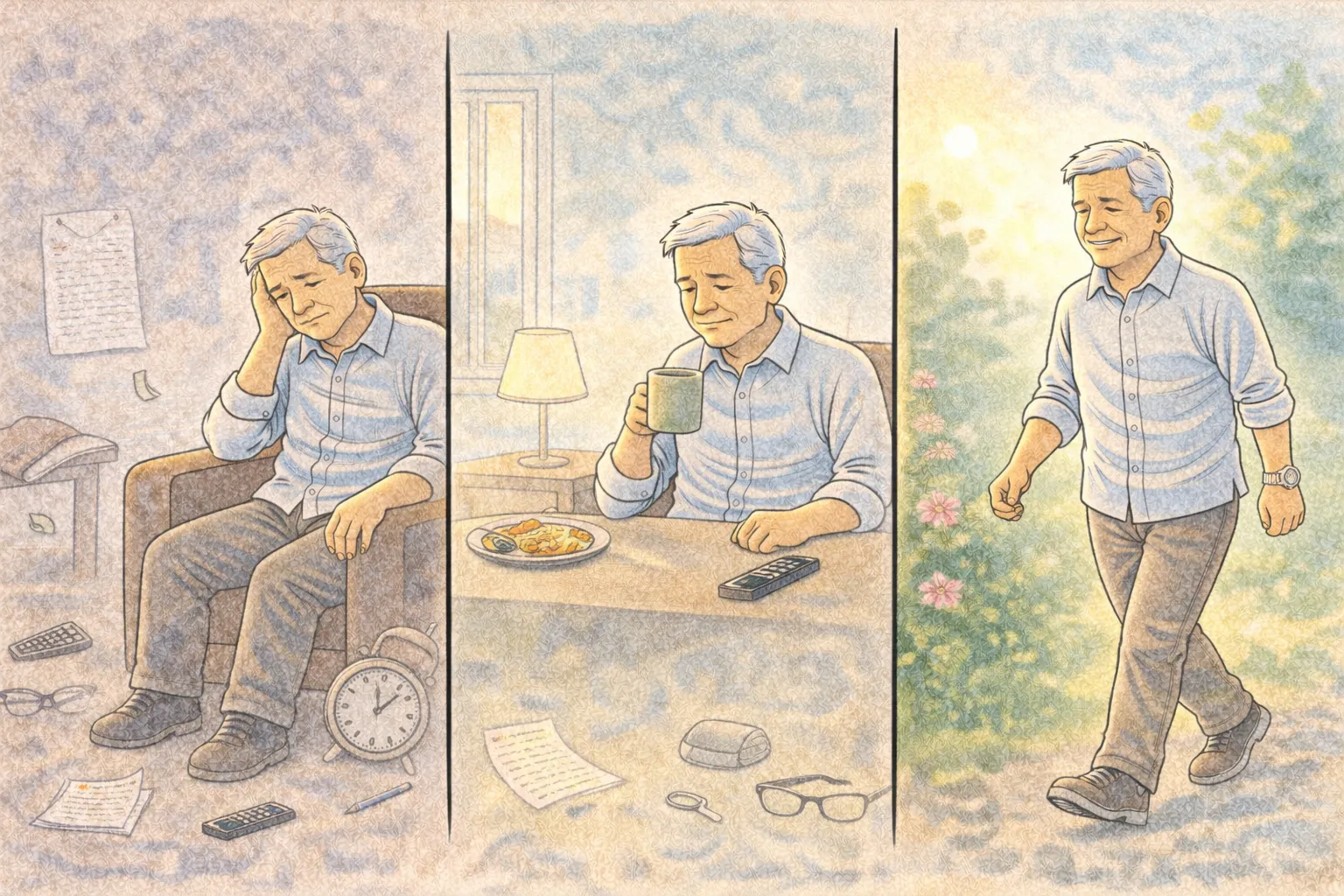
Panoramic comic-style illustration showing a retiree moving from a chaotic unstructured day to a calm and stable routine
“I have freedom… but no structure.”
This is more common than people expect.
After retirement:
No schedule. No deadlines. No fixed rhythm.
At first, it feels good.
But over time…
It can feel unstable.
1. Why structure matters more than you think
Structure is not restriction.
It’s support.
It gives your day:
shape
rhythm
direction
Without it:
Everything feels… loose.
2. The hidden problem: too much open time
Open time sounds ideal.
But too much of it creates:
indecision
delay
low energy
drifting days
3. Why retirees feel “off” without structure
It’s not laziness.
It’s lack of anchors.
Your brain looks for:
starting points
transitions
endings
Without them, the day feels unclear.
4. The difference between control and structure
You don’t need control.
You need light structure.
Not rigid.
Not strict.
Just enough to guide your day.
5. The “3 anchor system”
Instead of a full schedule,
Use 3 simple anchors:
morning anchor
mid-day anchor
evening anchor
That’s it.
6. What an anchor actually is
An anchor is:
A small, repeatable moment in your day.
Not a long task.
Not pressure.
Just something consistent.
7. Examples of simple anchors
Morning:
coffee + quiet time
light stretch
short walk
Mid-day:
meal at a consistent time
short activity
quick check-in (money / home / health)
Evening:
wind-down routine
light reflection
same bedtime window
8. Why this works
Because anchors create:
rhythm
predictability
mental clarity
You don’t need a full plan.
Just a framework.
9. The biggest mistake: over-structuring
Some people try:
detailed schedules
strict plans
too many rules
This usually fails.
Why?
Because it feels like work again.
10. Keep it flexible
Structure should feel:
supportive
light
adaptable
If it feels heavy → it won’t last
11. Real-life examples
Janet, 68:
“I added three simple anchors.”
Her words:
“My days stopped drifting.”
Michael, 72:
“I didn’t need more to do. I needed structure.”
12. Signs you need this
your day feels unstructured
you don’t know when to start things
time feels scattered
you delay simple tasks
your routine feels unclear
Table: No Structure vs Simple Structure
No Structure
Simple Structure
Day feels random
Day feels guided
Low clarity
Clear flow
More procrastination
Easier action
Energy feels flat
Energy has rhythm
13. Simple daily structure example
Time
Anchor
Morning
Coffee + light movement
Midday
Meal + small activity
Evening
Wind-down routine
Quick checklist
do I have a morning anchor?
do I have a mid-day anchor?
do I have an evening anchor?
If yes, your day will feel more stable.
The key insight
You don’t need a schedule.
You need anchors.
Conclusion
Retirement gives you freedom.
But freedom needs structure to feel good.
Not strict.
Not complicated.
Just simple anchors.
That’s enough to make your days feel steady again.
Disclaimer
This content is for general educational purposes only and does not consider individual psychological or health conditions. If ongoing difficulties with daily functioning occur, consult a qualified professional.
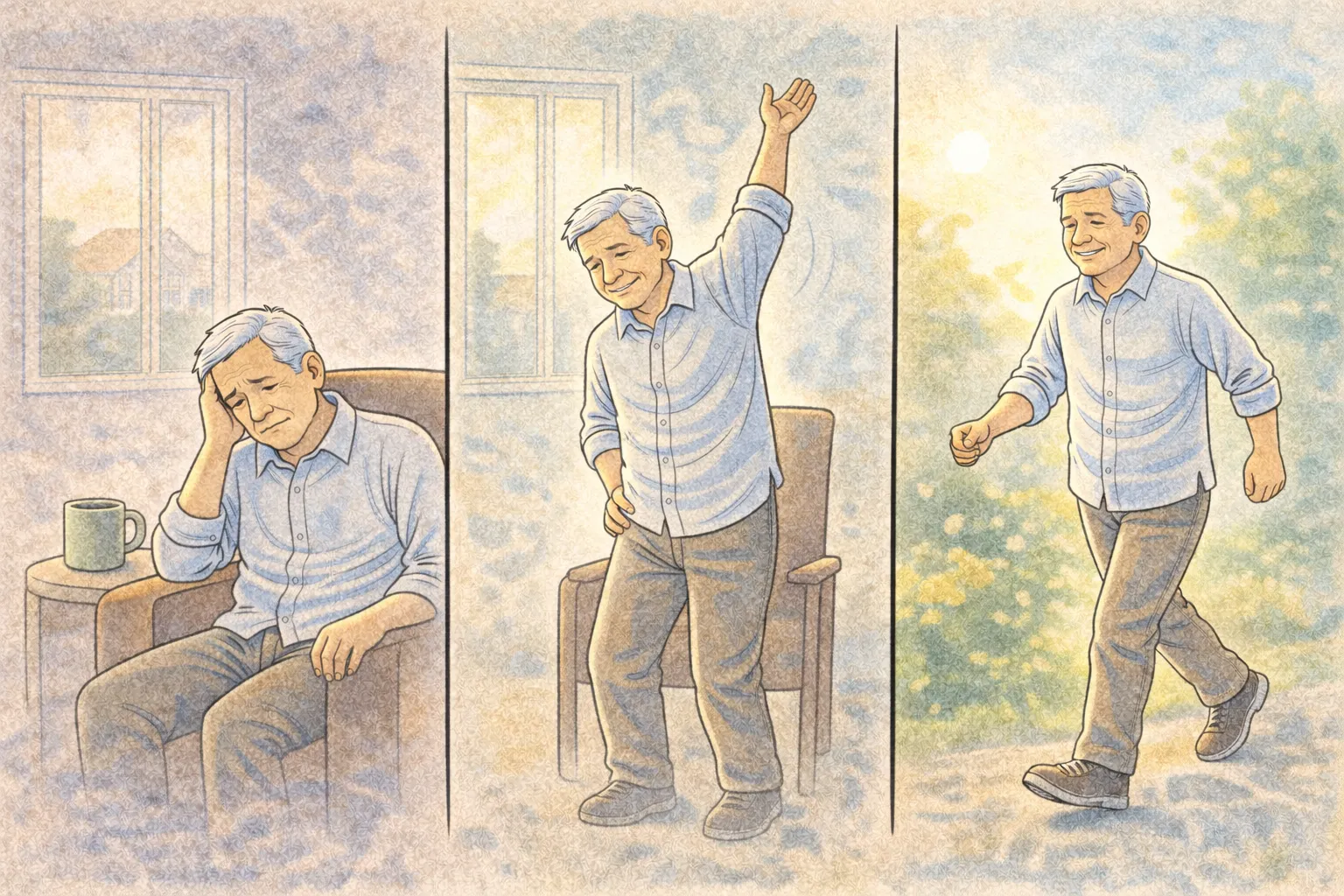
Panoramic comic-style illustration showing a retiree feeling tired while sitting and becoming energized through movement and walking outdoors
“I didn’t do much… so why am I so tired?”
This question surprises many retirees.
You’re not overworking. You’re not rushing. You’re not stressed in the usual way.
And yet…
You feel tired.
Not exhausted.
But low-energy. Slow. A bit drained.
1. Why this feels confusing
Before retirement, tiredness made sense.
You worked. You used energy. You needed rest.
After retirement:
Less activity → should mean more energy
But often, the opposite happens.
2. The real issue is not effort—it’s energy flow
Energy is not just about how much you do.
It’s about how your day moves.
Without movement:
energy stagnates
alertness drops
your body slows down
3. The “low stimulation” problem
Your brain needs stimulation to stay energized.
Not stress.
Just variation.
Without it:
your brain becomes passive
your body follows
you feel tired without reason
4. Sitting too much drains energy
This is one of the biggest hidden causes.
Even if you feel “rested,”
Too much sitting leads to:
reduced circulation
lower alertness
slower metabolism
Result → low energy
5. Lack of transitions
During working life, your day had transitions:
commute
meetings
movement
changes
These transitions reset your energy.
After retirement:
Fewer transitions = flatter energy
6. Mental inactivity creates physical fatigue
This is surprising but real.
When your mind is under-stimulated:
your body becomes slower
your motivation drops
your energy decreases
7. Too much “comfort” can reduce energy
Comfort is good.
But constant comfort can lead to:
low movement
low stimulation
low engagement
Which results in:
Low energy
8. The key problem: no energy rhythm
Energy works best in cycles:
activity
rest
activity
rest
Without cycles:
Energy stays flat.
And flat energy feels like tiredness.
9. The simple fix: create micro-energy cycles
You don’t need intensity.
You need small changes.
10. The 3-part energy reset
Each day, include:
movement (even light)
stimulation (new or engaging)
transition (change of state)
11. Simple examples
stand up every hour
walk for 5–10 minutes
change rooms
go outside briefly
do one slightly new activity
Small changes → big energy shift
12. Real-life examples
Linda, 69:
“I thought I needed more rest.”
She actually needed more movement.
Her energy improved within days.
George, 73:
“I wasn’t tired from doing too much.”
He was tired from doing too little.
13. Signs this is your issue
you feel tired without doing much
your energy feels flat all day
you sit for long periods
your routine feels repetitive
you feel better after small movement
Quick checklist
did I move today?
did I change my environment?
did I stimulate my mind?
If yes, your energy improves.
The key insight
Tiredness is not always from doing too much.
Sometimes, it’s from doing too little.
Conclusion
Retirement changes your energy patterns.
You don’t need more rest.
You need better energy flow.
Small movement. Small variation. Small changes.
That’s what brings your energy back.
Disclaimer
This content is for general educational purposes only and does not consider individual medical conditions. If persistent fatigue or health concerns occur, consult a qualified healthcare professional.
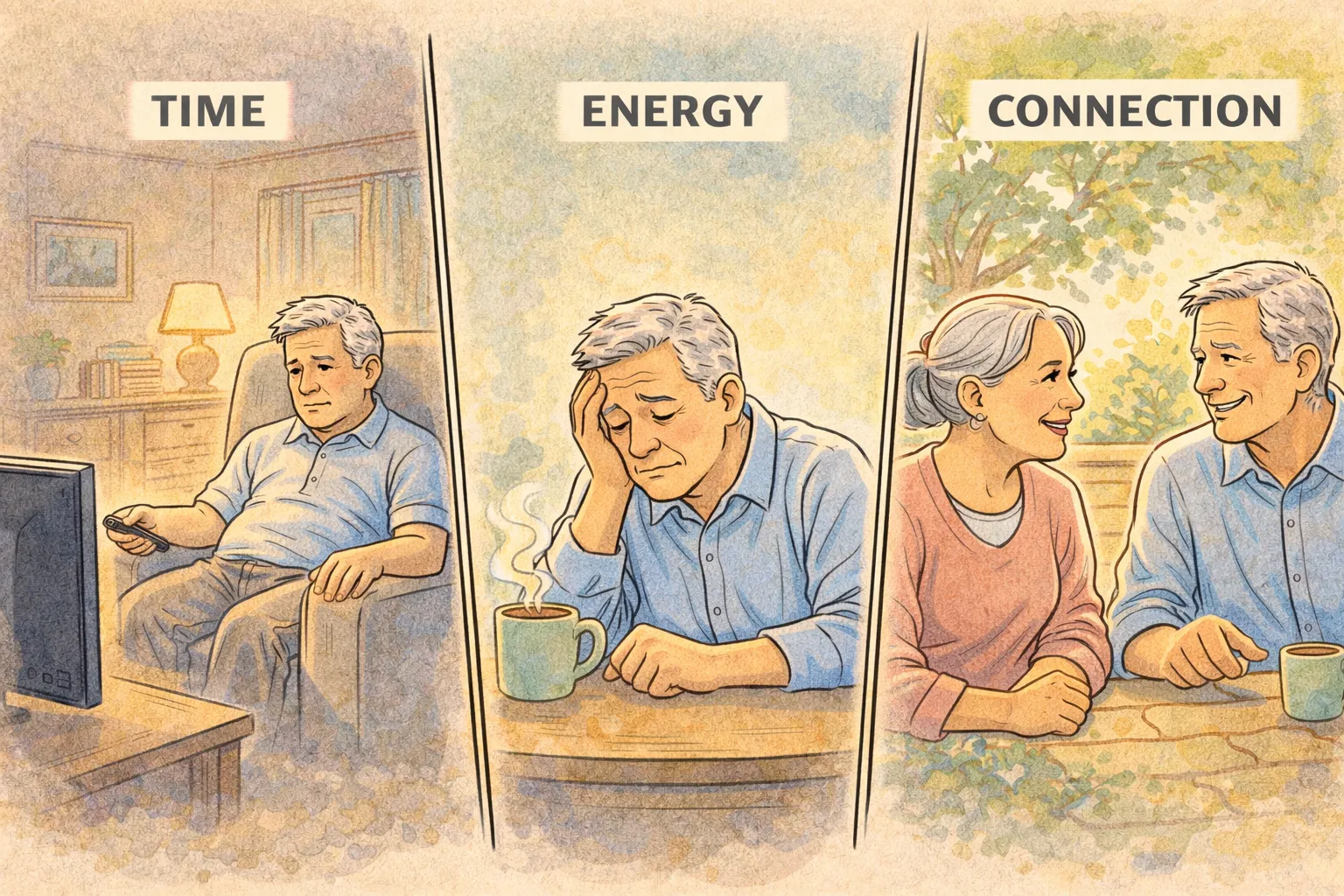
Panoramic comic-style illustration showing three retirement states: poor time use, low energy, and meaningful social connection
Most people think retirement is shaped by money.
But that’s not entirely true.
Money matters.
But what really shapes your retirement is something deeper.
Three decisions.
Not hundreds.
Just three.
And once they are set, everything else follows.
1. Decision #1 — How you use your time
After retirement, time becomes your main resource.
But here’s the challenge:
There’s no default structure anymore.
No one tells you what to do.
No schedule is given to you.
So you must decide:
“What is my day for?”
Why this decision matters
Without a clear answer, days become:
repetitive
unstructured
low-energy
With a clear answer, days become:
intentional
steady
meaningful
Two common patterns
Passive time use:
waiting for something to happen
reacting to the day
filling time randomly
Intentional time use:
choosing small daily anchors
creating rhythm
planning lightly
2. Decision #2 — How you protect your energy
Time is important.
But energy is everything.
You can have time…
And still feel tired, slow, or unmotivated.
That’s because retirement is not about hours.
It’s about how those hours feel.
What drains energy
too much sitting
too much staying at home
too many small decisions
too much availability
low interaction
What protects energy
simple movement
daily structure
limited commitments
mental clarity
recovery time
The key shift
Stop asking:
“How do I fill my day?”
Start asking:
“How do I protect my energy?”
3. Decision #3 — Who you stay connected to
Connection becomes more important after retirement.
Not less.
But it often becomes less automatic.
You no longer have:
coworkers
daily interactions
built-in conversations
So connection becomes a choice.
Without connection
Days can feel:
quiet
isolated
repetitive
With connection
Life feels:
more alive
more balanced
more meaningful
Connection doesn’t have to be big
It can be:
a short call
a quick conversation
a regular weekly visit
Small contact matters.
4. Why these 3 decisions matter more than anything else
Most retirement advice focuses on:
saving money
investing
budgeting
But those don’t shape your daily experience.
These three decisions do:
time
energy
connection
They control how your life feels every day.
5. What happens if you ignore them
Without clear decisions:
time becomes empty
energy becomes low
connection becomes rare
And retirement starts to feel:
slow
unclear
slightly unsatisfying
6. What happens if you get them right
With these decisions in place:
your days have rhythm
your energy improves
your life feels more stable
Not perfect.
But steady.
And that’s what most people actually want.
7. A simple way to apply this
You don’t need a full plan.
Start small.
Each day:
choose one anchor (time)
protect one energy habit
include one connection
That’s enough.
8. Real-life examples
George, 72:
“I thought retirement was about free time. Turns out, I needed structure more than freedom.”
Linda, 69:
“Once I focused on my energy, everything else improved.”
Michael, 74:
“I didn’t realize how important small conversations were until I had fewer of them.”
9. Signs these decisions need attention
your days feel unstructured
you feel low energy often
you have fewer interactions
your routine feels unclear
you feel slightly disconnected
If this sounds familiar, these three decisions are the place to start.
Quick checklist
did I use my time intentionally today?
did I protect my energy?
did I connect with someone?
If yes, your day is working.
The key insight
Retirement is not shaped by one big decision.
It’s shaped by three small ones—repeated daily.
Conclusion
You don’t need to control everything.
You just need to guide:
your time
your energy
your connection
When those are steady,
Retirement becomes not just easier—
But better.
Disclaimer
This content is for general educational purposes only and does not consider individual health, financial, or psychological conditions. For personalized guidance, consult a qualified professional.
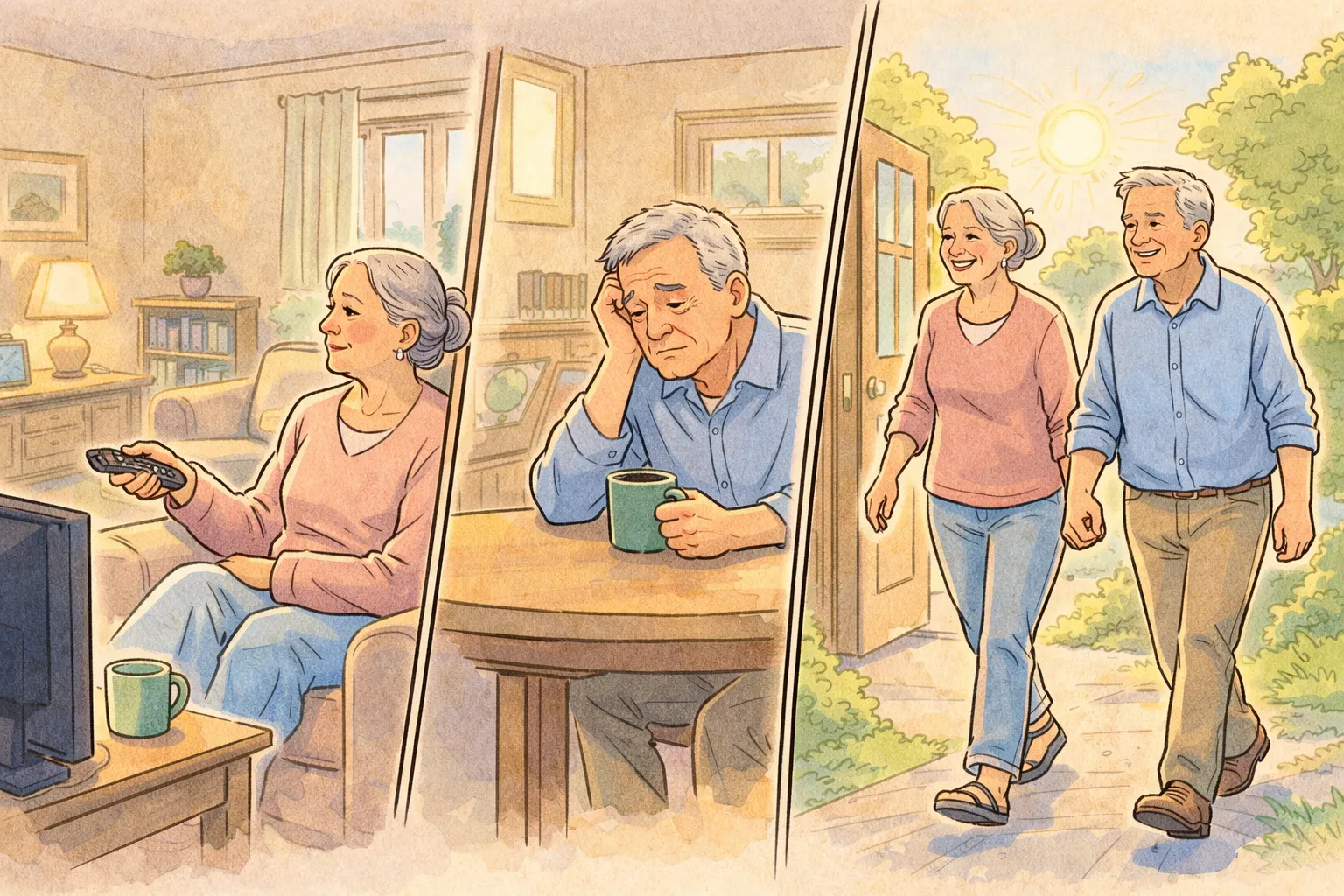
Panoramic comic-style illustration showing retirees staying indoors feeling low energy versus going outside feeling refreshed and active
“I didn’t go anywhere today.”
At first, that feels comfortable.
No traffic.
No pressure.
No schedule.
Just quiet.
But when many days start to look like this…
Something slowly changes.
Not suddenly.
Not dramatically.
But noticeably.
1. Why staying home feels good at first
After retirement, staying home can feel like relief.
no commute
no deadlines
no obligations
Home becomes a safe space.
And that’s a good thing.
2. When comfort turns into pattern
The problem is not staying home.
The problem is staying home too consistently.
When days repeat like this:
wake up
sit
move around the same space
minimal outside interaction
Your world quietly shrinks.
3. Your brain needs variation
The human brain responds to change.
Different places
Different faces
Different small experiences
When everything stays the same:
stimulation drops
alertness drops
energy drops
This is why long periods at home can feel oddly tiring.
4. The “slow blur” effect
Many retirees describe this feeling:
Days start blending together.
Monday feels like Wednesday.
Morning feels like afternoon.
There are fewer markers in the day.
This creates a sense of:
time moving strangely
lack of clarity
reduced motivation
5. Movement becomes minimal
At home, movement is limited.
fewer steps
less walking
less standing
more sitting
Even if you feel “rested,”
Your body slowly loses energy.
6. Social interaction drops quietly
This is one of the biggest changes.
Without realizing it, you may have:
fewer conversations
less eye contact
fewer spontaneous interactions
Even small interactions matter more than we think.
7. Mood becomes flatter
When environment and routine don’t change much:
Mood often becomes:
neutral
low-energy
slightly disconnected
Not depressed.
Just… flat.
8. The key problem is not laziness
This is important.
Staying home too much is not about laziness.
It’s about lack of variation.
Your brain and body are responding exactly as expected.
9. A simple way to fix it
You don’t need a busy life.
You need small changes.
Try:
stepping outside once a day
changing rooms intentionally
short walks
visiting one place weekly
brief social contact
Small changes → big impact
10. The 3-exposure rule
A simple structure:
Each day, include at least:
outside exposure
movement
human interaction
Even small versions count.
11. Real-life example
Carol, 71:
“I didn’t feel bad. Just… dull.”
She started going outside for 10 minutes every morning.
That alone made her feel more awake.
David, 68:
“I didn’t realize how little I was moving.”
He added one short walk after lunch.
His energy improved within a week.
12. Signs you may be staying home too much
days feel repetitive
you feel slightly tired without reason
you delay going outside
your mood feels flat
you move less than before
you have fewer conversations
If this feels familiar, it’s not a problem.
It’s a signal.
Quick checklist
did I go outside today?
did I move my body?
did I talk to someone?
did I change my environment at least once?
If not, tomorrow is a new chance.
The key insight
Home should feel safe.
Not limiting.
Conclusion
Staying home is comfortable.
But too much comfort can quietly reduce energy, clarity, and mood.
You don’t need a full schedule.
You need small variation.
That’s what keeps retirement feeling alive.
Disclaimer
This content is for general educational purposes only and does not consider individual health or psychological conditions. If prolonged low mood or isolation occurs, consult a qualified professional.
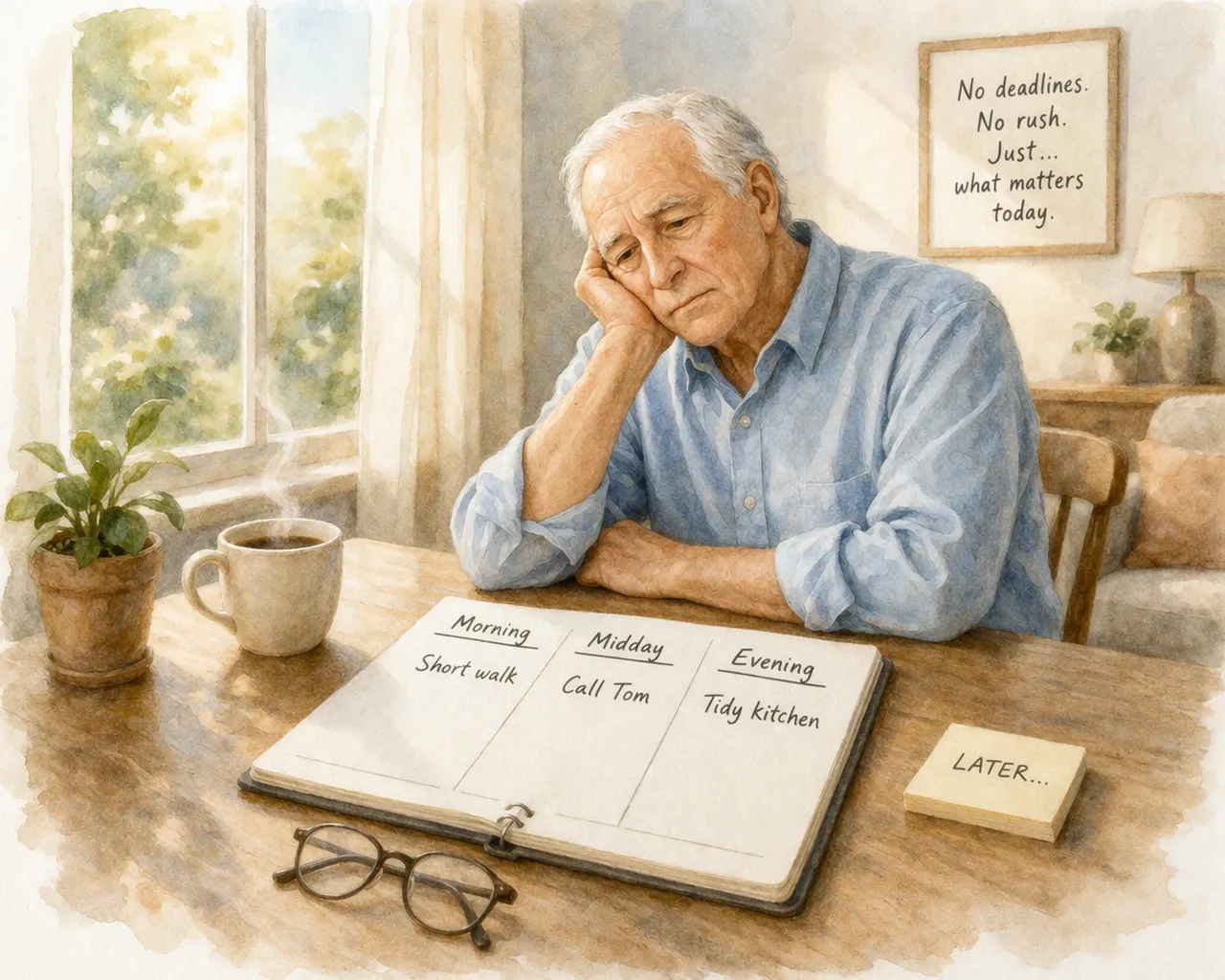
Older adult sitting quietly with a blank planner looking unsure how to start the day
“Nothing really needs to be done today… so why do I feel stuck?”
This is a quiet but very real experience after retirement.
No deadlines. No boss. No urgent emails.
At first, this feels like freedom.
But over time, something strange happens.
You start to feel:
unmotivated
slow to start the day
unsure what matters
mentally stuck
Not because you’re lazy.
But because nothing feels urgent anymore.
1. Why urgency disappears after retirement
During working years, urgency is built into life.
deadlines
meetings
responsibilities
expectations
These create structure automatically.
After retirement, that structure disappears.
And with it, urgency disappears too.
2. Why this creates a problem
You might think:
“No urgency = less stress”
But in reality:
No urgency can lead to:
delayed decisions
endless postponing
low energy
loss of direction
Without urgency, the brain struggles to prioritize.
3. The brain needs signals
Your brain works best when it has:
clear start points
clear reasons to act
small levels of pressure
Without these, everything feels optional.
And when everything is optional…
Nothing gets done.
4. The “I’ll do it later” loop
This is the most common pattern:
“I’ll go for a walk later.” “I’ll organize that tomorrow.” “I’ll call them sometime.”
Later becomes:
next day
next week
never
This creates a quiet mental burden.
Unfinished tasks drain energy.
5. The hidden emotional effect
When nothing feels urgent, you may start feeling:
slightly restless
mentally foggy
oddly tired
unaccomplished
Even if your day was “easy”
That’s because progress—not pressure—creates satisfaction.
6. The simple fix: gentle urgency
You don’t need stress.
You need light structure.
Think of it as “gentle urgency.”
Not pressure.
Just direction.
7. The 3-anchor day method
A simple solution:
Create 3 small anchors each day.
Morning Midday Evening
Each anchor = one small action.
Example:
Morning → short walk Midday → one task (call, errand) Evening → simple reset (tidy, plan)
That’s it.
8. Why this works
This method works because it:
gives your brain direction
creates light momentum
reduces decision fatigue
builds natural rhythm
You’re not forcing productivity.
You’re creating flow.
9. Real-life example
Mark, 70, said:
“I didn’t feel busy—but I also didn’t feel good.”
He started using a simple rule:
“One thing before lunch.”
That alone changed his days.
Linda, 67:
“I stopped waiting to feel like doing things.”
Instead, she picked one small action each morning.
Her words:
“That small start fixed everything.”
10. Signs you need more structure
You delay simple tasks
Days feel long but unproductive
You feel low energy without reason
You keep saying “later”
You don’t feel satisfied at the end of the day
If this feels familiar, you don’t need more discipline.
You need more clarity.
11. What not to do
Avoid:
over-scheduling your day
creating long to-do lists
forcing productivity
comparing yourself to your working years
This is not about doing more.
It’s about starting easier.
12. A better mindset
Instead of asking:
“What do I have to do today?”
Ask:
“What is one thing that will move my day forward?”
That one shift changes everything.
Quick checklist
choose 1 morning action
choose 1 practical task
choose 1 small reset
avoid “later” thinking
keep it simple
The key insight
Retirement doesn’t remove urgency.
It removes external urgency.
You replace it with gentle, internal direction.
Conclusion
When nothing feels urgent, life can feel slow and unclear.
The solution is not pressure.
It’s small structure.
A little direction each day creates:
better energy
clearer thinking
more satisfying days
That’s what makes retirement feel good again.
Disclaimer
This content is for general educational purposes only and does not consider individual mental health or medical conditions. If persistent lack of motivation or fatigue occurs, consult a qualified professional.
Older adults planning spring appointments and a small trip at a cozy table with calendar, travel notes, and flowers in a bold-line pastel cartoon panorama illustration.
Cindy’s Column × Senior AI Money
Spring can feel like life suddenly speeds up.
The weather improves. Appointments pile back onto the calendar. Family events restart. Gardening begins. Short trips sound appealing again. House projects reappear. Everyone seems to want to “make the most” of the season.
That sounds positive.
But for many adults over 55, spring can also become one of the most overloaded times of year.
One doctor visit turns into three. A simple day trip becomes a full week of errands. A family plan lands next to a dental check, a car service appointment, and a home repair window. What should feel fresh starts to feel crowded.
The problem is usually not poor motivation.
It is poor spacing.
A lot of retirees and older adults are no longer dealing with office deadlines, but they are still dealing with limited energy, appointment coordination, transportation time, health routines, recovery time, and the mental cost of too many “small” commitments landing too close together.
That is why good spring planning is not about doing more.
It is about arranging the season so your calendar still feels livable.
This guide is for adults 55+ who want to handle appointments, errands, small trips, and social plans without turning spring into a month of constant catch-up.
Why spring gets crowded so fast
Spring planning problems are rarely caused by one giant event.
They come from stacking.
Individually, each plan feels reasonable:
a checkup a specialist follow-up a lunch with friends a short family visit a garden center stop a car inspection a local trip a community event
But when they all land in the same two weeks, life starts to feel cramped.
That matters more after 55 because the “cost” of an outing is not just the hour on the calendar.
It often includes:
getting ready driving or arranging a ride parking walking waiting sitting in uncomfortable chairs eating at odd times taking medications on schedule recovering energy afterward
A one-hour appointment can easily behave like a three-hour energy event.
That is why many older adults feel confused by their own calendars.
They look at the week and think,
“This doesn’t even seem that busy.”
But it feels busy because the events are not spaced for reality.
The spring planning rule
Schedule by energy, not by empty spaces on the calendar.
That is the difference between a realistic plan and an overloaded one.
An empty Tuesday afternoon does not automatically mean you should put something there.
The better question is:
What does this week already ask of my body, attention, transportation, and recovery time?
That shift changes everything.
Instead of planning from available time, you plan from total load.
That makes your schedule calmer and much more sustainable.
Part 1: Sort plans into three levels
One of the best ways to reduce spring overload is to stop treating every commitment like it belongs in the same category.
Not all plans cost the same amount of effort.
A practical system is to sort your spring plans into three levels:
Level 1: Must-Happen Plans Medical appointments insurance deadlines tax-related tasks medication refills necessary home or car service family obligations that are truly fixed
Level 2: Helpful but Flexible Plans routine errands social lunches seasonal shopping home projects garden center visits haircuts community activities
Level 3: Joy Plans day trips museum days lunch outings family fun short travel spring events that add pleasure rather than pressure
This matters because many people put joy plans directly on top of must-happen plans and then wonder why even the fun things feel tiring.
The real solution is not to remove joy.
It is to place joy where it can actually be enjoyed.
Part 2: Use “anchor days” instead of filling every gap
A calmer spring calendar usually has structure.
One of the easiest structures is the anchor-day method.
Pick certain kinds of days for certain kinds of tasks.
For example:
Monday = admin and phone calls Tuesday = appointments Wednesday = home and rest Thursday = errands or social plans Friday = flexible or fun Weekend = family or recovery
This does not need to be rigid.
It simply reduces the constant mental work of deciding everything from scratch.
When the calendar has anchors, the week feels easier to steer.
You stop scattering appointments randomly.
You stop putting a doctor visit and a lunch outing on the same day just because “it fit.”
You stop creating accidental marathon days.
Table 1. A simple spring week structure for seniors
Day Type
Best Use
Why It Helps
Appointment day
Doctor, dentist, labs, car service
Keeps logistics grouped
Recovery day
Rest, light chores, quiet home time
Protects energy
Errand day
Grocery, pharmacy, bank, seasonal supplies
Prevents small tasks from spreading everywhere
Social day
Lunch, family visit, club, coffee
Leaves space to enjoy people
Flexible day
Backup plans, weather shifts, rescheduling
Reduces calendar stress
Joy day
Day trip, garden outing, museum, scenic drive
Keeps spring from becoming all obligation
This is not about making retirement feel like work.
It is about preventing the week from feeling shapeless and crowded at the same time.
Part 3: Never stack two “energy events” back to back if you can avoid it
An older adult’s schedule should be planned not only by clock time but by energy demand.
Some activities are low-load.
Others look small on paper but are high-load.
Examples of high-load events:
medical appointments long drives large family gatherings days with lots of walking bureaucratic tasks home-repair visits that require waiting around anything involving uncertainty or delays
If you put two high-load events back to back, spring starts feeling like a series of little crashes.
For example:
Tuesday: specialist visit Wednesday: family lunch across town Thursday: car service wait and pharmacy stop
None of these is outrageous.
Together, they are tiring.
That is why spacing matters more than ambition.
A better version might be:
Tuesday: specialist visit Wednesday: light home day Thursday: family lunch Friday: flexible or quiet errand day
The second version often feels dramatically easier even though the same tasks still happen.
Part 4: Build your trips around what week you are already having
Many people plan spring trips as if travel exists outside real life.
It does not.
A day trip or overnight outing lands on top of your actual week.
That means the best time for a small spring trip is not simply when the weather looks nice.
It is when the surrounding days are light enough to hold it.
Before adding a trip, ask:
Do I already have appointments this week? Will I need recovery time after the trip? Is there a refill, lab visit, delivery window, or service appointment nearby? Will this trip compete with sleep, meal routine, or medications? Do I actually want the outing, or do I just feel like I “should get out more”?
That last question is important.
Not every open day needs to become a trip.
And not every beautiful spring weekend needs to be used.
The best trip weeks are the weeks with room around them.
Part 5: Plan spring in blocks, not one date at a time
A lot of calendar stress comes from planning one thing at a time.
You agree to lunch.
Then schedule an appointment.
Then add a day trip.
Then remember a blood test.
Then book a haircut.
Then realize the same week now feels too full.
A better method is to look at spring in blocks.
Try reviewing the next 2 to 4 weeks at once.
Ask:
Which week already has the most obligations? Which week looks lighter? Where are the likely transportation-heavy days? Where can I place one enjoyable outing without crowding the rest?
This is especially useful in spring because seasonal tasks can arrive in clusters.
Examples:
garden prep tax wrap-up medical follow-ups house airing and cleaning family holiday plans spring clothing or shoe replacements local events opening back up
When you see the month in blocks, overload becomes easier to prevent.
Table 2. Spring planning mistakes vs. better choices
Common Mistake
Better Choice
Why It Works
Putting appointments wherever they fit
Group them into one or two likely days
Reduces mental clutter
Scheduling fun after a tiring appointment
Put fun on lighter days
Protects enjoyment
Treating every outing like “just one more thing”
Count travel and recovery too
Reflects real energy cost
Filling every good-weather day
Leave some open
Prevents resentment and fatigue
Planning week by week only
Look ahead 2 to 4 weeks
Helps balance the season
Saying yes before checking your full load
Pause and review the week first
Lowers overcommitment
Part 6: The “one big thing” limit
A very useful rule for spring is this:
Do not place more than one big thing in a day, and often not more than one big thing in a week section.
A “big thing” can be:
a medical appointment across town a long lunch visit a museum outing a home contractor window a family gathering a long errand loop a day trip
This does not mean your life has to become small.
It means you stop underestimating how much bandwidth ordinary life already uses.
For many retirees, a much calmer spring rhythm looks like this:
one main appointment day one errand block one social or fun plan everything else light
That may sound modest.
But it is often exactly what makes the season feel good instead of rushed.
Part 7: Use a “spring buffer list”
Some plans do not need a date yet.
That is where a spring buffer list helps.
This is a short list of things you want to do soon, but not necessarily this week.
Examples:
visit the garden center take a scenic drive plan an overnight visit with family go to the farmers market clean the porch schedule eye exam replace walking shoes book a local museum day
The buffer list matters because it prevents false urgency.
You stop treating every good idea like an immediate calendar event.
Instead, you hold it in a visible place and choose from it when the week actually has room.
This is one of the best ways to enjoy spring without turning it into a race.
Part 8: Real examples
Elaine, 71
Elaine kept feeling like her spring calendar was “mysteriously exhausting.” She had not scheduled anything dramatic. But once she looked closely, she realized she was putting appointments, social plans, and seasonal errands on consecutive days. She switched to appointment Tuesdays, quiet Wednesdays, and optional Fridays for joy plans. Within two weeks, the same amount of activity felt much easier because it was spaced better.
Robert, 67
Robert likes to make the most of good weather, so he kept adding extra errands to outing days. A simple dermatologist appointment would become lunch out, a hardware stop, grocery shopping, and a car wash. By evening he was wiped out. His fix was simple: one purpose per outing day, with one optional add-on only if energy still felt good. He said the biggest surprise was how much calmer his weeks felt.
Marsha, 64
Marsha wanted to take more spring day trips but kept choosing busy weeks. She would plan a scenic outing and then realize it was sitting next to dental work, a prescription refill run, and a family birthday. She started scanning each month for one “light week” and placed travel there first. Her trips immediately felt more restorative because they stopped competing with everything else.
Part 9: Use “good enough” planning, not perfect planning
A lot of spring overload comes from trying to optimize every week.
Perfect weather. Perfect timing. Perfect attendance. Perfect use of retirement freedom.
That pressure is part of the problem.
You do not need the perfect spring calendar.
You need a workable one.
Good enough planning looks like this:
appointments are visible trip weeks are not crowded recovery time exists there is room for joy not every day is spoken for you can still say yes without paying for it three days later
That is success.
Part 10: What a well-planned spring should feel like
A good spring plan should not look impressive.
It should feel breathable.
You should be able to look at the week and know:
when you need to leave the house when you can rest when you can enjoy something when you should not add one more thing where the margin is
This is what many older adults actually want from planning:
not maximum activity,
but steadiness.
Checklist: Spring Planning Without Overloading Yourself
✔ Write down all fixed appointments first ✔ Separate must-happen plans from flexible plans ✔ Put joy plans in the calendar only after checking total load ✔ Avoid stacking two high-energy events on back-to-back days ✔ Use anchor days for appointments, errands, and rest ✔ Leave at least one true buffer day most weeks ✔ Check the next 2 to 4 weeks before saying yes ✔ Keep a spring buffer list for nice ideas that do not need a date yet ✔ Count drive time and recovery time as real calendar cost ✔ Limit each day to one main event when possible ✔ Place trips in lighter weeks, not crowded ones ✔ Use weather windows wisely but do not chase every good day ✔ Protect medication, meals, and rest routines ✔ Review the calendar once a week instead of constantly adjusting it ✔ Aim for a breathable season, not a packed one
EEAT note
This article is practical planning guidance for older adults and is designed to help readers manage appointments, travel, and seasonal commitments more comfortably. It is not medical or mental health treatment. Adults managing fatigue, chronic illness, mobility changes, cognitive strain, or recent health events may need to plan with even more spacing and should use personalized guidance when appropriate.
Final thought
Spring should feel like re-entry, not overload.
The best calendar is not the fullest one.
It is the one that lets you handle what matters, enjoy what is good, and still have enough energy left to feel like the season belongs to you.
Space is part of the plan.
And in spring, spacing is often what makes everything else work.
Disclaimer
This article is for general educational purposes only and does not provide medical, mental health, transportation, or legal advice. Individual health status, mobility, driving tolerance, medication schedules, caregiving duties, and family obligations vary. Readers should plan according to their real needs and consult qualified professionals when scheduling around important health or safety concerns.
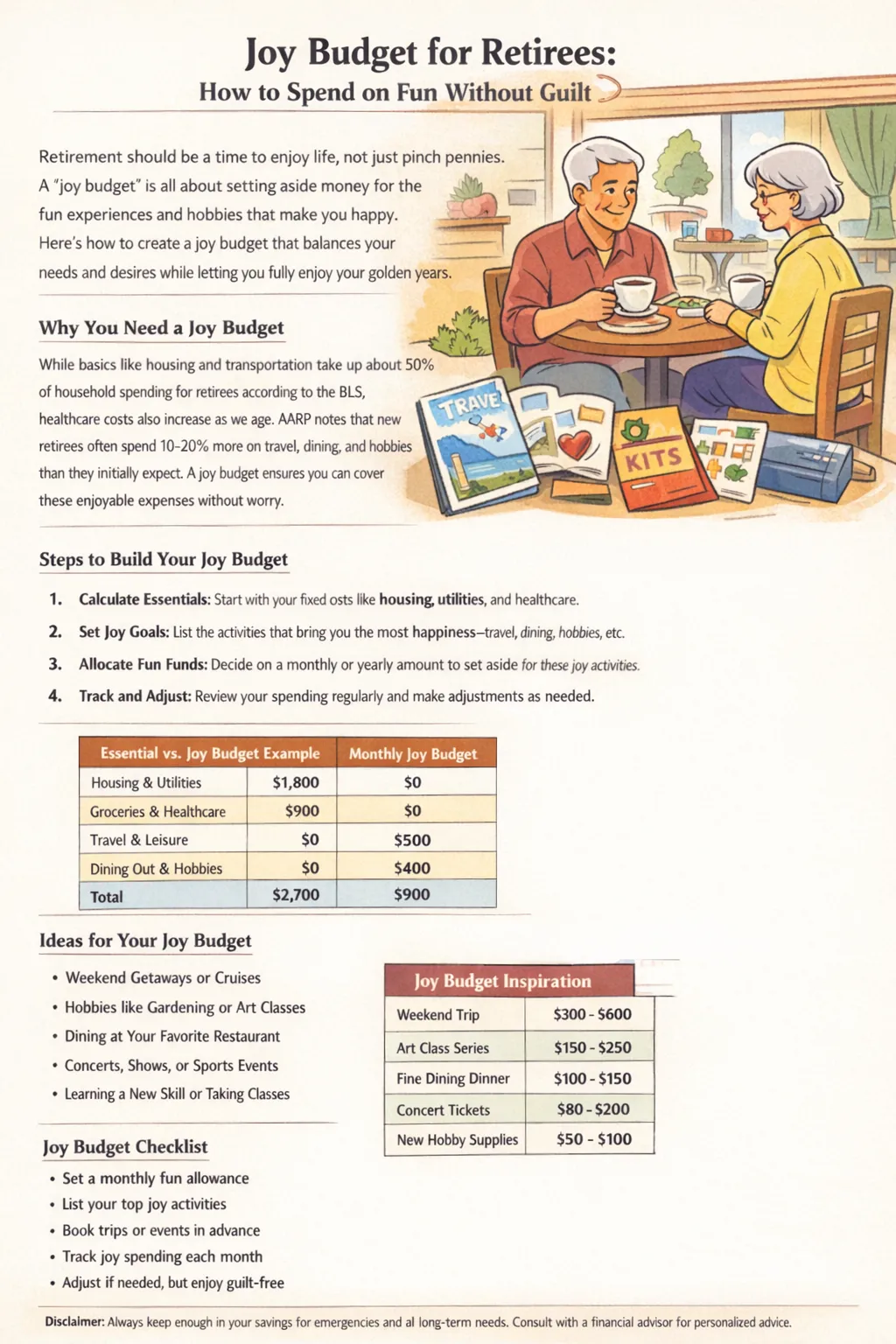
A joy budget helps retirees enjoy hobbies, outings, and small pleasures without letting random spending take over the month.
Cindy’s Column × Senior AI Money
Retirement money advice often sounds serious for a reason.
Protect your savings. Control fixed expenses. Watch inflation. Plan for healthcare. Avoid lifestyle creep.
All of that matters.
But there is another truth that matters too:
If your budget only protects survival and never protects joy, it starts to feel like punishment.
A lot of retirees do not overspend because they are careless. They overspend because they never gave fun a proper place in the plan.
So the spending happens in a scattered way:
a lunch here a gift there an impulse day trip another streaming subscription a hobby purchase that “doesn’t count” a weekend away that somehow ends up on the credit card
That is exactly why a joy budget works.
A joy budget is not reckless spending.
It is a small, intentional part of your retirement plan that gives money a job beyond bills, groceries, medication, and maintenance. It lets you enjoy retirement without pretending enjoyment is irresponsible.
That matters because housing and transportation still take a large share of household spending overall, and retiree households have historically spent a higher share of income on healthcare than average. At the same time, AARP notes that people in early retirement often spend 10 to 20 percent more on discretionary items than they expected.
The goal is not to spend more.
The goal is to spend on purpose.
What a joy budget really means
A joy budget is a pre-decided amount of money for things that make life feel lighter, warmer, more meaningful, or more enjoyable.
That can include:
coffee dates hobby supplies lunch out movie tickets short trips gardening upgrades family outings craft classes museum days seasonal treats small comforts that help you feel like life is still being lived
This is not the same as “miscellaneous.”
Miscellaneous spending usually leaks.
Joy spending should be named.
That is the key shift.
When joy gets named, it becomes easier to control.
When it is unnamed, it often becomes emotional spending disguised as “just this once.”
Why retirees need a joy budget
Retirement is not only a math problem.
It is also a lifestyle transition.
Your time changes.
Your routines change.
Your sense of reward changes.
For many people, work once provided structure, identity, and built-in treats:
the drive for coffee,
the lunch out,
the trip after a busy quarter,
the excuse to buy something useful.
Once retirement begins, spending can get strange.
Some retirees become so cautious that they stop enjoying money they can responsibly use.
Others swing the other way and spend freely because retirement feels like a long-delayed reward.
Neither extreme feels steady.
A joy budget helps because it creates permission with limits.
You do not have to ask every week:
“Can I afford this?”
“Should I feel guilty about this?”
“Am I being too tight?”
“Am I being irresponsible?”
You already decided.
That makes the spending calmer.
The joy budget rule
Fund joy after essentials, before random spending.
That order matters.
If joy comes before essentials, the budget becomes unstable.
If joy comes after random spending, joy disappears.
So the basic order is:
essentials savings buffer planned joy everything else
This is especially useful in retirement because income may be fixed while spending is uneven.
Some months are calm.
Other months bring home repairs, healthcare bills, travel invitations, birthdays, or sudden family expenses.
A joy budget helps you protect a small quality-of-life amount without pretending every month will feel identical.
Part 1: Start with the real floor, not the fantasy floor
Before you can build a joy budget, you need a clear view of what your month already requires.
That means your true non-negotiables:
housing utilities groceries insurance medications transportation minimum debt payments phone and internet basic household supplies
Be honest here.
A lot of retirees underestimate their monthly floor because they forget irregular necessities like:
car registration co-pays home maintenance gifts pet care seasonal clothing annual subscriptions appliance replacement
A joy budget only works when it sits on a realistic base.
If the base is too optimistic, joy money will get blamed later for problems it did not create.
Part 2: Decide what “joy” actually means to you
A useful joy budget is personal.
Not all retirees want the same things.
For one person, joy is travel.
For another, it is lunch with friends twice a month.
For another, it is taking grandchildren out for ice cream.
For another, it is fresh flowers, better coffee, art supplies, books, or music events.
That is why copying someone else’s retirement lifestyle is expensive.
The better question is:
What spending makes me feel most alive, most connected, or most restored?
Some joy spending gives a high emotional return for a low dollar amount.
Examples:
library café date local garden center visit baking supplies museum membership monthly breakfast with a friend craft materials small upgrades to a favorite hobby
Some joy spending is larger and needs planning.
Examples:
weekend travel family reunion trip concert tickets seasonal classes major hobby equipment
The point is not to eliminate joy.
The point is to choose the joy that matters most.
Table 1. Common joy categories for retirees
Joy Category
Small Monthly Version
Planned Larger Version
Why It Works
Social joy
Coffee, lunch, cards, local meetups
Birthday dinner, small gathering
Supports connection
Hobby joy
Yarn, seeds, books, art supplies
Class series, equipment, workshop
Keeps the week interesting
Comfort joy
Better coffee, flowers, streaming, bakery treats
Recliner upgrade, patio refresh
Improves daily life
Experience joy
Museum day, day trip, movie
Weekend getaway, event tickets
Creates memories
Family joy
Treats for grandkids, shared meals
Holiday outing, family travel
Builds meaning
Health-linked joy
Pool pass, walking shoes, yoga class
Wellness retreat, fitness program
Supports energy and routine
Part 3: Set one number, not ten vague promises
This is where many people get stuck.
They say things like:
I’ll just be careful.
I won’t eat out too much.
I’ll see how the month goes.
I’ll only spend when it feels worth it.
That sounds responsible, but it is not a real system.
A joy budget needs a number.
It can be monthly or annual.
Examples:
$100 a month
$250 a month
$400 a month
$1,200 a year for day trips
$2,400 a year for travel and fun
There is no magic number.
The right number depends on your cash flow, obligations, emergency cushion, and priorities.
A practical starting point is to choose a number small enough to feel safe and large enough to feel real.
If it is too tiny, you will ignore it.
If it is too big, you will not trust it.
AARP budgeting advice for older adults emphasizes separating discretionary from nondiscretionary expenses and building contingency room, which fits this approach well.
Part 4: Use “joy buckets” so fun spending does not sprawl
One joy budget can still feel messy unless you divide it.
Try three simple buckets:
Everyday Joy Small weekly or monthly treats
Social Joy Meals, coffees, outings, small gifts, events with others
Big Joy Trips, tickets, larger hobby costs, family experiences
This matters because not all fun spending should compete with itself.
If one restaurant dinner wipes out the entire month’s fun money, the budget starts to feel harsh again.
Buckets make it easier to balance:
small pleasures now,
larger pleasures later.
Example:
$250 monthly joy budget
$80 Everyday Joy $70 Social Joy $100 Big Joy sinking fund
That means not every dollar must be spent this month.
Some of it can wait for the thing you truly care about.
Part 5: Stop guilt-spending and stop revenge-spending
Retirees often fall into one of two patterns.
Guilt-spending:
You buy something enjoyable, then feel uneasy, then over-correct by becoming extremely restrictive.
Revenge-spending:
You have been too strict for too long, then suddenly decide, “I’m retired. I deserve this,” and spend without structure.
Neither pattern is really about the item purchased.
It is about the absence of a plan.
A joy budget helps because it turns emotion into policy.
You no longer have to negotiate every pleasure from scratch.
You simply check:
Is it within the joy budget?
Does it fit this month’s plan?
Would I rather save this amount for a better joy purchase later?
That is a much steadier conversation.
Part 6: Use the “best memory per dollar” test
Not all joy spending is equal.
Some purchases feel expensive and forgettable.
Others feel modest and meaningful.
A strong retirement budget favors high-memory, high-value spending.
Ask:
Will I remember this next month?
Does this improve my week or just my mood for 20 minutes?
Does this fit my actual energy level?
Would I enjoy a simpler version just as much?
Am I buying joy or buying relief from stress?
That last question matters.
Buying joy and buying relief are not always the same thing.
If you are bored, lonely, anxious, or restless, spending can briefly feel like emotional treatment.
That is when the budget starts drifting.
The better goal is not “never spend emotionally.”
It is “notice what kind of spending this really is.”
Part 7: Real examples
Elaine, 68
Elaine and her husband were doing fine financially, but she felt guilty every time they spent money on anything “nonessential.” That created a strange pattern: months of extreme restraint followed by expensive restaurant weekends. They switched to a joy budget of $300 per month. They used $120 for social meals, $80 for local outings, and $100 for a travel sinking fund. After four months, Elaine said the biggest change was not the spending itself. It was the lack of self-argument.
David, 72
David lived alone and realized his random spending was not on luxury. It was on boredom. Convenience food, subscriptions he barely used, and impulse hobby purchases were quietly adding up. He replaced that with a $150 joy budget: $40 for coffee and reading outings, $35 for gardening, $25 for music, and $50 saved monthly for small trips. His spending became lower, but his enjoyment became higher because it was chosen.
Marsha, 64
Marsha had recently retired and wanted travel to be part of her life, but she did not want every trip to trigger anxiety. She created two levels of joy spending: $200 monthly for ordinary fun and a separate annual travel goal funded automatically. She discovered that small weekly pleasures actually reduced her urge for expensive “escape spending.” Her words were simple: “I stopped acting like joy had to be huge to count.”
Part 8: Plan joy around the calendar, not just the month
Some retirement spending is seasonal.
Spring may bring gardening and travel.
Summer may bring family outings.
Fall may bring hobbies, classes, and local events.
December may bring gifts and gatherings.
That means monthly budgeting alone can be too flat.
A better system is to look ahead 3 to 6 months.
Ask:
What fun expenses are likely coming?
Which ones matter most?
Which ones can I fund slowly?
This is especially relevant in 2026 because older adults continue to prioritize discretionary spending like travel while still being cost-conscious about it, according to AARP’s 2026 travel trends reporting.
So instead of pretending that joy is spontaneous, plan for it.
Planned joy usually feels better than panicked joy.
Table 2. Example joy budget by monthly income comfort level
Monthly Cash-Flow Comfort
Suggested Joy Budget Range
Best Structure
Tight
$50–$125
Focus on small recurring treats and free/low-cost outings
Moderate
$125–$300
Mix of monthly joy and one sinking fund
Comfortable
$300–$600
Social, hobby, and travel buckets
Very Comfortable
$600+
Layered approach with annual experience planning
This is not a rule.
It is a planning guide.
The best number is the one that protects both stability and enjoyment.
Checklist: Joy Budget Setup for Retirees
✔ List your true monthly essentials first ✔ Include irregular necessary costs before setting joy money ✔ Define what “joy” means for your life, not someone else’s ✔ Choose one monthly joy number ✔ Split joy into small buckets if needed ✔ Create a sinking fund for bigger experiences ✔ Track joy spending separately from groceries and bills ✔ Use low-cost joy on tired or quiet weeks ✔ Plan seasonal fun ahead of time ✔ Ask which purchases create the best memory per dollar ✔ Notice when spending is really stress relief ✔ Review the joy budget once a month without guilt ✔ Increase or reduce the number based on reality, not shame ✔ Protect emergency savings and major essentials first ✔ Let joy be intentional, not accidental
Part 9: What not to do
Do not call every unplanned purchase “joy.”
That turns the category into an excuse.
Do not make the joy budget so strict that it feels like punishment.
That usually causes backlash spending.
Do not compare your joy spending to wealthier retirees.
Someone else’s cruise habit is not your budget.
Do not assume low-cost joy is lesser joy.
For many retirees, routine pleasures create more happiness than occasional big expenses.
Do not forget that companionship, novelty, beauty, movement, and creativity all count as joy.
It is not only about travel.
EEAT note
This article is practical budgeting guidance for older adults and is meant to support thoughtful retirement spending, not replace individualized financial planning. It draws on current consumer spending data and retirement budgeting guidance showing that essentials remain heavy, healthcare can take a larger share for retirees, and discretionary spending can rise unexpectedly without a plan.
Final thought
A good retirement budget does not only keep you safe.
It keeps you human.
It makes room for connection, curiosity, pleasure, and memory.
A joy budget is not careless.
It is one of the cleanest ways to enjoy what you have without letting enjoyment quietly run the month.
Spend on purpose.
Save on purpose.
Enjoy on purpose.
Disclaimer
This article is for general educational purposes only and does not provide individualized financial, tax, investment, retirement-income, or legal advice. Retirement budgets vary based on income sources, savings, debt, health costs, family obligations, and risk tolerance. Readers should review their situation carefully and consult a qualified financial professional when making major spending or withdrawal decisions.
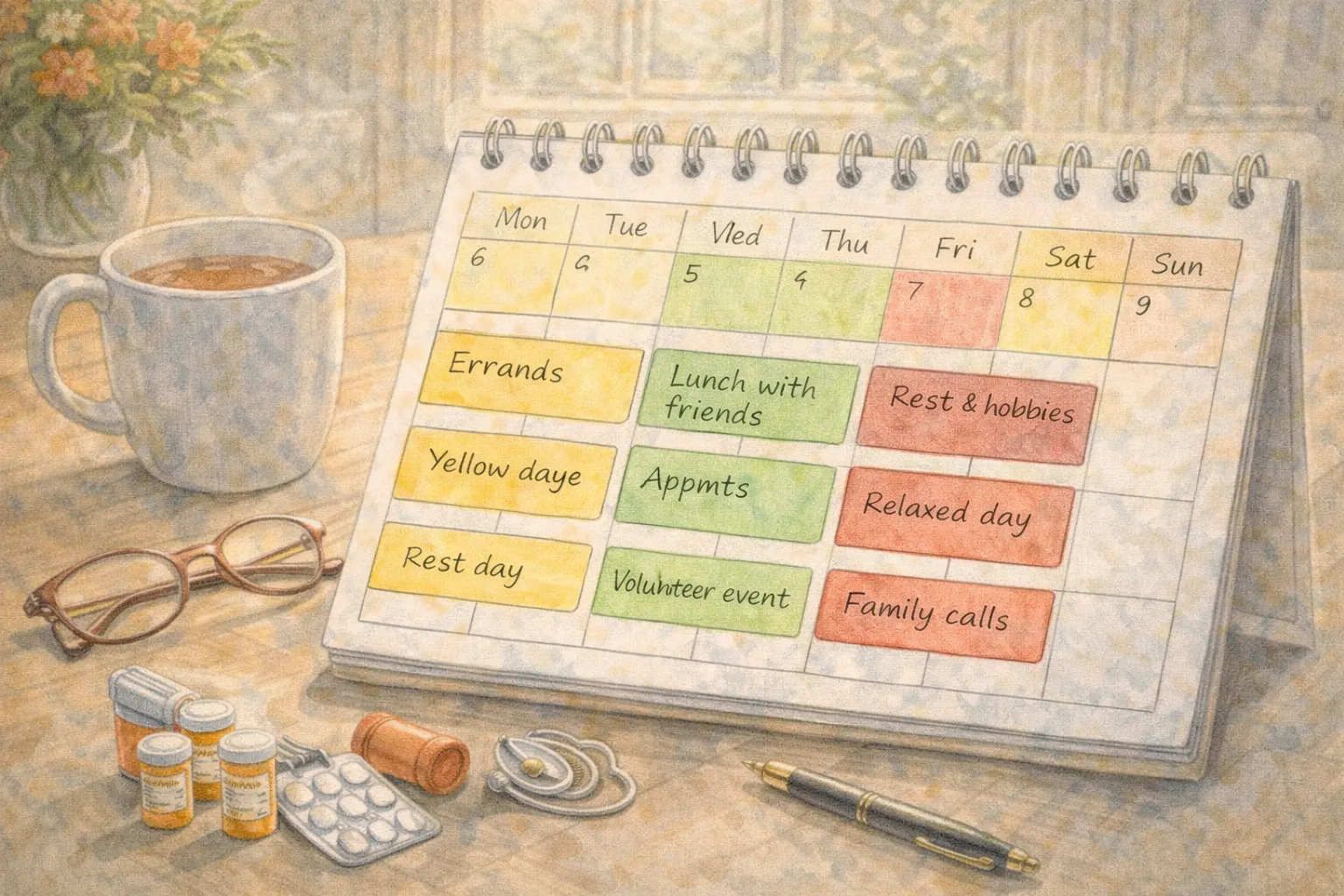
Color-coded calendar planning helps retirees balance activities with energy and rest.
Cindy’s Column × Senior AI Money
Retirement is supposed to feel freer.
But many retirees discover something surprising.
Their calendar slowly fills again.
Appointments. Family requests. Volunteer work. Medical visits. Social events.
Soon the week feels crowded.
Not because the activities are bad — but because energy becomes the real limit after 55.
This is where a simple planning system can help.
It’s called the Calm Calendar Method.
Instead of scheduling based only on time, this method schedules based on energy levels.
Why retirees often feel overbooked
Many retirees want to stay active.
That’s healthy.
But overbooking can create:
fatigue
missed rest days
stress before appointments
reduced enjoyment of activities
The issue is rarely motivation.
The issue is energy management.
Energy changes daily after 55.
Planning with energy in mind creates a more balanced schedule.
The Calm Calendar Rule
Every week should contain:
• Green days • Yellow days • Red days
Each type of day has a different purpose.
Table: The Calm Calendar System
Color
Meaning
Example Activities
Green
High-energy day
social plans, outings
Yellow
Moderate day
errands, appointments
Red
Rest day
home time, recovery
A balanced week includes all three types.
Part 1: Green days (active days)
Green days are when energy feels stronger.
Good activities for these days:
meeting friends
longer outings
travel days
social events
volunteer work
Try to limit green days to 2–3 per week.
Too many active days can create fatigue later.
Part 2: Yellow days (light activity days)
Yellow days are practical days.
Examples include:
grocery shopping
doctor appointments
small errands
light household tasks
These days keep life organized without draining energy.
Part 3: Red days (recovery days)
Red days are intentional rest days.
They are not lazy days.
They are recovery days.
Healthy red-day activities:
reading
light stretching
quiet hobbies
short walks
calling family
At least 1–2 red days per week can protect long-term energy.
Table: Example Weekly Energy Calendar
Day
Energy Type
Activity
Monday
Yellow
errands
Tuesday
Green
lunch with friends
Wednesday
Red
rest and hobbies
Thursday
Yellow
appointments
Friday
Green
community event
Saturday
Red
relaxed day
Sunday
Yellow
family calls
This rhythm keeps the week balanced.
Part 4: The “one big thing” rule
Each day should have only one major activity.
Examples:
✔ doctor visit ✔ meeting a friend ✔ grocery trip
Avoid stacking several large tasks in one day.
Spacing activities protects energy.
Part 5: How to say “not today”
Many retirees feel pressure to accept every invitation.
But it is healthy to respond like this:
“Thursday doesn’t work for me — how about next week?”
Or:
“I’m keeping that day quiet, but another day would be nice.”
Protecting your schedule protects your wellbeing.
Real-life examples
David, 73
“I started marking my calendar with colors. I realized I had no rest days.”
Linda, 69
“Now I keep Wednesdays as red days. I feel much less tired.”
Robert, 76
“Spacing appointments changed everything.”
Printable Calm Calendar Checklist
✔ plan 2–3 green days ✔ schedule errands on yellow days ✔ protect 1–2 red days ✔ limit one major activity per day ✔ leave space between appointments
The goal is a calmer weekly rhythm.
The real benefit of energy planning
A calm calendar doesn’t reduce activity.
It improves how activities feel.
When energy is respected, retirement becomes more enjoyable.
Disclaimer
This article is for general educational purposes only and does not provide medical, psychological, or professional advice. Energy levels, health conditions, and lifestyle needs vary among individuals. Readers should consult qualified professionals regarding personal health or scheduling needs.