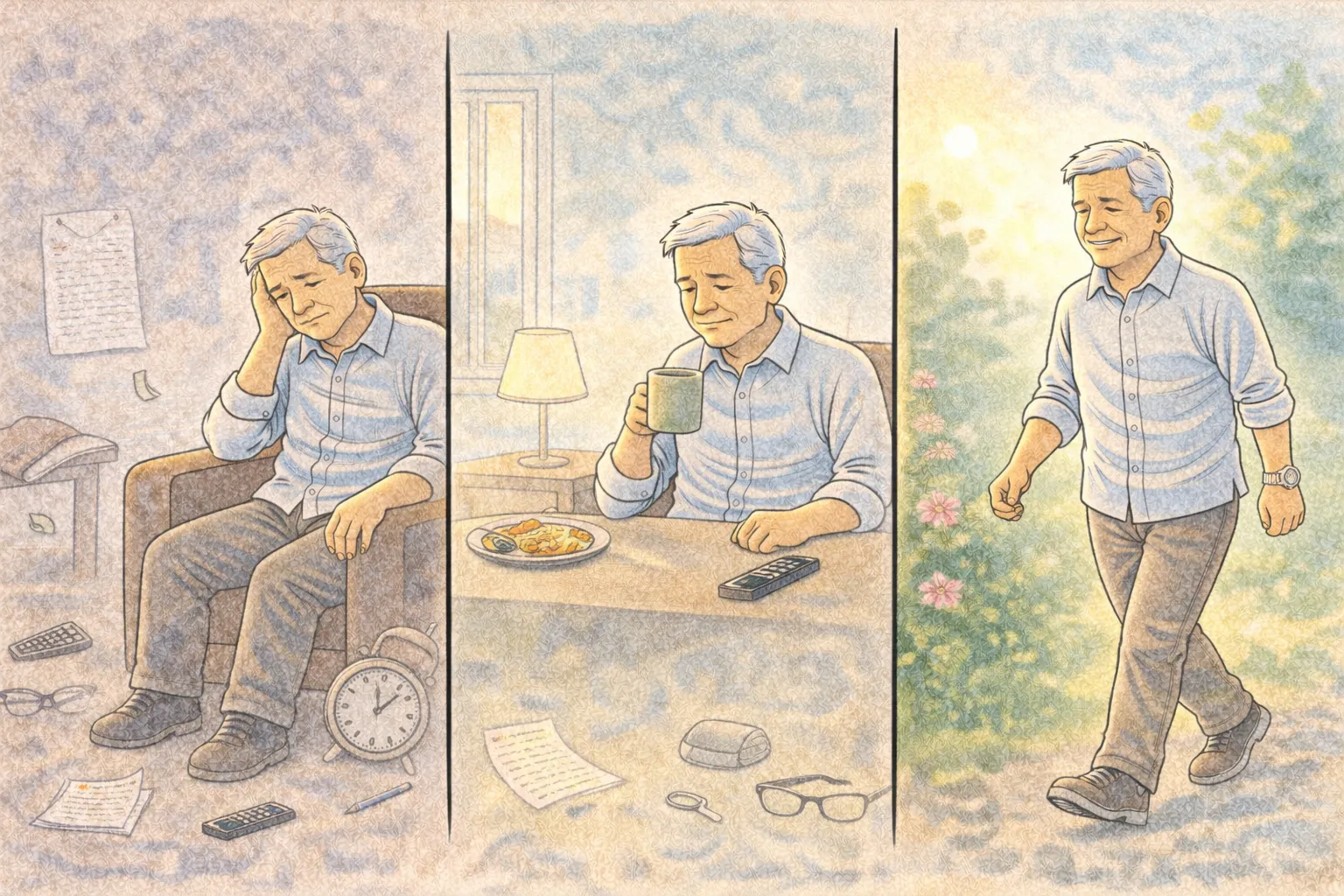
“I have freedom… but no structure.”
This is more common than people expect.
After retirement:
No schedule.
No deadlines.
No fixed rhythm.
At first, it feels good.
But over time…
It can feel unstable.
1. Why structure matters more than you think
Structure is not restriction.
It’s support.
It gives your day:
- shape
- rhythm
- direction
Without it:
Everything feels… loose.
2. The hidden problem: too much open time
Open time sounds ideal.
But too much of it creates:
- indecision
- delay
- low energy
- drifting days
3. Why retirees feel “off” without structure
It’s not laziness.
It’s lack of anchors.
Your brain looks for:
- starting points
- transitions
- endings
Without them, the day feels unclear.
4. The difference between control and structure
You don’t need control.
You need light structure.
Not rigid.
Not strict.
Just enough to guide your day.
5. The “3 anchor system”
Instead of a full schedule,
Use 3 simple anchors:
- morning anchor
- mid-day anchor
- evening anchor
That’s it.
6. What an anchor actually is
An anchor is:
A small, repeatable moment in your day.
Not a long task.
Not pressure.
Just something consistent.
7. Examples of simple anchors
Morning:
- coffee + quiet time
- light stretch
- short walk
Mid-day:
- meal at a consistent time
- short activity
- quick check-in (money / home / health)
Evening:
- wind-down routine
- light reflection
- same bedtime window
8. Why this works
Because anchors create:
- rhythm
- predictability
- mental clarity
You don’t need a full plan.
Just a framework.
9. The biggest mistake: over-structuring
Some people try:
- detailed schedules
- strict plans
- too many rules
This usually fails.
Why?
Because it feels like work again.
10. Keep it flexible
Structure should feel:
- supportive
- light
- adaptable
If it feels heavy → it won’t last
11. Real-life examples
Janet, 68:
“I added three simple anchors.”
Her words:
“My days stopped drifting.”
Michael, 72:
“I didn’t need more to do. I needed structure.”
12. Signs you need this
- your day feels unstructured
- you don’t know when to start things
- time feels scattered
- you delay simple tasks
- your routine feels unclear
Table: No Structure vs Simple Structure
| No Structure | Simple Structure |
|---|---|
| Day feels random | Day feels guided |
| Low clarity | Clear flow |
| More procrastination | Easier action |
| Energy feels flat | Energy has rhythm |
13. Simple daily structure example
| Time | Anchor |
|---|---|
| Morning | Coffee + light movement |
| Midday | Meal + small activity |
| Evening | Wind-down routine |
Quick checklist
- do I have a morning anchor?
- do I have a mid-day anchor?
- do I have an evening anchor?
If yes, your day will feel more stable.
The key insight
You don’t need a schedule.
You need anchors.
Conclusion
Retirement gives you freedom.
But freedom needs structure to feel good.
Not strict.
Not complicated.
Just simple anchors.
That’s enough to make your days feel steady again.
Disclaimer
This content is for general educational purposes only and does not consider individual psychological or health conditions. If ongoing difficulties with daily functioning occur, consult a qualified professional.