Cindy’s Column × Senior AI Money
Prepared doesn’t mean complicated. It means steady.
If you’ve ever tried an app “to get organized” and felt more stressed than before, you’re not alone. Many adults 55+ tell me the same things:
-
“I don’t want more passwords.”
-
“I don’t want notifications.”
-
“I just want to know where my paperwork is.”
-
“I’m tired of searching for things when I need them.”
This 2026 guide is for seniors who want a paper system that feels calm, practical, and easy to maintain—without turning your home into a filing cabinet.
This is not about being perfect.
It’s about building a small system that keeps important things findable—especially when you’re tired, sick, or in a hurry.
Why a paper system still works (especially after 55)
Paper has a few quiet advantages:
-
It doesn’t need charging.
-
It doesn’t update or change layouts.
-
It doesn’t lock you out.
-
It works during internet outages.
-
It’s faster than searching through “where did I save that?”
For many seniors, the real goal isn’t “organization.”
It’s reducing stress, avoiding missed bills or appointments, and making it easy for your future self.
The 2026 Paper Rule
One Core Rule: Paper only does three jobs—Capture, Decide, Store.
That’s it.
-
Capture: papers enter one place, not many places
-
Decide: you make one small decision about what happens next
-
Store: important papers live in predictable homes
If a paper system tries to do more than that, it usually collapses under its own weight.
Part 1: The only supplies you actually need
You don’t need a printer, label maker, or fancy binders.
Start with:
-
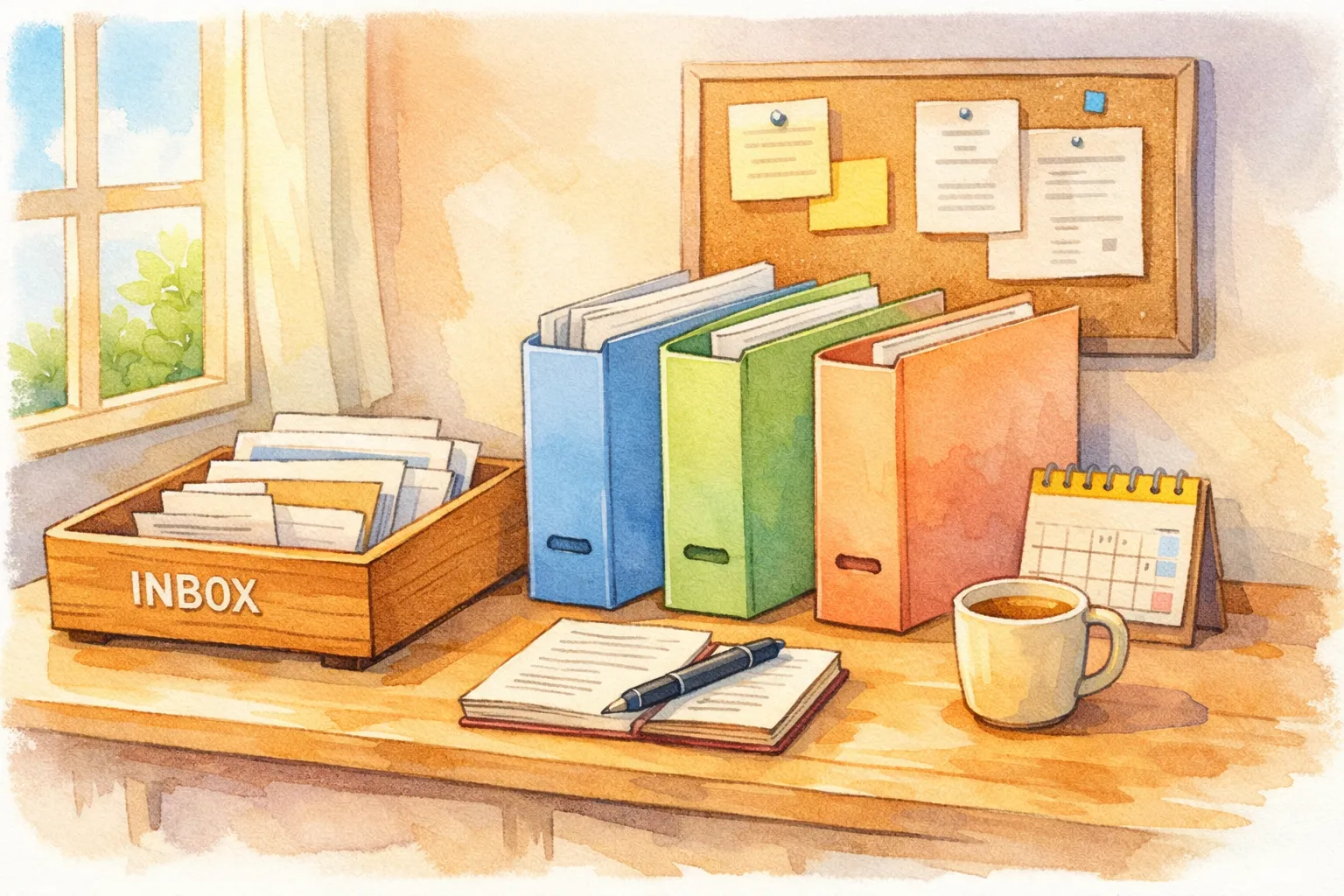
One “INBOX” tray or basket (for incoming papers)
-
Three folders (or three thin file pockets)
-
One small notebook OR one single page “weekly plan”
-
A pen you like
Optional (only if helpful):
-
a zip pouch for medical cards / copies
-
a 12-pocket file organizer (for simple monthly sorting)
The calm goal is: fewer tools, fewer decisions.
Part 2: The simple 3-folder method (works in almost any home)
Name your three folders:
-
TO DO (things that need action)
-
TO FILE (things you’re keeping, but not urgent)
-
TO SHRED / RECYCLE (things leaving your life)
That’s the whole sorting system.
Most paper clutter isn’t “hard.”
It’s just undecided.
A folder system gives paper a place to land while you stay calm.
Table 1: The Calm Paper System in One Page (2026)
| Section | What goes here | When you touch it | Time needed |
|---|---|---|---|
| INBOX tray | mail, forms, receipts, notices | once a week | 10 minutes |
| TO DO folder | bills, calls, appointments, renewals | 1–2 times/week | 5–15 minutes |
| TO FILE folder | statements you keep, medical summaries, home docs | once a week | 5 minutes |
| TO SHRED/RECYCLE | junk mail, duplicates, expired papers | once a week | 3 minutes |
| Home File (Archive) | truly important long-term papers | once a month | 10 minutes |
If you can keep the INBOX small, your system stays light.
Part 3: The “mail moment” that prevents piles
Many seniors don’t struggle with paperwork because they’re disorganized.
They struggle because mail arrives daily and life is already full.
Try one calm rule:
Mail gets opened near a trash can. Immediately.
Then do this:
-
Toss obvious junk right away
-
Put “action items” into TO DO
-
Put “keep but not urgent” into TO FILE
-
Put anything uncertain into the INBOX (not the kitchen counter)
You’re not finishing tasks in this moment.
You’re simply keeping paper from spreading.
Part 4: How to file without turning it into a project
This is where many systems fail: people try to “file perfectly.”
A calmer approach is a small archive with a few broad categories:
-
Medical
-
Home (lease, repairs, insurance, manuals)
-
Money (tax, banking, retirement, benefits)
-
Identity (ID copies, important records)
-
Car / Travel (if relevant)
Inside each category, you can keep things in a simple stack.
Perfect labeling is optional. Calm is the priority.
If you have to make 20 decisions to file one paper, you won’t file it.
If you have to make 2 decisions, you probably will.
Part 5: The “10-minute weekly paper reset” (the part that makes it sustainable)
A paper system survives when it has a weekly rhythm.
Pick one day—many people like Friday or Sunday.
Set a timer for 10 minutes:
-
Empty your INBOX (not perfectly—just move papers into the three folders)
-
Pull the TO DO folder and choose the next 1–3 actions
-
Put everything else back where it belongs
That’s it.
You’re not solving your entire life in one sitting.
You’re keeping your system from overflowing.
Table 2: Weekly Paper Reset (10 Minutes) — a realistic rhythm
| Minute | What you do | Why it works |
|---|---|---|
| 0–2 | Gather papers into INBOX | stops the “paper spread” |
| 2–6 | Sort into TO DO / TO FILE / TO SHRED | reduces decisions later |
| 6–9 | Choose 1–3 actions only | prevents overwhelm |
| 9–10 | Put folders back in place | system stays visible and usable |
If you only do the first 6 minutes, you still win.
Because the pile shrinks.
Part 6: What goes in “TO DO” (and what doesn’t)
Your TO DO folder should contain only papers that lead to a clear action.
Good examples:
-
a bill you need to pay
-
an appointment reminder that needs scheduling
-
a renewal notice
-
a medical form that needs filling out
-
a letter that requires a call
Not good for TO DO:
-
statements you’re simply keeping
-
catalogs
-
“maybe someday” papers
If you put “maybe someday” into TO DO, your brain starts avoiding the folder.
Part 7: A calm system for medical paperwork (the one most seniors care about)
Medical paperwork causes stress because it can feel high-stakes.
Try a very simple medical mini-system:
-
One Medical Folder (Active): recent visit summaries, referral notes, current test results
-
One Medication List Page (one sheet, updated when needed)
-
One Insurance/Benefits Folder (cards copies, letters, approvals)
That’s enough for most people.
The calm goal is: when a clinic asks a question, you can find the answer within 2 minutes—not 20.
Part 8: Real senior examples (what “calm paper” looks like)
Elaine, 69 (lives alone, hates apps)
Elaine used to keep mail in three places: a kitchen pile, a side table pile, and a “I’ll deal with it later” bag. She switched to one INBOX basket and the 3-folder method.
After 3 weeks, she told me the biggest change wasn’t organization—it was mood.
“I don’t feel chased by paper anymore.”
Her weekly reset took 9 minutes most weeks. She paid two bills on time that month without last-minute stress.
Dennis, 76 (caregiver stress + paperwork overload)
Dennis was managing paperwork for himself and occasionally helping a sibling. He didn’t want more systems.
He used one TO DO folder and a rule: “Only 3 actions per week.”
His stress dropped because he stopped trying to do everything at once.
Within 6 weeks, he reduced his “paper panic” episodes from about 3 times a week to about once every two weeks—simply because the pile stopped growing.
Maria, 66 (medical-heavy year)
Maria had frequent appointments and was overwhelmed by test results. She created a “Medical Active” folder and kept only the last 90 days there, moving older items to archive monthly.
She told me the biggest benefit was not having to re-read old paperwork every time she opened the folder.
Printable Checklist: 2026 Calm Paper System (Seniors 55+)
Copy/paste or print this checklist:
-
I have one INBOX tray/basket for all incoming paper
-
I have three folders: TO DO / TO FILE / TO SHRED
-
Mail gets opened near a trash can (junk removed immediately)
-
Action papers go into TO DO (not on counters)
-
I chose one weekly “paper reset” day (10 minutes)
-
During the reset, I pick only 1–3 actions to do next
-
Important categories have simple homes (Medical / Home / Money / Identity)
-
I keep a one-page medication list updated when needed
-
I do a monthly 10-minute archive tidy (optional, but helpful)
Small note: A calm paper system is one you can repeat even on tired weeks.
Common sticking points (and gentle solutions)
“I don’t know what to keep.”
If it feels unclear, place it in TO FILE temporarily. Decide later during your weekly reset.
“I’m behind. I have piles.”
Start with today forward. Then do one small “catch-up scoop” per week (only 10 minutes). The pile didn’t form in one day; it doesn’t need to disappear in one day.
“I feel guilty throwing things out.”
You’re not throwing out “responsibility.” You’re removing noise. Keep what supports your life now.
Disclaimer (important)
This article is for general educational purposes only and does not provide medical, financial, legal, or professional organizing advice. Individual health conditions, cognitive needs, mobility levels, and household situations vary. For personalized guidance, consider speaking with qualified professionals.
Read More Post at artanibranding.com