Cindy’s Column × Senior AI Money
Less clutter doesn’t require a big purge. It requires a small rule you can repeat—even on tired days.
If you’re 55+ and the idea of “decluttering” makes you want to lie down, you’re not alone.
Many seniors tell me:
-
“I don’t have the energy for a full cleanout.”
-
“I’ve tried before and it came back.”
-
“I don’t want to make a mess.”
-
“I’m not downsizing. I just want my home to feel lighter.”
This 2026 guide is for older adults who want a gentle, finishable method—something that works in real life, not just in videos.
No dramatic before-and-after.
No guilt.
No pressure to get rid of meaningful things.
Just one calm habit.
Why decluttering feels harder after 55 (and why that’s normal)
After 55, clutter isn’t just “stuff.” It’s often connected to:
-
fatigue or chronic pain
-
changes in mobility (bending, lifting, reaching)
-
grief (keeping items can feel like keeping love)
-
fear of waste (“I might need this later”)
-
fewer opportunities to donate or dispose easily
-
decision fatigue (“What do I do with this?”)
So if decluttering feels heavy, it’s not a personal failure.
It’s a realistic response to real constraints.
That’s why we use a method that reduces decisions, limits mess, and creates steady progress.
The 2026 Declutter Rule
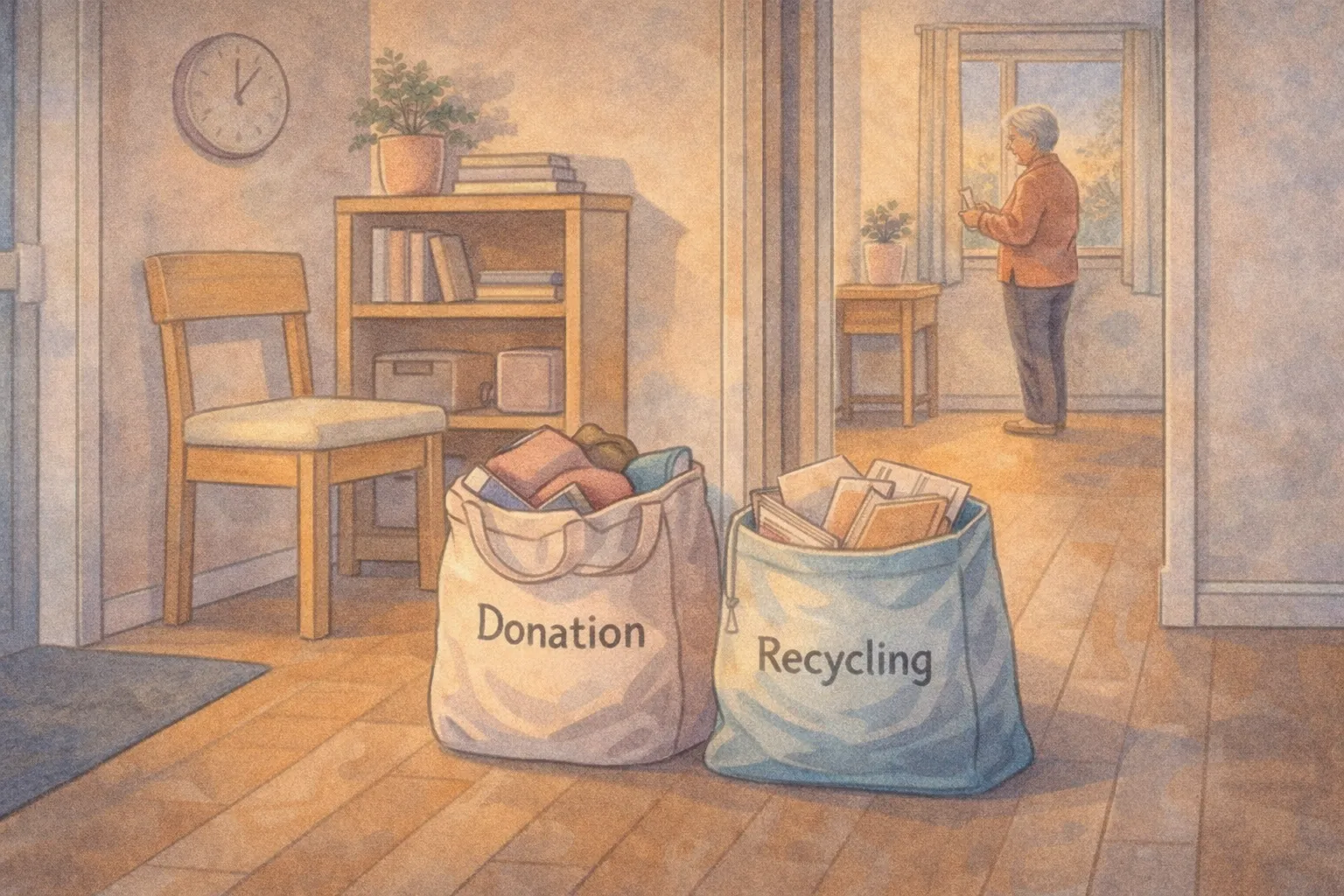
One Core Rule: One bag in, one bag out.
-
One bag in = you fill one donation/trash/recycling bag at a time
-
One bag out = you remove it from your home the same day (or schedule the exit immediately)
The magic here is not intensity.
It’s completion.
Most decluttering fails because bags sit around, piles grow, and your home feels worse before it feels better.
This method protects your energy and your space.
What counts as a “bag”?
A “bag” can be any container you can safely lift.
Options:
-
a grocery bag
-
a small trash bag
-
a tote bag
-
a small box
Gentle safety rule: If it’s heavy, it’s too big.
Your method should never risk your back, knees, or balance.
Part 1: Choose your “one bag” type (donation, trash, or relocate)
Not every bag has to be donation. Sometimes the easiest win is trash or recycling.
Here are the three simplest bag types:
-
Trash: broken, expired, unusable
-
Recycling: paper, cardboard, packaging
-
Donation: usable items you don’t want to keep
A fourth category (optional) is Relocate: items that belong elsewhere in your home.
But be careful: “Relocate” can become “move clutter around.”
Use it sparingly.
Table 1: The One Bag Method (Choose Your Lane)
| Bag Type | Best for | Examples | Fast decision question |
|---|---|---|---|
| Trash | quick wins, low emotion | broken items, expired cosmetics, worn-out linens | “Would I pay to keep this?” |
| Recycling | paper clutter, packaging | catalogs, junk mail, boxes | “Is this only information/packaging?” |
| Donation | usable items you don’t need | duplicate kitchen tools, extra sweaters, books | “Would I choose this again today?” |
| Relocate (optional) | items in the wrong room | scissors on kitchen table, mail on sofa | “Where is this home?” |
If you feel stuck, start with trash or recycling.
That builds confidence without emotional strain.
Part 2: Pick the easiest “declutter zone” (so you actually finish)
This method works best when you start small and specific—one zone you can complete without making a mess.
Good beginner zones for seniors:
-
a bathroom drawer
-
one kitchen shelf
-
the top of a dresser
-
one nightstand
-
a small section of the closet (not the whole closet)
-
the “mail pile” area
Avoid starting with:
-
photos and sentimental boxes
-
entire garages or basements
-
anything that requires heavy lifting
-
anything that needs multiple trips up and down stairs
Your first few bags should be easy wins.
Part 3: The 12-minute “fill the bag” routine (gentle and finishable)
Set a timer for 12 minutes.
-
Put the bag next to you (stable surface, no bending if possible)
-
Start with obvious items (trash/recycling first)
-
If you pause for more than 10 seconds on an item, skip it and move on
-
Stop when the timer ends or the bag is full—whichever comes first
-
Tie/close the bag and move it to the exit spot immediately
This routine prevents the most common decluttering trap:
“Just one more area…” → exhaustion → half-finished piles.
Small, finished sessions beat large, incomplete sessions.
Part 4: The “exit plan” (the part that makes decluttering work)
A bag that stays in your hallway is still mental clutter.
So we decide the exit before we start:
-
Trash bag → goes to the bin today
-
Recycling bag → goes to recycling today
-
Donation bag → goes into the car trunk today (or placed by the door with a pickup scheduled)
If leaving the house is hard:
-
ask a neighbor or family member to take donations once a month
-
use a donation pickup service where available
-
create one “donation day” each month and keep donations in one safe, contained place
The key is that bags leave your living space quickly.
Table 2: How to Keep Bags From Getting Stuck
| Situation | What usually happens | Calm fix (one step) |
|---|---|---|
| Donation bag sits by door for weeks | guilt + clutter returns | put it in trunk immediately |
| Mobility makes drop-off hard | bag becomes a “project” | schedule one pickup / ask one helper |
| You overfill the bag | heavy + unsafe | use smaller bags only |
| You start too big | piles form | shrink the zone (one drawer) |
| You get emotional mid-session | you stop completely | switch to trash/recycling zone next time |
| You “relocate” too much | clutter moves rooms | limit relocate to 5 items per session |
Decluttering is not about willpower.
It’s about removing friction.
Part 5: What to do with “maybe” items (without getting stuck)
Many seniors get stuck on the middle category: “I might need it.”
Try a calmer question:
-
“If I needed this again, could I borrow it, replace it cheaply, or do without it?”
And a calmer rule:
If you’re unsure, don’t decide today.
Put it back and keep moving. Your goal is to fill one bag, not solve every decision.
You’ll meet “maybe” items again later, and decisions often get easier after you’ve had a few wins.
Part 6: Gentle decluttering when you have pain, low energy, or balance concerns
This method is already gentle, but you can make it even safer.
Try these upgrades:
-
sit while you declutter (chair at counter height is great)
-
avoid bending: bring items to table level first
-
choose zones between waist and shoulder height
-
avoid step stools when alone
-
wear supportive shoes, not socks
-
keep pathways clear while you work
-
do shorter sessions: 8 minutes instead of 12
Decluttering should never create a fall risk.
Safety is part of calm.
Part 7: The emotional side (because clutter is often love, memory, and identity)
Some items aren’t “stuff.” They’re stories.
If an item carries grief or deep memory, you do not need to force a decision.
A gentle approach:
-
choose one small memory item and create a “display home” for it
-
keep a small memory box (one box, not ten)
-
photograph items you don’t have space for
-
keep the best version (one sweater, not six)
Prepared doesn’t mean cold.
Calm decluttering can still honor meaning.
Real-life senior examples (how this looks in real homes)
Example 1: Carol, 73 — “I stopped making piles”
Carol had tried decluttering before, but she’d start by pulling everything out of a closet. She’d get tired, and then the closet would stay half-empty and half-piled for weeks.
She switched to “one bag in, one bag out” and started with recycling:
-
catalogs
-
expired coupons
-
old packaging
Her first session took 10 minutes. The bag left the house immediately.
Two weeks later she told me:
“I didn’t dread it because I knew I would finish.”
Example 2: Thomas, 67 — “My kitchen felt calmer in three bags”
Thomas wasn’t interested in a big purge. He just wanted the kitchen counters clear.
He did three sessions over one week:
-
Bag 1: trash (broken tools, expired spices)
-
Bag 2: donation (duplicate gadgets)
-
Bag 3: recycling (boxes and paper clutter)
He didn’t reorganize the whole kitchen.
He simply removed what didn’t belong.
He said the biggest benefit was daily:
“I stopped feeling annoyed every time I cooked.”
Example 3: Mina, 79 — “I used smaller bags and it finally worked”
Mina had arthritis and balance concerns. Carrying large bags was painful, so she avoided decluttering.
We adjusted the system:
-
tiny bags only
-
seated sessions
-
a monthly donation pickup arranged by her daughter
She filled one small bag every few days for two weeks.
Her words:
“I didn’t feel like I was ‘decluttering.’ I felt like I was gently editing my home.”
Printable Checklist: One Bag In, One Bag Out (2026)
Copy/paste or print:
-
I chose a small bag/container I can safely lift.
-
I chose one simple bag type: Trash, Recycling, or Donation.
-
I picked one small zone (one drawer, one shelf, one surface).
-
I set a timer (8–12 minutes).
-
If I hesitate more than 10 seconds, I skip the item for now.
-
When the timer ends, I stop—no expanding the project.
-
I close the bag and move it to the exit spot immediately.
-
The bag leaves my living space the same day (or pickup is scheduled).
-
I keep the next session easy so I’ll repeat it.
Small reminder: progress you can repeat is the kind that lasts.
Disclaimer
This article is for general educational purposes only and does not provide medical, safety, or professional organizing advice. Individual health conditions, mobility levels, and home environments vary. If you have balance concerns, pain, or safety risks, consider adapting tasks to your abilities and consulting qualified professionals for personalized guidance.
Read More Post at artanibranding.com