Calendar (5 min)
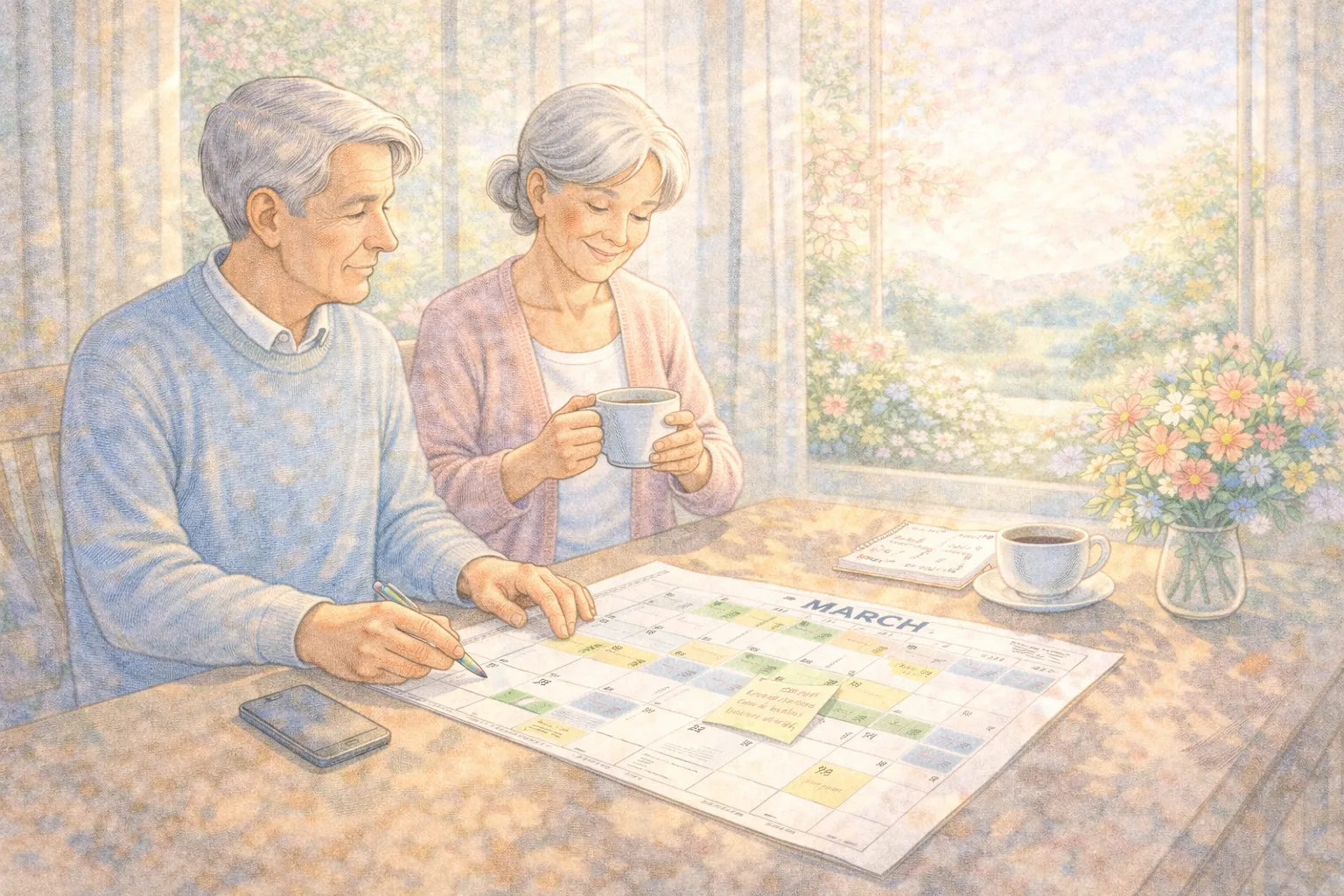
[ ] Limited to 2 major commitments per week [ ] Ensured one light week
Energy (5 min)
[ ] Listed one energizer [ ] Listed one drainer [ ] Chose one adjustment
Home (5–7 min)
[ ] Completed one visible reset
Connection (5 min)
[ ] Scheduled one meaningful interaction
Focus
[ ] Wrote one March intention sentence
If you do nothing else this month, do this.
WHY THIS WORKS
It’s small.
Small systems are repeatable.
Repeatable systems reduce anxiety.
Anxiety reduction protects:
sleep
decision-making
patience
financial clarity
March doesn’t need motivation.
It needs steadiness.
WHAT NOT TO DO
Redesign your life in one weekend
Compare your year to someone else’s
Add new habits before stabilizing current ones
Shame yourself for January or February
Adjustment beats ambition.
DISCLAIMER
This article is for general educational purposes only and does not provide financial, medical, or legal advice. Individual circumstances, health conditions, and financial situations vary. Consult qualified professionals before making significant financial or health-related decisions.
Key principle: It doesn’t need to be impressive. It needs to be consistent.
PART 2: HEART (EMOTIONAL CONNECTION)
Loneliness impacts brain health as much as inactivity.
Heart activities include:
meeting a friend for tea
calling someone regularly
volunteering
attending small group events
church or community groups
hobby clubs
It’s not about large crowds.
It’s about:
Predictable, warm contact.
Table 2: Heart Frequency Guide
Comfort Level
Suggested Rhythm
Introverted
1 meaningful connection per week
Balanced
2–3 small interactions weekly
Highly social
Multiple touchpoints but with rest days
Quality matters more than quantity.
PART 3: HEAD (GENTLE COGNITIVE STIMULATION)
This is where people overdo it.
Brain stimulation doesn’t mean:
4-hour puzzle marathons
overwhelming online courses
constant news consumption
It means:
reading 10–20 minutes daily
learning one small new skill per season
language apps 5 minutes at a time
strategy games in moderation
memory games occasionally
Avoid mental overload.
Your brain improves through moderate challenge + recovery.
THE MISTAKE MOST PEOPLE MAKE
They focus only on Head.
Puzzles. News. Courses.
But without Hands and Heart:
mood declines
stress rises
sleep worsens
Brain health is a 3-part system.
Remove one leg of a stool—it wobbles.
REAL-LIFE EXAMPLES
Example 1: Susan, 72
Before:
Crossword puzzles daily, rarely left home.
After:
Added weekly walking group + watercolor class.
Result:
“I feel more alive, not just occupied.”
Example 2: George, 67
Before:
Heavy news consumption and online debates.
After:
Reduced news to 20 minutes/day.
Started woodworking twice a week.
Result:
“My sleep improved more than I expected.”
Example 3: Anita, 75
Before:
Volunteered constantly, little rest.
After:
Reduced to once weekly.
Added short reading routine at night.
Result:
“Balanced feels better than busy.”
PRINTABLE: 2026 Brain Health Weekly Tracker
Hands:
[ ] Physical or tactile activity 3x this week [ ] At least 20 minutes each session
Heart:
[ ] One meaningful connection [ ] One spontaneous conversation
Head:
[ ] Reading or learning 4x this week [ ] Limited overstimulating media
Balance:
[ ] At least one full rest day [ ] Sleep prioritized
If all three are present, you’re doing enough.
WHY THIS MATTERS FINANCIALLY TOO
Brain health protects:
decision-making
scam resistance
emotional spending
retirement planning clarity
Cognitive fatigue increases:
impulsive purchases
financial anxiety
poor judgment
Balanced hobbies protect your money indirectly.
WHAT TO AVOID IN 2026
Signing up for 5 classes at once
Overbooking social calendars
Obsessive news consumption
Feeling guilty for resting
Treating hobbies like performance
Calm consistency beats intense bursts.
A SIMPLE START PLAN (THIS WEEK)
Choose:
1 Hands activity 1 Heart connection 1 Head challenge
Put them on your calendar.
That’s it.
No reinvention required.
DISCLAIMER
This article is for general educational purposes only and does not provide medical advice. Brain health, cognitive changes, and neurological conditions vary by individual. Consult a qualified healthcare professional if you have concerns about memory, cognitive decline, or neurological symptoms.
This article is for general educational purposes only and does not provide medical, nutritional, or financial advice. Individual health conditions, dietary needs, and budgets vary. Consult qualified professionals for guidance tailored to your situation.
Simple meal planning for seniors living alone in 2026: eating well, spending less, and wasting almost nothing without daily cooking pressure.
Cindy’s Column × Senior AI Money Calm, practical living after 55—without pressure.
Living alone has its freedoms. It also creates quiet challenges—especially around food.
Many seniors living alone say things like:
“Cooking feels like too much effort for just me.”
“I buy food with good intentions and throw half of it away.”
“Eating out is easier, but it’s getting expensive.”
“I don’t want to live on frozen dinners.”
This 2026 guide is for adults 55+ who live alone and want to:
eat simply without boredom
reduce grocery costs
waste far less food
avoid daily cooking pressure
feel nourished without overthinking meals
This is simple meal planning, not dieting, not batch-cooking marathons, and not perfection.
Why meal planning feels harder when you live alone
When you cook for one:
portions don’t match package sizes
motivation drops
leftovers feel repetitive
food spoils faster
decision fatigue hits every day
So many seniors don’t struggle with cooking. They struggle with planning and pacing.
The goal in 2026 is not “three perfect meals a day.” It’s steady nourishment with minimal effort.
The 2026 Meal Planning Rule
Cook once. Eat twice (or three times). Stop there.
If a plan creates dread, it won’t last.
Part 1: The “core foods” approach (simpler than meal plans)
Instead of planning meals, plan core foods.
Core foods are:
flexible
easy to combine
familiar
used across multiple meals
Examples of core foods
eggs
yogurt
oatmeal
chicken or fish
rice or potatoes
frozen vegetables
soup or broth
fruit
With 8–10 core foods, dozens of meals appear naturally.
Table 1: Core Foods vs Traditional Meal Planning
Traditional Planning
Core Foods
Fixed recipes
Mix-and-match
Specific days
Flexible timing
High pressure
Low effort
More waste
Less waste
You’re building options, not commitments.
Part 2: The “two-meal + one flexible” day
Many seniors don’t need three full meals.
A gentle structure:
One main cooked meal
One easy repeat meal
One flexible option (snack, soup, leftovers)
Example day
Breakfast: oatmeal or yogurt
Main meal: chicken + vegetables
Evening: soup, toast, or leftovers
This reduces decisions and costs.
Part 3: Grocery shopping for one (without waste)
The biggest money loss comes from:
buying variety instead of volume
buying aspirational food
buying like you’re cooking for two
Smarter shopping rules
Buy fewer items, slightly better quality
Choose frozen when possible
Avoid “family size” unless it freezes well
Shop weekly, not biweekly
Table 2: Waste-Reducing Grocery Choices
Item
Better Choice
Why
Fresh vegetables
Frozen vegetables
Use only what you need
Big bread loaf
Half loaf or freeze slices
Less mold
Multiple proteins
One main protein
Easier planning
Bulk snacks
Small packages
Fewer leftovers
Food waste is invisible spending.
Part 4: Leftovers without boredom
Leftovers fail when they look the same.
Simple ways to change leftovers
add soup or broth
change seasoning
turn into sandwiches or wraps
combine with eggs or rice
You’re not “eating leftovers.” You’re creating the next meal.
Part 5: The “cook once” rhythm that actually works
Many seniors do best with:
2 cooking days per week
simple recipes
repeating favorites
Example rhythm:
Sunday: cook main protein
Wednesday: cook second simple dish
Everything else assembles itself.
Part 6: Eating well without daily cooking
No one should cook every day.
Zero-cook meal ideas
yogurt + fruit + nuts
soup + toast
eggs and toast
rotisserie chicken + salad
oatmeal with additions
Convenience is not failure—it’s strategy.
Table 3: Low-Effort Meals for One
Meal
Effort
Cost
Yogurt bowl
Very low
Low
Soup + bread
Low
Low
Eggs & toast
Low
Low
Chicken salad
Medium
Medium
Frozen meal + veg
Low
Medium
Part 7: Eating alone without loneliness
Food is emotional.
Some seniors skip meals because:
eating alone feels sad
meals feel pointless
Gentle fixes:
eat near a window
use a nice plate
add music or radio
eat one meal out weekly
share meals occasionally with friends
Eating alone doesn’t mean eating joylessly.
Real stories (quiet improvements)
Janet, 72 Stopped buying for a full week.
“I finally stopped throwing food away.”
Michael, 68 Chose 8 core foods.
“Meals stopped feeling like work.”
Rose, 79 Added soup nights.
“It felt comforting, not lazy.”
Printable checklist: Simple Meal Planning for One (2026)
Choose 8–10 core foods
One main cooked meal per day
Two cooking days per week
Frozen foods for flexibility
Simple repeat breakfasts
Zero-cook backup meals
Disclaimer
This article is for general educational purposes only and does not provide medical, nutritional, or dietary advice. Individual health conditions, medications, and nutritional needs vary. Consult a qualified healthcare professional or registered dietitian for personalized guidance.
Choose three 2026 retirement hobbies that fit your energy, budget, and space—body, mind, and heart.
Cindy’s Column × Senior AI Money Practical, senior-friendly guides for a calmer, safer life.
Retirement is supposed to feel lighter. But many adults 55+ discover an unexpected problem: too much time can create pressure.
You finally have freedom… and suddenly you feel you should be doing something meaningful, productive, healthy, social, creative, and enriching—preferably all at once. Add online ads and “new hobby” trends, and it’s easy to end up with a closet full of supplies you don’t use and a quiet feeling of, “Why can’t I stick with anything?”
Here’s a calmer way to approach hobbies in 2026:
You don’t need ten hobbies.
You don’t need the “perfect” hobby.
You don’t need to buy your way into a new identity.
You need three interests that fit your real life—your energy, body, budget, space, and personality.
This guide will help you choose 3 hobbies that add joy without adding clutter, using a simple framework you can finish in one afternoon.
Why “3 hobbies” is the sweet spot (especially after 55)
Choosing “just one hobby” can feel like too much pressure. Choosing “all the hobbies” creates chaos.
Three works because it covers your needs without overloading you. Think of it as a balanced hobby “plate”:
A body hobby (keeps mobility and confidence)
A mind hobby (keeps curiosity and focus)
A heart hobby (keeps connection and meaning)
Not every hobby fits neatly into one category, but the structure prevents a common retirement trap: picking hobbies that look good on paper but don’t fit your day-to-day life.
The 2026 “No-Clutter Hobby Rule” (the one rule that saves most people)
Before you start, adopt this rule:
Rule: You don’t buy supplies until you do the “trial version” twice.
That’s it. Two tries.
Try #1 tells you if you feel curious.
Try #2 tells you if you’ll actually repeat it.
After two tries, you can decide if it deserves money and storage space.
This rule keeps hobbies from becoming expensive clutter projects.
Step 1: Pick your “energy truth” (the hobby must match your real body)
Many older adults quit hobbies because the hobby demands a version of them that only exists on a “good day.”
So begin with honesty. Circle one:
Green energy: I usually have steady energy most days.
Yellow energy: I’m up and down; pain/fatigue varies.
Red energy: I need gentle pacing; I tire easily.
Your hobby plan should still work on Yellow and Red days. That’s how it becomes sustainable.
Table 1: Matching hobbies to real energy levels
Energy Level
What works best
What often backfires
Green
Classes, longer sessions, projects
Too many commitments at once
Yellow
Short sessions, flexible schedules, “pause-friendly” hobbies
$25–$60/month: occasional class fees, craft supplies, club membership
$60–$120/month: regular classes, pool membership, special outings
The key is not the amount. The key is choosing it intentionally.
A helpful rule:
Spend money on repetition, not on fantasy. If you’ve done the hobby twice and want to keep going, it earns the budget.
Real-life examples (with realistic numbers)
Case 1: Diane, 66 — “I kept buying supplies, but I never started.”
Diane loved the idea of being “an art person.” Over two years she spent roughly $340 on watercolor sets, paper, and online courses—then felt guilty every time she saw the supplies.
In 2026 she tried the “try it twice” rule:
She did two 10-minute sketch sessions using a cheap notebook.
She discovered she enjoyed simple pencil sketching more than watercolor.
She kept one small art bin and set a $15/month joy budget for paper and pencils.
Result: more consistency, less guilt, and no expanding pile of unused supplies.
Case 2: Martin, 73 — “I needed connection, not more activities.”
Martin filled his week with errands and TV but still felt lonely. He chose a heart hobby:
a weekly community lunch group ($8–$12 each week)
a short volunteer shift twice a month
He said the biggest change wasn’t “being busy.” It was feeling known. His spending increased slightly, but his wellbeing improved enough that he called it “worth it.”
Case 3: Sandra, 79 — “My energy is unpredictable.”
Sandra has Yellow/Red energy days. She built a hobby stack that works even when she’s tired:
Body: 6-minute chair stretch routine
Mind: audiobook + simple puzzle book
Heart: one scheduled call every Sunday
Cost: mostly free/library-based. Result: hobbies that still exist when she’s not having a “perfect week.”
“What if I don’t know what I like anymore?”
This is more common than people admit.
After big life changes—retirement, caregiving, grief, relocation—your preferences can shift. You’re not broken. You’re updating.
Try these gentle discovery prompts:
What did I enjoy before life got busy?
What do I do that makes time pass faster?
What do I watch or read repeatedly?
What do I do after a hard day that actually helps?
Then test, not commit.
The retirement hobby traps (and how to avoid them)
Trap 1: Choosing hobbies to impress someone
If the hobby is more about identity than enjoyment, it won’t last.
Fix: choose hobbies that feel pleasant even if nobody sees them.
Trap 2: Choosing hobbies that require perfect health
If the hobby collapses the moment you have pain or fatigue, it’s fragile.
Fix: build a minimum version and a backup hobby.
Trap 3: Overbuying supplies
Shopping feels like progress. It’s not the same thing.
Fix: try it twice before buying.
Trap 4: Overcommitting socially
Too many obligations can create stress and resentment.
Fix: choose one heart hobby and keep it light.
A 2026 “Hobby Starter Menu” (easy trials you can do this week)
Pick any 3 and try each twice:
Body (choose one)
10-minute walk (or indoor mall walk)
chair stretch routine (5–10 minutes)
beginner tai chi video (10 minutes)
Mind (choose one)
library audiobook + 10 minutes listening
20-piece puzzle session
5-minute sketch of a mug/plant
Heart (choose one)
call one person you like (10 minutes)
attend one community event (even if you leave early)
join a low-pressure group once (book club, walking group)
You are not picking “the rest of your life.” You’re picking “this week’s experiments.”
Quick checklist (printable-friendly)
Circle your energy level (Green/Yellow/Red)
Choose 3-hobby stack (Body + Mind + Heart)
Apply the Try-It-Twice rule before buying supplies
Choose a one-container storage limit for hobby items
Define the minimum version of each hobby
Set a small monthly joy budget
Re-evaluate after 2 weeks: keep what repeats, drop what doesn’t
Disclaimer
This article is for general educational purposes only and does not provide medical, mental health, legal, or financial advice. Individual needs and abilities vary. If you have health concerns that affect activity, consult a qualified healthcare professional before starting new physical routines, and choose options that match your comfort and safety.
This article is for general educational purposes only and does not provide medical advice. Fatigue and energy levels vary by individual health conditions and medications. Consult a qualified healthcare professional if low energy is persistent or worsening.
A simple 2026 evening routine after 60—less scrolling, calmer nights, and safer bathroom trips.
Cindy’s Column × Senior AI Money Practical, senior-friendly guides for a calmer, safer life.
Sleep advice can feel strangely unrealistic after 60.
It often assumes you have no pain, no bathroom trips, no stress, no medications that affect your body, no caregiving responsibilities, no grief, no racing thoughts, and no stiff joints that wake you up at 3:17 a.m. for no apparent reason.
In real life, sleep changes as we age. That doesn’t mean you’re “doing it wrong.” It means your routine has to be built around what actually happens—fatigue, nighttime waking, changing schedules, and a nervous system that sometimes gets stuck in “alert” mode.
This 2026 sleep reset is not about becoming a perfect sleeper. It’s about creating an evening rhythm that:
lowers nighttime stress
makes it easier to fall asleep
reduces “revenge scrolling” and late-night snacking
helps you get back to sleep faster after waking
supports safer nights (fewer falls, fewer “where did I put that?” moments)
No complicated tracking. No strict rules that cause guilt. Just a repeatable routine that still works when you’re tired.
The goal (and why most sleep plans fail)
Most plans fail because they demand too much willpower at the end of the day.
At 9 p.m., your brain doesn’t want a lifestyle overhaul. It wants comfort, habit, and the path of least resistance.
So this routine is built on two principles:
Make the good choice easier than the bad choice.
Keep it short enough to repeat.
In 2026, the best sleep routine is the one you can keep on your most ordinary days.
What “success” looks like after 60
Let’s define success in a realistic way:
Falling asleep faster most nights
Waking up and returning to sleep with less panic
Fewer nights of “I guess I live awake now”
Feeling steadier the next morning—physically and emotionally
If you still wake up at night sometimes, that’s normal. The win is reducing the stress around it.
The 2026 Evening Routine (20–35 minutes total)
This is the complete routine. You can also do the “short version” later in this article.
This stops the brain from trying to hold everything at once—one of the biggest sleep disruptors for older adults.
Step 2 (5 minutes): Light + Screen Shift
Choose one:
Dim overhead lights; use a lamp
Turn down screen brightness and set “night mode”
Or (best): put the phone on a charger across the room
This isn’t about being perfect. It’s about signaling “wind down” to your body.
Step 3 (5–8 minutes): Gentle body release
Pick just ONE:
slow calf stretch at the wall
seated hamstring stretch
shoulder rolls + neck relaxation
a warm shower (even short)
or a heating pad on the area that aches
If pain or stiffness keeps you awake, a small “release ritual” helps your body settle.
Step 4 (3 minutes): Bathroom + Safety Set-Up
This is a sleep-and-safety combo step:
do your last bathroom trip
place a nightlight on (or motion sensor)
make sure the path is clear (no cords, no loose rugs)
keep water and glasses within reach
This lowers nighttime fall risk and reduces the “I’m awake and annoyed” spiral.
Step 5 (7–15 minutes): The “Soft Landing” activity
Choose one relaxing activity that doesn’t wake your brain up:
paper book (easy reading, not intense)
calm music
a simple puzzle book
light journaling (gratitude or a single prompt)
guided breathing (no strict meditation required)
Avoid: news, heated conversations, stressful TV, intense mystery/thriller content right before bed (some people love it, but it backfires for many).
The Short Version (5 minutes) for low-energy nights
Some nights you’re exhausted and still wired. Or you’ve had a long day. Or your body is flaring up.
On those nights do this:
Write one worry down (30 seconds)
Turn off bright lights/screens (1 minute)
Gentle breathing: inhale 4, exhale 6 (2 minutes)
Safety set-up (1 minute)
That’s it. Keeping the habit alive is more important than doing the full routine.
Why you wake up at 2–4 a.m. (and what to do that actually helps)
Night waking is common after 60. The mistake is treating it as an emergency.
Instead, treat it like weather: “Oh. This is happening.” Then use a script.
The “No Panic” Script
“My body is awake. I am still resting.”
“I’m not required to solve life tonight.”
“I’ll do the next calm step.”
What to do if you’re awake more than ~20 minutes
Pick ONE:
get up and sit in dim light, read something easy
sip water if you’re thirsty
do gentle breathing
return to bed when sleepy
The key is: don’t turn night waking into phone time. Phones are excellent at waking your brain fully.
A simple 7-day “Sleep Reset Week” (no perfection required)
Here’s a gentle plan you can start tonight.
Table 1: 7-Day Sleep Reset (After 60)
Day
One Focus
What to do (10 minutes or less)
Day 1
Make it easy
Put phone on charger across the room
Day 2
Light shift
Dim lights 60 minutes before bed
Day 3
Body comfort
Add 5 minutes of gentle stretching or heat
Day 4
Brain dump
Write 3 bullets for tomorrow, then stop
Day 5
Night safety
Nightlight + clear path to bathroom
Day 6
Wake-up plan
Choose your “if awake” activity (book/puzzle)
Day 7
Repeat what worked
Keep the best 2 steps and drop the rest
This is how routines stick: one change at a time.
What to eat/drink in the evening (without turning it into diet culture)
You don’t need strict rules. Just a few senior-friendly guidelines:
Try not to go to bed hungry (hunger wakes you up)
Try not to go to bed overfull (discomfort wakes you up)
If you wake up hungry at night, a small snack can help
Senior-friendly “calm snacks” (if needed):
yogurt
toast with peanut butter
banana
warm milk or caffeine-free tea
a few crackers + cheese
Caffeine note: some people are sensitive even to afternoon coffee. If you suspect caffeine, test a simple change for one week rather than guessing forever.
Bathroom trips: the most common sleep disruptor nobody talks about politely
If you’re waking up to use the bathroom, you’re not alone. The practical goal is to make it safe and un-dramatic.
Table 2: Nighttime Bathroom Trips—Reduce the Disruption
Problem
Why it breaks sleep
Gentle fix
Bright lights
Fully wakes the brain
Use a low nightlight only
Cold floor
Shocks body awake
Keep slippers nearby
Searching for glasses
Frustration spike
Keep them in one place
Tripping hazards
Injury risk + fear
Clear path, remove loose rugs
Returning to bed worried
Stress blocks sleep
Use the “No Panic” script
If frequent nighttime urination is new or worsening, it’s worth discussing with a clinician—especially if it’s paired with pain, burning, swelling, or unusual thirst.
Medications and sleep: a calm way to think about it
Many adults 60+ take medications that can affect sleep, energy, or nighttime waking. The safest approach is not to self-adjust medications based on internet advice.
A practical, safe step:
Keep a short note: “What time did I take my meds? What time did I fall asleep? How many times did I wake up?” for 3–5 nights.
Bring that to your clinician or pharmacist if sleep is becoming a major problem.
This turns vague frustration into useful information.
The “sleep friction” checklist (make sleep easier than scrolling)
These are small changes that stop your environment from working against you.
Checklist: Make Sleep the Easy Default
Put phone on charger across the room
Keep a paper book by the bed
Use a lamp (not overhead lighting) after dinner
Set thermostat to comfortable sleep temp
Keep a nightlight for safe bathroom trips
Keep water + glasses in the same place
Use a simple bedtime alarm (“start wind-down now”)
Reduce bedroom clutter (less visual stress)
Keep a light blanket option (temperature swings are common)
If you nap, keep naps earlier and shorter (if naps affect your nighttime sleep)
You don’t need to do all of these. Pick 2–3.
Real-life examples (with numbers, not perfection)
Example 1: Elaine, 67 (retired teacher)
Elaine noticed she was falling asleep around 1:30 a.m. after “just checking her phone.” She tried two changes for one week:
phone charged in the kitchen after 9 p.m.
a 2-minute brain dump + one paper novel by the bed
Result after 7 days:
average bedtime shifted from 1:30 a.m. to 12:10 a.m.
nighttime “panic spiral” decreased from “most nights” to 1–2 nights/week
she described mornings as “less foggy, less fragile”
Example 2: Mark, 72 (mild knee pain + frequent waking)
Mark woke up 2–3 times nightly and felt tense returning to bed. He tried:
nightlight + slippers (safety + comfort)
a heating pad on knee for 8 minutes before bed
a calm “if awake” rule: sit in dim light and read 10 minutes, then return
Result after 2 weeks:
fewer “fully awake” nights
returning to sleep felt easier
more confidence walking to the bathroom at night
These are not miracle stories. They’re routine stories—small changes that add up.
severe insomnia lasting weeks and affecting functioning
new/worsening nighttime urination with other symptoms
Getting help is not “failing.” It’s the adult version of solving a real problem.
The easiest way to start tonight (choose one)
If you want one tiny starting step, choose one:
Put your phone on a charger across the room
Set a “wind-down reminder” alarm for 60 minutes before bed
Do a 2-minute brain dump on paper
Turn on a nightlight and clear the path to the bathroom
Do 2 minutes of slow exhale breathing (4 in, 6 out)
If you do one of these, you started your 2026 sleep reset.
Disclaimer
This article is for general educational purposes only and does not provide medical advice, diagnosis, or treatment. Sleep needs vary by individual health conditions, medications, allergies, and personal circumstances. If you have new or worsening symptoms—such as severe insomnia, breathing problems during sleep, chest pain, faintness, extreme daytime sleepiness, or frequent nighttime urination with other symptoms—consult a qualified healthcare professional. Do not start, stop, or change prescribed medications or treatments without professional guidance.
Calm Morning Routine for Seniors (2026): six gentle steps to start the day steady, not rushed.
A gentle way to start the day with less pressure and more steadiness
For many seniors, mornings are no longer automatic.
Sleep may be lighter. Stiffness may linger. Energy may arrive slowly — or not at all.
And yet, mornings matter more than ever.
A calm morning routine doesn’t need to be impressive or productive. It needs to be kind, predictable, and supportive.
This guide shows how seniors can build a morning routine in 2026 that works with their bodies — not against them.
Who This Morning Routine Is For
Adults 55+ who wake up feeling rushed, tired, or disoriented
Seniors managing stiffness, pain, medications, or low energy
Older adults who want structure without pressure
Anyone who wants mornings to feel steadier and less anxious
Why Mornings Are Harder as We Age
Morning difficulty is not a failure of discipline.
It’s often caused by:
lighter, fragmented sleep
slower circulation and joint stiffness
medications that affect energy or balance
anxiety about the day ahead
Trying to “power through” usually makes mornings worse.
What helps instead is predictability + gentleness.
The Rule That Changes Everything: Slow First, Then Small
Before we talk about routines, one rule matters most:
Nothing demanding belongs in the first 30 minutes of your day.
No decisions. No news. No problem-solving.
The nervous system needs time to arrive.
Step 1: Anchor the Same Wake-Up Window
You don’t need an exact minute.
Choose a 30–45 minute window and keep it consistent.
For example:
Wake between 7:00–7:45 a.m.
Even after a poor night’s sleep
This helps:
regulate appetite
stabilize mood
improve nighttime sleep over time
Consistency matters more than duration.
Step 2: Create a “First Five” Ritual
Your first five minutes shape the whole morning.
Keep it extremely simple:
turn on a light
sit up slowly
drink water
take morning medication if prescribed
No phone. No thinking.
Just arrival.
Step 3: Build a Gentle Sensory Cue
The body wakes before the mind.
Helpful cues include:
warm tea or coffee
soft music
sunlight or a lamp
a familiar scent
Use the same cue every day so your body learns: “This is morning.”
Step 4: Add One Easy Physical Movement
Movement in the morning should reduce stiffness — not create fatigue.
Examples:
seated stretches
standing slowly at the counter
a short walk to the window or mailbox
Stop before you feel tired.
This is about circulation, not exercise.
Step 5: Eat Something Predictable
Morning meals don’t need to be big or perfect.
They need to be regular.
Even:
toast
yogurt
fruit
soup
Predictable fuel helps stabilize blood sugar and mood.
What Does Not Belong in a Senior Morning Routine
Checking news immediately
Scheduling appointments early in the day if avoidable
Heavy chores
Comparing your morning to others
Your morning is not a performance.
A Sample Calm Morning Routine (45–75 Minutes)
This is a template, not a rule.
Wake within your window
First Five ritual
Warm drink + light
Gentle movement (5–10 minutes)
Simple breakfast
One quiet activity (reading, journaling, sitting by the window)
That’s enough.
If Mornings Feel Anxious or Heavy
Morning anxiety is common in seniors.
If you notice:
dread on waking
racing thoughts
nausea or tight chest
frequent early waking
Please tell your doctor.
Sleep quality, medications, and mood all affect mornings — and can be adjusted.
30-Second Summary
Calm mornings begin with gentleness, not discipline
Consistent wake-up windows matter more than early rising
The first 30 minutes should be quiet and predictable
Small routines stabilize mood and energy
Your morning should support you — not test you
A good morning doesn’t start the day fast. It starts the day safe.
Editorial Disclaimer
This article provides general lifestyle and wellness information for older adults. It is not medical advice. If you experience persistent morning anxiety, sleep problems, dizziness, pain, or medication concerns, please consult your healthcare provider.
A 2026 10-minute low-impact strength routine for adults 55+: steadier balance, stronger legs, safer everyday movement.
Cindy’s Column × Senior AI Money Practical, senior-friendly guides for a calmer, safer life.
There’s a quiet truth many adults discover after 55: you can feel “fine” most days—until something small happens. A slippery sock on a smooth floor. A hurried turn in the kitchen. A curb you didn’t notice. A suitcase you lifted the way you always did.
Strength training isn’t just about fitness. For older adults, it’s about keeping everyday life easier: standing up without using your hands, walking with steadier steps, carrying groceries without strain, and reducing the fear that one fall could change everything.
The good news: you don’t need a gym, fancy equipment, or painful workouts.
This guide gives you a 10-minute, low-impact strength routine designed for adults 55+—especially anyone who wants better balance, stronger legs, and more confidence moving through the day.
It’s gentle by design:
no jumping
no floor exercises required
no “push through the pain” language
simple progress over time
If you’re starting from zero, you can still do this. If you’ve been active for years, you can still benefit from the basics done consistently.
Who this routine is for (and who should modify it)
This routine is designed for:
adults 55+ who want steadier balance and stronger legs
retirees who feel stiffness, reduced stamina, or “wobbly” moments
anyone who wants a safe, repeatable habit that doesn’t require motivation
You should modify or ask a clinician for guidance first if you:
have chest pain, dizziness, fainting, or unexplained shortness of breath
have a recent fall with injury
are recovering from surgery or have a new diagnosis
have severe osteoporosis, acute joint injury, or uncontrolled blood pressure
experience sharp pain (not normal muscle effort) during movements
You can still build strength in these situations—but the safest version may need professional customization.
The mindset that makes this work in 2026
Most exercise plans fail because they ask for intensity.
This plan is built on something more realistic: repeatability.
Your goal is not to “get ripped.” Your goal is to:
feel safer moving around your home
protect your knees/hips/back with stronger support muscles
keep independence longer
reduce fatigue from everyday tasks
In this stage of life, a small routine done often beats a perfect routine done rarely.
What you need (keep it simple)
Pick one:
a sturdy chair (no wheels)
a wall or countertop for light support
comfortable shoes or barefoot on a non-slip surface (avoid socks on smooth floors)
Optional:
a light resistance band (not required)
1–3 lb hand weights (not required; soup cans work)
Safety setup (30 seconds):
clear the area (no rugs that slide)
good lighting
chair positioned so it won’t slip
water nearby
How hard should this feel?
Use the “talk test” and a simple effort scale.
You should be able to talk in full sentences.
Effort should feel like “moderate”: working, but not straining.
A helpful target is around 5–6 out of 10 effort.
You should feel muscle effort—especially in legs and hips—but not sharp pain, pinching, or dizziness.
The 10-minute 2026 Low-Impact Strength Routine (55+)
Do this 3–5 days a week. If you can only do 2 days, that’s still a win.
Minute 0–2: Gentle warm-up (2 minutes)
March in place (or seated march): 45 seconds
Lift knees comfortably.
Keep shoulders relaxed.
Shoulder rolls + ankle circles: 45 seconds
Roll shoulders back slowly.
Circle ankles gently (one foot at a time).
“Tall posture” breath: 30 seconds
Stand tall (or sit tall).
Inhale slowly, exhale slowly.
Imagine your head floating upward.
Why this matters: warm muscles move safer. Warm-ups reduce strain and make balance steadier right away.
Upper body strength helps with pushing doors, getting up from chairs, carrying bags, and protecting shoulders.
How:
Stand facing a wall.
Hands on wall at chest height.
Step feet back slightly.
Bend elbows, bring chest toward wall.
Push back to start.
Do:
8–15 repetitions
Form tips:
body stays straight (no sagging hips)
keep neck long
elbows angle comfortably (not flared sharply)
Finish with a 20-second posture reset:
stand tall
gently squeeze shoulder blades down/back
take two slow breaths
If 10 minutes feels like too much (the “2-minute starter”)
Some days, energy is low. That’s normal.
On those days, do the “2-minute minimum”:
5 sit-to-stands (or partial stands)
10 heel raises
Done.
This keeps the habit alive. In 2026, consistency matters more than heroic effort.
Common mistakes (and how to fix them)
Mistake 1: Going too fast
Fast reps reduce control and increase risk.
Fix:
slow down the lowering phase
count “1–2–3” on the way down
Mistake 2: Holding your breath
Holding breath can spike pressure and increase strain.
Fix:
exhale on effort (standing up, pushing away from wall)
inhale on the easier part (sitting down, returning to wall)
Mistake 3: Using unstable chairs or slippery floors
Safety issues undo the benefits.
Fix:
use a sturdy chair
avoid socks on smooth floors
remove rugs that slide
Mistake 4: Pain that’s not normal effort
Pain isn’t proof you’re “working hard.” Pain is information.
Fix:
reduce range of motion
reduce reps
use more support
stop and seek advice if pain is sharp, sudden, or worsening
How to progress safely in 2026 (without injury)
Progress should be small, predictable, and boring. Boring is good.
Here are three safe progression options—choose one at a time:
Progression A: Add 1–2 reps per move
Example:
Sit-to-stand: 6 reps → 8 reps → 10 reps over several weeks
Progression B: Slow down the lowering phase
Example:
Heel raises: 10 reps with a 3-second lower
Progression C: Add an extra day per week
Example:
3 days/week → 4 days/week
Avoid progressing everything at once. One small progression every 1–2 weeks is plenty.
A simple weekly plan (realistic)
Week 1–2 (Foundation)
Do the routine 3 days/week
Keep reps modest
Focus on slow, controlled movement
Week 3–4 (Confidence)
Add 1–2 reps to one movement
Or add a 4th day if you feel good
Week 5–6 (Strength that sticks)
Keep schedule stable
Add slow lowering (control) to one movement
Consider very light resistance (optional)
How this supports travel, hobbies, and everyday life
Strength isn’t a separate “fitness thing.” It’s a life thing.
This routine helps you:
get in/out of cars more easily
climb stairs with less strain
carry groceries with more confidence
stand longer while cooking
feel safer in hotel bathrooms and unfamiliar environments
keep hobbies like gardening, walking, and sightseeing more enjoyable
A big part of senior travel stress is fatigue and fear of falling. Better strength and balance reduce both.
“Balance bonus” (optional, 60 seconds)
If you want a tiny balance drill (only if safe), add this after the routine:
Supported single-leg stand
hold a chair
lift one foot slightly
aim for 10–20 seconds per side
If you feel wobbly, keep toes on the floor and just lighten pressure. That still trains balance.
When to stop and get help
Stop and seek medical guidance if you experience:
chest pain, faintness, severe shortness of breath
new or worsening joint pain
numbness, weakness, or severe dizziness
a fall during exercise
There’s no prize for pushing through warning signs. The win is staying safe and consistent.
Quick checklist (printable-friendly)
Before you start:
Clear floor space, remove slipping hazards
Use a sturdy chair, good lighting
Wear stable shoes or use non-slip surface
During:
Move slowly, especially lowering phase
Breathe (don’t hold breath)
Use support as needed
After:
Note how you feel (energy, pain, confidence)
Put next session on your calendar
Frequently asked questions (short and practical)
How many days a week should I do this in 2026? 3–5 days/week is ideal. 2 days/week still helps. The best schedule is the one you’ll actually keep.
What if my knees hurt during sit-to-stand? Try a higher chair or add a cushion, reduce range of motion, and use hands lightly. If pain persists, get individualized advice.
Do I need weights? No. Bodyweight is enough to start. If you want, very light weights can be added later.
Can I do this if I’m very deconditioned? Yes—start seated, use support, reduce reps, and do the 2-minute minimum on low-energy days.
Is this safe with osteoporosis? Many people with osteoporosis benefit from safe strength and balance work, but individual guidance matters. Start gently and consult a clinician for tailored recommendations.
A simple closing for 2026
If you do this routine consistently, you’re not just “exercising.” You’re building a quieter kind of security—one that makes daily life easier and future plans feel less risky.
Start with today. Ten minutes. Slow, steady movement.
Then tomorrow, do it again—or do the 2-minute minimum. That still counts.
In 2026, the goal isn’t intensity. The goal is a body that supports the life you want to keep living.
Disclaimer (at the end, as requested)
This article is for general educational purposes only and does not provide medical advice, diagnosis, or treatment. Exercise affects people differently, and individual conditions vary. If you have medical concerns, new symptoms, recent injuries, or questions about safety, consult a qualified healthcare professional before starting or changing an exercise routine. Stop immediately if you feel chest pain, severe dizziness, faintness, or sudden/worsening pain.
A 2026 7-day senior meal plan that lowers grocery costs with simple repeat meals, planned leftovers, and low-energy backups.
Cindy’s Column × Senior AI Money Practical, senior-friendly guides for a calmer, safer life.
A lot of grocery advice feels unrealistic for adults 55+. It assumes you have unlimited energy, perfect joints, endless time, and a fridge full of “special ingredients.” Real life is different—especially if you’re managing fatigue, pain, caregiving, or simply wanting cooking to feel easier.
This 7-day meal plan is built for real seniors in 2026:
Simple meals with familiar foods
Short prep steps (and fewer dishes)
Budget-minded without feeling like punishment
Flexible for one person, two people, or a household
Built-in leftovers so you cook less, not more
Easy substitutions if chewing, appetite, or digestion changes
You’ll get:
A money-saving strategy that doesn’t feel restrictive
A 7-day plan with breakfast/lunch/dinner + snack options
A grocery list and “batch prep” plan that saves time and money
A few gentle nutrition guardrails (without diet culture)
PART 1 — THE 2026 GROCERY PROBLEM (AND THE REAL SOLUTION)
Rising grocery costs have made many older adults feel like they’re constantly making trade-offs: quality vs. budget, convenience vs. nutrition, or comfort vs. “doing it right.” The truth is you can lower costs without feeling deprived—but only if your plan is designed around the two biggest savings levers:
Less food waste (buying what actually gets eaten)
Fewer convenience purchases (without turning cooking into a second job)
This plan does both by using a simple structure:
3 flexible breakfasts you repeat
2 easy lunches you rotate
7 dinners that intentionally create leftovers
snacks that prevent “I’m starving” impulse buying
The goal is not perfect nutrition. The goal is a week that feels steady, satisfying, and financially calmer.
PART 2 — THE “NO-DEPRIVATION” BUDGET RULES (SENIOR-FRIENDLY)
Use these 5 rules to cut costs without feeling like you’re losing joy.
Rule 1: Pick ONE “comfort item” for the week
This is how you avoid feeling deprived (and then overspending later).
Examples:
good bread you love
fresh berries
quality coffee/tea
one dessert item
a nicer cheese
One planned comfort item beats five impulse treats.
Rule 2: Choose 2 proteins for the week (and repeat them)
Protein is often the most expensive category. Repeating a couple options prevents half-used packages and waste.
Budget-friendly protein examples:
eggs
canned tuna/salmon
chicken thighs
beans/lentils
Greek yogurt
tofu
ground turkey (when on sale)
Rule 3: Build dinners around “base + add-on”
Base options:
rice / pasta / potatoes
frozen vegetables
canned tomatoes
beans
eggs
Add-on options:
chicken, tuna, tofu, or beans
simple sauce (jarred or homemade)
herbs/spices
This is how you cook like a calm person, not like a contestant on a cooking show.
Rule 4: Plan for leftovers on purpose
Leftovers are not failure. Leftovers are savings.
This plan uses “cook once, eat twice” dinners so you spend less time and less money.
smaller portions more often can be easier than big meals
PART 8 — ADAPTATIONS FOR COMMON SENIOR NEEDS (GENTLE, NON-MEDICAL)
This is not medical advice—just practical ideas many older adults find helpful. If you have specific conditions, ask a clinician or dietitian for tailored guidance.
If you’re watching sodium
use frozen vegetables and “no salt added” canned items when possible
season with herbs, lemon, vinegar, garlic powder, pepper
choose lower-sodium broths if available
If you’re managing blood sugar
pair carbs with protein (oatmeal + yogurt, toast + eggs, rice bowl + tofu/chicken)
keep snacks balanced (fruit + cheese or yogurt)
If you have low energy or pain flares
rely on the backup meals
double a soup/chili recipe and freeze portions
keep pre-washed items (salad kits, frozen veg) so healthy choices are easy
PART 9 — THE “HOW MUCH WILL THIS COST?” REALISTIC EXPECTATIONS
Exact costs vary by location and store. But the structure of this plan typically reduces spending in three ways:
fewer impulse trips
fewer spoiled leftovers
fewer expensive convenience purchases
A practical way to measure success is not “how low can you go,” but:
“Did I waste less food this week?”
“Did I avoid takeout on my tired days?”
“Did I feel satisfied and steady?”
If yes, your grocery budget is moving in the right direction.
QUICK START: WHAT TO DO TODAY (10 MINUTES)
Pick your 2 proteins for the week (example: eggs + chicken)
Choose your comfort item
Buy frozen vegetables and oats if you have none
Put 2 backup meals where you can see them
Cook one pot of rice or one soup (whichever feels easiest)
That’s enough to start.
QUICK VERIFICATION (SEO / YMYL / EEAT)
SEO: Strong long-tail title includes “2026,” “Senior Meal Plan,” “7 Days,” “Cut Grocery Costs,” and “Without Feeling Deprived.” Includes tables, lists, and a practical plan (good dwell time). YMYL safety: No extreme diet claims, no medical promises, gentle adaptations only, and a clear end disclaimer. EEAT: Concrete steps, realistic constraints for 55+, emphasis on safety, waste reduction, and repeatable routines.
IMAGE PROMPT (panorama 3-panel storyboard)
A wide panoramic 3-panel storyboard illustration (21:9) in friendly pastel cartoon style with bold clean outlines. Panel 1: a smiling older adult (55+) holding a simple grocery list and a small basket with basic items (oats, eggs, frozen veggies icons), minimal background. Panel 2: the person cooking an easy one-pan meal with a pot and a sheet pan, simple steam lines, calm kitchen, no brand logos, no readable text. Panel 3: a cozy table with a balanced plate and a labeled leftovers container icon (no readable words), warm friendly vibe, simple shapes, minimal detail, designed as a lightweight blog header.
ALT Pastel cartoon panorama showing a 7-day senior meal plan setup—grocery list, simple cooking, and leftovers for calmer 2026 grocery costs.
Caption A 2026 7-day senior meal plan that lowers grocery costs with simple repeat meals, planned leftovers, and low-energy backups.
Description A friendly pastel, bold-line panoramic storyboard illustrating budget-friendly senior meal planning: smart shopping, easy cooking, and leftover-ready dinners to reduce waste and spending.
Disclaimer (at the end, as requested)
This article is for general educational purposes only and does not provide medical or nutritional advice. Dietary needs vary by individual health conditions, medications, allergies, and personal circumstances. For personalized guidance, consult a qualified healthcare professional or registered dietitian—especially if you have diabetes, kidney disease, heart conditions, swallowing/chewing difficulties, or other medical concerns.
![2026 Hobbies for Brain Health: The “Hands + Heart + Head” Rule (A Realistic Version for Adults 55+)Cindy’s Column × Senior AI Money “Brain health isn’t about doing more. It’s about doing the right mix.” After 55, many people start hearing the same advice: “Keep your brain active.” “Do puzzles.” “Learn a new language.” “Stay mentally sharp.” And yet, the reality feels different. You may think: “I don’t want another ‘self-improvement project.’” “I’m tired of hobbies that feel like homework.” “I start things… and then I lose interest.” This 2026 guide is not about becoming a genius. It’s about building a sustainable brain-friendly hobby mix that: supports memory improves mood protects social connection feels realistic doesn’t drain energy Let’s make this simple. WHY BRAIN HEALTH FEELS DIFFERENT AFTER 60 Brain health isn’t just memory. It includes: focus emotional regulation sleep quality resilience problem-solving social awareness After 60: Sleep changes. Stress recovery slows. Social circles shift. Physical energy fluctuates. The brain thrives not from intensity—but from variety + repetition + meaning. That’s where the rule comes in. THE 2026 RULE: HANDS + HEART + HEAD One brain-healthy week includes all three: • Hands → physical or tactile engagement • Heart → emotional or social connection • Head → cognitive stimulation If one is missing, the system feels incomplete. You don’t need daily intensity. You need balanced input. PART 1: HANDS (MOVE OR MAKE SOMETHING) Hands activities stimulate: motor coordination circulation sensory processing brain-body integration Examples: light gardening knitting or sewing simple home repairs watercolor painting baking from a new recipe light strength training walking in a new area Table 1: Hands Activity Intensity Levels Energy Level Suggested Activities Low Energy Stretching, folding laundry mindfully, watering plants Moderate Gardening, cooking, light strength exercises Higher Longer walks, beginner dance class, DIY projects Key principle: It doesn’t need to be impressive. It needs to be consistent. PART 2: HEART (EMOTIONAL CONNECTION) Loneliness impacts brain health as much as inactivity. Heart activities include: meeting a friend for tea calling someone regularly volunteering attending small group events church or community groups hobby clubs It’s not about large crowds. It’s about: Predictable, warm contact. Table 2: Heart Frequency Guide Comfort Level Suggested Rhythm Introverted 1 meaningful connection per week Balanced 2–3 small interactions weekly Highly social Multiple touchpoints but with rest days Quality matters more than quantity. PART 3: HEAD (GENTLE COGNITIVE STIMULATION) This is where people overdo it. Brain stimulation doesn’t mean: 4-hour puzzle marathons overwhelming online courses constant news consumption It means: reading 10–20 minutes daily learning one small new skill per season language apps 5 minutes at a time strategy games in moderation memory games occasionally Avoid mental overload. Your brain improves through moderate challenge + recovery. THE MISTAKE MOST PEOPLE MAKE They focus only on Head. Puzzles. News. Courses. But without Hands and Heart: mood declines stress rises sleep worsens Brain health is a 3-part system. Remove one leg of a stool—it wobbles. REAL-LIFE EXAMPLES Example 1: Susan, 72 Before: Crossword puzzles daily, rarely left home. After: Added weekly walking group + watercolor class. Result: “I feel more alive, not just occupied.” Example 2: George, 67 Before: Heavy news consumption and online debates. After: Reduced news to 20 minutes/day. Started woodworking twice a week. Result: “My sleep improved more than I expected.” Example 3: Anita, 75 Before: Volunteered constantly, little rest. After: Reduced to once weekly. Added short reading routine at night. Result: “Balanced feels better than busy.” PRINTABLE: 2026 Brain Health Weekly Tracker Hands: [ ] Physical or tactile activity 3x this week [ ] At least 20 minutes each session Heart: [ ] One meaningful connection [ ] One spontaneous conversation Head: [ ] Reading or learning 4x this week [ ] Limited overstimulating media Balance: [ ] At least one full rest day [ ] Sleep prioritized If all three are present, you’re doing enough. WHY THIS MATTERS FINANCIALLY TOO Brain health protects: decision-making scam resistance emotional spending retirement planning clarity Cognitive fatigue increases: impulsive purchases financial anxiety poor judgment Balanced hobbies protect your money indirectly. WHAT TO AVOID IN 2026 Signing up for 5 classes at once Overbooking social calendars Obsessive news consumption Feeling guilty for resting Treating hobbies like performance Calm consistency beats intense bursts. A SIMPLE START PLAN (THIS WEEK) Choose: 1 Hands activity 1 Heart connection 1 Head challenge Put them on your calendar. That’s it. No reinvention required. DISCLAIMER This article is for general educational purposes only and does not provide medical advice. Brain health, cognitive changes, and neurological conditions vary by individual. Consult a qualified healthcare professional if you have concerns about memory, cognitive decline, or neurological symptoms.](https://senioraimoney.com/wp-content/uploads/2026/02/2026-Hobbies-for-Brain-Health-–-Hands-Heart-Head-Rule.webp)
 Cindy’s Column × Senior AI Money


