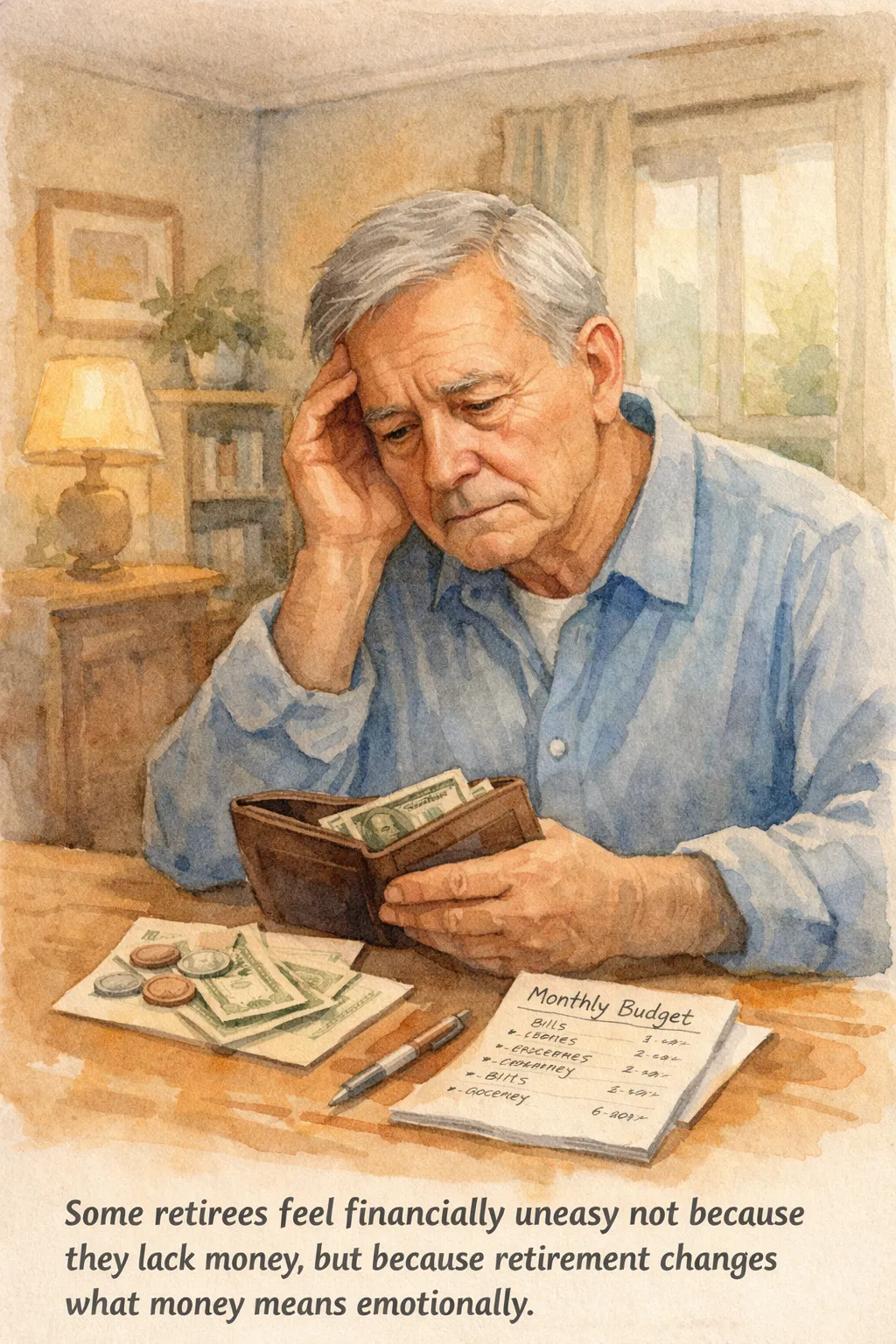
Older adult looking at a wallet with cash and monthly budget notes, appearing financially uneasy despite having money
“I know I’m not broke… so why do I still feel financially uneasy?”
This is more common than people think after retirement.
On paper, things may look okay.
the bills are being paid
savings still exist
there is no immediate crisis
spending is not out of control
And yet, emotionally, something feels tight.
You hesitate before buying small things. You check balances more often than you want to. You feel uneasy spending money even when the spending is reasonable.
This experience can be confusing.
Because it is not always about actual poverty.
Sometimes, it is about the psychology of retirement money.
1. Income feels different when it stops being earned
Before retirement, money often felt connected to effort.
You worked. You got paid. You could recover from a mistake with future income.
After retirement, money feels different.
Now it can feel like:
a fixed pool
a limited runway
something that only goes down
Even when your numbers are stable, your emotional experience of money changes.
That shift alone can make people feel poorer than they actually are.
2. Uncertainty feels expensive
Retirement money is rarely stressful only because of the amount.
It is stressful because of uncertainty.
Questions begin to stack up:
What if prices keep rising?
What if I need more care later?
What if I live longer than expected?
What if one big expense throws everything off?
These questions create a constant background tension.
So even when today is financially manageable, tomorrow feels expensive.
That emotional gap can feel like poverty, even when it is really uncertainty.
3. Spending now can feel like stealing from your future self
This is one of the biggest retirement money shifts.
Before retirement:
spending often felt normal if income continued coming in.
After retirement:
spending can feel like taking something away from the future.
That is why even reasonable purchases can trigger guilt.
You may think:
“Do I really need this?”
“What if I regret spending this later?”
“I should probably save that instead.”
This mindset can become so strong that enjoyment disappears.
4. Past money stress does not disappear just because retirement begins
Many retirees carry old money emotions into a new stage of life.
If you spent decades feeling:
cautious
under pressure
responsible for everyone
worried about bills
afraid of financial mistakes
Those patterns do not vanish automatically at retirement.
Sometimes the old stress remains, even when the current numbers are better.
Your bank account may improve faster than your nervous system.
5. Retirement removes the feeling of “margin”
A lot of retirees do not feel poor.
They feel like they have no margin.
Margin means:
room to absorb surprises.
Without margin, even stable finances can feel fragile.
A person may technically have enough money for monthly life,
but still feel anxious because there is not much extra space for:
repairs
medical changes
family emergencies
travel
inflation
care needs later on
That lack of breathing room is emotionally powerful.
You stop asking:
“Am I safe enough for my actual life?”
And start asking:
“Why am I not as comfortable as them?”
Comparison often creates false scarcity.
7. The word “enough” becomes harder to define
Before retirement, enough may have meant:
paying bills
saving regularly
avoiding debt
After retirement, enough becomes more emotional.
Now it may mean:
safety
predictability
longevity
freedom from fear
That is a much harder target.
And when the target keeps moving, it becomes easy to feel poor even while objectively stable.
Real-life example
Elaine, 70, had no debt, a paid-off home, and enough monthly income to cover her life comfortably.
But she still felt anxious buying new shoes or replacing small household items.
Her words were simple:
“I don’t feel broke. I feel exposed.”
That was the real issue.
Not lack of money.
Lack of emotional safety around money.
Once she created a small monthly “allowed spending” amount for everyday life, her stress dropped.
Nothing about her finances changed dramatically.
But her relationship with money did.
Another example
Martin, 73, kept checking his accounts every few days.
He was not overspending.
He was not in danger.
But he still felt uneasy.
Eventually he realized he was not checking for information.
He was checking for reassurance.
That distinction mattered.
Once he moved to a weekly money check instead of frequent balance checking, he felt steadier.
8. Feeling poor is sometimes really fear of future dependence
This is especially true for older adults living alone or thinking ahead.
Money anxiety is often connected to questions like:
Will I need help later?
Will I become a burden?
Will I be able to choose my care?
Will I lose control?
In this case, “I feel poor” may really mean:
“I’m afraid I won’t have enough control later.”
That fear deserves respect.
But it should be named accurately.
Because once you identify the real fear, you can respond more clearly.
9. What actually helps
The solution is not always “save more.”
Sometimes the real need is:
more clarity
less over-checking
a realistic buffer
a simple spending structure
a better definition of enough
Helpful questions:
What does “enough” mean for my real life?
Which expenses are actually stable?
Which fears are concrete, and which are vague?
What would make me feel more financially steady this month?
These questions calm the nervous system more than constant account checking.
10. A calmer way to think about retirement money
Try separating money into three emotional categories:
1. Safety money
This covers essentials:
housing, food, utilities, insurance, medication
2. Stability money
This covers realistic irregular costs:
repairs, appointments, gifts, seasonal spending
3. Life money
This covers living:
coffee out, hobbies, outings, comfort purchases, small joy
Many retirees feel poor because “life money” disappears emotionally.
Everything starts feeling like it must stay in safety mode.
But a retirement life with no room for enjoyment often feels smaller than it needs to.
11. Signs this is more emotional than mathematical
You may be experiencing retirement money anxiety more than actual shortage if:
you feel guilty spending small amounts
you are financially stable but still feel constantly uneasy
you check balances often for reassurance
you postpone reasonable purchases repeatedly
you struggle to define what “enough” means
you feel safer saving than living
That does not mean the feeling is imaginary.
It means the solution may require emotional clarity, not only arithmetic.
12. A better question than “Am I poor?”
Instead of asking:
“Am I poor?”
Try asking:
“Do I feel unclear, unsafe, or out of control?”
That question is usually more accurate.
And it leads to better next steps.
Because those are not all the same problem.
Quick checklist
I feel guilty spending even small amounts
I often fear future costs more than current ones
I check accounts for comfort, not just information
I rarely feel like I have enough margin
I struggle to enjoy money I can reasonably afford to use
If this feels familiar, the problem may not be lack of money alone.
It may be lack of emotional steadiness around money.
The key insight
Some retirees feel poor even with enough money
because retirement changes what money means.
It is no longer just income.
It becomes safety, time, control, and future security.
That is why the emotional experience can feel much tighter than the numbers suggest.
Conclusion
Feeling financially uneasy in retirement is not always a sign that you are doing something wrong.
Sometimes it means:
you need more clarity
you need a calmer money rhythm
you need permission to define “enough” more realistically
Money peace in retirement is not just about having more.
It is about understanding what the money is carrying emotionally.
Once you see that clearly, the fear often becomes easier to manage.
Disclaimer
This content is for general educational purposes only and does not provide financial, legal, tax, or investment advice. Individual financial situations vary. For personalized guidance, consult a qualified financial professional.
Flexible spending [ ] No guilt spiral [ ] One awareness note
Adjustment [ ] One small change chosen
Calendar [ ] Next month’s review scheduled
WHY THIS PROTECTS YOUR FUTURE
Monthly review protects:
emergency fund
retirement timeline
stress levels
sleep quality
Financial calm is health protection.
IF MONEY ANXIETY SPIKES
Pause.
Take 3 slow breaths.
Remind yourself:
“I am reviewing, not reacting.”
That sentence changes everything.
DISCLAIMER
This article is for general educational purposes only and does not provide financial, investment, or tax advice. Individual retirement accounts, income sources, and expenses vary. Consult a qualified financial professional for personalized guidance.
A 2026 no-spreadsheet retirement budget: six lines, two money days, and a calm cushion that reduces worry.
Cindy’s Column × Senior AI Money Practical, senior-friendly guides for a calmer, safer life.
If you’re 55+ and tired of budgeting advice that feels like homework, this is for you.
A lot of “retirement budgeting” content assumes you want to track every coffee, every receipt, every category, every month—forever. But many older adults don’t need a perfect spreadsheet. They need something simpler:
“Am I okay?”
“Can I pay my essentials without dread?”
“Do I have a cushion for surprises?”
“Where is my money quietly leaking?”
“How do I feel less anxious about the month?”
This 2026 method uses six lines—not fifty. It’s designed to be done with paper, a notes app, or a single page you keep in your bills folder.
It’s not about control. It’s about peace.
Why this works better than complicated budgets (especially after 55)
Most money stress in retirement isn’t caused by lack of intelligence. It’s caused by:
too many moving parts (bills, renewals, medical costs, gifts, travel)
unpredictable expenses (utilities, car repairs, copays)
emotional pressure (helping family, fear of “running out”)
decision fatigue (making 30 tiny spending decisions every day)
A six-line budget reduces stress by giving you one clear answer each month:
“Do I have enough for essentials, and am I protecting future me?”
You don’t need perfect tracking. You need a reliable rhythm.
The 2026 “6-Line Budget” (the whole system)
You’re going to write six lines. That’s it.
Line 1: Monthly income (after taxes)
Examples: Social Security, pension, annuity payout, part-time work, regular withdrawals you choose.
Medications, copays, dental/vision, therapy, home help, mobility aids—anything health-related.
Line 5: Joy & life
Gifts, hobbies, dining out, travel saving, memberships, entertainment—what makes life feel worth living.
Line 6: Cushion & future
Emergency cushion, sinking funds (car repairs, home repairs), extra savings, or planned retirement withdrawals.
Your goal is not to squeeze joy out of life. Your goal is to keep joy sustainable.
Table 1: The 6-Line Budget Template (copy this)
Line
Category
Your Monthly Number
Notes
1
Income (after taxes)
Social Security + pension + withdrawals
2
Fixed essentials
housing, insurance, phone, internet
3
Flexible essentials
groceries, utilities, transport
4
Health & care
meds, copays, dental, support
5
Joy & life
eating out, gifts, hobbies, travel
6
Cushion & future
emergency/sinking funds, savings
The only math you need:
Income (Line 1) – (Lines 2+3+4+5+6) = “Monthly breathing room”
Breathing room can be positive, zero, or negative. None of those makes you a good or bad person. It just gives you truth.
Step 1: Decide your “calm number” first (this is the secret)
Before you start adjusting spending, you choose one number:
Your Calm Number = the cash cushion you want in your account after bills clear.
Examples:
$500
$1,000
one month of essentials
“enough so I don’t panic”
This number is personal. If you’re on a tight income, even $300 can still be meaningful.
The calm number helps you stop the daily worry cycle:
If your balance is above your calm number → you’re okay
If it’s below → you slow down spending and review
It turns money into a simple signal, not a constant fear.
Step 2: Fill out the six lines (without overthinking)
You don’t need exact precision. You need useful accuracy.
How to estimate each line quickly
Line 1 (Income): Look at one month of deposits, or use your benefit statements and known payouts.
Line 2 (Fixed essentials): These are mostly predictable. List them once and you’re done.
Line 3 (Flexible essentials): Look at the last 2–3 months and average it.
Line 4 (Health & care): If this varies, use your “usual month” number and keep a small buffer.
Line 5 (Joy & life): This is where many seniors either overspend out of pressure or underspend out of fear. We’ll handle this kindly.
Line 6 (Cushion & future): This isn’t “extra” if it keeps your life stable. This is your safety and your future.
Step 3: Use the 2026 “Guardrail Percentages” (optional, not strict)
Some people like guardrails. If you do, use these gentle targets:
Fixed essentials: often 35–55% of income
Flexible essentials + health: often 25–45% of income
Joy & life: often 5–15% of income
Cushion & future: often 5–20% of income
These ranges are not rules. They’re just a way to notice pressure points.
If fixed essentials take too much, you don’t need shame. You need strategy.
Table 2: A Realistic Example (Single Retiree)
Here’s a realistic example for a retiree living on $2,850/month after taxes.
Line
Category
Monthly Number
1
Income
$2,850
2
Fixed essentials
$1,350
3
Flexible essentials
$550
4
Health & care
$280
5
Joy & life
$220
6
Cushion & future
$250
Total spending
$2,650
Breathing room
$200
This person isn’t “rich,” but the system gives them clarity:
If groceries jump, they know where it comes from (joy, cushion, or temporary buffer)
If health costs rise, they can adjust intentionally
If they want to travel later, they can increase Line 5 or 6 with a plan
Step 4: Turn “surprises” into sinking funds (so they stop feeling like emergencies)
A sinking fund is money you set aside for predictable-but-not-monthly costs.
Common sinking funds for 55+:
car repairs/maintenance
home repairs
annual insurance premiums (if not monthly)
travel/visits
gifts/holidays
dental work
glasses/hearing needs
pet care
You don’t need ten sinking funds. Start with one.
The simplest sinking fund:
Line 6: “Surprises Fund” Even $25–$50/month reduces fear over time.
Table 3: Sinking Fund Examples (Simple Monthly Targets)
Fund
Annual Cost Example
Monthly Set-Aside
Car repairs/tires
$600
$50
Gifts/holidays
$360
$30
Dental/vision
$240
$20
Home fixes
$480
$40
Travel buffer
$300
$25
If you can’t afford these right now, that’s not a failure. Start with one tiny fund—because the habit matters.
Step 5: Make “Joy & Life” spending feel safe (instead of guilty)
Many older adults swing between:
“I shouldn’t spend anything—what if I run out?”
and
“I’m tired of saying no—so I’ll just do it.”
The six-line system fixes this by giving joy a place.
Two simple joy rules for 2026:
Rule A: Plan one comfort item per week A café visit, a bookstore, a dessert, a small meal out—something that feels human.
Rule B: Put joy inside a boundary Example:
“$50/week for joy” or
“$200/month for joy” or
“two meals out per month”
Planned joy prevents impulse spending and prevents deprivation rebounds.
Step 6: The “Leak Check” (10 minutes, once a month)
Most budgets fail because leaks are invisible.
Do this once per month:
Look at your last month’s bank/card activity
Circle anything that was:
unused subscription
duplicate charge
“I don’t even remember buying this”
fees (late fees, overdraft, random service fees)
Then choose one leak to fix.
That’s it. One leak per month is powerful over a year.
Common retirement leaks:
subscriptions you forgot
insurance premium creep
eating out due to fatigue (not enjoyment)
shipping fees from frequent small orders
auto-renewals for things you no longer use
Fixing leaks is calmer than cutting groceries.
Table 4: Leak Fixes That Don’t Feel Miserable
Leak Type
Gentle Fix
Why it works
Subscriptions
cancel 1 per month
steady savings without suffering
Fatigue takeout
keep 2 backup meals at home
cheaper and easier than willpower
Insurance creep
review annually
often big savings opportunity
Bank fees
alerts + calm number
prevents expensive mistakes
Impulse shopping
“wait 48 hours” rule
urges fade, money stays
The 2026 “Two-Day Money Rhythm” (so it doesn’t take over your life)
You don’t need to think about money every day.
Pick two money days each month:
Money Day 1 (early month): pay or confirm bills, update your 6 lines
Money Day 2 (mid-month): leak check + adjust if needed
Total time: 30–45 minutes each day.
This keeps you informed without living inside financial anxiety.
Case stories (real seniors, real numbers)
Case 1: “I was scared to look” (Janet, 69)
Janet avoided her accounts because it made her anxious. She tried the 6-line system with a calm number of $800.
In month one, she found two leaks:
an unused subscription: $14.99/month
a “protection plan” on a retail account: $11.50/month
That’s $26.49/month, or about $318/year—without cutting a single grocery item.
Her biggest change wasn’t the money. It was the feeling:
“I can look without spiraling.”
Case 2: “My health costs were unpredictable” (Miguel, 74)
Miguel’s copays varied and he felt like every appointment ruined the budget. He set Line 4 (Health & care) to a slightly higher average and created a small “Health buffer” in Line 6: $40/month.
After three months:
fewer panic moments
fewer “I can’t go to the doctor” thoughts
clearer decisions about what he could comfortably afford
Case 3: “I wanted joy without guilt” (Elaine, 63)
Elaine felt guilty spending on anything “fun,” then occasionally splurged. She set Line 5 to $180/month and made it visible.
She used it for:
one meal out per week OR
two outings + one small hobby item
Result:
less impulse spending
more enjoyment
less guilt
When joy has a line, it becomes safer.
If your budget comes out negative (what to do, calmly)
If your breathing room is negative, do not panic. The 6-line method still helps because it shows you which lever actually matters.
Backup meals at home, planned errands, fewer last-minute purchases.
3) Adjust joy gently (not to zero)
Even a small joy line prevents burnout.
4) Explore support options
Depending on your situation, this might include:
benefits reviews
medical cost review with a pharmacist/clinic billing department
housing decisions
financial counseling or a trusted advisor
A negative month isn’t a moral failure. It’s a signal that the plan needs support.
A printable one-page checklist (paste into your post)
Write your Calm Number (cash cushion target)
Fill in the 6 lines (income, fixed, flexible, health, joy, cushion)
Calculate breathing room (Line 1 minus Lines 2–6)
Choose two money days each month (early + mid-month)
Do one leak fix per month
Add one sinking fund (even small)
Keep joy inside a boundary (so it stays safe)
Re-check quarterly and adjust
Disclaimer
This article is for general educational purposes only and does not provide financial, legal, tax, or investment advice. Individual circumstances vary. For guidance tailored to your situation—especially regarding retirement withdrawals, benefits, debt, taxes, or major financial decisions—consult a qualified professional.
A 2026 one-folder bills routine: two bill days per month, fewer late fees, less paperwork stress.
Cindy’s Column × Senior AI Money Practical, senior-friendly guides for a calmer, safer life.
If budgeting apps make you feel tense, you’re not alone.
A lot of adults 55+ don’t want to “track everything.” They want something simpler: a way to pay bills on time, avoid late fees, reduce paper clutter, and stop that background anxiety of “Did I miss something?”
This guide is a paper-first, senior-friendly system you can set up in one afternoon:
The 2026 One-Folder Bills System
It’s not fancy. That’s the point. It’s designed to work even if you’re tired, stressed, traveling, or dealing with health changes.
You’ll end up with:
one folder where bills and bill info live
one list that tells you what’s due and when
one simple routine you repeat twice a month
fewer late fees, fewer “surprise” charges, less worry
No apps required. Optional digital steps are included for people who want them, but the core system works on paper.
Why a one-folder system works so well after 55
Most “bill stress” doesn’t come from big math. It comes from:
too many places bills can hide (mail piles, email inbox, portals)
inconsistent due dates
forgotten renewals and auto-pay surprises
paperwork fatigue
fear of making a mistake
A one-folder system reduces stress by doing two things:
Centralizing information (so you don’t have to remember where things are)
Standardizing habits (so you’re not reinventing the process each month)
Think of it like keeping your keys in the same spot every day. It’s not a productivity hack—it’s a nervous system hack.
What you need (simple supplies)
1 sturdy folder (letter-size, with pockets if possible)
10–20 sheets of paper (or a small notebook)
pen + highlighter
optional: a few sticky notes and paper clips
That’s it.
If you want a slightly sturdier version:
a thin accordion folder works well
one-page plastic sleeves can protect your “master list”
Step 1: Choose your bill style (Paper, Email, or Hybrid)
Circle one:
Paper style: most bills arrive by mail
Email style: most bills arrive digitally
Hybrid: you get a mix
The system works for all three. The key is deciding where “the truth” will live.
For this method, the truth lives in your one folder—even if the bill arrives digitally. You will print or write down the key details and store them in the folder so you’re not hunting through email later.
Step 2: Build your “Master Bills List” (the heart of the system)
This is a single page that lists:
who you pay
what it’s for
due date
typical amount range
how you pay (check, card, autopay)
how to contact them (phone/website)
notes (logins, account numbers, only if you store them safely)
Table 1: Master Bills List (copy this format)
Bill
Due Date
Typical Amount
How Paid
Where to Pay / Contact
Notes
Rent / Mortgage
Electric / Gas
Water / Trash
Phone
Internet
Insurance (auto/home)
Insurance (health/other)
Credit card (if any)
Medical payment plan
Subscriptions (streaming, etc.)
Senior-friendly tip: If writing everything at once feels overwhelming, start with just the top 6 essentials. Add the rest later.
Step 3: Create two pockets in your folder: “TO PAY” and “PAID”
Label the folder pockets or use two paper clips:
TO PAY: any bill, note, or reminder that needs action
PAID: anything you handled this month (or confirmed autopay)
This is the simplest bill “workflow” you will ever use:
bills come in → TO PAY
you handle them → PAID
end of month → clear out PAID (keep only what you need)
No piles. No guessing.
Step 4: Choose your two bill days (the calm schedule)
You don’t need to “stay on top of bills every day.”
Pick two bill days:
Bill Day 1: early month (ex: 1st–5th)
Bill Day 2: mid-month (ex: 15th–20th)
That’s it.
If you get paid on certain dates, align bill days after income arrives.
Table 2: Bill Day Routine (15–25 minutes)
Task
Bill Day 1
Bill Day 2
Open mail / check email for bills
✅
✅
Move anything needing action into “TO PAY”
✅
✅
Pay bills due before next bill day
✅
✅
Check autopay bills posted correctly
✅
✅
Update your one-page checklist
✅
✅
File handled items into “PAID” pocket
✅
✅
This reduces the “constant vigilance” feeling many seniors describe.
Step 5: Add the “One-Page Due Soon” checklist (so you stop forgetting)
This is a very short list you rewrite monthly or reuse with checkboxes.
Checklist: Bills Due Soon (example layout)
Housing payment
Utilities
Phone / Internet
Insurance
Credit card minimum (if applicable)
Any medical bills
Subscriptions review (optional monthly, or every 2 months)
Put this sheet at the front of your folder.
When you feel anxious, you don’t have to “remember.” You just look at the page.
The #1 problem for seniors: autopay that causes surprise overdrafts
Autopay can be helpful, but it can also create stress if:
due dates are scattered
amounts vary (utilities)
income timing is tight
you forget what’s on autopay
A safer autopay approach
Use autopay for predictable bills first:
insurance premium
internet
phone
rent/mortgage (only if your cash flow is stable)
For variable bills (utilities), consider:
calendar reminders
or autopay with alerts and a buffer
“Autopay audit” mini list (do once, then revisit quarterly)
what bills are on autopay?
what date do they pull?
are you comfortable with that timing?
do you have alerts for large withdrawals?
is there a buffer in the account?
A simple way to prevent late fees (without micromanaging)
Late fees are often avoidable with one habit:
Put due dates into “date ranges,” not exact dates
Example:
“Housing: 1st–3rd”
“Utilities: 8th–12th”
“Phone/internet: 15th–18th”
Then your bill day catches the whole range.
This is friendlier to the human brain than remembering exact dates.
Realistic example (with numbers): how this saves money
Case: Patricia, 71 (hybrid bills, occasional late fees)
Patricia had:
rent due 1st
utilities scattered
two subscription renewals she forgot about
occasional $25–$39 late fees
Her “before” pattern:
bills in three places (mail pile, email, portals)
she paid some bills late 1–2 times per quarter
Her “one-folder” changes:
two bill days per month
a master list with due ranges
subscriptions listed with renewal months
everything moved through TO PAY → PAID
After 3 months:
late fees dropped to zero
she caught two unused subscriptions totaling $27/month
she said the biggest benefit was “I’m not scared to open the mail.”
That’s the real win: calm.
How to handle medical bills (without confusion)
Medical bills can arrive late, be confusing, and come from multiple sources.
Use this rule:
No bill gets paid until it’s identified.
Meaning:
who is it from?
what date of service?
does it match what you received?
does insurance explain any part?
In your folder:
keep a “Medical” divider sheet
write the date, provider, and what it’s for
keep any payment plans documented
If you’re unsure, it’s okay to call and ask for clarification. Confusion is common; you’re not “behind,” you’re being careful.
The “Travel version” of the system (so nothing falls apart on trips)
If you travel, the one-folder system still works.
Before you leave:
do Bill Day routine within 48 hours of departure
pay anything due while you’re away
confirm autopay dates
put a “While I’m traveling” sticky note on top of the folder:
next bill day date
any bill you must check online (if any)
If you don’t want to do anything while traveling:
set up bill days so you’re not traveling during peak due dates
or ask a trusted person to check mail (if you have that arrangement)
Optional: the “one-number” account balance habit (no spreadsheets)
If you want a simple financial snapshot without tracking:
write down your “safe balance” number: the minimum you want in the account after bills.
Example:
“My safe balance is $600.”
If your account is above that after bills, you feel calmer. If it’s below that, you know to pause extra spending and review.
This avoids detailed budgeting but still protects stability.
Common obstacles (and gentle fixes)
“I’m embarrassed because I feel disorganized.”
Fix: This system is designed for people who are tired of being punished by complexity. It’s not a character issue.
“I forget to do bill day.”
Fix: Put bill days on a physical calendar and set one gentle reminder (phone alarm is optional).
“I have too many small subscriptions.”
Fix: Put them on your master list and review them every two months, not daily.
“My bills are online and I don’t print things.”
Fix: You can keep handwritten notes in your folder:
“Electric: pay online between 8th–12th”
“Internet: autopay on 16th”
The folder holds the plan, not necessarily the paper bill.
The 2026 One-Folder Setup Plan (do it this weekend)
Day 1 (30–60 minutes)
label your folder TO PAY and PAID
start the master list with essentials
add your two bill days to calendar
Day 2 (20–40 minutes)
gather any bills you can find (mail/email)
fill in due dates and typical amounts
list subscriptions and renewal months
decide which bills are autopay vs manual
Day 3 (10 minutes)
do your first “bill day” routine
put handled items in PAID
enjoy the quiet feeling of “I have a system now”
Printable-friendly checklist (paste into your post)
Choose two bill days each month
Create master bills list (one page)
Set up TO PAY and PAID pockets
Put due date ranges on your list
List autopay items + pull dates
Add a “Bills Due Soon” checklist at front
Review subscriptions every 2 months
Keep medical bills together with notes
Disclaimer
This article is for general educational purposes only and does not provide financial, legal, or tax advice. Individual circumstances vary. For guidance specific to your situation—especially regarding debt, billing disputes, benefits, or payment plans—consult a qualified professional or contact the relevant provider directly. Always protect personal information and use official contact channels when paying bills or resolving billing issues.
“The 15-Minute Money Map for Adults 55+ (2026 Calm Start)”
Hero image placement suggestion (above the title or directly below it): Use a wide panoramic hero image that visually signals “calm planning”: a warm table, a simple calendar, a one-page note, gentle morning light, and the feeling of a fresh start.
Recommended image title: The 15-Minute Money Map (2026 Calm Start) ALT: Older adults reviewing a simple 2026 money map with a calendar and notes in a calm home setting Description: A panoramic hero image showing a calm, senior-friendly approach to monthly income, essentials, and flexible spending—without a spreadsheet.
If money has felt heavier than it used to—more confusing, more emotional, more tied to uncertainty—there’s nothing unusual about that. Many adults 55+ aren’t struggling because they “don’t care” or “aren’t disciplined.” They’re struggling because modern life has become noisy: rising costs, medical paperwork, subscription traps, constant warnings about scams, and the mental load of remembering what’s due and when.
A calm financial start to 2026 doesn’t require a new personality or a complicated app. It requires something far simpler:
A clear picture you can understand in one glance.
That’s what this guide gives you: a 15-minute Money Map—a one-page snapshot of your monthly life that helps you feel steady, make safer decisions, and reduce the constant background stress that money can create.
You do not need to track every penny. You do not need to be “good with numbers.” You do not need to do this perfectly.
You only need a page that answers three questions:
What comes in each month?
What must go out each month?
What is quietly draining you without improving your life?
When you can see those three things clearly, your next steps become obvious—and much less frightening.
Why a “Money Map” works when budgets don’t
Traditional budgets often fail for older adults for practical reasons, not personal ones:
They demand ongoing tracking, which is tiring.
They create guilt when real life interrupts the plan.
They can feel like homework—and nobody wants more homework after 55.
A Money Map works because it’s designed for the real world. It focuses on the outcomes that matter most in this life stage:
Stability: fewer late fees, fewer surprise shortages
Step 3 (2 minutes): Your Flexible Amount — the number that determines your stress
Now subtract:
TOTAL INCOME – TOTAL ESSENTIALS = FLEXIBLE AMOUNT
This is the money that covers:
dining out / takeout
gifts
travel
subscriptions
clothing
entertainment
hobbies
home extras
helping family
“life happens”
People often feel relief just seeing this number. Even when it’s tight, it becomes easier to plan once it has a name.
A simple note that helps emotionally:
If your flexible amount is small, that does not mean you did something wrong. It means you’re living in the same economy everyone else is living in.
Step 4 (3 minutes): Quiet Leaks — find what’s draining you without giving much back
Quiet leaks aren’t always big purchases. They’re often small costs that repeat.
Write:
QUIET LEAKS (pick 1–3 to check this week)
Subscriptions I forgot or don’t use: _________
Delivery/takeout creep: _________
Impulse shopping (online/TV): _________
Fees (late fees, bank fees, interest): _________
Extra gifting or family help beyond comfort: _________
Important: this is not about shame. It’s about stopping money from leaving your life without permission.
One helpful mindset shift:
Cutting a quiet leak isn’t “depriving yourself.” It’s reclaiming money for what actually matters.
Step 5 (2 minutes): Choose ONE rule that makes money feel safer in January
Pick one “Money Comfort Rule” for the next 30 days. One. Not five.
Here are options that fit real life:
Rule A: The 24-Hour Pause
Before a non-essential purchase over $50, wait 24 hours.
Why it works:
It stops emotional spending.
It reduces regret.
It’s easy to follow.
Rule B: The Subscription Filter
If you don’t use a subscription weekly, pause/cancel it and see if you miss it.
Why it works:
Many people pay for services they stopped enjoying months ago.
Rule C: The Bills-First Buffer
Keep a small buffer in checking (whatever is realistic—$100, $200, $500) to avoid overdraft stress.
Why it works:
Overdraft fees and panic are expensive.
Rule D: The Gift Boundary
Set a monthly “gift/help” limit and stick to it.
Why it works:
Many older adults overspend from love or pressure and pay for it later.
Circle your rule. Write it on the bottom of the page.
This is the part that reduces anxiety, because your brain can relax when it knows there’s a plan.
A simple one-page layout (copy this)
If you want a clean template, your page can look like this:
MONEY MAP — JANUARY 2026
INCOME (monthly): $____
ESSENTIALS (monthly): $____
FLEXIBLE AMOUNT: $____
QUIET LEAKS TO CHECK (1–3):
MY MONEY COMFORT RULE (30 days):
MONTHLY MONEY CHECK DAY:
_________ (example: first Monday)
That’s it. That’s the system.
What to do next (so this page actually changes your life)
A Money Map helps most when it connects to a tiny routine.
The 20-minute monthly money check
Once a month, same day each month, do this:
Look at your account balance(s).
Confirm essentials are covered.
Review one quiet leak category.
Decide one small adjustment for the next month.
Stop. You’re done.
This routine is short enough to continue even when life is busy.
“Consistency” for older adults shouldn’t mean “every day.” It should mean “simple enough to repeat.”
The most common money stress points after 55 (and how to soften them)
1) “I dread checking my accounts.”
This is common. Dread grows in the dark.
A gentle strategy:
Check once weekly, same time, same day, for 3 minutes.
Not to judge—just to notice.
Even a short weekly check can reduce anxiety over time because your brain stops imagining worst-case scenarios.
2) “Bills feel confusing and scattered.”
Scattered bills create mental load.
A calming fix:
Put everything into one place: one folder, one drawer, one email label.
Create one list: “Bills + Due Dates.”
You don’t need a fancy system. You need a system you can find when you’re tired.
3) “Subscriptions keep sneaking in.”
Subscriptions are designed to be forgotten.
A practical approach:
Choose one “subscription review day” every two months.
Cancel anything you wouldn’t buy again today.
4) “Helping family is getting expensive.”
Many older adults help from love, but love shouldn’t create fear.
A boundary that protects everyone:
Decide your monthly “help amount” in advance.
When it’s used, it’s used.
You can still be generous and still protect your future self.
A quick “quiet leaks” checklist (fast wins)
If you want easy wins in Week 1 of 2026, check these:
Streaming services you don’t use
Premium channels or add-ons
Forgotten app subscriptions
Delivery memberships
Duplicate insurance add-ons
Bank account fees you could avoid with a different account type
Auto-renewals you didn’t mean to keep
Even saving $25–$75 a month can reduce stress. Those small savings add up to groceries, prescriptions, or one enjoyable outing.
Scam safety: a calm rule that prevents costly mistakes
In retirement years, scams are not just annoying—they can be devastating. The best protection is not fear. It’s a habit.
Use one rule:
PAUSE → VERIFY → TALK
PAUSE: never act under pressure
VERIFY: use a phone number you find yourself (not the number provided)
TALK: consult a trusted person before sending money in an unusual way
Red flags that matter:
“Don’t tell your family.”
“It’s urgent.”
Gift cards, crypto, wire transfers requested.
Threats or intimidation.
Even if a call “sounds official,” pressure is a warning sign.
If your Money Map shows you’re too close to the edge
If your flexible amount is tiny—or negative—do not panic. Panic leads to bad decisions. Instead, think in “tiers.”
Tier 1: Stabilize (small changes first)
Reduce one leak by 10–20%
Cut one recurring fee
Simplify one bill situation (autopay only if safe and reviewed)
Tier 2: Improve (bigger levers)
Review insurance or phone/internet plans
Shop prescription pricing options with professional guidance
Adjust discretionary spending categories with compassion (not punishment)
Tier 3: Get support (when it’s worth it)
If you’re dealing with debt, taxes, complex withdrawals, or benefits decisions, consider qualified help. A professional can sometimes save more than they cost by preventing mistakes.
The key is to choose support that is transparent about fees and aligned with your goals.
Make it stick: the “January gentle promise”
Write one sentence at the bottom of your Money Map:
“In January, I will protect my peace by _________.”
Examples:
“…checking money once weekly for three minutes.”
“…pausing purchases over $50 for 24 hours.”
“…canceling one subscription I don’t use.”
“…keeping a small buffer so I don’t feel panicked.”
This isn’t motivation. This is a promise you can keep.
A final note that matters
A calm financial life after 55 is not about never spending. It’s about spending with intention—so money supports your safety, your independence, and your joy.
Your Money Map is a small page, but it does a big job:
It replaces fear with facts.
It replaces chaos with a simple system.
It helps you make better decisions without exhausting yourself.
If you complete the Money Map today, you already did something meaningful for your future self.
Next step suggestion (optional): Choose one quiet leak and take one action in under 10 minutes—cancel, pause, or set a reminder to review.
Small actions build calm.
Important Disclaimer (placed at the end, as requested)
This article is for general educational purposes only and does not constitute financial, legal, tax, or medical advice. It does not take into account your personal circumstances, goals, or needs. Rules and implications vary by country, region, and individual situation. For guidance tailored to you, consult qualified professionals (such as a licensed financial advisor, CPA/tax professional, attorney, physician, or pharmacist). If you feel at risk of financial fraud or exploitation, contact local authorities or trusted consumer protection resources in your country.
2026 Budget Planning for Seniors: a gentle, one-page roadmap to protect essentials, plan health costs, and still make room for small joys on a fixed income.
If 2025 felt like “everything is getting more expensive,” you are not imagining it.
Housing, groceries, insurance, and medical costs have all moved, and many older adults are feeling the pressure. That’s why 2026 Budget Planning for Seniors needs to be calmer, clearer, and kinder than the harsh budgeting rules you may have seen when you were younger.
This guide is not here to scold you about coffee or tell you to stop being generous. It’s here to help you:
see your real 2026 income clearly,
protect your essentials first,
make space for joy on purpose,
and create one simple page you can actually follow all year.
Who this 2026 budget planning guide is for
adults 55+ (especially 65+)
seniors living on Social Security, pensions, or mixed income
older adults in Florida, Arizona, California, or similar cost-of-living states
anyone who wants a 2026 budget that is simple enough to keep, not just dream about
What you’ll get
a step-by-step process to build a realistic 2026 budget
a clear way to list income from Social Security, pensions, 401(k)/IRA withdrawals, and part-time work
a “must-have vs nice-to-have” checklist that respects how life really feels after 55
a simple health-care and medication planning section for 2026
a one-page 2026 senior budget worksheet you can copy and put on your fridge
gentle scripts to talk with family about money boundaries
Important note (YMYL)
This “2026 Budget Planning for Seniors” guide is general educational information, not personal financial, tax, legal, or retirement advice. Your situation is unique. Before making decisions about Social Security, 401(k) and IRA withdrawals, Medicare choices, investments, or taxes, please speak with a qualified financial planner, tax professional, or benefits counselor who can look at your full picture.
1. Why 2026 budget planning is different after 55
Budget advice written for 25-year-olds assumes:
your income will go up,
your body can work long hours if needed,
you can “catch up later” if you overspend.
After 55–65, your reality is different:
Income may be fixed or limited: Social Security, pensions, and retirement accounts.
Health may be less predictable: more appointments, medications, and co-pays.
Energy is part of your budget: you can’t just “work more” to cover a surprise bill.
Long-term security matters more than short-term “keeping up” with others.
That means your 2026 budget has to do three jobs at once:
Protect your essentials.
Make room for small joys.
Avoid choices that threaten your future safety.
You don’t need perfection. You need a map.
2. Step 1: See your real 2026 income on one page
Before you touch expenses, you need a clear picture of money coming in.
On a blank page, write:
“My 2026 Monthly Income”
Underneath, list:
Social Security (after Medicare Part B, if it’s deducted)
Pension(s)
401(k) or IRA withdrawals
Annuity income
Part-time work or self-employment
Rental income (if any)
Other regular income (alimony, support, side gigs)
For each, write the monthly amount you expect in 2026.
Example:
Social Security: $1,850
Pension: $600
401(k)/IRA withdrawals: $400
Part-time work: $300
Total expected monthly income: $3,150
A few gentle reminders:
If you are taking money from a 401(k) or IRA, consider asking a financial planner what a sustainable withdrawal looks like for your age and savings.
If you are still deciding when to start Social Security, speak with a Social Security representative or planner before finalizing your 2026 budget.
If part-time work is uncertain, budget conservatively (assume a lower number) and treat extra income as a bonus, not a guarantee.
Write your own total:
“My expected monthly income for 2026 is about $________.”
This number is the ceiling, not the starting point for spending.
3. Step 2: Protect your essentials first (no guilt)
Essentials are the things that keep you housed, safe, fed, and connected.
Write a new heading:
“My 2026 Essential Monthly Expenses”
Categories to include:
Housing (rent or mortgage, condo/HOA fees)
Property tax (divide annual amount by 12)
Home insurance (and flood/hurricane/fire if separate)
Utilities (electricity, water, gas, trash)
Phone and internet
Groceries and basic household supplies
Transportation (fuel, public transit, rides, maintenance)
Health insurance premiums (Medicare, Medigap, Advantage, Part D, employer plans)
Out-of-pocket medications and co-pays (estimate monthly average)
Minimum debt payments (credit cards, personal loans)
Go category by category and write a realistic monthly number next to each. Use recent bank or card statements if you can.
Then add them up.
Example (numbers just to illustrate):
Housing (rent): $1,200
Utilities (average): $220
Phone & internet: $120
Groceries & basics: $450
Transportation: $150
Health premiums & dental plan: $350
Medications & co-pays (average): $150
Minimum debt payments: $160
Total essentials: $2,800
Now compare:
Monthly income (from step 2 example): $3,150
Essential expenses: $2,800
Money left after essentials: $3,150 – $2,800 = $350
This leftover is precious. It has to cover:
“wants” (meals out, gifts, travel, hobbies),
savings and emergency buffer,
irregular costs (car repairs, home repairs, eyeglasses, dental work).
If your essential expenses are higher than your income, that’s a red flag — not a failure, but a signal that you may need professional help to adjust housing, debt, or benefits. Don’t ignore it; this is exactly when talking to a credit counselor, benefits counselor, or planner is worth the time.
4. Step 3: Give healthcare its own line in your 2026 budget
For seniors in the U.S., health costs in 2026 can be one of the biggest budget surprises.
Instead of hiding health costs inside “miscellaneous,” give them their own section:
“My 2026 Health-Care & Medication Budget”
Include:
Medicare Part B premium (if taken from Social Security)
Medicare Advantage or Medigap plan premium
Part D (drug plan) or drug coverage through other insurance
Dental and vision plans (if any)
Average monthly co-pays and prescriptions
A small monthly amount for over-the-counter items (pain relievers, supplements, supplies)
Then, add a health buffer if you can:
Even $20–$50/month set aside for future medical bills can help with:
unexpected tests,
new prescriptions,
a specialist visit.
If you had unexpected health costs in 2025, ask:
“If 2025 repeats in 2026, what would a safe monthly average look like?”
Whatever number you decide, write:
“In 2026, I plan to set aside about $_____ per month for health-care costs.”
This makes future doctor visits less frightening because you’re planning for them, not pretending they won’t happen.
5. Step 4: Plan your “joy spending” on purpose, not by accident
After essentials and basic health costs, you will see what’s truly left for wants.
Instead of feeling guilty every time you buy something nice, plan a small, named amount for each joy category.
Start with your leftover amount (from earlier example: $350). Then divide it by purpose.
Example:
Gifts: $70
Eating out and treats: $60
Hobbies & streaming: $50
Travel & visits: $90
Grandchildren & giving: $40
Small extra savings: $40
Total: $350
You can adjust the numbers however you like, but the point is:
every dollar has a job,
joy is allowed,
but joy also has limits so that you don’t hurt your future self.
Write your own version:
“In 2026, I will aim to spend about $_____ per month on gifts, $_____ on eating out, $_____ on hobbies/streaming, and $_____ on travel or visits.”
When those amounts are gone for the month, you’re done — not because you’re failing, but because you’re honoring your plan.
6. Step 5: Build mini “sinking funds” for big, irregular costs
Some of the most stressful bills for seniors are not monthly. They are:
car repairs,
home repairs (roof, AC, plumbing),
dental work,
new glasses or hearing aids,
insurance renewals.
Instead of being surprised each time, use a simple idea called a “sinking fund.”
Write a heading:
“My 2026 Sinking Funds”
Then list 3–5 areas:
Car maintenance & repairs
Home repairs & appliances
Dental & vision
Gifts & holidays
Travel fund
Next to each, write:
an annual target (what you’d ideally like to have),
and a monthly mini-contribution.
Example:
Car repairs: aim for $600/year → $50/month
Home repairs: aim for $600/year → $50/month
Dental & vision: aim for $360/year → $30/month
Gifts & holidays: aim for $600/year → $50/month
Total sinking fund contributions: $180/month
If your leftover money doesn’t allow all of these, prioritize:
Health & safety first (car, home, dental),
Then gifts & travel.
Even small amounts help. $25/month for car repairs is $300 by the end of the year — enough to ease many emergencies.
7. Step 6: Adjust for where you live (Florida, Arizona, California and beyond)
Where you live changes your 2026 budget in real ways.
If you are in Florida:
Watch: homeowner’s insurance, flood or hurricane coverage, HOA fees.
Utilities: air conditioning can push electric bills up, especially in summer.
Good news: no state income tax, which can help stretch your retirement income.
If you are in Arizona:
Watch: summer cooling costs, medical care access in your area, potential travel to cooler places in very hot months.
Transportation: distances can be longer; budget for fuel or rides.
If you are in California:
Watch: higher housing costs (rent or property tax), wildfire insurance in some areas.
Transportation: fuel, parking, and tolls may be higher.
Some cities have higher local taxes or fees.
Regardless of state:
Write down the 3 biggest location-specific costs you face (for example, “hurricane insurance,” “HOA fee,” or “parking and tolls”).
Make sure they appear clearly in your 2026 budget instead of catching you off-guard.
If you are thinking about moving (downsizing, relocating closer to family, or moving to a lower-cost area), treat 2026 as a research year, not a panic year:
Note what your 2026 housing and utility numbers really are.
Compare them to realistic numbers in places you’re considering.
Talk to a financial professional before making big moves.
8. Step 7: Create your one-page 2026 senior budget
Now we pull it all together into a simple page you can keep on your fridge or in a folder.
You can copy this format by hand:
2026 Budget Planning for Seniors – One-Page Worksheet
Monthly income
Social Security: $_____
Pension(s): $_____
401(k)/IRA withdrawals: $_____
Part-time work: $_____
Other: $_____
Total monthly income: $_____
Essentials
Housing (rent/mortgage/HOA): $_____
Property tax (monthly equivalent): $_____
Utilities (average): $_____
Phone & internet: $_____
Groceries & basics: $_____
Transportation: $_____
Health premiums (Medicare, Medigap, etc.): $_____
Medications & co-pays (average): $_____
Minimum debt payments: $_____
Total essentials: $_____
Health-care buffer
Extra monthly amount for medical surprises: $_____
Joy & living money
Gifts: $_____
Eating out & treats: $_____
Hobbies & streaming: $_____
Travel & visits: $_____
Grandchildren & giving: $_____
Total joy & living: $_____
Sinking funds (irregular costs)
Car maintenance & repairs: $_____
Home repairs & appliances: $_____
Dental & vision: $_____
Holidays & big gifts: $_____
Total sinking funds: $_____
Summary
Total income: $_____
Essentials + health + joy + sinking funds: $_____
If your total expenses are less than your income, you have some room to save or add to sinking funds. If they are more, you’ll need to adjust: reduce some “wants,” explore cheaper options, or seek help with debt or benefits.
Tape this page where you can see it. It’s not a punishment sheet. It’s your 2026 safety and peace map.
9. Scripts for talking with family about your 2026 budget
Sometimes the hardest part of 2026 budget planning for seniors is not the math — it’s the conversations.
Here are some gentle, ready-to-use lines:
For adult children:
“I’ve done my 2026 budget, and I need to be careful. I’ll be giving smaller gifts this year, but my love isn’t smaller.”
“My priority is staying independent as long as I can. That means I have to say no to some expenses, even when I wish I could say yes.”
For grandchildren:
“I won’t always be able to buy big things, but I can promise time, stories, and calls. That’s the part I want you to remember.”
For friends or extended family:
“I’m on a simple, fixed budget now. I’ll join for things that fit, and I may say no to pricier plans. I hope you understand — I still want to see you.”
For yourself (yes, this matters too):
“I am allowed to protect my future, even if other people don’t see the full picture.”
10. 30-second summary of 2026 budget planning for seniors
If you remember only a few lines from this guide, let them be these:
Write down your real 2026 income on one page before you plan anything.
Protect essentials and health costs first; joy comes next, not the other way around.
Plan small monthly amounts for big, irregular costs so they don’t become emergencies.
Adjust your 2026 budget for the real costs of where you live.
Use one simple page as your budget map — and talk openly with family about your limits.
You don’t need a perfect budget. You need a kind, realistic one that keeps 2026 safer for you and your future self.
Editorial disclaimer
This “2026 Budget Planning for Seniors” article is for general education only. It does not provide personalized financial, investment, tax, legal, Social Security, Medicare, or retirement planning advice. Every person’s situation is different. Before making decisions about Social Security timing, pension options, 401(k)/IRA withdrawals, annuities, insurance, or debt, please consult qualified professionals such as a financial planner, tax preparer, attorney, or certified credit counselor.
If you are struggling to pay essential bills, consider reaching out to local agencies on aging, nonprofit credit counseling services, or government benefits programs to explore additional support.
You saved diligently for 30 years. Your neighbor saved the exact same amount, in the same investments, earning the same average return. Yet when you both retire, one of you might run out of money years before the other. How is this possible? The answer lies in sequence-of-returns risk—a mathematical concept that can affect retirement savings even when long-term returns look identical on paper. This guide breaks down this concept using simple math that anyone over 60 can understand, without financial jargon or complex formulas. You’ll see exactly why the order of your investment returns can matter, especially in the years immediately before and after retirement. Understanding this concept may help you plan more effectively for retirement security, though outcomes vary significantly by individual circumstances.
⚠️ Important Financial Disclaimer
This article provides educational information only and is not financial, investment, or legal advice. It does not recommend specific investment strategies or guarantee any outcomes. Sequence-of-returns risk is a complex topic with many variables. The simplified examples shown cannot capture all factors that affect real retirement outcomes—including taxes, fees, inflation, varying withdrawal amounts, and individual circumstances. Market conditions vary unpredictably, and past performance does not predict future results. The strategies discussed may not be suitable for your situation. Before making any financial decisions, please consult a qualified financial advisor who can assess your specific situation, goals, and complete financial picture. Professional guidance specific to your circumstances is strongly recommended.
What Is Sequence-of-Returns Risk? The Tale of Two Retirees
Let’s start with a story that illustrates the concept. Meet Robert and Susan, both age 65, both retiring with exactly $500,000 in savings. Both invest in the same balanced portfolio. Both withdraw $30,000 per year to live on. Over the next 20 years, both earn an average annual return of 6%.
Common sense suggests they’d end up in roughly the same financial position, right? In theory, with identical averages, outcomes should be similar. But here’s what the math shows can happen:
Robert retires in a year when the market immediately drops 20%, then recovers gradually. In this scenario, his account might be significantly depleted over time.
Susan retires in a year when the market immediately gains 20%, then experiences the exact same returns as Robert, just in reverse order. In this scenario, Susan might still have substantial assets remaining.
Same starting amount. Same average return. Same withdrawal rate. Yet the order of returns creates potentially very different outcomes. This is the essence of sequence-of-returns risk—the possibility that poor market returns in the early years of retirement can affect your financial security differently than if those same returns occurred later, even if long-term averages are identical.
The mathematics behind this might sound counterintuitive, but once you see it broken down with simple numbers, it becomes clearer why the timing of returns can matter when you’re withdrawing money regularly from a portfolio. However, remember that these are simplified examples for educational purposes—your actual experience will involve many additional factors.
The Simple Math: Why Order Can Matter When You’re Withdrawing
Let’s use a simplified three-year example to demonstrate the concept. We’ll compare two scenarios with identical returns, just in different orders.
Starting amount: $100,000 Annual withdrawal: $5,000 (taken at year-end) Three years of returns: -20%, +10%, +15% Average return: 1.67% per year
Scenario A: Negative returns first (-20%, +10%, +15%)
Year 1: $100,000 drops 20% = $80,000. Withdraw $5,000. End balance: $75,000
Year 2: $75,000 gains 10% = $82,500. Withdraw $5,000. End balance: $77,500
Year 3: $77,500 gains 15% = $89,125. Withdraw $5,000. End balance: $84,125
Scenario B: Positive returns first (+15%, +10%, -20%)
Year 1: $100,000 gains 15% = $115,000. Withdraw $5,000. End balance: $110,000
Year 2: $110,000 gains 10% = $121,000. Withdraw $5,000. End balance: $116,000
Year 3: $116,000 drops 20% = $92,800. Withdraw $5,000. End balance: $87,800
The difference: $87,800 – $84,125 = $3,675
That’s nearly $4,000 difference from the same three returns in different order—on just $100,000 over three years. Scale this concept to larger portfolios over longer time periods, and the differences can grow substantially, though actual results vary widely based on many factors.
The key insight: When you experience losses early, you’re withdrawing from a smaller account balance, which means you’re selling proportionally more of your remaining investments to generate the same dollar amount. Those shares aren’t available to participate in subsequent growth. Once sold, they can’t compound back.
Important Note About These Examples:
This simplified example demonstrates the mathematical concept but doesn’t include taxes, investment fees, inflation adjustments, varying withdrawal amounts, rebalancing, or many other real-world factors that significantly affect actual outcomes. Your personal experience will differ from these theoretical calculations. Use this as a learning tool to understand the concept, not as a prediction of your specific situation. Always consult a financial advisor for guidance tailored to your circumstances.
Visual Art by Artani Paris
The Critical 10-Year Window: Ages 60-70
Financial research often focuses on the returns you experience in the five years before and five years after retirement as potentially having an outsized impact on long-term retirement outcomes. This 10-year period is sometimes called the “retirement red zone” or the “fragile decade,” though the degree of impact varies by individual circumstances.
Why might these particular years matter? Because this is when two forces can collide:
1. Your portfolio may reach its maximum size. After decades of accumulation, you potentially have more money at risk than ever before. A 20% market decline on $50,000 affects $10,000. A 20% decline on $500,000 affects $100,000. The absolute dollar impact of percentage movements grows with portfolio size.
2. You begin making withdrawals. Instead of adding money during market downturns (buying at lower prices), you may now need to sell during downturns to generate income. This reverses the compounding dynamic that built wealth during your working years and creates the sequence-of-returns situation.
Consider this hypothetical scenario: A 65-year-old retires with $600,000 and withdraws $30,000 annually (5% initial withdrawal rate). If the market drops 25% in year one of retirement:
Portfolio value after decline: $450,000
After $30,000 withdrawal: $420,000 remaining
Recovery needed to return to starting value: 43%
But here’s the challenge: Even if markets eventually recover that amount, the retiree continues withdrawing annually (typically adjusted for inflation). The portfolio is attempting to recover while being drawn down. It’s like trying to fill a bathtub while water drains out.
Some financial planning research suggests that the sequence of returns during this critical decade may influence long-term portfolio outcomes, though many other factors—including withdrawal flexibility, other income sources, and longevity—also play significant roles. Individual results vary dramatically based on specific circumstances.
Real-World Example: The 2008 Financial Crisis Perspective
The 2008-2009 financial crisis offers one historical example of how retirement timing can create different experiences, though every market cycle differs and past events don’t predict future results. Consider two groups of hypothetical retirees with identical $500,000 portfolios invested in a typical 60/40 stock/bond mix:
Group A: Retired in 2007 (just before the crisis) These retirees experienced portfolios declining approximately 37% during 2008. Someone withdrawing $25,000 annually might have gone from $500,000 to roughly $290,000 after the decline and withdrawal. Even as markets recovered from 2009-2013, portfolios starting from this depleted level faced different mathematical dynamics than those that avoided the initial decline.
Group B: Retired in 2010 (after the crisis recovery began) These retirees avoided the 2008-2009 decline entirely while still working and potentially contributing to their portfolios. They retired into a period of growth (2010-2019) and generally experienced different portfolio dynamics while making withdrawals.
Some financial planning analyses comparing these timing scenarios have noted substantially different outcomes over subsequent years, though the specific differences varied based on withdrawal strategies, asset allocations, and many other factors. This isn’t hypothetical—the timing of retirement relative to market cycles created genuinely different experiences for real people. However, it’s impossible to isolate the retirement timing factor from all the other variables that affected individual outcomes.
Many 2007-2008 retirees made various adjustments: some returned to work, some reduced spending, others adjusted their strategies. Not because they saved poorly or spent recklessly, but in response to the specific sequence of returns they experienced early in retirement.
How to Address This Risk: Five Strategies to Consider
Understanding sequence-of-returns risk is useful, but considering strategies to address it may be more valuable. Here are five approaches that financial planners commonly discuss with clients. Each has trade-offs, and their appropriateness varies significantly by individual circumstance. None guarantees protection, and all should be discussed with a qualified advisor before implementation.
Strategy 1: Build a Cash Buffer (The “Bucket Strategy”)
One approach involves keeping 2-3 years of living expenses in cash or very stable investments. This “cash bucket” may allow you to avoid selling stocks during market downturns. If markets decline early in retirement, you could potentially draw from cash while your portfolio recovers, possibly reducing sequence-of-returns exposure.
Example: If you need $40,000 annually, this would mean keeping $80,000-$120,000 in high-yield savings, money market funds, or short-term CDs. This cash typically earns lower returns, but that’s not its purpose in this strategy. It’s intended as a reserve against being forced to sell stocks during declines.
Trade-off: Cash earning minimal returns means potentially lower long-term portfolio growth in favorable market conditions. You’re trading some growth potential for possible stability during early retirement market downturns. Whether this trade-off makes sense depends on your specific situation and risk tolerance.
Note: This strategy’s effectiveness varies by individual circumstances, market conditions, and how it’s implemented. Discuss with a qualified advisor before adopting this approach.
Strategy 2: Use a Dynamic Withdrawal Strategy
Instead of withdrawing a fixed dollar amount every year regardless of market conditions, some retirees adjust their withdrawals based on portfolio performance. When portfolios perform well, they may withdraw more. When portfolios decline, they reduce withdrawals if possible.
Example approaches financial advisors sometimes discuss:
The “guardrails” method: Set upper and lower spending limits. If your portfolio performs well, spend up to the upper limit. If it drops below a threshold, temporarily reduce to the lower limit.
The percentage method: Always withdraw a fixed percentage (like 4%) of your current balance, not a fixed dollar amount. This automatically reduces withdrawals after losses and increases them after gains.
Trade-off: Requires flexibility in your budget and willingness to reduce spending during challenging market years. Not everyone has this flexibility, especially if you’re already covering only essential expenses. The psychological difficulty of cutting spending shouldn’t be underestimated.
Note: Dynamic withdrawal strategies have various implementations, each with different implications. Professional guidance is important for determining if and how to apply this approach to your situation.
Strategy 3: Consider Delaying Retirement If Markets Decline Sharply
If you’re 63-65 and planning to retire, but markets have just experienced a major downturn, some financial advisors suggest considering delaying retirement briefly if circumstances permit. Even one or two additional years of not withdrawing from your portfolio—and perhaps continuing to contribute—might help address sequence-of-returns concerns, though this depends heavily on individual factors.
The potential considerations: If your portfolio declined substantially and you delay retirement:
You might avoid withdrawing from a depleted account during early recovery
You could potentially add contributions for a longer period
You might give the portfolio more time to recover before drawing begins
You would delay Social Security, which increases your future guaranteed monthly benefit
Trade-off: Obviously, not everyone can delay retirement—health issues, job loss, caregiving responsibilities, or other factors may prevent this. But if you have the flexibility and the option, timing retirement to avoid starting withdrawals during a major market decline is worth considering with an advisor. However, this also means working longer than originally planned.
Note: The decision to delay retirement involves many factors beyond investment returns, including health, job availability, and personal preferences. This is a complex decision requiring professional guidance tailored to your complete situation.
Strategy 4: Reduce Stock Exposure Gradually Before Retirement
The traditional advice to become more conservative as you age relates partly to sequence-of-returns considerations. A portfolio that’s 80% stocks at age 64 may be more vulnerable to early retirement market declines than a portfolio that’s 50% stocks and 50% bonds, though specific allocations should be based on your individual circumstances.
Common approach some advisors discuss: Gradually reduce stock allocation from 70-80% in your 50s to 50-60% by retirement, then to 40-50% by age 70. The exact numbers depend greatly on your circumstances, other income sources, and risk tolerance. There is no universal “right” allocation.
Trade-off: Lower potential for long-term growth. Bonds and cash typically grow more slowly than stocks over extended periods. You’re potentially trading some growth opportunity for more stability during the critical early retirement years. Whether this trade-off makes sense depends entirely on your specific situation.
Note: Asset allocation is highly individual and should be based on your complete financial picture, time horizon, risk tolerance, and goals. Generic allocation rules rarely fit everyone. Work with a financial advisor to determine what makes sense for you.
Strategy 5: Consider Guaranteed Income Sources
The more of your essential expenses covered by guaranteed income (Social Security, pensions, annuities), the less you may need to withdraw from your portfolio, potentially reducing exposure to sequence-of-returns risk since you’re drawing less from market-exposed assets.
Example: If Social Security covers $30,000 of your $50,000 annual needs, you only need to withdraw $20,000 from your portfolio. This lower withdrawal rate may make your portfolio more resilient to poor early returns, though outcomes vary.
Some retirees use a portion of their savings to purchase an income annuity that provides guaranteed payments, reducing portfolio withdrawal needs. Others delay Social Security to age 70 to maximize that guaranteed income stream. Each approach has significant trade-offs.
Trade-off: Annuities involve costs, complexity, and reduce flexibility—you’re typically giving up a lump sum in exchange for guaranteed income. Delaying Social Security means less income in your 60s and only benefits those who live longer. These decisions involve highly complex trade-offs that vary dramatically by individual circumstances.
Note: Decisions about annuities and Social Security timing are among the most consequential financial choices in retirement and involve numerous factors. Professional guidance from a fee-only financial planner who can analyze your specific situation is strongly recommended.
Strategy
May Be Suitable For
Potential Benefit
Common Trade-off
Cash Buffer (2-3 years)
Many retirees
May help avoid selling during downturns
Cash typically earns lower returns
Dynamic Withdrawals
Those with flexible budgets
Might adjust to market conditions
Requires spending flexibility
Delay Retirement 1-2 years
Those with flexibility
Could avoid starting from depleted level
Work longer than planned
Reduce Stock Exposure
Risk-conscious retirees
Potentially lower volatility
Possibly lower growth potential
Guaranteed Income
Those wanting more certainty
May reduce portfolio reliance
Costs, reduced flexibility
Common strategies financial advisors discuss for addressing sequence-of-returns considerations (consult advisor for personalized guidance)
Visual Art by Artani Paris
What If You’re Already Retired and Markets Decline?
If you’ve already retired and experience a major market decline in your first few years, you’re facing sequence-of-returns risk in real-time. Here are some approaches that financial advisors commonly discuss with clients in this situation, though appropriateness varies dramatically by individual circumstances:
1. Consider reducing withdrawals temporarily if possible. Even reducing withdrawals by 10-20% for 2-3 years during a market recovery might help improve long-term portfolio sustainability in some situations, though this depends on many factors. Can you reduce discretionary spending, take on part-time work, or tap other resources temporarily? Not everyone has this flexibility.
2. Withdraw from bonds/cash rather than stocks if possible. If you have a diversified portfolio, some advisors suggest taking your needed withdrawals from bonds and cash during downturns when possible, leaving stocks untouched to potentially recover. This is one reason the cash buffer strategy may be valuable, though it doesn’t guarantee protection.
3. Avoid panic selling. Selling everything during a market bottom locks in losses permanently and eliminates the possibility of recovery. Market recoveries have historically followed downturns, though timing varies unpredictably and past patterns don’t guarantee future outcomes. However, staying invested during downturns is psychologically difficult and requires tolerance for uncertainty.
4. Consider Social Security timing if you haven’t started. If you’re 65-69 and haven’t claimed Social Security, starting it now might reduce portfolio withdrawals, even though delaying to 70 would increase the monthly benefit. In some situations, preserving your portfolio during recovery may be more valuable than the higher future benefit, though this involves complex trade-offs. Discuss with an advisor who can run specific analyses.
5. Review your plan with a professional. A significant downturn early in retirement is a good reason to consult a fee-only financial planner who can run projections based on your actual situation and help you evaluate adjustments. What works for one person may not work for another.
The key principle: If possible, try to avoid withdrawing large amounts from your portfolio while it’s significantly declined. The more you can reduce withdrawals during recovery phases, the better your long-term outcome might be, though this isn’t always feasible and isn’t guaranteed to work.
Real Stories: How Two Retirees Approached Sequence Risk
Story 1: Patricia, 66, Denver, Colorado
Patricia (66)
Patricia retired in January 2008 with $480,000 saved, planning to withdraw $25,000 annually. Within 10 months, her portfolio had dropped to $320,000 due to the financial crisis. She faced a significant sequence-of-returns challenge.
Instead of panic selling, Patricia made three key adjustments with her advisor’s guidance. First, she took a part-time consulting job that brought in $15,000 annually for three years, reducing her portfolio withdrawal to $10,000. Second, she shifted her withdrawals to come entirely from bonds and cash for two years while stocks recovered. Third, she delayed claiming Social Security until age 70, using her reduced portfolio withdrawals to bridge the gap.
By 2014, markets had recovered and Patricia’s portfolio had rebounded to $410,000 despite ongoing withdrawals. She attributes this partly to her strategy, though market recovery obviously played a major role. When she claimed Social Security at 70, her monthly benefit was 32% higher than if she’d claimed at 66, which reduced future portfolio withdrawal needs. However, it’s impossible to know what would have happened with different choices.
Changes Patricia experienced:
Avoided selling at market lows through strategic adjustments
Temporary income from work reduced withdrawal pressure on portfolio
Higher eventual Social Security reduced long-term portfolio dependence
“Those first two years were scary, but having a plan and sticking to it made all the difference. I’m 73 now and my portfolio situation is much more comfortable. But I know others who made different choices and also did well—there’s no single right answer.” – Patricia
Story 2: James, 64, Portland, Maine
James (64)
James had planned to retire at 65 with $540,000 saved. However, in the year before his planned retirement, markets declined significantly due to various factors. His portfolio fell to $421,000. His financial advisor helped him understand sequence-of-returns risk and the potential implications of retiring during this decline.
James made the difficult decision to delay retirement by 18 months. During those months, he continued working and contributing $1,200 monthly to his 401(k). More importantly, he avoided withdrawing from his portfolio during the recovery period. By the time he retired at 66.5, markets had recovered and his portfolio had grown back to $515,000, though he acknowledges that market recovery was the primary factor, not just his contributions.
When James finally retired, his portfolio was larger than if he’d retired as originally planned. His advisor suggested this timing adjustment might improve his long-term outcomes, though actual results depend on future market performance, which cannot be predicted. It’s impossible to know what would have happened if he’d retired on schedule—perhaps markets would have recovered quickly enough that the difference would have been minimal.
Changes James experienced:
Avoided starting retirement during a portfolio decline
Continued contributions during a market recovery period
Gave portfolio time to rebound before withdrawals began
Started retirement with a larger portfolio, though future outcomes remain uncertain
“Working that extra year and a half wasn’t my first choice, but understanding the math made the decision clearer. I felt it was worth it, though I know it’s not an option everyone has. And honestly, there’s no way to know if it will matter in 20 years.” – James
Frequently Asked Questions
Is sequence-of-returns risk only a problem for retirees?
Primarily, yes. During your working years when you’re adding money to your portfolio, sequence of returns typically matters much less because you’re buying at various price levels, including during declines (which can be beneficial long-term). The risk emerges specifically when you’re withdrawing money regularly from your portfolio, which usually happens in retirement. However, those very close to retirement (within 5 years) may also want to consider this concept when planning. Individual circumstances vary significantly.
How do I know if I should be concerned about this risk?
You may be more exposed if: (1) You’re within 5 years of retirement or early in retirement, (2) You’re heavily invested in stocks (70%+), (3) You have limited guaranteed income sources beyond Social Security, and (4) You plan to withdraw 4-5% or more of your portfolio annually. If several of these apply, consider discussing sequence-of-returns risk with a financial advisor who can assess your specific situation. However, everyone’s circumstances differ, and there’s no universal threshold for “at risk.”
Does the 4% rule account for sequence-of-returns risk?
The original 4% rule research tested withdrawals across many different historical retirement periods, including some with poor early returns, so it did implicitly consider sequence risk. However, the research was based on historical data, and some experts now suggest the 4% guideline may not be appropriate for all current market conditions or individual circumstances. Your personal sustainable withdrawal rate depends on your specific situation, asset allocation, flexibility, and other income sources. The 4% rule is a starting point for discussion with an advisor, not a guarantee.
Should I avoid stocks entirely in retirement because of this risk?
Most financial advisors don’t recommend avoiding stocks entirely. While sequence-of-returns risk is a real consideration, completely avoiding stocks creates a different challenge: your portfolio may not grow enough to sustain purchasing power over a potentially 30-year retirement. Most planners suggest maintaining some stock exposure (commonly 40-60%) even in retirement, while using strategies to address sequence risk. The goal is typically balance based on your individual circumstances, not elimination of all market exposure. However, appropriate allocation varies dramatically by individual.
Can I completely eliminate sequence-of-returns risk?
You might significantly reduce exposure but rarely eliminate it entirely unless your entire retirement is funded by guaranteed sources like pensions and Social Security. The strategies discussed (cash buffers, lower withdrawal rates, guaranteed income, etc.) all may help reduce the risk, but some market exposure typically remains if you’re relying partly on invested assets for income. This is why professional guidance tailored to your specific situation is valuable—an advisor can help you understand and manage the level of risk appropriate for your circumstances.
What’s more important: sequence-of-returns risk or my withdrawal rate?
Both factors matter and they interact significantly. A lower withdrawal rate (3% or less) may provide more cushion against poor early returns. A higher withdrawal rate (6%+) may make you more vulnerable to sequence-of-returns challenges. Many financial planning studies suggest withdrawal rate is among the most important factors for portfolio sustainability, but the sequence of returns you experience affects whether any given withdrawal rate proves sustainable for your specific retirement. They’re interconnected, not separate concerns. Individual results vary widely.
If I experience poor returns early in retirement, what are my options?
Poor early returns create challenges but don’t necessarily doom a retirement plan. The adjustments discussed earlier (reducing withdrawals if possible, working part-time, strategic withdrawal sources, adjusting asset allocation) may help improve outcomes in some situations, though effectiveness varies. Many retirees who experienced market declines like 2008 early in retirement successfully navigated it by making strategic adjustments with professional guidance. The key is recognizing the situation early and considering adjustments rather than hoping markets will quickly recover, though there are no guarantees. Every situation is unique.
Action Steps: Considerations for Your Retirement Plan
Calculate your current or planned withdrawal rate. Divide your anticipated annual withdrawal by your total portfolio value. This gives you a baseline number to discuss with an advisor. Note that “safe” withdrawal rates vary by individual circumstances and market conditions.
Assess your cash reserves. Do you have 1-3 years of living expenses in cash or very stable investments? If not, this is worth discussing with an advisor, especially if you’re within 5 years of retirement. Whether to build such a reserve depends on your complete financial picture.
Review your stock/bond allocation. If you’re near retirement, consider whether your current allocation matches your risk tolerance and circumstances. There’s no universal “right” allocation—it depends entirely on your specific situation. An advisor can help you evaluate this.
Calculate your guaranteed income coverage. What percentage of your retirement expenses will be covered by Social Security, pensions, or other guaranteed sources? Understanding this helps frame how much you’ll depend on portfolio withdrawals. The higher your guaranteed income coverage, the less exposed you may be to portfolio sequence risk, though this varies by situation.
Consider “what if” scenarios. What would you do if markets declined 30% in your first year of retirement? Could you reduce spending? Work part-time? Having thought through possibilities before they occur may help you respond more effectively if needed, though no one can predict their actual reaction to real stress.
Consult a fee-only financial planner. Especially if you’re within 5 years of retirement, professional guidance on sequence-of-returns risk specific to your complete situation may be valuable. Look for a CFP (Certified Financial Planner) who charges flat fees, hourly rates, or percentage-based fees and has a fiduciary duty. They can run projections based on your actual circumstances rather than generic examples.
Comprehensive Financial Disclaimer This article provides educational information only and is not personalized financial, investment, tax, or legal advice. It does not recommend specific investment products, strategies, or actions. The author and publisher are not financial advisors, and nothing in this article should be interpreted as financial advice or recommendations. Sequence-of-returns risk is a complex concept affected by numerous variables including (but not limited to): market conditions, inflation, taxes, fees, withdrawal timing and amounts, asset allocation, rebalancing strategies, Social Security claiming decisions, healthcare costs, longevity, and many other factors. The examples and scenarios shown are simplified illustrations for educational purposes only and do not reflect actual investment recommendations, predictions, or likely outcomes for any specific individual. They cannot capture the full complexity of real retirement situations. Market returns vary unpredictably and past performance does not guarantee or predict future results. All investments involve risk, including possible loss of principal. Before making any financial decisions, including retirement planning, investment strategies, withdrawal approaches, asset allocation changes, or Social Security timing, please consult a qualified financial advisor who can assess your specific situation, goals, risk tolerance, time horizon, and complete financial picture. Different advisors may provide different recommendations based on their analysis. The National Association of Personal Financial Advisors (NAPFA) and the Certified Financial Planner Board can help you find fee-only fiduciary advisors. Investment decisions involve risk and outcomes are uncertain. Information current as of October 2025. Tax laws, financial regulations, market conditions, and retirement planning best practices may change. The strategies discussed may not be suitable for your situation and may have different implications depending on when they’re implemented.
Your entrepreneurial journey starts now—age is your advantage, not your obstacle Visual Art by Artani Paris | Pioneer in Luxury Brand Art since 2002
You’ve spent decades building expertise, relationships, and wisdom. Now it’s time to turn that into a business on your own terms. Starting a micro-business after 60 isn’t just possible—it’s becoming one of the fastest-growing trends among retirees. This 30-day roadmap will guide you from idea to launch, with realistic steps designed specifically for seniors. No massive investment required. No complex technology barriers. Just practical action steps that fit your life, your schedule, and your goals. Whether you want supplemental income or a meaningful project, this plan works. Let’s transform your retirement into an active, entrepreneurial chapter.
Why Micro-Businesses Make Sense for Seniors in 2025
The micro-business movement is perfectly suited for people over 60. According to the Kauffman Foundation, adults 55-64 now have the highest rate of entrepreneurial activity in the United States. Here’s why this trend makes sense:
You have what money can’t buy: Decades of industry knowledge, problem-solving experience, and professional networks. A 62-year-old former accountant doesn’t need to “learn accounting”—you already know it better than most younger competitors. Your expertise is your foundation.
Lower overhead, manageable risk: Micro-businesses typically require modest startup investment. You’re not renting commercial space or hiring employees. You’re leveraging technology to work from home, on your schedule, serving clients locally or online.
Flexibility meets purpose: Many retirees find that fixed income covers basics but leaves little room for extras—or that sitting idle feels unfulfilling. A micro-business addresses both: supplemental income and continued contribution to your field or community.
Technology is more accessible: Tools like Zoom, Canva, Square, and user-friendly website builders have interfaces designed for simplicity. You don’t need coding skills or technical degrees. If you can send an email and browse websites, you can manage a modern micro-business.
Traditional Part-Time Work
Micro-Business After 60
Fixed hourly wage
Set your own rates
Employer’s schedule
Your schedule
Physical commute often required
Work from anywhere
Age bias can be an issue
Experience valued as expertise
Limited growth potential
Scale as you choose
Benefits tied to employment
Potential tax deductions on business expenses
Comparing traditional retirement work with micro-business ownership for seniors
AARP research shows that self-employment among adults 65+ has increased significantly over the past two decades. These aren’t Silicon Valley startups—they’re consulting practices, online stores, service businesses, and creative ventures that provide both income and intellectual engagement.
The 8 Most Popular Micro-Business Models for People Over 60
Not all business ideas work equally well for seniors. The most successful models leverage existing knowledge, require modest startup capital, and offer flexible workloads. Here are proven models used by thousands of 60+ entrepreneurs:
1. Consulting in Your Former Field
You spent 30-40 years mastering your profession. Organizations value that expertise without the overhead of full-time employment. Former teachers consult on curriculum. Retired engineers advise on projects. Ex-accountants help small businesses with bookkeeping. The work is familiar, and you choose which projects to accept.
Startup range: $200-500 (website, business cards, professional profile) Time to first client: Often 2-6 weeks through networking Work style: Project-based, typically 10-20 hours/week
2. Online Course Creation
Package your knowledge into video courses on platforms like Teachable or Udemy. You create content once and can sell repeatedly. Popular topics from senior creators include: gardening techniques, woodworking, genealogy research, craft skills, and specialized professional knowledge.
Startup range: $300-800 (basic equipment, platform fees) Time to launch: 4-8 weeks to create first course Work style: Front-loaded creation work, then ongoing marketing
3. Local Service Business
Your community needs services you can provide: pet sitting, home organization, garden design, senior tech support, estate sale coordination, or handyman services. These businesses rely on reputation and referrals—your strength.
Startup range: $100-500 (business license, basic supplies, insurance) Time to first client: 1-4 weeks through local marketing Work style: Part-time, local, relationship-based
4. E-commerce/Etsy Store
Turn hobbies into income. Woodworking, knitting, painting, jewelry-making, vintage collecting—if you create or curate items, there’s an online market. Etsy reports strong growth among sellers over 60.
Startup range: $200-1,000 (materials, listing fees, shipping supplies) Time to first sale: 2-8 weeks depending on product and marketing Work style: Flexible hours, combination of creation and customer service
5. Bookkeeping Services
Small businesses need affordable bookkeeping help. If you have accounting experience or are willing to complete training, this offers steady work. Many bookkeepers manage several small business clients on a monthly retainer basis.
Startup range: $500-1,200 (software, certification, insurance) Time to first client: 4-10 weeks Work style: Recurring monthly work, 15-25 hours/week typical
6. Freelance Writing/Editing
Businesses need professional content: blog posts, website copy, newsletters, grant proposals, or editing services. Many senior writers focus on niches where experience matters—healthcare, finance, education, or retirement topics.
Startup range: $100-300 (portfolio website, writing tools) Time to first client: 2-6 weeks Work style: Project-based, work-from-anywhere flexibility
7. Virtual Assistant Services
Busy professionals and small business owners need administrative help: email management, scheduling, travel booking, customer service, or social media posting. Your organizational skills and reliability are valuable assets.
Startup range: $200-400 (reliable internet, productivity tools) Time to first client: 2-6 weeks Work style: Hourly or retainer-based, remote work
8. Photography Services
Family portraits, real estate photos, event photography, or stock photography can generate income. Modern smartphones take excellent photos—the key is learning basic editing and marketing locally.
Startup range: $500-2,000 (equipment if needed) Time to first client: 3-8 weeks Work style: Project and event-based, often weekends
Business Model
Typical Startup Range
Best If You…
Consulting
$200-500
Have deep professional expertise
Online Courses
$300-800
Enjoy teaching, want scalable income
Local Services
$100-500
Prefer in-person, community work
E-commerce/Etsy
$200-1,000
Make or collect items, creative
Bookkeeping
$500-1,200
Have numbers/accounting skills
Writing/Editing
$100-300
Communicate clearly, enjoy writing
Virtual Assistant
$200-400
Are organized and detail-oriented
Photography
$500-2,000
Have photography skills/interest
Comparing micro-business models: investment requirements and ideal fit for different skills and preferences
Your 30-Day Launch Plan: Week-by-Week Action Steps
This timeline assumes working 5-10 hours per week on business setup. You can adjust the pace to match your schedule. The goal: have your business ready to accept its first customer or client by Day 30.
Week 1: Foundation & Decision (Days 1-7)
Day 1-2: Self-assessment and idea validation List your skills, experience, and interests. What problems can you solve? What do people ask you for help with? Write down 5-10 possible business ideas. Keep it simple—just brainstorm.
Day 3-4: Market research For your top 3 ideas, research actual demand. Search online for similar services or products. Check local marketplaces and forums. Are people already paying for this? If yes, that’s market validation.
Day 5-6: Financial planning Calculate what you need: supplemental income goal, startup budget, ongoing costs. What do you already own? What must you buy? Create a simple budget. Most micro-businesses start with under $1,000.
Day 7: Final decision and commitment Choose ONE business model. Write it down: “I am starting a [specific business] that helps [specific people] solve [specific problem].” Tell someone about your decision—accountability helps follow-through.
Week 2: Legal & Logistics (Days 8-14)
Day 8-9: Business structure research Research whether you need to register a business entity. Many seniors start as sole proprietors (simplest) or may choose an LLC. Check your state’s Secretary of State website for requirements and costs. Consider consulting a local attorney or business advisor about which structure fits your situation.
Day 10: Banking setup If recommended for your business type, apply for an Employer Identification Number (EIN) at IRS.gov. Open a dedicated business checking account. This separates personal and business finances.
Day 11-12: Insurance and licenses Check if you need a local business license (call your city clerk). Research business insurance options—general liability protects your assets. Contact an insurance agent for guidance on appropriate coverage for your business type.
Day 13-14: Set up basic systems Create a business email address. Set up a simple spreadsheet for tracking income and expenses. Choose how you’ll accept payments: Square, PayPal, checks, or other methods. Test everything.
Week 3: Brand & Online Presence (Days 15-21)
Day 15-16: Name and basic branding Choose a business name that’s clear and memorable. Check domain availability at domain registrars. Buy the .com for around $12-15 annually. Design a simple logo using free tools like Canva—spend 2 hours max, not 2 days.
Day 17-18: Create your website Use beginner-friendly platforms: Wix, Squarespace, or WordPress. Choose a clean template. Include: what you offer, who you help, how to contact you, and your background. Add 3-5 pages maximum. Launch with “good enough” and improve later.
Day 19: Set up Google Business Profile Create a free listing that appears in Google Maps and local searches. Add photos, services, and hours. This simple step can help potential customers find you locally.
Day 20-21: Social media presence Choose ONE platform where your customers are likely to be: Facebook for local services, LinkedIn for professional consulting, Instagram for visual products. Create a business page, post 3 times introducing yourself, and connect with your network.
Your visual roadmap: 30 days from idea to launch, broken down into manageable weekly goals Visual Art by Artani Paris
Week 4: Marketing & Launch (Days 22-30)
Day 22-23: Create your offer Define exactly what you’re selling and for how much. Be specific: “2-hour home organization consultation: $150” beats “organization services.” Research competitor rates in your area before setting prices.
Day 24-25: Reach out to your warm network Make a list of 25-50 people who know you: former colleagues, friends, neighbors, community contacts. Send personalized messages: “I’m starting [business] and would appreciate your advice. Can we chat for 10 minutes?” Many first clients come from warm introductions.
Day 26-27: Create marketing materials Design simple business cards (online printing services offer affordable options). Write a one-page service description. Prepare your “elevator pitch”—30 seconds explaining what you do and who you help. Practice delivering it naturally.
Day 28-29: Launch announcement Post on social media. Email your network. Tell everyone you know. Ask for shares and referrals. Join local online groups and introduce yourself appropriately. Visit local businesses that serve your target market and network.
Day 30: Celebrate and commit to next 30 days You did it. Your business exists. Set goals for Days 31-60: contact potential clients weekly, improve one business process, learn one new skill monthly. Schedule specific work hours. Treat this like the real business it is.
Setting Up Your Home Office for Under $500
You don’t need an expensive setup. You need a functional workspace that separates “business time” from “personal time.” Here’s what actually matters:
Essential equipment (estimated total: $350-500):
Dedicated desk space: $0-100 (repurpose existing furniture or buy a simple desk)
Comfortable chair: $100-150 (important for your back health)
Reliable computer: $0-300 (your current laptop likely works; upgrade only if necessary)
Basic supplies: $50 (notebooks, pens, folders, business cards)
Free or affordable software tools: Google Workspace (free for basic use), Canva (free version for graphics), Wave or ZipBooks (free accounting), Calendly (free scheduling), Zoom (free for meetings under 40 minutes).
Organization systems: Dedicate specific hours for business work. Create physical boundaries—when you sit at your desk, you’re “at work.” When you leave that space, you’re done for the day. This psychological separation helps maintain work-life balance.
Real Success Stories: Seniors Who Launched Micro-Businesses
Case Study 1: From Retired Teacher to Educational Consultant (Phoenix, Arizona)
Margaret C., 64 years old
Background: Retired elementary school principal after 38 years in education. Pension covered living expenses, but she wanted supplemental income and a sense of purpose.
Business launched: Educational consulting for homeschool families and small private schools—curriculum design, teacher training, and parent workshops.
Startup investment: Approximately $425 (website, business cards, professional membership, initial insurance)
Launch timeline: Started outreach in Week 3 of her planning; first paid client within 5 weeks; built to three regular clients by Month 2.
Current status (18 months later):
Works approximately 15 hours per week, entirely from home via video consultations
Serves 4-6 clients on rotating basis depending on season
Adjusted rates twice based on demand and market feedback
Gets most new clients through referrals—hasn’t needed active advertising in 12 months
Created two online courses that generate passive income
“I thought my teaching career was over. Instead, I found a way to share my expertise on MY terms—without meetings or bureaucracy. It keeps me intellectually engaged and connected to work I love.”
Key lesson: Margaret didn’t “learn something new”—she packaged what she already knew. Her decades of experience gave her immediate credibility. Note: Individual results vary significantly based on market, effort, and circumstances.
Case Study 2: From Corporate Accountant to Bookkeeper for Small Businesses (Asheville, North Carolina)
Robert P., 67 years old
Background: Retired after 41 years in corporate accounting. Financially secure but missed problem-solving and structure.
Business launched: Bookkeeping services for local restaurants, retail shops, and service businesses—monthly financials and basic consulting.
Startup investment: Approximately $780 (QuickBooks subscription, business license, professional liability insurance, website, professional association membership)
Launch timeline: Spent 6 weeks getting all systems right; first client from former colleague referral; gradually built client base over 6 months.
Current status (2 years later):
Maintains 8 regular clients on monthly retainer basis
Works primarily Monday-Wednesday, travels Thursday-Sunday with wife
Intentionally maintaining comfortable workload rather than expanding
Uses cloud-based technology that initially seemed intimidating but is now routine
“The hardest part was believing businesses would hire someone my age. Turns out, my age is an advantage—clients see me as steady, reliable, and experienced. They appreciate that I’m not building some empire—just doing good work.”
Key lesson: Robert’s accounting background gave him immediate credibility. After overcoming initial tech anxiety, he now handles everything digitally. Note: Building a client base takes time and varies by location and market conditions.
Case Study 3: From Hobby Woodworker to Etsy Store Owner (Portland, Maine)
James and Linda M., ages 63 and 61
Background: James worked in construction; Linda in healthcare. Both retired with modest savings. Needed supplemental income and something productive to do together.
Business launched: Etsy store selling handmade wooden home goods—cutting boards, shelves, small furniture, and custom pieces. James builds; Linda handles photography, listings, and customer service.
Startup investment: Approximately $1,200 (tool upgrades, wood supplies, photography setup, Etsy fees, business license)
Launch timeline: Took 8 weeks to build initial inventory and learn Etsy platform; first sale Week 9; consistent orders by Month 4.
Current status (20 months later):
Averages 15-25 orders monthly depending on season (busier October-December)
Has achieved “Star Seller” status with hundreds of five-star reviews
Expanded to local craft shows for additional revenue stream
Works 20-25 hours weekly—James builds 3-4 days, Linda manages business side 2-3 days
“We never imagined selling online. We’re not ‘computer people.’ But Etsy makes it surprisingly manageable. Our daughter helped us set everything up, and now we handle it ourselves. The best part? We’re doing something we love together, and it actually generates income.”
Key lesson: The Morrisons succeeded by focusing on quality, responding quickly to customers, and continuously improving their craft. Note: E-commerce success requires consistent effort and patience—results vary widely by product, pricing, and market timing.
Overcoming Common Obstacles and Fears
“I’m too old to start a business.” Research shows entrepreneurs over 55 have high success rates. Your experience, emotional intelligence, and network are significant advantages. Age brings wisdom that young entrepreneurs lack.
“I don’t understand technology.” You don’t need to understand it deeply—you need to use it functionally. Can you send email? Watch YouTube? Use your smartphone? Then you can manage most business technology. Most platforms are designed for non-technical users. YouTube tutorials and customer support handle most questions. When stuck, local tech-savvy helpers (teenagers, college students) can assist affordably.
“What if I fail?” Define what failure means to you. Most micro-businesses don’t “fail catastrophically”—they either grow modestly or teach valuable lessons. If you invest $500 and learn it’s not for you, you’re wiser and out $500. Many seniors find that even “unsuccessful” businesses generated some income and valuable experience. The risk is generally manageable.
“I don’t have enough money to start.” Many successful micro-businesses start with under $500. Use what you own. Borrow what you can. Start small and reinvest early revenue. You’re not buying a franchise—you’re starting a lean, efficient business.
“What about business taxes?” Keep it simple initially: dedicated bank account, spreadsheet tracking all income/expenses. Common practice includes setting aside approximately 25-30% of profit for taxes. Consult a CPA or tax professional in your first year—they can advise on quarterly estimated payments, eligible deductions, and proper record-keeping for your specific situation.
“How does self-employment affect Social Security or Medicare?” Rules vary based on your age and benefit status. The Social Security Administration (SSA.gov or 1-800-772-1213) can explain how self-employment income affects your specific benefits. Medicare eligibility is generally age-based, though premiums may vary with income. Contact Medicare.gov (1-800-MEDICARE) for guidance on how business income might affect your coverage and costs. Always verify current rules with official sources.
Frequently Asked Questions
How much money do I realistically need to start a micro-business after 60?
Many successful senior micro-businesses start with $300-1,000 in initial investment. Service-based businesses (consulting, writing, bookkeeping) often need less—$200-500 for website, business cards, and basic tools. Product-based businesses (Etsy stores, local crafts) typically need $500-1,500 for initial inventory and materials. The key is starting lean and reinvesting early revenue rather than making large upfront investments. Focus on essentials first, then expand as the business grows.
Can I run a micro-business while receiving Social Security or other retirement benefits?
Self-employment is generally permitted while receiving retirement benefits, but specific rules vary based on your age and benefit type. If you’re under full retirement age, earnings limits may apply. The Social Security Administration can explain how self-employment income affects your specific situation—contact SSA.gov or call 1-800-772-1213 for official guidance. Many seniors successfully run micro-businesses alongside retirement benefits, but it’s important to understand the rules that apply to your circumstances.
What if I’m not “tech-savvy”—can I still run a modern business?
Yes, absolutely. Modern business platforms are designed for ease of use: website builders like Wix use drag-and-drop; Square processes payments with simple taps; Zoom handles video calls with one click. If you can send email and browse websites, you can learn these tools. Start with one platform at a time. YouTube offers free tutorials for almost everything. You can also hire local tech-savvy helpers (students, young adults) for affordable one-time setup assistance. Thousands of seniors over 70 successfully run businesses with basic tech skills.
How many hours per week do I need to commit?
It varies significantly by business type and your goals. The first 30-60 days typically require more time (15-20 hours weekly) for setup and learning. Once established, many senior entrepreneurs report working 10-25 hours weekly, depending on income goals and workload preferences. The beauty of micro-businesses is flexibility: you can increase hours when you want more income, decrease during travel or family time. You control the pace.
What business structure should I choose?
Many small businesses start as sole proprietorships due to simplicity—no separate formation paperwork needed. Others choose LLC structures for potential liability protection and professional appearance. Each option has different legal and tax implications. Business structure decisions depend on your specific risk tolerance, business type, and financial situation. Consult with a local attorney and CPA to understand which structure best fits your circumstances before deciding.
How do I handle business taxes and accounting?
Start with basics: open a dedicated business bank account and track all income and expenses in a spreadsheet (date, description, amount). Save receipts digitally (photos work fine). Many self-employed individuals make quarterly estimated tax payments to the IRS. In your first tax year, hire a CPA or use specialized tax software for self-employed individuals. A tax professional can explain deductions you may be eligible for, set you up with proper systems, and ensure compliance. Budget for professional tax help—it typically pays for itself through proper planning and deduction guidance.
What if I don’t get customers immediately—should I quit?
Give yourself realistic time: 3-6 months minimum. First clients often come from personal networks (former colleagues, friends, community) and referrals, which take time to develop. If you have minimal interest after 90 days of active effort, consider adjusting: refine your message, try different marketing channels, modify your service slightly, or revisit your pricing. Most successful senior entrepreneurs report their business “clicked” somewhere between Months 3-6. Persistence and willingness to adjust are key factors in eventual success.
How should I price my services without a track record?
Research market rates for your service in your geographic area, then price competitively. Your decades of experience justify professional pricing, even without a new client list. Confidence in your value matters. After serving your first 3-5 clients, you can adjust based on market response. If you’re consistently booked or turning away work, that may signal opportunity to increase rates. If you’re not getting inquiries, your marketing message or target market may need refinement more than your pricing.
What insurance do I need for a home-based business?
Insurance needs vary significantly by business type. General liability insurance protects against accidents and injuries. Professional liability (errors & omissions) matters for consulting and professional services. Product liability is important if you manufacture or sell physical goods. Home business insurance may be needed if clients visit your home. Contact an insurance agent who specializes in small business coverage to discuss appropriate protection for your specific business type and situation.
Should I tell my former employer about my business?
Review any employment contracts or agreements you signed, particularly non-compete or confidentiality clauses. If you’re fully retired with no ongoing employment relationship and your business doesn’t compete with your former employer, there’s generally no obligation to inform them. If you signed restrictive agreements, consult an attorney about your obligations. If you’re currently employed part-time, check your employment agreement and company policies before launching a side business.
Next Steps: Your Immediate Action Plan
Reading this guide is Step Zero. Here’s what to do in the next 48 hours:
Complete self-assessment (2 hours): List your skills, experience, interests, and resources. Write down 5-10 business ideas. Which one interests you most? Which leverages existing expertise? Circle your top choice.
Validate the market (1 hour): Search online for similar services or products. Are people paying for this? What do they charge? Read reviews—what do customers praise and complain about? This tells you if demand exists.
Calculate your numbers (30 minutes): What supplemental income would be meaningful to you? What can you afford to invest in startup costs? Write down these numbers realistically.
Set your start date (5 minutes): Pick a specific date within the next 7 days to officially begin your 30-day plan. Mark it on your calendar. Tell someone who’ll hold you accountable.
Buy your domain name (15 minutes): Even if you don’t build a website immediately, securing your business name domain is an affordable first commitment. Search for “[YourBusinessName].com” at a domain registrar. Available? Consider buying it.
Schedule your Week 1 tasks (15 minutes): Block specific times in your calendar for business development. Treat these appointments seriously. “Monday 9-11am: Business research. Wednesday 2-4pm: Financial planning. Friday 10am-noon: Final decision.”
Six actions in 48 hours. After that, you’re not “thinking about” starting a business—you’re actively building one.
⚠️ Important Legal Disclaimer
Not Professional Advice: This article provides general educational information only and does not constitute professional financial, legal, tax, insurance, or business advice. Do not rely on this content as a substitute for consultation with qualified professionals.
Individual Results Vary: Case studies, income ranges, timelines, and examples presented represent specific individual experiences and are not typical or guaranteed results. Your outcomes will differ based on numerous factors including market conditions, personal effort, skills, location, timing, economic environment, and circumstances beyond your control. No income, earnings, or business success is guaranteed or implied.
Financial Risk: Starting any business involves financial risk, including potential loss of invested capital. Only invest money you can afford to lose. Success is not guaranteed, and many small businesses do not generate significant income.
Consult Qualified Professionals Before Starting: – Tax Professional: Consult a Certified Public Accountant (CPA) or licensed tax professional regarding tax obligations, potential deductions, quarterly payment requirements, and business structure tax implications specific to your situation – Attorney: Consult a licensed attorney regarding business formation, contracts, liability protection, intellectual property, and compliance with applicable laws and regulations – Financial Advisor: Consult a Certified Financial Planner (CFP) or fiduciary financial advisor regarding how self-employment income may affect your retirement benefits, overall financial plan, and long-term goals – Social Security Administration: Contact SSA.gov or call 1-800-772-1213 for official guidance on how self-employment earnings affect your specific Social Security benefits – Medicare: Contact Medicare.gov or call 1-800-MEDICARE for guidance on how business income might affect your Medicare premiums and coverage – Insurance Agent: Consult an insurance professional regarding appropriate business insurance coverage for your specific business type
Regulatory Compliance: Business licensing, permits, insurance requirements, and regulations vary significantly by location, industry, and business type. You are responsible for researching and complying with all applicable federal, state, and local requirements. This article does not address all legal obligations.
No Professional Relationship Created: Reading this article does not create any attorney-client, CPA-client, advisor-client, or other professional relationship. The author and publisher are not your attorney, accountant, financial advisor, or business consultant.
Information Currency: Content is current as of October 17, 2025. Tax laws, Social Security rules, Medicare regulations, and business requirements change frequently. Always verify information with current official sources before making decisions.
Third-Party Links: Links to external websites are provided for convenience only. We do not endorse, guarantee, or assume responsibility for third-party content, products, or services.
Limitation of Liability: Use this information entirely at your own risk. To the fullest extent permitted by law, the author, publisher, and Senior AI Money assume no liability for any financial losses, legal issues, tax problems, or other damages resulting from acting on information in this article.
By continuing to read, you acknowledge understanding these terms and agree to seek appropriate professional advice before making business, financial, legal, or tax decisions.
Get Our Free “60+ Entrepreneur Starter Guide”
Join thousands of seniors exploring entrepreneurship after 60. Receive our weekly newsletter with practical guides, business templates, real success stories, and resources designed specifically for senior entrepreneurs. Plus get immediate access to our free “60+ Entrepreneur Starter Guide” with checklists and worksheets.
Create a safe, accessible home environment supporting independent senior living Visual Art by Artani Paris | Pioneer in Luxury Brand Art since 2002
Creating a safe, accessible home environment becomes increasingly critical as we age, with home modifications potentially preventing the falls, injuries, and accidents that lead to loss of independence and forced relocation to assisted living facilities. According to the CDC, one in four Americans aged 65+ falls each year, with falls being the leading cause of fatal and non-fatal injuries among older adults—yet most falls occur at home and are preventable through environmental modifications. Research from the Journal of the American Geriatrics Society shows seniors living in properly modified homes maintain independence 3.2 years longer on average than those in unmodified environments, with 67% fewer serious falls requiring hospitalization. The good news is that making your home safer doesn’t require expensive whole-house renovations—strategic, affordable modifications in key areas create dramatic safety improvements while maintaining the comfort and aesthetics that make your house feel like home. This comprehensive guide provides room-by-room safety strategies, affordable modification options, and practical implementation advice helping you create a secure environment supporting healthy, independent aging in place for years to come.
Making Bathrooms Safe: The Highest-Priority Room
Bathrooms pose the greatest fall risk in homes—slippery surfaces, wet conditions, and awkward movements required for bathing, toileting, and grooming create dangerous situations. The CDC reports that bathroom falls account for approximately 80% of home-related injuries among seniors, making this room the most critical area for safety modifications.
Grab Bars: Non-Negotiable Safety Investment Installing grab bars is the single most important bathroom safety modification. These sturdy supports prevent falls during the most dangerous activities—entering and exiting showers or tubs, sitting on and standing from toilets, and maintaining balance while bending or reaching. Professional-grade grab bars must support 250-300 pounds minimum and mount directly into wall studs or with specialized anchors, never into drywall alone which cannot support your weight.
Essential grab bar locations include: inside the shower or tub (horizontal bar at waist height 33-36 inches from floor), outside the shower or tub entrance (vertical bar assisting entry and exit), beside the toilet on the wall side (horizontal bar 33-36 inches high), and near the bathroom sink if balance is an issue. Install L-shaped bars combining vertical and horizontal elements providing support in multiple directions during complex movements.
Grab bars now come in attractive finishes (brushed nickel, oil-rubbed bronze, chrome) and styles matching your bathroom fixtures rather than institutional-looking white bars. Decorative grab bars ($30-80 each) blend seamlessly with bathroom design while providing crucial safety. Professional installation costs $75-150 per bar including labor and materials, or DIY installation saves money if you’re confident locating studs and drilling properly. Never compromise on installation quality—improperly installed grab bars provide false security and can cause serious falls if they pull out during use.
Non-Slip Surfaces and Mats Wet bathroom floors and tub surfaces become dangerously slippery, particularly for seniors with balance issues or slow reflexes. Address slipping hazards through multiple strategies. Install textured non-slip strips or decals in bathtubs and shower floors ($10-25 per set)—these adhesive strips provide traction without changing your tub’s appearance significantly. Place non-slip bath mats with suction cups inside tubs and showers during use ($15-30), ensuring they stay firmly attached and don’t slide during stepping.
Outside tubs and showers, use bath rugs with rubber backing or non-slip pads underneath preventing rugs from sliding on tile floors. Replace traditional loop-pile bath rugs with low-pile, quick-dry mats that won’t bunch or curl at edges creating tripping hazards. Consider replacing slippery tile flooring with textured, slip-resistant flooring materials ($3-8 per square foot professionally installed) if you’re planning bathroom updates—this permanent solution eliminates ongoing concerns about mat placement and maintenance.
Shower and Bath Modifications Walk-in showers with no curbs or lips to step over are ideal for senior safety, eliminating the dangerous step-up and step-down movements required with traditional tubs and shower pans. If you have a bathtub and bathing is difficult, consider converting it to a walk-in shower ($2,000-6,000 professionally installed)—this significant investment dramatically improves safety and accessibility while often increasing home value.
For less expensive modifications, install a transfer bench or shower chair ($40-150) allowing you to sit while bathing, eliminating standing balance requirements and reducing fall risk. Hand-held shower heads ($25-80) attach to existing shower arms, allowing seated bathing and making hair washing easier without overhead reaching. Raised toilet seats ($30-80) add 3-5 inches to toilet height, making sitting and standing significantly easier for those with knee problems, arthritis, or limited mobility.
Lighting Improvements Bathrooms need bright, even lighting eliminating shadows that hide depth changes and obstacles. Replace single overhead fixtures with multiple light sources—vanity lights on both sides of mirrors, recessed ceiling lights, and nightlights providing gentle illumination for nighttime bathroom visits. Install motion-sensor nightlights ($15-30) in bathrooms and hallways leading to bathrooms, automatically lighting paths for safe nighttime navigation without fumbling for switches in the dark.
Ensure light switches are easily accessible near bathroom entrances—you should be able to turn on lights before entering rather than navigating dark bathrooms to reach switches inside. Consider rocker-style switches ($3-8 each) requiring pressing rather than pinching, easier for arthritic hands than traditional toggle switches.
Securing Stairways and Steps
Stairs present serious fall risks—the National Safety Council reports that stairway falls cause over 12,000 deaths annually among adults 65+, with thousands more suffering serious injuries. Making stairs safer requires attention to lighting, railings, visibility, and sometimes alternatives to stair use.
Proper Railings and Handrails Every stairway must have sturdy handrails on both sides regardless of building code requirements (which typically mandate only one handrail for stairs less than 44 inches wide). Two-sided handrails allow you to maintain support throughout climbs regardless of which hand you favor and provide critical support if one side is temporarily unusable due to carrying items or injury.
Handrails should extend beyond the top and bottom steps by 12 inches, providing support before you begin descending and after you complete climbing. Rails must be mounted 34-38 inches above stair treads and should be graspable—round or oval profiles 1.25-2 inches in diameter work better than flat profiles or decorative rails impossible to grip properly. Test handrails by pulling hard—they should feel absolutely solid without any wobble or movement. Loose handrails are dangerous, providing false security that fails when you need support most.
If your home lacks handrails or has only one, installing a second rail costs $150-400 professionally depending on stairway length and configuration. This investment dramatically improves stairway safety and often increases home value, as proper handrails appeal to buyers of all ages.
Visibility and Marking Many stair falls occur because people misjudge step locations, particularly at the top and bottom where transitions from flat surfaces catch attention less than mid-stairway steps. Improve step visibility through high-contrast marking—apply bright colored tape or paint to step edges (nosing) creating clear visual boundaries between steps. Yellow or white contrasting tape ($10-20 for 30 feet) works well on dark stairs, while dark tape suits light-colored stairs.
Ensure adequate lighting at stair tops, bottoms, and along entire stairways. Install three-way switches allowing lights to be controlled from both top and bottom, so you never climb or descend in darkness. Motion-sensor lights eliminate the need to find switches while carrying items or if switches are inconveniently located. LED strip lights under stair nosing or along baseboards ($30-60 for 15 feet) provide gentle illumination perfect for nighttime stair use without harsh overhead glare.
Stair Treads and Carpet Stairs should have non-slip surfaces preventing foot slippage that causes falls. If you have hardwood or tile stairs, install rubber or carpet stair treads ($50-150 for 13 steps) providing traction while leaving stair appearance attractive. Secure loose carpet or torn edges immediately—even small lifting corners can catch feet causing tumbles. Replace worn, slippery carpet on stairs rather than waiting until carpet is thoroughly worn out—the cost of replacement ($300-800 for typical residential staircases) is insignificant compared to injury costs from falls.
Remove or secure runners on stairs—loose runners slide dangerously under feet. If you love the aesthetic of runners, secure them properly with runner rods ($30-80 per flight) or carpet tacks every few inches rather than relying on friction alone.
Alternatives to Stairs For multi-story homes where stairs become increasingly difficult or dangerous, consider alternatives preserving access to all levels. Stairlifts ($3,000-5,000 installed for straight stairs, $7,000-15,000 for curved stairs) provide seated transport up and down stairs, eliminating physical demands and fall risks of stair climbing. While expensive, stairlifts often cost less than moving to single-story housing and preserve ability to age in place in homes you love.
For homes with small step transitions between rooms or into garages, install permanent ramps ($200-800 depending on length) eliminating steps entirely. Modular ramp systems work for higher transitions, though professional design ensures proper slope ratios (maximum 1:12 slope recommended for independent wheelchair use, 1:16 for walker use) and code compliance.
Strategic safety modifications throughout your home prevent falls and injuries Visual Art by Artani Paris
Creating Safe, Accessible Bedrooms
Bedrooms should provide safe, comfortable rest without hazards during nighttime bathroom trips when you’re groggy and vision is compromised by darkness. Falls in bedrooms frequently occur during these nighttime movements, making this room crucial for safety modifications.
Proper Bed Height and Access Bed height significantly affects getting in and out safely. Ideal bed height positions your feet flat on the floor when sitting on the bed edge, with knees bent approximately 90 degrees—typically 20-23 inches from floor to top of mattress for most adults. Beds too low require difficult standing from low positions, straining knees and back. Beds too high force dangerous jumping or climbing down, risking falls and twisted ankles.
Adjust bed height using bed risers ($15-40 per set) adding 3-8 inches to low beds, or by removing box springs and using low-profile foundations for too-high beds. Hospital-style adjustable beds ($800-3,000) allow electronic height adjustment plus head and foot elevation, providing optimal comfort and safety for those with breathing problems, acid reflux, or circulation issues.
Ensure clear space on both sides of beds for safe entry and exit. Position beds away from walls on at least one side (preferably both) allowing unrestricted access. Keep bed sides clear of furniture impeding movement—nightstands should sit back slightly from bed edges rather than blocking side access.
Bedroom Lighting Bedrooms require multiple lighting options accommodating different needs and times. Install bedside lamps on both sides of beds for reading and for illuminating the room when getting up at night. Use motion-sensor nightlights ($15-25) providing automatic path lighting for bathroom trips without requiring fumbling for switches. Position nightlights along pathways from beds to bathrooms, eliminating navigation in complete darkness.
Consider smart bulbs or switches allowing voice activation of bedroom lights—calling “lights on” eliminates dangerous groping for switches or lamps when disoriented by nighttime waking. Voice control particularly benefits those with limited mobility or arthritis making switch operation painful. Smart switches cost $15-50 each, while smart bulbs cost $10-25 each, with most systems working with Amazon Alexa or Google Assistant voice controls.
Floor Hazards and Trip Prevention Keep bedroom floors completely clear of tripping hazards—shoes, clothing, extension cords, and loose rugs cause unnecessary falls. Establish specific storage locations for everything: shoes in closets or under-bed organizers, clothing in hampers or hung immediately, cords secured along baseboards rather than crossing floor pathways. This organization eliminates moment-by-moment decisions about where to place items, preventing the gradual floor clutter accumulation that creates hazards.
Remove or secure loose area rugs. Small scatter rugs slide easily on hardwood or tile floors, catching feet and causing falls. If you want rugs for warmth or aesthetics, use non-slip rug pads ($15-40 depending on size) underneath or choose rugs with non-slip rubber backing. Low-pile rugs (1/4-1/2 inch) pose fewer tripping hazards than high-pile or shag rugs where feet can catch on fibers.
Emergency Preparedness Keep flashlights on both bedside tables for power outage situations. Motion-activated emergency lights ($20-40) provide automatic backup lighting during outages, preventing dangerous navigation in complete darkness. Keep phones within easy reach from beds—cordless phones on charging cradles ($30-70) or cell phones with large-button emergency contact settings ensure you can call for help if needed without leaving beds during nighttime emergencies.
Room-by-room safety priorities and modification costs for senior homes (2025 estimates)
Kitchen Safety and Accessibility Modifications
Kitchens present unique safety challenges—hot surfaces, sharp objects, reaching and bending requirements, and standing duration demands make this room hazardous without proper modifications. The goal is maintaining independence in meal preparation while minimizing injury and fatigue risks.
Storage Reorganization for Easy Access Store frequently used items at waist to shoulder height (roughly 30-54 inches from floor), eliminating dangerous reaching overhead or bending to floor-level cabinets. Move everyday dishes, glasses, cooking utensils, pots, pans, and food staples to easily accessible shelves. Use lower cabinets for rarely used items or items you can retrieve while seated. Upper cabinets above shoulder height should hold only rarely used holiday items or excess supplies.
Install pull-out shelves ($30-80 each) in lower cabinets, bringing contents to you rather than requiring kneeling or deep reaching into cabinet backs. Lazy Susans ($15-40) in corner cabinets make all items accessible with simple rotation rather than reaching awkwardly into dark corners. Drawer organizers ($10-30) keep utensils and small items sorted and visible, preventing frustrated digging through cluttered drawers.
Reducing Physical Demands Anti-fatigue mats ($30-70) in front of sinks and preparation areas reduce leg and back fatigue during meal preparation, allowing longer standing without pain. Pull-out cutting boards and work surfaces at comfortable heights reduce awkward bending and reaching. Keep a stool or chair in kitchens for seated food preparation when possible—chopping vegetables, mixing ingredients, and other tasks often can be done while seated, reserving standing for activities truly requiring it.
Use lightweight cookware rather than heavy cast iron or thick stainless steel. Nonstick pans require less scrubbing, reducing hand and wrist strain. Replace traditional tea kettles with electric kettles ($25-60) featuring automatic shut-off preventing dangerous dry-boiling if you forget the kettle. Electric can openers ($15-35) eliminate hand strain and arthritis pain from manual openers.
Preventing Burns and Injuries Mark stove controls clearly with large, high-contrast labels indicating off positions, making it easy to verify burners are off. Consider induction cooktops ($300-1,200) for kitchen updates—these stay cool to touch except where pots sit, dramatically reducing burn risks and automatically shutting off when pots are removed. Keep a fire extinguisher ($20-50) easily accessible in kitchens, mounted near exit doors rather than near stoves (you don’t want to reach over fires to access extinguishers).
Use timer reminders for anything cooking or boiling—smartphone timers, kitchen timers, or smart speakers all work. Set timers immediately when starting cooking, preventing forgotten items burning or boiling dry while you’re distracted. Install smoke detectors ($15-40) in kitchens and adjacent rooms, testing them monthly to ensure they function properly.
Lighting and Visibility Kitchens need excellent task lighting for safe food preparation. Install under-cabinet LED strip lights ($30-60 per cabinet section) illuminating countertops where you work, eliminating shadows from overhead fixtures. Increase overall ambient lighting with brighter bulbs or additional fixtures—kitchens should be the brightest rooms in your home. Use warm-white LEDs (2700-3000K) providing adequate brightness without harsh, cold institutional feelings.
General Home Modifications for Overall Safety
Beyond room-specific modifications, general changes throughout your home improve safety comprehensively, creating secure environments regardless of which rooms you occupy at any moment.
Flooring and Surface Improvements Replace slippery flooring with textured, slip-resistant alternatives when planning updates. Luxury vinyl plank flooring ($2-7 per square foot installed) provides attractive, durable, slip-resistant surfaces at moderate cost. If replacing flooring isn’t feasible, secure loose carpet edges, repair or replace worn carpet, and ensure area rugs have non-slip backing or pads underneath.
Maintain consistent flooring heights throughout homes—transitions between different flooring types often create small lips where materials meet. These height differences, even 1/4 inch, create tripping hazards particularly for those using walkers or shuffling feet rather than lifting high with each step. Install beveled transition strips ($8-20 each) smoothing height differences, or consider removing transitions entirely during flooring updates by extending single flooring types through multiple rooms.
Lighting Throughout the Home Aging eyes require 2-3 times more light than younger eyes for comfortable vision and safe navigation. Increase lighting throughout homes, particularly in hallways, staircases, and transition areas where falls commonly occur. Replace low-wattage bulbs with brighter LEDs—many modern LEDs produce equivalent light to 100-watt incandescent bulbs while using only 15-20 watts, providing brightness without excessive energy costs.
Install motion-sensor lights ($15-35 each) in hallways, bathrooms, and entryways providing automatic lighting when you enter spaces, eliminating fumbling for switches. Three-way switches in hallways allow lighting control from both ends, preventing navigation through dark hallways to reach switches on opposite ends. Timer switches or smart switches allowing scheduled automatic lighting ensure key routes stay illuminated during times you typically move through them.
Eliminating Tripping Hazards Conduct thorough room-by-room hazard assessments identifying and eliminating tripping risks. Remove unnecessary furniture blocking pathways or creating narrow passages. Secure electrical cords along baseboards using cord channels ($8-15) or cord clips rather than allowing cords to cross floor pathways. Remove throw rugs without non-slip backing. Eliminate floor clutter—shoes, bags, pet toys, and miscellaneous items left on floors create unnecessary hazards.
Establish and maintain clear pathways minimum 36 inches wide through all living spaces—sufficient for safe walking and wide enough for walkers or wheelchairs if needed in future. This width provides comfortable passing even when carrying items and prevents the sideways shuffle required to navigate tight spaces that can cause balance loss.
Technology for Safety Medical alert systems ($25-50 monthly) provide emergency response access at button-push, connecting you with monitoring centers 24/7. Modern systems include fall detection automatically alerting responders if falls are detected even when you can’t press buttons. While monthly fees add up, these systems provide peace of mind for both you and your family, potentially saving lives during medical emergencies when you cannot reach phones.
Smart home technology enhances safety through voice control, automation, and remote monitoring. Smart speakers ($30-100) allow voice control of lights, thermostats, timers, and calls without physical movement. Video doorbells ($80-250) let you see and speak to visitors without approaching doors, preventing falls rushing to answer bells. Smart locks ($100-300) allow remote locking verification and emergency access for family or responders without physical key management.
Modification Type
DIY Cost
Professional Cost
Impact Level
Grab Bars (per bar)
$30-50
$75-150
Very High
Non-Slip Mats/Strips
$10-30
N/A
High
Motion Sensor Lights (each)
$15-35
$50-100
High
Stair Handrails (one side)
$80-200
$150-400
Very High
Raised Toilet Seat
$30-80
N/A
Medium-High
Lever Door Handles (each)
$15-40
$50-100
Medium
Stairlift Installation
N/A
$3,000-5,000
Very High
Walk-in Shower Conversion
N/A
$2,000-6,000
Very High
Common safety modification costs and impact ratings (2025 estimates)
Outdoor and Entryway Safety
Outdoor areas and entryways present unique hazards—weather exposure, uneven surfaces, steps, and poor lighting combine creating dangerous conditions. Many falls occur during entry and exit, making these transition areas critical for safety attention.
Steps and Ramps All outdoor steps require sturdy handrails on both sides regardless of step number—even single steps cause falls and benefit from handrail support. Handrails should be weather-resistant materials (powder-coated metal, treated wood, composite materials) withstanding rain, snow, and temperature extremes without deteriorating. Mark step edges with high-contrast paint or tape improving visibility, particularly important outdoors where lighting varies throughout the day and step edges may be less obvious than indoors.
For homes with multiple entry steps, consider permanent ramp installation ($500-3,000 depending on height and length) eliminating steps entirely. Modular ramp systems allow DIY installation or professional installation, providing wheelchair access and easier entry for anyone using walkers, canes, or simply finding steps increasingly difficult. Ramps require proper slope ratios (1:12 maximum for independent wheelchair use) and may need railings on both sides depending on height and local codes.
Lighting and Visibility Outdoor entry areas need excellent lighting for safe nighttime access. Install motion-sensor lights ($30-80) at front and back doors, automatically illuminating approaches when you arrive home after dark. Dusk-to-dawn lights ($20-50) provide all-night illumination without manual switching, ensuring entry areas stay lit throughout dark hours. Solar-powered pathway lights ($30-100 for sets of 6-12) mark walkways from driveways or sidewalks to doors, requiring no electrical work and providing sustainable lighting.
Ensure house numbers are large (minimum 4 inches tall), high-contrast, and well-lit so emergency responders can locate your home quickly during emergencies. Backlit or solar house numbers ($25-60) provide 24/7 visibility without ongoing electricity costs.
Weather Protection and Surface Maintenance Keep walkways, steps, and entry areas clear of ice, snow, leaves, and debris. Apply ice-melt products ($10-25 per 50-pound bag) liberally during winter, preventing slippery conditions on walkways and steps. Store ice melt in easily accessible locations near doors you use regularly, allowing quick application before leaving home. Consider heated entry mats ($80-200) automatically melting snow and ice from small entry areas like single steps or small porches.
Repair cracked or uneven concrete, asphalt, or paving stones creating tripping hazards. Small height differences between paving sections catch toes and cause falls. Fill cracks with concrete patch ($8-15 per container), level sunken sections with polyurethane foam injection ($500-1,500 professionally for typical residential repair), or replace severely damaged sections ($5-15 per square foot installed).
Seating at Entries Place benches or chairs near entryways allowing seated shoe removal and rest while handling bags, packages, or mail. Entry seating proves particularly valuable after shopping trips or when arriving home tired. Weather-resistant benches ($80-250) work for covered porch areas, while simple plastic resin chairs ($15-40) provide affordable, durable seating for more exposed areas. Seating eliminates rushed, one-legged hopping while putting on or removing shoes—a surprisingly common cause of entry area falls.
Thoughtful accessibility modifications support independent living for years to come Visual Art by Artani Paris
Financial Assistance for Home Modifications
Home safety modifications can be expensive, particularly major projects like stairlifts or bathroom conversions. Fortunately, various programs and strategies can help fund necessary modifications, making safety improvements accessible even on limited budgets.
Government Programs and Tax Benefits Medicaid Waiver programs in many states cover home modifications allowing seniors to remain at home rather than entering nursing facilities. Coverage and eligibility vary by state, but programs typically cover modifications like ramps, grab bars, stairlifts, and bathroom adaptations when medically necessary. Contact your state Medicaid office or local Area Agency on Aging for specific program information and application assistance.
Veterans Affairs (VA) offers home modification grants for eligible veterans through programs like Specially Adapted Housing (SAH) grants up to $109,986 and Special Housing Adaptation (SHA) grants up to $21,996 for service-connected disability modifications. Even veterans without service-connected disabilities may qualify for Home Improvements and Structural Alterations (HISA) grants up to $6,800. Contact your local VA office or visit va.gov for eligibility information and applications.
IRS medical expense deductions may include home modifications if prescribed by doctors for specific medical conditions. Modifications improving accessibility for mobility-impaired individuals (ramps, widened doorways, modified bathrooms) qualify as deductible medical expenses. Consult tax professionals about claiming these deductions, as rules are complex and require proper documentation.
Nonprofit and Community Resources Rebuilding Together (rebuildingtogether.org) provides free home repairs and modifications for low-income homeowners, including seniors. Local affiliates coordinate volunteer labor and donated materials making critical safety repairs at no cost. Services typically include grab bar installation, ramp construction, step repairs, and other safety modifications. Contact your local affiliate for eligibility requirements and application processes.
Habitat for Humanity and similar organizations often operate aging-in-place or home repair programs for seniors. While famous for building new homes, many affiliates now focus on modification and repair services helping seniors remain in existing homes. Services and eligibility vary by location, so contact local affiliates for program information.
Home Equity and Loan Options Home equity loans or lines of credit provide funds for major modifications using your home’s value as collateral. Interest rates are typically lower than personal loans or credit cards, and interest may be tax-deductible (consult tax professionals). However, these loans require monthly payments and put your home at risk if you can’t repay, so consider carefully whether this option suits your financial situation.
Reverse mortgages for homeowners 62+ convert home equity into cash without monthly payments, with loans repaid only when you move or pass away. Proceeds can fund home modifications, though reverse mortgages involve fees and reduce equity available for heirs. Consult with HUD-approved counselors before pursuing reverse mortgages to ensure you understand terms and implications.
Funding Source
Maximum Amount
Eligibility
Application Process
Medicaid Waivers
Varies by state
Low income, medical necessity
State Medicaid office
VA SAH Grant
$109,986
Eligible veterans, service-connected disability
Local VA office, va.gov
VA SHA Grant
$21,996
Eligible veterans, service-connected disability
Local VA office, va.gov
VA HISA Grant
$6,800
Eligible veterans
Local VA office, va.gov
Rebuilding Together
Free (donated)
Low income homeowners
Local affiliate, rebuildingtogether.org
IRS Medical Deduction
No limit
Medically necessary modifications
Tax return (consult professional)
Financial assistance programs for home safety modifications (2025 information)
Real Success Stories
Case Study 1: Tampa, Florida
Barbara M. (73 years old)
Barbara fell twice in six months—once stepping out of her bathtub and once on her dimly lit staircase. The second fall resulted in a fractured wrist requiring surgery, and her orthopedic surgeon warned that another serious fall could end her independence. Her daughter pushed for moving to assisted living, but Barbara desperately wanted to remain in the home where she’d lived for 40 years.
Working with an occupational therapist ($150 for home assessment), Barbara identified critical modifications needed for safe aging in place. She prioritized bathroom safety first, installing grab bars inside and outside her tub ($200 professionally installed), adding a shower chair ($60), placing non-slip mats ($25), and installing a raised toilet seat ($45). For stairway safety, she added a second handrail on the previously open side ($180 professionally installed), applied bright yellow contrast tape to all step edges ($12), and installed motion-sensor LED lights at top and bottom ($40).
Additional modifications included motion-sensor nightlights in hallways and bathrooms ($60 for four lights), removing throw rugs throughout the house, and reorganizing kitchen storage to eliminate overhead reaching. Total investment of $772 transformed Barbara’s home from hazardous to safe.
Results:
Zero falls in the 18 months following modifications versus 2 serious falls in previous 6 months
Maintained independent living versus facing assisted living costs of $4,000-6,000 monthly
Increased confidence performing daily activities without fear of falling
Daughter’s anxiety about Barbara’s safety decreased significantly, reducing family conflict about living arrangements
Total investment of $772 (including OT assessment) provided peace of mind and prevented potential medical costs from future falls
“After my second fall and surgery, I was terrified in my own home—scared to shower, scared to use the stairs, scared to move around at night. The modifications changed everything. I feel safe again. My daughter wanted me to move to assisted living, but now she sees I can stay here safely. Those grab bars and better lighting probably saved my independence.” – Barbara M.
Case Study 2: Portland, Oregon
David and Susan K. (both 70 years old)
This retired couple loved their two-story home but increasingly struggled with stairs as arthritis and balance issues worsened. They considered selling and buying a ranch-style home but dreaded leaving their neighborhood, friends, and the home where they’d raised their children. Daily stair climbing caused knee pain, and both feared falling on stairs—a realistic concern given Susan’s two near-falls in recent months.
Rather than moving, they explored modifications allowing them to age in place in their beloved home. After researching options and consulting with contractors, they invested in a straight stairlift ($3,800 installed) eliminating physical demands and fall risks of stair climbing. They converted a first-floor office into a bedroom ($800 for closet addition and privacy upgrades) and modified the adjacent powder room with a shower insert ($1,200 professionally installed) creating a complete first-floor living suite.
These modifications allowed David and Susan to live entirely on the first floor if desired while maintaining access to second-floor bedrooms for guests. Total investment of $5,800 seemed significant initially but compared favorably to selling costs (typically 6-8% of home value plus moving expenses) and the emotional cost of leaving their community.
Results:
Eliminated daily stair climbing pain and fall anxiety while maintaining access to all home areas
Avoided selling costs of approximately $24,000-32,000 on their $400,000 home plus $5,000-10,000 moving expenses
Remained in their community near friends, familiar doctors, and support networks
Created guest bedroom suite on second floor allowing adult children and grandchildren to visit comfortably
Increased home value by approximately $6,000-8,000 through modifications, recovering most investment
“We almost sold our house because of those stairs—we couldn’t imagine continuing to climb them multiple times daily as we got older. The stairlift seemed expensive until we calculated moving costs and realized we’d spend three times as much selling and buying a different house. Now we get to stay in the home and neighborhood we love, and honestly, we use the lift multiple times daily and wonder why we waited so long to install it.” – Susan K.
Case Study 3: Albuquerque, New Mexico
Robert T. (68 years old)
As a veteran with service-connected mobility issues, Robert struggled increasingly with his home’s accessibility as his condition worsened. He used a walker full-time and anticipated needing a wheelchair within a few years. His home had three entry steps with no handrails, a step-in shower impossible to use safely with a walker, narrow doorways barely accommodating his walker, and a toilet too low for safe transfers. He assumed he’d eventually need to move to accessible housing despite wanting to stay in his home near the VA medical center where he received care.
Robert’s VA social worker informed him about VA’s Special Housing Adaptation (SHA) grant providing up to $21,996 for accessibility modifications. Working with a VA-approved contractor, Robert installed a permanent entry ramp ($2,400), widened key doorways to 36 inches ($3,200 for four doorways), converted his step-in shower to a roll-in shower with built-in seat ($4,800), raised his toilet and added grab bars throughout the bathroom ($800), and added lever-style door handles throughout the house replacing difficult-to-grip knobs ($600 for 12 handles).
Total modifications cost $11,800, fully covered by his SHA grant. These changes transformed Robert’s home from barely manageable to fully accessible, extending his ability to age in place independently by an estimated 5-8 years according to his occupational therapist.
Results:
Achieved wheelchair accessibility throughout home, preparing for anticipated mobility decline
Eliminated dangerous step navigation and awkward doorway maneuvering risking falls and injury
Zero out-of-pocket costs through VA SHA grant—$11,800 in modifications fully funded
Extended projected independent living by 5-8 years, saving estimated $240,000-480,000 in facility care costs ($4,000-6,000 monthly for 5-8 years)
Remained near VA medical center providing specialized care for his service-connected conditions
“I had no idea the VA would pay for all these modifications. I thought I’d have to move to some accessible apartment complex away from my doctors and the VA hospital. Instead, my house is now fully accessible—I can get in and out independently, use my bathroom safely, and move throughout my home with my walker or wheelchair when I eventually need one. These modifications changed everything. Every veteran should know about these benefits.” – Robert T.
Frequently Asked Questions
Do home safety modifications decrease home value?
Most safety modifications either maintain or increase home value, contrary to common concerns. Grab bars, improved lighting, non-slip surfaces, and handrails appeal to buyers of all ages as “universal design” features. Major modifications like stairlifts can be removed before selling if buyers don’t need them, while walk-in showers, ramps, and widened doorways typically increase home value by improving accessibility. Real estate agents report that homes with safety and accessibility features often sell faster and for higher prices than comparable homes without them, as aging Baby Boomers increasingly seek move-in-ready homes requiring no modification work.
Should I make all modifications at once or gradually over time?
Prioritize modifications addressing your most serious fall risks and mobility limitations first, then add others over time as needed and budget allows. Start with bathroom grab bars, adequate lighting throughout, and stairway handrails—these prevent the most common and dangerous falls. Add other modifications gradually unless you’re recovering from falls or injuries requiring immediate comprehensive changes. Gradual modification allows spreading costs over time and ensures you invest in modifications you actually need rather than anticipating problems that may never occur. However, if you’re planning other home updates (bathroom remodels, flooring replacement), incorporate accessibility features during those projects rather than making separate modifications later.
Can I install safety modifications myself or should I hire professionals?
Simple modifications like non-slip mats, nightlights, lever door handles, and cord organization are easy DIY projects requiring no special skills. Installing grab bars requires finding wall studs and drilling properly—DIY is possible if you’re confident with tools, but improper installation creates dangerous false security. Handrails, lighting modifications requiring new electrical work, and any structural changes (ramps, doorway widening, bathroom conversions) should be done by licensed professionals ensuring safety, code compliance, and proper installation. When in doubt, hire professionals—the cost difference is small compared to injury costs from failed DIY installations. Many handyman services charge $50-100 per hour for simple installations like grab bars and handrails, providing professional installation at reasonable costs.
How do I know which modifications I actually need?
Consider professional home safety assessments by occupational therapists ($150-300) who evaluate your home identifying specific fall risks and mobility challenges based on your current and anticipated needs. OTs provide prioritized recommendations and can write prescriptions for modifications potentially covered by insurance or qualifying for tax deductions. Alternatively, free or low-cost assessments are available through Area Agencies on Aging (find yours at eldercare.acl.gov) offering home safety evaluations, or through organizations like Rebuilding Together if you qualify for their services. You can also conduct self-assessments using free checklists from CDC, National Institute on Aging, or AARP, though professional assessments identify issues you might miss.
Will Medicare or insurance pay for home modifications?
Traditional Medicare does not cover home modifications like grab bars, ramps, or stairlifts, though it covers durable medical equipment like shower chairs, raised toilet seats, and walkers when prescribed by doctors. Medicare Advantage plans sometimes cover home safety modifications as supplemental benefits—check specific plan details. Medicaid waiver programs in most states cover home modifications for eligible low-income seniors, though coverage varies by state. Long-term care insurance policies may cover modifications if you’re receiving benefits. Private homeowners insurance doesn’t cover accessibility modifications but may cover repairs if damage from falls or accidents necessitates modifications. Check specific policies and consult with insurance agents about potential coverage.
How can I make modifications without making my home look institutional?
Modern safety products come in attractive finishes and styles blending with home decor rather than looking medical or institutional. Grab bars are available in oil-rubbed bronze, brushed nickel, chrome, and other finishes matching bathroom fixtures. Decorative grab bars incorporate towel bar styling looking like intentional design elements. Stair handrails come in wood, metal, and composite materials matching existing trim and design aesthetics. LED lighting with warm color temperatures (2700-3000K) provides bright, safe lighting without harsh institutional feelings. Focus on universal design principles benefiting everyone rather than appearing specifically disability-oriented. Many safety features—lever handles, adequate lighting, non-slip surfaces—are simply good design appropriate for all ages and abilities.
What if I’m renting and can’t make permanent modifications?
Many effective safety modifications require no permanent changes and can be implemented in rentals. Use suction-cup grab bars ($20-50) in showers and near toilets—while not suitable for full weight-bearing, they provide balance support for most situations. Add motion-sensor plug-in nightlights, non-slip mats, shower chairs, raised toilet seats, and improved lighting through floor and table lamps. Secure cords with removable cable channels. Use furniture risers to adjust bed and seating heights. Discuss critical modifications like grab bars or handrails with landlords—many will install or allow installation if you offer to cover costs, as modifications increase property value. Document all modifications before moving in and plan restoration if required when moving out, though many safety features actually make properties more marketable to a wider range of tenants.
At what age should I start thinking about home safety modifications?
Start implementing basic modifications in your 60s before falls or injuries force reactive modifications, allowing gradual, affordable improvements rather than expensive emergency changes. Many modifications benefit all ages—adequate lighting, clutter-free pathways, non-slip surfaces—making implementation sensible at any age. However, focus intensifies after age 65 when fall risks increase significantly. If you’ve experienced falls, near-falls, or notice balance or mobility changes, implement modifications immediately regardless of age. Proactive modification prevents injuries rather than responding to them, and early modifications allow time to adjust to changes like using grab bars or handrails that feel odd initially but become automatic with use. Think of safety modifications as preventive healthcare—addressed early, they prevent problems rather than fixing damage after it occurs.
How do I convince a parent or spouse that modifications are needed?
Resistance to modifications often stems from denial about aging or fear that changes make homes look institutional. Approach conversations focusing on maintaining independence rather than limitations—modifications allow longer independent living rather than acknowledging disability. Share statistics about fall risks and consequences, noting that falls are the leading cause of forced moves to assisted living. Suggest starting with small, non-invasive changes (better lighting, decluttering) allowing them to experience benefits before major modifications. Consider professional home assessments by occupational therapists providing objective, expert recommendations hard to dismiss as overconcern. After falls or close calls, act quickly during windows when resistance is lower and necessity is obvious. If appropriate, involve their doctors who can prescribe modifications as medical necessities, increasing psychological acceptance. Emphasize that modifications are investments in future freedom, not admissions of current incapacity.
What modifications provide the best return on investment for safety?
Bathroom grab bars provide the highest safety return on investment—relatively inexpensive ($30-150 per bar installed) but preventing the most dangerous and common falls. Improved lighting throughout homes ranks second—affordable ($100-300 for whole-home improvements) but dramatically reducing falls during nighttime navigation. Stair handrails (preferably both sides) are third—moderate cost ($150-400 per flight) preventing falls on the most dangerous home feature. These three modifications address the vast majority of senior home fall risks at combined costs of $280-850, providing maximum safety improvement for minimum investment. Additional modifications should be prioritized based on individual fall risks and mobility limitations identified through home assessments. Don’t postpone these critical modifications trying to save money—fall-related injuries cost far more than preventive modifications both financially and in quality of life impacts.
Action Steps to Make Your Home Safer
Conduct room-by-room home safety assessment using free checklists from CDC or AARP, photographing hazards and noting specific concerns about falls, reaching, or access difficulties
Prioritize bathroom modifications first—install grab bars inside/outside tub or shower, add non-slip mats, consider raised toilet seat and shower chair based on current mobility and balance
Improve home lighting throughout by replacing low-wattage bulbs with bright warm-white LEDs and installing motion-sensor nightlights in bathrooms, hallways, and any areas you navigate at night
Ensure all stairways have sturdy handrails on both sides, apply high-contrast tape to step edges, and add lighting at tops and bottoms of stairs controlled by three-way switches
Eliminate tripping hazards by removing unnecessary rugs without non-slip backing, securing electrical cords along baseboards, decluttering floors, and maintaining clear 36-inch-wide pathways throughout your home
Reorganize kitchen and bathroom storage placing frequently used items at waist to shoulder height (30-54 inches), eliminating dangerous overhead reaching and floor-level bending for everyday items
Research financial assistance programs including Medicaid waivers, VA grants if you’re a veteran, local nonprofit home repair programs, and potential tax deductions for medically necessary modifications
Consider professional home safety assessment by occupational therapist ($150-300) providing expert recommendations prioritized to your specific fall risks and mobility challenges
Create modification budget and timeline starting with highest-priority safety issues (bathroom, stairs, lighting) and adding other improvements gradually as funds allow over 6-12 months
Install medical alert system ($25-50 monthly) with fall detection providing emergency response access if falls occur despite modification efforts—prevention is primary, but backup plans ensure safety
Disclaimer This article is provided for informational purposes only and does not constitute professional medical, safety, or construction advice. While modification strategies discussed generally improve home safety for seniors, individual needs vary based on specific health conditions, mobility limitations, cognitive status, and home configurations. Consult qualified professionals including occupational therapists, certified aging-in-place specialists, licensed contractors, and healthcare providers before implementing modifications, particularly those involving structural changes or electrical work. Building codes and safety standards vary by location—ensure all modifications comply with local requirements. Financial assistance program eligibility and benefits change frequently—verify current program details through official sources before making decisions based on this information. Information current as of October 2, 2025. Safety standards, product availability, costs, and assistance programs may change. Always verify critical information with qualified professionals and official program sources before implementation.
Get Weekly Senior Safety and Home Modification Tips
Join thousands of seniors discovering practical strategies for safe, accessible homes. Receive room-by-room safety checklists, affordable modification ideas, financial assistance updates, and success stories delivered to your inbox every Tuesday morning.
Structured daily routines provide purpose, health, and satisfaction throughout retirement years Visual Art by Artani Paris | Pioneer in Luxury Brand Art since 2002
Retirement’s unlimited free time feels liberating initially—then surprisingly empty. Without work structure dictating your days, you drift: sleeping irregular hours, skipping meals, abandoning exercise, losing track of time. Days blur together indistinguishably. The freedom you anticipated becomes purposeless void. “What did I accomplish today?” yields uncomfortable silence. This isn’t uncommon—many retirees struggle replacing decades of work routine with meaningful daily structure. The solution isn’t recreating work’s rigid schedule but designing intentional routines providing purpose, health, and satisfaction without feeling restrictive. This guide helps you build balanced daily routines matching your needs, energy levels, and interests. You’ll learn why routines matter more in retirement than working years (structure prevents drift, maintains health, creates satisfaction), how to design morning rituals energizing your day, incorporate physical activity sustainably, balance productivity with leisure without guilt, maintain social connections preventing isolation, and adapt routines as needs change with age. Whether you’re newly retired feeling lost or years into retirement seeking better balance, these strategies create days you look forward to—productive yet relaxed, structured yet flexible, purposeful yet enjoyable. Retirement’s gift isn’t endless leisure—it’s freedom to design days reflecting your values and priorities rather than employer demands. Let’s build routines making retirement years your best years.
Why Routines Matter More Than Ever in Retirement
Work provided automatic structure—wake time, commute, meetings, deadlines, lunch breaks, end-of-day. Retirement removes this scaffolding. Many discover structure wasn’t constraint but foundation enabling everything else.
The Science of Routine and Well-Being: Research consistently shows routines benefit mental and physical health—effects amplify with age. Circadian rhythm regulation—consistent sleep/wake times strengthen circadian rhythms governing sleep quality, hormone production, metabolism, immune function. Irregular schedules disrupt these systems causing: poor sleep (falling asleep difficult, waking frequently), daytime fatigue, weakened immunity, digestive issues, mood problems. Seniors especially sensitive—circadian disruption contributes to cognitive decline. Reduced decision fatigue—every decision depletes mental energy. Routines eliminate hundreds of daily micro-decisions: “What should I do now?” “When should I eat?” “Should I exercise today?” Conservation of mental energy for meaningful decisions. Habit formation and maintenance—routines make healthy behaviors automatic. Exercise at same time daily becomes habit requiring little willpower. Irregular exercise requires constant motivation (quickly abandoned). Sense of purpose and accomplishment—completing routine tasks creates satisfaction. Crossing items off daily checklist provides tangible progress feeling. Without routines, days end with vague dissatisfaction: “I was busy but accomplished nothing.” Anxiety reduction—predictability reduces anxiety. Knowing what comes next feels secure. Too much unstructured time paradoxically increases anxiety—freedom becomes overwhelming.
Common Retirement Routine Pitfalls:Complete lack of structure—”I’ll do whatever I feel like each day!” sounds ideal but often results in: sleeping late inconsistently (10 AM some days, noon others), skipping breakfast or eating irregularly, aimless internet browsing for hours, forgetting to exercise, isolated days without leaving home, guilt about “wasting” retirement. Over-structuring—opposite extreme: rigid schedules mimicking work, back-to-back activities leaving no rest, guilt when deviating from schedule, exhaustion from constant obligations. Both extremes fail. Lack of purpose—routines must include meaningful activities. Watching TV 6 hours daily is routine but not fulfilling. Social isolation—routines focused entirely on solo activities lead to loneliness. Must include regular social interaction. Neglecting health basics—busy retired people skip exercise, eat poorly, defer medical appointments despite having time. Inability to adapt—health changes, seasons change, life circumstances shift. Routines must flex.
Components of Balanced Retirement Routine: Ideal routine includes these elements—not necessarily daily, but regularly throughout week. Physical activity—movement daily, formal exercise 3-5 times weekly. Maintains health, energy, independence. Mental stimulation—learning, reading, puzzles, hobbies. Prevents cognitive decline, provides satisfaction. Social connection—meaningful interaction with others. In-person ideal, phone/video acceptable. Prevents isolation depression. Productive activity—accomplishing something tangible. Gardening, volunteering, projects. Creates purpose. Leisure and relaxation—guilt-free enjoyment. Reading, hobbies, entertainment. Retirement should include pleasure. Self-care—sleep, nutrition, hygiene, medical appointments. Foundation enabling everything else. Spiritual/reflective time—meditation, prayer, journaling, nature walks. Whatever provides meaning and peace. Not everyone needs this but many benefit. Balance means all components present—not necessarily equal amounts daily but regularly throughout weeks.
Morning Routines: Starting Your Day With Purpose
How you start your day largely determines how the rest unfolds. Intentional morning routine sets positive tone, builds momentum, establishes control.
Establishing Consistent Wake Time:Why consistency matters—same wake time daily (within 30 minutes) strengthens circadian rhythm dramatically improving sleep quality. Even weekends—sleeping late Saturday disrupts rhythm causing “social jet lag.” Choosing your wake time—consider natural tendencies. Morning person? 6-7 AM ideal. Night owl? 7-8 AM. Compromise between natural preference and practical needs (appointments, activities). Most retirees thrive with 6:30-7:30 AM wake time—early enough to accomplish morning routine before late morning activities, late enough to avoid 5 AM alarm. Transitioning to earlier wake time—if currently waking 9-10 AM, shift gradually: Week 1: wake 8:30 AM, Week 2: wake 8:00 AM, Week 3: wake 7:30 AM, Week 4: wake 7:00 AM. Gradual 30-minute weekly shifts easier than sudden change. Waking naturally without alarm—goal for many retirees. Consistent sleep/wake times plus adequate sleep (7-8 hours) allows waking naturally. Initially use alarm as backup until pattern establishes. What if you’re not sleeping well? Poor sleep common in retirement (schedule irregularity, less physical activity, medical issues). Consistent wake time paradoxically improves sleep—trains body. Pair with good sleep hygiene: bedroom cool/dark, no screens 1 hour before bed, limit caffeine after 2 PM, regular exercise (not before bed).
Morning Movement and Exercise:Why morning exercise optimal—completed before other commitments interfere, boosts energy for entire day, improves focus and mood, establishes sense of accomplishment early, easier to maintain consistency (afternoon exercise often postponed). Types of morning movement—Gentle stretching (10-15 minutes)—upon waking, loosens stiff muscles and joints, improves flexibility gradually, can be done in bedroom before breakfast. Simple routine: neck rolls, shoulder shrugs, spinal twists, hamstring stretches, calf stretches. YouTube has numerous “morning stretching for seniors” videos. Walking (20-45 minutes)—most accessible exercise. Neighborhood walk, park, treadmill if weather poor. Brisk pace (can talk but slightly breathless). Alone for meditation or with spouse/friend for social connection. Observe neighborhood, listen to podcasts/audiobooks, or simply think. Yoga or tai chi (30-45 minutes)—improves flexibility, balance, strength, mindfulness. Many senior-specific classes (community centers, YouTube). Gentle pace appropriate for aging bodies. Swimming or water aerobics (30-45 minutes)—excellent low-impact exercise. Joint-friendly. Requires pool access. Home workout routine (20-30 minutes)—resistance bands, light dumbbells, bodyweight exercises. Focus on functional strength (ability to get off floor, carry groceries, climb stairs). Starting exercise habit—begin small: Week 1-2: 10-minute walk daily, Week 3-4: 15-minute walk daily, Week 5-6: 20-minute walk plus 10-minute stretching, Week 7+: 30-minute walk plus stretching, add strength training 2× weekly. Build gradually—overdoing causes injury and abandonment.
Breakfast and Morning Nutrition:Why breakfast matters—breaks overnight fast, stabilizes blood sugar (prevents mid-morning energy crashes), improves concentration, supports healthy weight (breakfast eaters less likely to overeat later), part of healthy routine rhythm. Skipping breakfast correlates with worse health outcomes in seniors. Components of healthy breakfast—Protein (20-30g)—eggs, Greek yogurt, cottage cheese, protein powder, nut butter, lean breakfast meat. Promotes satiety, preserves muscle mass (critical for seniors). Fiber (5-10g)—whole grain bread, oatmeal, berries, vegetables. Supports digestion, heart health, steady energy. Healthy fats—avocado, nuts, olive oil, fatty fish (smoked salmon). Supports brain health, satisfying. Limit sugar and refined carbs—sugary cereals, pastries, white bread cause blood sugar spikes and crashes. Quick healthy breakfast ideas—Greek yogurt with berries and granola (5 minutes), scrambled eggs with whole wheat toast and avocado (10 minutes), oatmeal with banana and walnuts (10 minutes), smoothie with protein powder, spinach, frozen fruit (5 minutes), whole grain toast with almond butter and sliced apple (5 minutes). Making breakfast routine sustainable—prep ingredients night before (cut fruit, measure oats), rotate 3-4 favorite meals (variety without decision fatigue), eat at consistent time (7:30-8:30 AM for most), sit down and eat mindfully (don’t eat standing or watching TV—creates eating routine).
Morning Planning and Intention Setting:Daily planning ritual (10-15 minutes)—after breakfast, before launching into day, review schedule and set intentions. What to do: Check calendar for appointments/commitments, identify 1-3 priorities for day (“Today I will: call doctor, work in garden 1 hour, read 2 chapters”), consider any obstacles or needs (errands, phone calls), visualize successful day. Benefits: Transforms vague day into purposeful day, prevents drift (“what should I do now?”), creates sense of control and direction, enables evening review (did I do what I intended?). Tools: Paper planner (many retirees prefer physical), digital calendar (Google Calendar, Apple Calendar), simple notebook (daily to-do list), habit tracking app (shows streaks, motivating). Avoiding over-planning: 1-3 priorities sufficient. Don’t create rigid hourly schedule (defeats retirement flexibility). Plan enough to provide direction, not so much to create stress. Some days priority is “rest and relax”—that’s valid.
Time
Activity
Duration
Benefit
6:30-7:00 AM
Wake, stretching, hygiene
30 min
Consistent wake time, physical preparation
7:00-7:30 AM
Exercise (walk, yoga, etc.)
30 min
Physical health, energy boost, accomplishment
7:30-8:00 AM
Shower, dress
30 min
Self-care, readiness for day
8:00-8:30 AM
Breakfast
30 min
Nutrition, energy, routine
8:30-8:45 AM
Daily planning, intention setting
15 min
Purpose, direction, control
8:45 AM
Day begins
–
Ready for productive, balanced day
Sample morning routine for balanced retirement day (adjust times to personal preference)
Structuring Your Days: Productivity and Leisure Balance
Mornings establish foundation—rest of day requires balance between accomplishment and enjoyment, structure and flexibility.
The “Anchor Activities” Approach: Rather than hourly schedule, identify 3-4 “anchor activities” occurring at consistent times providing structure without rigidity. Morning anchor—already covered: wake time, exercise, breakfast, planning. Midday anchor—lunch at consistent time (12:00-1:00 PM). Marks transition from morning productivity to afternoon. Includes: nutritious meal, brief rest or walk, social interaction (eat with spouse, call friend). Afternoon anchor—productive activity or hobby (2:00-4:00 PM). Gardening, volunteering, project work, errands. Something accomplished. Prevents entire afternoon vanishing into TV. Evening anchor—dinner time (6:00-7:00 PM), evening routine (discussed later). Anchors provide predictability. Between anchors, flexibility. Example day: 6:30 AM wake/exercise/breakfast (anchor), 9:00-11:30 AM flexible (reading, errands, appointments, hobbies), 12:30 PM lunch (anchor), 1:00-5:00 PM flexible (projects, social activities, rest, entertainment), 6:30 PM dinner (anchor), 7:30 PM+ evening routine (anchor). Structure without minute-by-minute control.
Productive Activities vs. Leisure: Both necessary—ratio depends on personality. Productive activities—provide accomplishment feeling, sense of purpose, tangible results. Examples: volunteering (food bank, library, hospital, mentoring), home projects (organizing, repairs, improvements, gardening), learning new skills (language, instrument, craft, technology), part-time work or consulting (income plus structure), creative pursuits (writing, painting, woodworking, photography), fitness goals (training for 5K, improving flexibility). How much productivity? 2-4 hours daily sufficient for most retirees. More exhausting, less enjoyable. Leisure activities—guilt-free enjoyment, relaxation, pleasure. Examples: reading (books, magazines, newspapers), entertainment (TV, movies, music, podcasts), hobbies (puzzles, games, crafts), social activities (coffee with friends, clubs, classes), nature (walks, birdwatching, gardening for pleasure), travel (day trips, exploration). How much leisure? 3-5 hours daily healthy. Entire days of leisure occasionally fine. Avoiding extremes—all productivity creates burnout (“retirement feels like second job”). All leisure creates emptiness (“I’m wasting my life”). Balance both based on energy and preferences. Some days productivity-heavy (major project), some days leisure-heavy (needed rest). Weekly balance matters more than daily.
Managing Energy Throughout the Day: Seniors often experience energy fluctuations—learning your patterns optimizes days. Common senior energy patterns—Morning larks—highest energy 7:00-11:00 AM, moderate 11:00 AM-3:00 PM, declining 3:00-6:00 PM, lowest evening. Strategy: productive activities morning, lighter activities afternoon, relax evening. Afternoon surge—moderate energy morning, dip late morning/early afternoon (post-lunch), surge 3:00-6:00 PM, decline evening. Strategy: light activities morning, nap or rest after lunch, productive activities mid-afternoon. Consistent energy—relatively steady throughout day (less common in seniors). Strategy: distribute activities evenly. Tracking your energy—for 1 week, note energy level each hour (1-10 scale). Patterns emerge. Schedule demanding activities during high-energy periods, rest/leisure during low-energy periods. Post-lunch dip—extremely common. 1:00-3:00 PM energy drops after lunch (natural circadian rhythm). Options: brief nap (20-30 minutes—longer causes grogginess), gentle walk (boosts energy), light reading or TV (accept lower energy period). Avoid scheduling demanding activities during this window. Respecting your energy—pushing through exhaustion counterproductive. Rest when needed. Consistent routine improves overall energy gradually.
Balanced daily structure combining productivity and leisure creates satisfying, purposeful retirement days Visual Art by Artani Paris
Social Connection and Community Engagement
Work provided automatic social interaction—coworkers, meetings, lunches. Retirement removes this, requiring intentional effort maintaining social connections critical for health and happiness.
Why Social Connection Is Non-Negotiable: Research overwhelmingly shows social isolation as dangerous as smoking 15 cigarettes daily. Physical health impacts—loneliness increases risk of: heart disease (29%), stroke (32%), dementia (50%), weakened immune system, higher blood pressure, inflammation. Isolated seniors die younger than socially connected peers. Mental health impacts—isolation causes or worsens: depression, anxiety, cognitive decline, poor sleep, decreased quality of life. Downward spiral: isolation leads to depression leads to more isolation. Loneliness vs. alone time—being alone isn’t problem (many enjoy solitude). Loneliness is feeling isolated, disconnected, unsupported—can occur even around people if connections shallow. Quality over quantity—one close friend better than ten acquaintances. Meaningful connections require: regular interaction (weekly minimum), genuine conversation beyond small talk, mutual support and care, shared activities or interests.
Building Social Connection Into Routine:Weekly commitments—join clubs/groups meeting regularly: book club (monthly discussions), exercise class (yoga, water aerobics, walking group 2-3× weekly), volunteer organization (weekly shifts at food bank, hospital, library), hobby groups (woodworking, quilting, photography, gardening), faith community (services, study groups, volunteering), senior center programs (classes, activities, meals). Benefit of scheduled activities: Automatic social interaction without planning each time, sense of belonging to community, shared purpose or interest, regular routine (Tuesdays 10 AM yoga becomes anchor). Maintaining existing friendships—schedule regular coffee/lunch with friends (weekly or biweekly standing date), phone calls with distant friends (same time weekly—Wednesdays call childhood friend), attend friend gatherings/celebrations (don’t decline due to inertia). Family connections—regular family dinners or video calls, involvement with grandchildren (babysitting, attending events), support to adult children (without overstepping). New friendships—retirement provides opportunity for new connections. Friends made through: classes, volunteering, neighbors (host block party, regular walks together), shared interests (meet at dog park, gym, library). Initiate: “Would you like to grab coffee sometime?” Most seniors receptive—also seeking connection.
Overcoming Social Barriers:Introversion—introverts need social connection too, just less frequently and in smaller groups. Strategy: one-on-one interactions rather than large groups, limited social activities (1-2 weekly instead of daily), balance with alone time for recharging. Mobility limitations—transportation challenges, physical difficulty attending events. Strategy: local activities within walking/easy driving, senior center programs often provide transportation, online groups/classes (Zoom book club, online courses), invite people to your home. Hearing loss—makes social situations frustrating, leads to withdrawal. Strategy: treat hearing loss (hearing aids dramatically improve socialization), smaller quiet venues rather than loud restaurants, inform friends about hearing challenges. Social anxiety—many seniors anxious about new social situations, especially after years in familiar work environment. Strategy: start with low-pressure situations (walking group—just walk together, class—shared focus, volunteer—task-oriented), bring spouse or friend initially, remember most seniors feel similarly, anxiety decreases with exposure. Geographic isolation—rural areas, moved away from friends/family. Strategy: prioritize building local connections even if takes time, use technology (video calls, online communities), consider relocation if isolation severe and alternatives exhausted.
Evening Routines: Winding Down and Reflection
Consistent Evening Routine Benefits: Evening routine as important as morning routine—signals day ending, prepares body for sleep, provides transition from activity to rest. Sleep preparation—consistent evening routine trains body to sleep. Same activities same time nightly tell brain “sleep coming soon.” Stress reduction—winding down process reduces cortisol (stress hormone) promoting relaxation. Reflection and gratitude—reviewing day increases satisfaction, recognizing accomplishments combats “I did nothing” feeling, gratitude practice improves mood and sleep quality. Connection with spouse/family—evening time for meaningful conversation, shared activities, reconnection after independent days.
Components of Healthy Evening Routine:Dinner at consistent time (6:00-7:00 PM)—earlier dinner allows digestion before bed (improves sleep), family meal (connection time), balanced nutrition (protein, vegetables, complex carbs, moderate portions). Light activity (6:30-7:30 PM)—evening walk (aids digestion, pleasant ritual), light gardening or hobby, household tasks (dishes, tidying). Avoid vigorous exercise (interferes with sleep). Leisure time (7:30-9:00 PM)—TV/movies, reading, conversation, games/puzzles, music, crafts. Enjoyable relaxation. Digital sunset (8:30-9:00 PM)—screens (TV, computer, phone) emit blue light suppressing melatonin (sleep hormone). Stop screens 1 hour before bed improves sleep. Alternatives: reading physical books, listening to music/audiobooks, conversation, journaling. Sleep preparation (9:00-9:30 PM)—light snack if hungry (warm milk, banana, small serving nuts—avoid heavy food), hygiene routine (brush teeth, wash face, medications), prepare bedroom (cool temperature 65-68°F, dark—blackout curtains or eye mask, quiet—white noise if needed), lay out tomorrow’s clothes (one less morning decision). Bedtime reflection (9:30-10:00 PM)—brief journaling (5 minutes): three things grateful for today, one thing accomplished, one thing learned. Ends day positively. Or meditation, prayer, reading inspirational/spiritual material. Consistent bedtime (10:00-10:30 PM)—same time nightly (within 30 minutes). With consistent wake time, creates 7-8 hour sleep window.
What If You Can’t Sleep? Sleep issues plague many retirees. Common causes—irregular sleep schedule (biggest factor), insufficient physical activity, daytime napping (over 30 minutes), worrying/rumination, medication side effects, sleep disorders (apnea, restless legs), underlying health conditions. Sleep hygiene basics—consistent sleep/wake times (most important), bedroom cool/dark/quiet, no screens 1 hour before bed, limit caffeine after 2 PM (6-hour half-life), limit alcohol (disrupts sleep quality), daily exercise (not near bedtime), expose to bright light daytime (strengthens circadian rhythm). If you can’t fall asleep—don’t lie awake frustrated. After 20 minutes, get up, do quiet activity (read, gentle stretching, meditation) until sleepy, return to bed. Repeat if necessary. Lying awake associates bed with wakefulness rather than sleep. If chronic insomnia—consult doctor. May need sleep study (diagnose apnea, restless legs), medication adjustment (some interfere with sleep), cognitive behavioral therapy for insomnia (CBT-I—highly effective, teaches techniques improving sleep). Don’t accept poor sleep as inevitable aging consequence—often treatable.
Adapting Routines as You Age
Flexibility Within Structure: Routines provide stability but must adapt. Seasonal adjustments—winter routines differ from summer. Winter: indoor exercise (gym, mall walking, YouTube workouts), earlier dinners (longer dark evenings), more indoor hobbies. Summer: outdoor activities (gardening, walks, patios), later dinners (enjoy daylight), travel. Adjust routines seasonally rather than fighting seasons. Health changes—surgery, illness, new limitations require temporary or permanent routine modifications. Post-surgery: gentler exercise, more rest periods, adapted activities. Chronic condition develops: accommodate limitations (seated exercises, delivery services for groceries, simpler cooking). Adjust routine to support health, not pretend limitations don’t exist. Energy changes with age—70-year-old routine may not work at 80. Generally: less intense exercise (switch running to walking, add rest days), shorter activity periods (2-hour projects become 1-hour), more frequent breaks, earlier bedtimes (many seniors shift earlier with age). Honor changing needs.
The “Good Enough” Principle: Perfectionism sabotages routines. Bad day? Simplified version still valuable. Full routine: 45-minute walk + strength training + yoga. Simplified: 15-minute walk. Simplified version infinitely better than nothing—and maintains routine momentum. Missing a day isn’t failure. Occasional missed workouts, skipped breakfast, irregular sleep inevitable. Resume next day without guilt. Routines are patterns, not perfect streaks. Progress over perfection. Inconsistent routine beats no routine. Flawed routine beats waiting for perfect routine. Start where you are, improve gradually. Self-compassion essential. Talk to yourself like supportive friend, not harsh critic. “I didn’t exercise today” not “I’m lazy and useless.” One day doesn’t define you.
Real Success Stories
Case Study 1: Ann Arbor, Michigan
David Martinez (67 years old, retired teacher)
David retired after 40 years teaching high school English. First 6 months felt wonderful—sleeping late, reading all day, no obligations. By month 7, depression crept in. Days blurred together indistinguishably. He’d wake 9:30 AM some days, noon others. Skip breakfast. Read or watch TV aimlessly. Realize at dinner he’d accomplished nothing. Feel guilty but repeat next day. Weight increased 15 pounds. Doctor visits skipped. Friends drifted (he’d decline invitations, too depressed). Wife concerned but unsure how to help. David described it: “I felt purposeless. Teaching gave my days structure and meaning. Retirement felt like falling into void.”
Turning point: Former colleague invited him to volunteer tutoring program at library—helping struggling readers. David agreed reluctantly. Required being there Tuesdays and Thursdays 10 AM-12 PM. To arrive on time, he needed wake 7:30 AM, exercise, shower, breakfast. Tutoring gave him purpose. He saw improvement in students. Felt valuable again.
This anchor prompted broader routine: Wake 7:30 AM daily (not just tutoring days—consistency better), 20-minute walk around neighborhood (gradual increase to 40 minutes), shower and dress properly (not staying in pajamas), 8:45 AM breakfast with wife (reconnection time), 9:30 AM-12:00 PM productive activity (tutoring, house projects, reading with purpose—book club meeting monthly), 12:30 PM lunch, 1:00-2:00 PM rest (read, light TV, nap if needed), 2:00-5:00 PM flexible (errands, hobbies, social activities, more projects), 6:00 PM dinner with wife, 7:00-9:00 PM leisure (TV, reading, games), 9:30 PM bedtime routine, 10:00 PM lights out.
Days feel satisfying—balance of productivity and leisure, accomplishment and rest
Looks forward to retirement now—”I understand what people mean by ‘best years of your life’ now”
“The first six months of retirement nearly killed me emotionally. I went from highly structured teaching schedule to complete chaos. I thought freedom meant doing whatever whenever. Turns out freedom without structure is just emptiness. Creating daily routine saved my retirement. I wake up knowing what my day looks like—not minute-by-minute control, but enough structure to feel purposeful. Tuesday and Thursday tutoring sessions are anchors. Other days follow similar pattern even without tutoring. The routine isn’t restrictive—it’s liberating. I’m not wasting my retirement anymore. I’m living it fully.” – David Martinez
Case Study 2: Charleston, South Carolina
Barbara “Barb” and Kenneth “Ken” Anderson (71 and 73 years old)
The Andersons both retired same year—looked forward to unstructured days together. Reality disappointed. Ken became couch potato—TV morning to night. Barb felt lonely despite Ken’s constant presence (he wasn’t really “there”). They bickered frequently about nothing. Both gained weight. House chores neglected. Social life evaporated—used to socialize with work colleagues. Marriage strained—”We realized we didn’t know how to be together without work providing our individual identities and schedules,” Barb explained.
Crisis moment: Ken’s annual physical revealed pre-diabetes and high blood pressure. Doctor warned: “Your current lifestyle is killing you.” Simultaneously, Barb admitted marriage counselor she felt more lonely retired than when working—despite being with Ken constantly. Counselor suggested: individual routines within shared structure. Stop trying to do everything together. Maintain independence while sharing key moments.
They created new routine emphasizing: Independent mornings—both wake 7 AM but pursue individual activities. Ken walks alone 30 minutes (meditation time), Barb does yoga YouTube video 30 minutes. Gives space and individual health focus. Shared breakfast—8:15 AM together, catch up on morning activities, plan day. Connection point. Independent productive time—9:00 AM-12:00 PM each pursue own interests. Ken volunteers at Habitat for Humanity (woodworking background) 3× weekly, works in garage workshop other days. Barb volunteers at hospital 2× weekly, tends extensive garden, takes watercolor classes. Separate activities, separate fulfillment. Shared lunch—12:30 PM, brief reconnection. Flexible afternoon—sometimes together (errands, appointments, outings), sometimes apart (Ken golf league, Barb ladies’ book club). Varies daily. Shared dinner prep and meal—6:00 PM, cook together (teamwork, conversation), eat together (day review). Major connection point. Independent evening leisure—7:00-9:00 PM Ken watches sports, Barb reads or crafts. Same room but independent activities. Comfortable presence without forced interaction. Shared bedtime routine—9:30 PM prep, 10:00 PM bed.
Results after 1 year:
Ken’s health transformed—lost 25 pounds, blood sugar normal range, blood pressure controlled, physically active through volunteering and golf, engaged and happy
Barb’s loneliness resolved—individual social activities (hospital, book club, garden club), fulfillment from own interests, less resentful of Ken
Marriage strengthened dramatically—time apart makes time together meaningful, conversation material from separate activities, reduced bickering (less constant togetherness), appreciate each other more, counselor discharged them (“You’ve figured it out”)
House well-maintained—divided responsibilities, both more energetic
Individual identities maintained—not just “the Andersons,” but individuals with own interests who happen to be married
Friends increased—each has own social circle plus shared couple friends
Both describe retirement as “finally what we hoped for”
“We almost ruined our marriage trying to do retirement ‘together.’ We thought being together all day would be romantic. It was suffocating. The routine saved us—specifically, building independence INTO our shared routine. Ken does his thing mornings, I do mine. We reconnect at breakfast. Then separate again. We’re together for meals and evenings, but we’re not joined at the hip. Sounds unromantic, but it’s actually brought us closer. We have things to talk about because we’re not experiencing every moment together. I’m happier individually, which makes me better company. Ken’s thriving with his woodworking and volunteering. We’re both living our best lives—separately and together.” – Barbara Anderson
Frequently Asked Questions
How do I create a routine without feeling like I’m back at work?
Key distinction: work routines were externally imposed and inflexible. Retirement routines should be self-designed and adaptable. Create routines providing structure without rigidity: use “anchor activities” at consistent times (wake, meals, exercise) rather than hourly schedules, leave flexibility between anchors—some days productive, some leisure-focused, include activities YOU want (not obligations), design around your energy patterns and preferences, allow deviations without guilt—routine is guide not prison. Think of routine as scaffolding supporting your chosen activities rather than cage restricting freedom. You’re in control—adjust anytime something isn’t working.
What if I’m a night owl and don’t want to wake up early?
Early wake time isn’t mandatory—consistency matters more than specific time. Night owls can create healthy routines waking 8-9 AM if that matches natural rhythm. However, consider: many activities (appointments, social events, volunteering) occur mornings, sleeping past 9 AM limits participation. Extreme night owl pattern (sleeping until noon, staying up past 2 AM) often indicates disrupted circadian rhythm benefiting from gradual adjustment. Compromise: wake 7:30-8:00 AM as middle ground. If naturally night owl with late bedtime (midnight), ensure 7-8 hour sleep (wake 7:30-8:30 AM). Consistent schedule still applies: same bedtime/wake time daily within 30 minutes strengthens circadian rhythm even for later times.
I feel guilty doing “nothing” even though I’m retired—how do I enjoy leisure without guilt?
Productivity guilt plagues many retirees—decades of work conditioning make leisure feel lazy. Reframe: Retirement isn’t endless vacation—it’s new life phase where YOU define productivity. Leisure IS productive if it: improves health (rest, hobbies reducing stress), maintains relationships (socializing, family time), provides joy and satisfaction (reading, gardening, entertainment). You earned this through decades of work. Combat guilt: schedule leisure like appointments (“2:00-4:00 PM reading time”—it’s planned activity, not laziness), balance productivity and leisure (2-3 hours productive activity daily satisfies achievement need, freeing remaining time for guilt-free leisure), recognize rest is necessary (bodies need recovery, especially aging bodies), remember nobody on deathbed regrets reading books, enjoying hobbies, relaxing. Guilt serves no purpose. Permission to enjoy leisure improves mental health.
What’s the ideal wake time for retirees?
No universal ideal—depends on individual circadian rhythm and lifestyle. General recommendations: 6:30-8:00 AM suits most retirees—early enough to participate in morning activities, late enough to allow adequate sleep (10:30 PM bedtime = 8 hours sleep), aligns with natural circadian rhythms (humans evolved as diurnal—daylight active). Waking before 6 AM unnecessary unless specific reason (early golf tee time, loved activity). Waking after 9 AM limits day structure, misses morning light exposure (critical for circadian health), may indicate too-late bedtime or poor sleep quality. Find YOUR ideal: experiment with different wake times for 1 week each, note energy levels, mood, productivity, sleep quality, choose time feeling best. Consistency matters more than exact time—7 AM daily better than varying 6-10 AM.
How do I maintain social connections if I’m naturally introverted?
Introverts need social connection too—just differently than extroverts. Strategies: choose quality over quantity—one close friend better than large friend group, one-on-one interactions instead of parties/large gatherings, select activities matching interests (book club, class, hobby group) providing natural conversation topics rather than forced small talk, limit frequency—1-2 social activities weekly sufficient for many introverts (extroverts need 4-5+), schedule alone time after socializing to recharge, recognize difference between introversion (energy from alone time) and social anxiety (fear of social situations)—latter may need therapy, social connection through shared activities (volunteering, classes) less draining than pure socializing, online communities provide connection without in-person energy drain (video calls, forums, email friends). Balance social needs with recharge needs—both legitimate.
What if my spouse and I have different routine preferences?
Common challenge—one morning person, one night owl. One active, one sedentary. One social, one introverted. Solutions: create individual routines within shared structure—separate mornings (each do own activities), shared meals (connection points), separate daytime activities (pursue individual interests), shared evening time, compromise on key routines (if one wakes 6 AM, other 8 AM, breakfast together 8:30 AM works for both), respect differences without judgment (neither wrong—just different), communicate needs clearly (“I need morning alone time” vs. silently resenting), divide household tasks by preference and energy (morning person makes breakfast, night owl handles evening tasks), maintain separate social circles plus shared friends (reduces resentment), schedule regular check-ins (“Is our routine working for you?”), adjust as needed. Anderson case study illustrates this well—independence within togetherness.
How much TV is too much in retirement?
No absolute number but guidelines exist. Research shows: 3+ hours daily associated with cognitive decline, sitting 6+ hours (TV common culprit) increases health risks significantly, passive entertainment (TV) less satisfying than active leisure (hobbies, socializing, reading). Healthy TV habits: limit to 2-3 hours daily maximum (some days less, occasional movie night more), break up viewing (not 4-hour marathon), combine with activity (stretch during show, stand/walk during commercials, use stationary bike/treadmill), choose quality programming (educational, meaningful) over mindless channel-surfing, social TV better than solo (watch with spouse, discuss shows, creates connection), balance with other leisure (reading, hobbies, socializing). Warning signs of excessive TV: using TV to avoid boredom without other interests, watching TV you don’t enjoy just to fill time, feeling guilty or depressed after watching, declining social invitations to watch TV, physical effects (weight gain, stiffness from sitting). TV isn’t evil but shouldn’t dominate retirement.
What if chronic pain or illness makes routine difficult?
Chronic conditions require routine adaptation not abandonment. Strategies: consult doctor about pain management improving function, adjust exercise (seated exercises, pool therapy, gentle yoga instead of impact activities), shorter activity periods with frequent breaks (30-minute tasks instead of 2-hour, rest between), flex routine—some days accommodate pain (high pain day = gentler routine), prioritize essential activities (medications, meals, basic hygiene) when pain severe, use “good days” productively (batch activities requiring more energy), build rest into routine (scheduled rest periods legitimize need), ask for help (grocery delivery, cleaning service, meal prep assistance), focus on what you CAN do rather than limitations, recognize routine maintaining health even if modified—consistency helps pain management. Example: arthritis prevents long walks—switch to pool walking 20 minutes 3× weekly. Routine exists, adapted to capabilities.
How long does it take to establish a new retirement routine?
Research on habit formation: simple habits (drinking water upon waking) take 18-21 days, complex behaviors (exercise routine) take 66 days average to become automatic, highly variable individual to individual (range: 18-254 days). Retirement routine recommendations: 3 months realistic expectation—first month awkward, lots of conscious effort, second month easier, habits forming, third month+ routine feels natural, requires less willpower. Tips for faster establishment: start with 2-3 core habits (wake time, exercise, meals) not entire routine simultaneously, use “implementation intentions” (specific plan: “I will walk at 7:30 AM in neighborhood for 30 minutes”), track habits (calendar X’s, app streaks—visual progress motivating), link new habits to existing ones (“after morning coffee, I will stretch for 10 minutes”), expect setbacks without abandoning—missing a few days doesn’t erase progress, be patient—worth the investment for decades of better retirement. Quick establishment: 1 month. Solid routine: 3 months. Automatic routine: 6 months.
Take Action: Building Your Retirement Routine
Track your current patterns for 1 week before changing anything – Write down: daily wake time, meals (times and content), physical activity, productive activities, leisure activities, social interactions, bedtime. Note energy levels throughout day (1-10 scale). Identify patterns: when do you feel best? Worst? What activities energize vs. drain you? Current routine (even chaotic) provides starting point. Don’t judge—just observe and record honestly.
Design your ideal morning routine on paper this week – Components to include: consistent wake time (choose based on natural tendency plus practical needs—7:00-8:00 AM for most), physical activity (start small—10-15 minutes, build gradually), breakfast (nutritious, consistent time), daily planning (10-15 minutes setting intentions). Write specific schedule: “7:00 AM wake, 7:15-7:30 AM stretch and walk, 7:45 AM shower/dress, 8:15 AM breakfast, 8:45 AM plan day.” Adjust times to your preferences. Morning routine is foundation—get this right, rest of day flows better.
Implement morning routine for 3 weeks starting Monday – Begin with morning only—don’t overhaul entire life simultaneously. Commit to 3 weeks (habits start forming). Set phone alarms for each component initially. Expect resistance first week—normal. Week 2 gets easier. Week 3 feels more natural. Track daily (calendar X’s, journal, app). If you miss a day, resume next day without guilt. After 3 weeks, evaluate: what’s working? What needs adjustment? Modify as needed. Once morning routine feels automatic (6-8 weeks), add afternoon/evening components.
Identify 2-3 weekly anchor activities providing social connection – Social connection non-negotiable for health—must be in routine. Options: volunteer commitment (weekly shifts—library, food bank, hospital, Habitat for Humanity), fitness class (yoga, water aerobics, walking group—schedule provides accountability), club or group (book club, hobby group, senior center programs), faith community (services, groups, volunteering). Choose activities you’ll enjoy (sustainability) and add to calendar as recurring appointments. Treat like doctor appointments—non-cancellable except for illness. Two weekly commitments minimum provides regular human interaction and routine structure.
Schedule evening routine starting this week – Evening routine as important as morning for sleep quality and daily closure. Components: consistent dinner time (6:00-7:00 PM), light activity (walk, hobby, conversation), leisure time (reading, TV, games), digital sunset (screens off 1 hour before bed), sleep preparation (hygiene, medications, bedroom prep, brief reflection/journaling), consistent bedtime (within 30 minutes nightly). Write your schedule, follow for 2 weeks, assess sleep quality improvement. Adjust as needed. Pair with morning routine creates bookend structure for days.
Review and adjust routine monthly for first 6 months – Last day of each month, evaluate: What’s working well? What feels forced or unenjoyable? Am I sleeping better? Do days feel purposeful? Am I maintaining social connections? Is health improving (exercise consistency, eating habits, weight, energy)? Do I feel satisfied end of day? Adjust based on honest assessment. Routine should serve you—not vice versa. Flexibility within structure. After 6 months, routine should feel natural requiring only seasonal adjustments or changes for major life events. Annual review sufficient thereafter.
Disclaimer This article is provided for informational purposes only and does not constitute professional medical, psychological, or lifestyle advice. Health conditions, physical capabilities, and optimal routines vary by individual. Before starting any new exercise routine or making significant lifestyle changes, consult your physician, especially if you have chronic health conditions, mobility limitations, or are taking medications that might be affected by routine changes. Mental health concerns including depression or severe anxiety require professional evaluation and treatment beyond routine adjustments. The routines and schedules suggested are general guidelines requiring personalization to individual circumstances, preferences, and capabilities. Information current as of October 2, 2025. Recommendations based on general health research and may not suit all individuals.
Get Weekly Retirement Living Tips
Join thousands of retirees building balanced, purposeful daily routines. Free weekly newsletter with habit-building strategies, schedule templates, activity ideas, and motivation for retirement wellness. Live your best retirement.