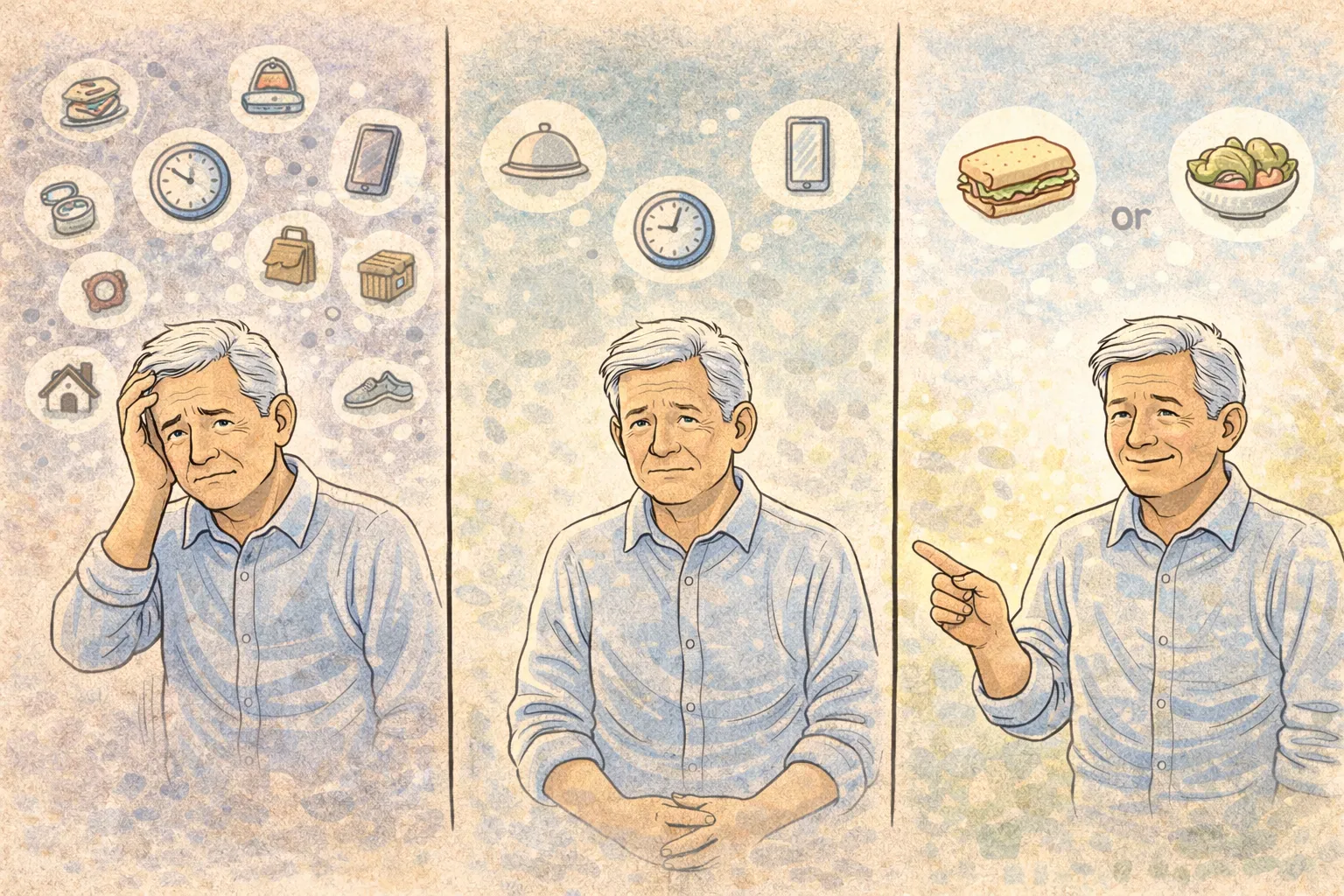
Panoramic comic-style illustration showing a retiree overwhelmed by many choices and then feeling calm after simplifying decisions
“Why is something this small so hard to decide?”
It’s a question many retirees quietly ask themselves.
What to eat. When to go out. Whether to call someone. What to do with the day.
None of these are big decisions.
And yet…
They can feel surprisingly difficult.
1. Why this happens after retirement
Before retirement, many decisions were already made for you.
work schedule
meal timing
daily structure
priorities
Your day had built-in direction.
After retirement, that disappears.
Now, everything becomes a choice.
2. Too much freedom creates friction
It sounds strange, but it’s true:
More freedom → more decisions
And more decisions → more mental effort
When everything is optional:
nothing feels clear
everything feels delayed
small choices feel heavier
3. The brain gets tired from deciding
This is called decision fatigue.
Even small decisions require energy.
When you face many small choices:
your brain slows down
you hesitate more
you delay action
This is why even simple things can feel exhausting.
4. The “no urgency” problem
After retirement, most decisions have no deadline.
You can always say:
“I’ll decide later.”
But that creates a loop:
delay
rethink
delay again
Without urgency, decisions lose momentum.
5. Why small decisions feel bigger than they are
Because they represent something deeper.
When you decide:
“What should I do today?”
You are really deciding:
“What does my life look like now?”
That’s not a small question.
6. The hidden mental load
Every unmade decision stays in your mind.
Even if you’re not actively thinking about it.
This creates:
background stress
mental clutter
low-level tension
7. The mistake most people make
They try to:
think more
analyze more
find the perfect choice
But that makes it worse.
More thinking = more pressure
8. The simple fix: reduce decisions
You don’t need better decisions.
You need fewer decisions.
9. The 2-choice rule
Instead of unlimited options:
Limit yourself to two.
Example:
walk or stay home
call or don’t call
cook or order
Two choices = faster action
10. The “default option” method
Create simple defaults.
breakfast stays the same
morning routine stays the same
certain days follow a pattern
This removes unnecessary decisions.
11. The “decide once” strategy
Some decisions don’t need to be repeated daily.
Decide once, then reuse.
Example:
fixed walk time
regular call day
weekly outing
12. Real-life examples
Nancy, 68:
“I didn’t realize how tiring small choices were.”
She simplified her mornings.
Her days became easier immediately.
Tom, 72:
“I stopped overthinking everything.”
He used the 2-choice rule.
That alone reduced stress.
13. Signs you have decision fatigue
you delay simple choices
you overthink small things
you feel mentally tired early
you keep changing your mind
you avoid deciding altogether
Quick checklist
did I limit my choices today?
did I avoid overthinking?
did I use simple defaults?
If yes, your day will feel easier.
The key insight
It’s not that decisions became harder.
It’s that you have more of them.
Conclusion
Retirement gives you freedom.
But freedom needs structure.
When you reduce decisions:
your mind becomes clearer
your energy improves
your day feels easier
Small changes make a big difference.
Disclaimer
This content is for general educational purposes only and does not consider individual psychological or medical conditions. If decision-making difficulty becomes persistent or distressing, consult a qualified professional.
“Yes… even when you mean maybe.” “Yes… even when you’re tired.” “Yes… even when it costs you.”
This guide is not about confrontation.
It’s about kind boundaries — steady, respectful, and protective.
WHY BOUNDARIES MATTER MORE AFTER 60
At this stage of life:
Energy matters more
Recovery takes longer
Finances are often fixed
Emotional peace becomes priceless
Overcommitting after 55 doesn’t just cause inconvenience.
It causes:
exhaustion
resentment
money stress
health setbacks
Boundaries protect all four.
THE 2026 RULE
If it drains your energy, your money, or your peace — pause before agreeing.
Pause creates space.
Space protects clarity.
PART 1: THE 3 TYPES OF BOUNDARIES
Most seniors struggle in three areas:
Time boundaries
Emotional boundaries
Financial boundaries
Let’s look at each calmly.
1️⃣ Time Boundaries
Examples:
Babysitting every weekend
Driving family members frequently
Attending every social event
Saying yes to volunteer roles you don’t enjoy
Gentle script:
“I’d love to help sometimes, but I can’t commit every week.”
Notice: calm tone. No apology spiral.
2️⃣ Emotional Boundaries
Some adults 55+ become default therapists for:
adult children
siblings
friends
It’s loving — but exhausting.
Gentle script:
“I care about you, but I don’t have the energy to solve this right now.”
You can care without carrying.
3️⃣ Financial Boundaries
This is the hardest one.
Common situations:
Lending money repeatedly
Co-signing loans
Paying adult children’s bills
Funding emergencies that repeat
Important truth:
Your retirement is not a revolving credit line.
Gentle script:
“I’m not in a position to help financially, but I can help you think through options.”
Kind. Firm. Protective.
TABLE 1: Boundary vs. Guilt
Feeling
Reality
“I’m selfish.”
You’re protecting capacity.
“They’ll be upset.”
Discomfort is temporary.
“I should help.”
Help should not harm you.
“They need me.”
Adults can adapt.
Guilt often appears before peace.
PART 2: WHY GUILT FEELS SO STRONG
Many seniors grew up believing:
Sacrifice equals love
Saying no equals selfishness
Family always comes first
But after 60, sacrifice without limits becomes instability.
Healthy boundaries improve relationships.
They prevent resentment.
PART 3: A SIMPLE 4-STEP PAUSE METHOD
When asked for something:
Step 1: Do not answer immediately. Step 2: Say, “Let me think about that.” Step 3: Check your energy + finances. Step 4: Respond calmly within 24 hours.
The pause prevents automatic yes.
TABLE 2: The Energy Check
Question
If Yes
If No
Do I have time?
Proceed carefully
Decline
Do I feel calm about it?
Possibly
Reconsider
Will this affect my budget?
Set limits
Decline
Will I resent this later?
Don’t do it
Protect yourself
Resentment is a warning light.
REAL-LIFE EXAMPLES
Example 1: Robert, 72
Before:
Loaned money three times to a family member.
After:
Stopped lending. Offered budgeting help instead.
Result:
Relationship improved.
Example 2: Elaine, 68
Before:
Babysat weekly despite fatigue.
After:
Reduced to twice per month.
Result:
“I enjoy it again.”
Example 3: Martin, 75
Before:
Said yes to every volunteer request.
After:
Chose one meaningful role.
Result:
Less stress. More impact.
PRINTABLE CHECKLIST: KIND BOUNDARY RESET
Time
[ ] I have one free day per week [ ] I am not overbooked
Emotional
[ ] I am not solving others’ problems daily [ ] I allow others to struggle safely
Financial
[ ] I do not lend money I cannot lose [ ] My retirement budget is protected
Pause
[ ] I give myself 24 hours before major yes
WHAT TO EXPECT AFTER SAYING NO
Temporary discomfort. Possibly pushback.
But also:
better sleep
calmer finances
clearer mind
stronger respect
Boundaries build stability.
WHY THIS MATTERS FINANCIALLY
Unclear boundaries often lead to:
retirement savings erosion
emergency fund depletion
hidden resentment spending
delayed personal goals
Kind boundaries protect long-term independence.
Independence is financial security.
WHAT NOT TO DO
Explain excessively
Argue your decision
Apologize repeatedly
Change your answer under pressure
Short and calm works best.
ONE SENTENCE TO PRACTICE THIS WEEK
“I need to think about that.”
That one sentence can change your year.
DISCLAIMER
This article is for general educational purposes only and does not provide legal, financial, or mental health advice. Individual family dynamics and financial situations vary. Consider consulting qualified professionals before making major financial or legal decisions.
“A gentle day is still a meaningful day—especially when your heart needs quiet.”
Cindy’s Column × Senior AI Money
Valentine’s Day doesn’t have to be loud to be meaningful. It can be calm, simple, and real—especially after 60.
For many older adults, February 14 can feel complicated. Sometimes it’s sweet. Sometimes it’s lonely. Sometimes it’s just… exhausting.
You might be:
happily partnered but not interested in “big gestures”
single and tired of feeling like you’re supposed to “do something”
grieving a spouse or long-time partner
newly dating and unsure what’s appropriate
supporting a friend who’s having a hard week
This guide is for older adults who want connection without pressure—and choices that respect your energy, your budget, and your season of life.
Why Valentine’s Day can feel different after 60
After 60, connection often becomes more valuable—but also more tender.
You may be carrying:
grief or anniversaries
changing health or mobility
family changes (kids moved, grandkids busy)
a smaller social circle than you used to have
a deeper need for calm instead of performance
The goal is not to “celebrate correctly.” The goal is to feel a little more connected than you did yesterday.
The 2026 Connection Rule
One Core Rule: Choose ONE small connection and make it easy to complete.
Not five plans. Not a perfect day. Just one simple action that feels doable—on a low-energy day.
Examples:
one phone call
one note
one shared meal at home
one short walk
one act of kindness (for someone else or for yourself)
Step 1: Pick your Valentine style (this prevents decision fatigue)
Before ideas, choose a “style.” It keeps the day from becoming overwhelming.
Table 1: Choose Your Valentine Style (Fast Decision Guide)
Style
Best for
What it looks like
Energy level
Quiet & Cozy
low energy, grief season, introverts
tea + movie + warm meal at home
Low
Simple & Sweet
most couples/singles
a card + one small treat
Low–Medium
Out & About
high energy, social mood
brunch, museum, short trip
Medium
Service & Care
caregivers, community-minded
help a neighbor, donate, volunteer
Medium
Memory & Meaning
widows/widowers, anniversaries
candle, photo, letter, ritual
Low–Medium
Pick one. That’s your plan.
Section 1: If you’re in a couple (and you want it calm, not performative)
Many couples after 60 don’t want a crowded restaurant or expensive gifts. You want something that feels like “us.”
Calm couple ideas that actually work
Breakfast at home + one question: “What are you grateful for about us this year?”
A comfort meal: cook one simple favorite (or order takeout once)
A 20-minute walk: somewhere familiar, no pressure
A living-room “date”: music + dessert + early bedtime (that counts)
A memory swap: each person shares one favorite memory from the past year
Tiny gifts that don’t create clutter
favorite tea/coffee
a single book or puzzle you’ll actually use
warm socks, hand cream, a small plant
a framed photo (one, not ten)
Gentle reminder: You don’t need to prove love with objects. Love can look like a calm day and fewer hard decisions.
Section 2: If you’re single (and you want connection without awkwardness)
Single after 60 can mean many things: content, tired, healing, hopeful, or all of the above.
Here are options that don’t pretend you’re someone else.
Connection ideas that feel normal
Send one “thinking of you” text to a friend who also hates holidays
Plan a daytime coffee (daylight helps mood for many people)
Join a public place activity: library event, community center class, gentle walking group
Do a “future-friendly” task: reset your contact list, plan a spring outing, prepare a cozy meal
If you want zero social pressure
Make it a “self-care Valentine,” but keep it grounded:
a warm bath or foot soak
a tidy sheet change + early night
a comfort meal with leftovers
a short nature walk
a phone call with someone who feels safe
Being single does not mean being “behind.” It means you get to choose your pace.
Section 3: If you’re widowed (or grieving) and Valentine’s Day hurts
This day can hit unexpectedly hard—especially when the world feels full of reminders.
You don’t have to “push through.” You can choose a gentle ritual that honors love without forcing cheer.
Calm grief-friendly options
Memory ritual (10 minutes): light a candle, hold a photo, say one sentence out loud
Write a letter (you do not have to keep it)
Visit a meaningful place (even briefly)
Make one comfort food you shared
Call one trusted person and say: “Today is tender. I didn’t want to be alone with it.”
A small permission that helps
If this day is heavy, treat it like weather: you don’t argue with it—you prepare gently.
Section 4: If you’re dating after 60 (and want it respectful, not confusing)
Dating later in life can be sweet—and also full of “What’s normal now?”
Here’s a calm approach:
Keep it simple, daytime, and low-cost for early stages.
Focus on comfort and conversation, not gifts.
Safe, low-pressure date ideas
coffee and a short walk
museum or bookstore browsing
early dinner (before crowds)
cooking something simple together
A good boundary line (if needed)
“I’d love something simple. I prefer experiences over gifts.”
That sentence solves a lot.
Section 5: The money side (so Valentine’s Day doesn’t create financial stress)
Many seniors live on fixed incomes. A holiday that pressures spending can create anxiety.
Here’s the truth: meaningful doesn’t have to be expensive.
Table 2: Calm Valentine Options by Budget (2026)
Budget
Couples
Singles
Widows/Widowers
Notes
$0–$10
handwritten note + tea at home
call + cozy movie
candle + letter
Most meaningful items are free
$10–$25
dessert + music night
coffee with friend
small flowers + memory ritual
Keep it light, avoid clutter
$25–$60
brunch or takeout + walk
small outing + treat
donation in their name + meal
Choose one “main” thing
$60+ (optional)
one experience (not gifts)
group event
supportive trip/visit
Spend only if it feels easy
Calm rule for spending: Pick a number you won’t regret on Feb 15.
Section 6: Simple scripts (for asking, inviting, or setting boundaries)
Sometimes the hardest part is not the plan—it’s the words.
If you want company
“Would you like to do something small for Valentine’s—maybe coffee or a short walk?”
“Valentine’s Day can feel quiet for me. Want to check in for 10 minutes?”
If you want to keep it low-key (couple/family)
“I’d love something simple this year. A calm meal at home would be perfect.”
If you’re grieving and need support
“Today is a little tender. Could we talk for a few minutes?”
If you want to decline
“Thank you. I’m keeping this week very quiet, but I appreciate you thinking of me.”
Words matter because they reduce uncertainty. And uncertainty is what makes days like this feel heavy.
Section 7: Real older-adult examples (calm, realistic)
Example 1: Nora, 72 (widowed) — “10 minutes was enough”
Nora told me Valentine’s Day felt like a “wall” after her spouse died. In 2025 she tried forcing herself into a social plan and went home exhausted.
In 2026, she chose a 10-minute ritual:
candle + one photo
one letter (one page)
one call with a friend at 2 p.m.
She said it didn’t “fix grief,” but it reduced dread. “That was the first year I didn’t feel swallowed by the day.”
Example 2: James, 68 and Anita, 70 (married) — “No gifts, one meal”
They agreed on a rule: no clutter gifts. They spent about $18 on a shared dessert and made soup at home. Then they played music and looked at old photos for 20 minutes.
Anita told me, “It felt like us again.”
Example 3: Miguel, 66 (single) — “One invitation”
Miguel didn’t want a big plan. He invited two neighbors for coffee at 11 a.m. on Feb 14. One came, one couldn’t.
He said the win wasn’t the attendance—it was that he didn’t spend the day in silence. Total cost: about $9 for pastries.
Printable Checklist: Valentine’s Day After 60 (Calm Version)
I chose ONE Valentine style (Quiet & Cozy / Simple & Sweet / Out & About / Service & Care / Memory & Meaning).
I chose ONE small connection action I can complete.
I decided my spending limit (a number I won’t regret tomorrow).
If I need support, I picked one person to contact.
If I want to invite someone, I used a simple script.
If I want a quiet day, I planned one comfort activity.
If grief is present, I chose one gentle ritual (10 minutes is enough).
I will not compare my day to anyone else’s highlight reel.
Small reminder: calm connection counts—even if it’s quiet.
Image generation (copy/paste) + ALT / Caption / Description
Image Prompt (WEBP, pastel watercolor cartoon, bold line, scene-focused, 16:9): Pastel watercolor cartoon illustration with bold clean outlines, cozy living room scene in soft warm light: a small table with two mugs of tea, a simple heart-shaped cookie plate, a handwritten card envelope (no readable text), a warm blanket folded on a sofa, and a window showing gentle winter evening glow; subtle inclusive details without close-up faces, calm and comforting mood, non-generic composition, no dramatic romance clichés, no text on the image, 16:9 wide, friendly senior lifestyle illustration.
ALT: “Calm Valentine’s Day scene for older adults with tea, a simple card, warm blanket, and cozy winter light in a living room”
Caption: “Connection after 60 can be quiet and still deeply real—one small moment is enough.”
Description: “Pastel watercolor illustration with bold outlines showing a calm Valentine’s Day setup for older adults: warm tea, a simple card, cozy blanket, and soft winter light. Designed for a 2026 guide focused on gentle connection ideas for couples, singles, and widows/widowers.”
This article is for general educational purposes only and does not provide medical, mental health, legal, or financial advice. Individual circumstances, grief experiences, relationships, and health needs vary. If you feel overwhelmed, unsafe, or persistently depressed, consider reaching out to a qualified professional or local support resources.
This article is for general educational purposes only and does not provide medical advice. Fatigue and energy levels vary by individual health conditions and medications. Consult a qualified healthcare professional if low energy is persistent or worsening.
A 2026 emergency folder system: quick info, calmer decisions, and privacy-first preparedness for adults 55+.
Cindy’s Column × Senior AI Money Practical, senior-friendly guides for a calmer, safer life.
Most “emergency planning” advice feels like it was written for people who have endless energy, perfect families, and a love of paperwork.
Real life is different.
Real life is: a confusing medical bill, a surprise ER visit, a winter storm, a lost wallet, a phone call that starts with “I’m sorry to bother you, but…”—and suddenly someone needs information you do have… but it’s scattered across drawers, emails, portals, and half-remembered passwords.
A 2026 Emergency Binder is not about fear. It’s about reducing chaos.
This guide shows you how to build a one-pocket emergency file that:
helps you get the right care faster
protects your money (fewer “we couldn’t find it” mistakes)
reduces family stress without handing over your privacy
keeps your life running if you’re sick, traveling, or tired
It’s designed for people who hate complicated systems. You can do a “good enough” version in 45–90 minutes.
What an Emergency Binder is (and what it is NOT)
It IS:
A simple, centralized set of pages that answers urgent questions quickly:
Who is this person’s doctor?
What medications do they take?
Who should we call?
Where is the insurance information?
What bills must be paid this month?
What should we do if they’re confused, dizzy, or can’t speak for themselves?
It is NOT:
a place to store every document you’ve ever owned
a binder full of originals you’re terrified to lose
a system that requires you to “maintain it weekly forever”
Think “one-pocket file with the essentials,” not “paper museum.”
Why this matters more after 55
Because the cost of confusion goes up with age.
When information is missing, people make expensive choices:
duplicate medical tests
missed medication details
late fees and stopped services
insurance claim confusion
family panic spending (overnight flights, last-minute care decisions)
A small binder prevents big messes.
The 2026 “Privacy-First” rule (so you don’t feel exposed)
You do not need to put every password in your binder.
You do not need to write sensitive account numbers in full.
Instead, use this rule:
Share access, not everything.
Your binder should make it possible for someone to help—without giving them your entire life.
A safe approach:
partial account identifiers (last 4 digits only)
“where to find it” instructions
official phone numbers
your preferred emergency contact plan
a separate sealed envelope for anything sensitive (optional)
What you need (simple supplies)
Pick one:
Option A: 1 sturdy folder with pockets
Option B: thin binder + plastic sleeves
Option C: accordion file (easy if you like sections)
Also:
15–25 sheets of paper
pen + highlighter
optional: one sealed envelope labeled “Open Only If Needed”
That’s it.
The 8-page Emergency Binder (the simplest version that still works)
If you only do these pages, you’re already ahead of most people.
Page 1: Emergency contacts + “who decides what”
This is the page paramedics, hospitals, and family need first.
Include:
Full name, DOB, address
Primary emergency contact + 2 backups
Your preferred hospital (if you have one)
Who has keys to your home
Who should be notified (and who should NOT be notified)
Table 1: Emergency Contact Page (copy this)
Item
Fill in
Full name + DOB
Address
Emergency contact #1
Name / relationship / phone
Backup contact #2
Name / relationship / phone
Backup contact #3
Name / relationship / phone
Preferred hospital/clinic
Home key holder
Name + phone
Pets (if any) plan
Who feeds / where supplies are
Notes
Hearing aids, mobility device, etc.
Small but powerful: add a note like “Please speak slowly; I wear hearing aids,” or “Dizziness risk—help me stand.”
Page 2: Medication list (including OTC and supplements)
This is one of the highest-impact pages.
Include:
medication name
dose
when you take it
what it’s for (short note)
pharmacy name + phone
Table 2: Medication & Pharmacy Page
Medication
Dose
When
Why
Notes
Pharmacy:
Name:
Phone:
Address (optional):
Page 3: Doctors + medical info snapshot
Keep it short. The goal is speed.
Include:
Primary care doctor
Key specialist(s)
Allergies
Major conditions (plain language)
Assistive devices used
Any implanted devices (pacemaker, etc.)
Page 4: Insurance + ID quick info (no over-sharing)
Include:
Medicare / supplemental / Advantage plan name (or private insurance)
Member ID (you can use partial + “card is in sleeve”)
Customer service phone number (official number on card)
Prescription coverage info (if separate)
Tip: Put photocopies of the front/back of insurance cards in a sleeve.
Page 5: “If I can’t speak for myself” preferences (simple version)
This is not a legal document. It’s guidance.
Include:
who should speak for you (and how to reach them)
a short sentence about your values (examples below)
where legal documents live (not necessarily in the binder)
Examples:
“Comfort matters to me. Please explain options clearly.”
“I want my daughter present for major decisions.”
“Please call my spouse before making changes.”
If you already have advance directives, you can note:
“Advance directive is in: top drawer / safe / attorney file / hospital file”
(And optionally include a copy.)
Page 6: Monthly bills that must be paid to keep life stable
This is the page that prevents late fees and service shutoffs.
Include only essentials:
housing payment
utilities
phone/internet
insurance premiums
credit card minimums (if any)
You do NOT need to list every subscription here.
Table 3: “Keep Life Running” Bills Page
Bill
Usual Amount
Due Window
How Paid
Where info is
Rent/mortgage/HOA
autopay / manual
folder / online portal
Electric/gas
Water/trash
Phone/internet
Insurance
Privacy tip: For “Where info is,” write things like:
“Bank bill-pay”
“Card on file”
“Portal bookmark on laptop” No passwords required.
Page 7: Home map + “where important things are”
This helps someone help you without tearing your house apart.
Include:
spare keys location (or who has them)
breaker box location
shut-off valves (water/gas)
where meds are stored
where pet supplies are stored
where you keep the folder (yes—label it!)
Page 8: The “24-hour plan” checklist
This is the page people follow when emotions are high.
Call clinic; write symptoms + start time; bring med list
Power outage / storm
Flashlight; water + meds; call check-in person
You’re traveling and get sick
Call travel contact; use medication list; find nearest urgent care
You’re confused/anxious
Sit, hydrate, call trusted person; avoid big decisions
Keep this page simple enough that anyone can follow it.
The “Sealed Envelope” option (for sensitive info)
If you want extra readiness, add an envelope labeled:
“Open Only If Needed”
What can go inside:
a list of where passwords are stored (example: “Password manager on phone, help contact #1 access”)
attorney contact info
safe combination (optional, only if you’re comfortable)
one spare house key (if safe in your home context)
This is optional. Many people skip it—and the binder still works.
How to set this up in one weekend (realistic pacing)
Day 1 (30–60 minutes): Build the core pages
Page 1 (contacts)
Page 2 (medications)
Page 4 (insurance cards)
Page 8 (24-hour plan)
That alone covers most emergencies.
Day 2 (20–45 minutes): Add stability pages
bills page
“where things are” page
doctor list page
Day 3 (10 minutes): Share the plan
Tell one trusted person:
where the binder lives
what it’s for
what you do and do not want shared
The conversation script (so it’s not awkward)
If you don’t want to make it dramatic, say:
“I made a small emergency folder so nobody has to scramble if I’m sick or traveling. It’s not about worry—it’s about convenience. If something happens, here’s where it is.”
That’s it. Calm. Adult. No fear speech required.
Common mistakes (and the fixes)
Mistake 1: Making it too big
Fix: keep only essentials. Add later if needed.
Mistake 2: Storing originals you’re afraid to lose
Fix: use copies. Keep originals elsewhere.
Mistake 3: Sharing too much
Fix: privacy-first rule + sealed envelope option.
Mistake 4: Not telling anyone the binder exists
Fix: tell one trusted person. One.
Mistake 5: Never updating it
Fix: update twice per year—January and July—like changing a smoke alarm battery habit.
Real-life examples (with realistic outcomes)
Example 1: “We avoided a medication mess” (Nora, 76)
Nora had an urgent clinic visit while traveling. Her daughter used Nora’s binder photo (med list page) to confirm medications quickly. Outcome: fewer questions, faster care, less stress. Not a miracle—just clarity at the right moment.
Example 2: “Bills didn’t fall apart while I was hospitalized” (Ray, 71)
Ray had a short hospitalization. His spouse used the bills page to confirm what needed to be paid and what was on autopay. Outcome: no late fees, no service shutoff anxiety, fewer frantic calls.
Example 3: “Privacy stayed intact” (Mei, 68)
Mei wanted preparedness but didn’t want to share passwords. She wrote “Where to find it” instructions and used a sealed envelope for one sensitive item. Outcome: family could help without full access to everything.
Printable-friendly master checklist (paste into your post)
Choose folder/binder and label it clearly
Page 1: Emergency contacts + key holder + pets plan
Page 2: Full medication list + pharmacy
Page 3: Doctors + allergies + key medical notes
Page 4: Insurance card copies + official phone numbers
Page 5: Simple preferences + where legal docs live
Page 6: Essential bills + due windows
Page 7: Home map + where important items are
Page 8: 24-hour plan checklist
Optional: sealed envelope for sensitive info
Tell one trusted person where it is
Put a reminder to review in 6 months
Disclaimer
This article is for general educational purposes only and does not provide medical, legal, or financial advice. Individual needs and circumstances vary. For medical decisions, consult qualified healthcare professionals. For legal planning (advance directives, powers of attorney, wills), consult a qualified attorney in your jurisdiction. Protect sensitive personal and financial information and use official contact channels for insurance and billing questions.
“A gentle year-end reset — soft routines, clear spaces, and a calm way to close 2025.”
“We don’t need to finish the year strong. We only need to finish it softly.”
There’s a moment every December when the world feels just a little too loud. Shops buzz, calendars fill, and even the peaceful corners of the home seem to gather small piles of things we meant to deal with “someday.” And yet, at this age — somewhere over 55, with more memories behind us than ahead — I’ve learned something comforting:
Year-end isn’t a race. It’s a soft landing.
This isn’t a season for performance. It’s a season for pausing, noticing, and gently resetting the parts of life that have gone a little off-center.
So today, I want to share a quiet, realistic way to close 2025 — the kind that doesn’t rush, doesn’t pressure, and doesn’t require us to pretend we have more energy than we do.
Just a soft reset. Just enough to feel clear again.
🌙 1. Begin With What Feels Heavy
I used to make long lists every December: Fix this. Organize that. Plan everything.
Now I simply ask myself one question: “What feels heavy right now?”
For some of us, it’s a drawer that hasn’t been opened since May. For others, it’s a feeling — something unresolved, unspoken, or quietly lingering.
You don’t have to fix everything. Just lighten the one thing that weighs on your mind most.
That alone creates surprising peace.
🕯️ 2. Clear Just One Small Space
Not the whole home. Not even the whole room.
Just one surface.
A side table. A kitchen counter corner. A bedroom dresser.
Every time I clear one small space, my mind also seems to clear a little. It’s a reminder: Fresh starts don’t require big actions — only small, honest ones.
📝 3. Write the Year a Simple Goodbye Note
This is my secret ritual.
I take a sheet of paper — nothing fancy — and I write:
What hurt
What helped
What surprised me
What I’m ready to release
What I want to carry into 2026
No pressure to be poetic.
Just clarity.
It feels like placing the year gently back onto a shelf.
✨ 4. Choose One Thing to Simplify
Not everything. Just one thing that could make life easier next year.
Examples:
Fewer subscription services
Two-step morning routine
Smaller winter wardrobe
Decluttering one category (mugs? scarves?)
Weekly planning on Sundays
Saying “no” a little faster
The goal isn’t perfection — it’s kindness toward yourself.
🧡 5. Let Yourself Feel Proud (Quietly)
So much happens in a year that no one sees.
The days we stayed patient. The moments we held back a harsh word. The times we kept going even when tired.
We rarely receive applause for these things — but they count.
Let yourself feel quietly proud of the way you made it through 2025.
🌤️ 6. Make Room for the Softer Version of You in 2026
Every year is a chance to grow gentler.
Gentler with mistakes. Gentler with aging. Gentler with expectations. Gentler with ourselves.
If 2026 has a theme, let it be: “I will not make my life harder than it needs to be.”
🌿 A Gentle Reset Checklist (Realistic, 10 Minutes Each)
Toss expired papers/receipts
Clear old appointments from calendar
Refresh one shelf
Wash one blanket
Recycle empty containers
Change one light bulb to warm light
Delete 20 photos from phone
Add one item to a donation bag
Wipe the entryway
Make a tiny “start 2026” basket (pen, notepad, charger)
Small things. Soft things. Enough.
💛 Final Thought
You don’t need to transform your life in December. You don’t need to rush into the new year perfectly prepared.
You only need to enter 2026 feeling a bit lighter, a bit clearer, and a bit more yourself.
And that — truly — is enough.
❄️ Editorial Disclaimer
This column is for reflective and informational purposes only. It does not provide medical, mental health, financial, or legal advice. Please consult qualified professionals for guidance related to your personal situation.